
Baseball betting odds in Great Britain — markets, margins and how the price is built
 Available in US
Baseball betting odds look like any other sport until a game turns on a single pitch in the seventh inning, and the punter who only knew the pre-match line suddenly finds their position worth more, or less, than the ticket said. This guide is for the reader who wants to understand what they are actually buying when they back a team, a total or a pitcher — how an MLB season is built, which markets a licensed bookmaker offers, what a margin hides inside the price, and where the offer words on the promotions page stop matching what the small print demands. The bookmakers reviewed here all carry a Gambling Commission remote licence, and the markets, the licence conditions and the way odds settle are described from the public register and the operators’ own terms.

This page is current as of 30 October 2026; licence status and the operator information set out below were checked against the Gambling Commission’s public register on the same day.
Crypto, anonymity and the limits of a GB-licensed baseball book
Baseball betting with Bitcoin, baseball betting with Bitcoin Cash, a “crypto baseball betting site” — these are search terms that come up around the sport, and they point in two directions that do not quite meet.
What “crypto baseball betting” actually buys
A crypto deposit is a way to move money. It is not, on its own, a way to bet anonymously in Great Britain. A bookmaker licensed by the Gambling Commission has to verify name, address and date of birth before the first deposit — that has been the rule since 7 May 2019, and it covers free bets and bonuses as well as cash stakes. The funding rail (a wallet, a coin, a token) does not change that step. A punter who sends Bitcoin to a licensed bookmaker still has to pass the same checks they would pass paying by Visa.
The coin sits on top of the sportsbook. The sportsbook sits inside a regulatory regime. Two layers, two questions: which coins the cashier accepts, and what the operator is licensed to do once the coin arrives. The two questions are not the same, and a punter who treats them as the same ends up holding Bitcoin at a brand they cannot complain to.

The anonymity problem, named honestly
Outside the GB framework the picture changes. Brands running on a Curaçao or other offshore licence have their own onboarding rules, and several do accept crypto without the same identity checks. The trade is explicit: no British consumer protection, no GAMSTOP coverage, no Commission complaints route, no approved dispute-resolution body and no British redress if funds are withheld. A punter who values pseudonymity over those protections is making a real choice, and this guide does not pretend the offshore option is the same product sold in opaque buckets. It is a different product.
The honest framing: a GB-licensed bookmaker that takes crypto gives the punter the protection and the verification. An offshore brand that takes crypto gives the punter the pseudonymity and the absence of protection. Neither is a free upgrade on the other.
For a punter who wants Bitcoin or Bitcoin Cash exposure inside a regulated environment, the path is a licensed bookmaker that lists the coin in its cashier — payment-method coverage is the relevant fact here, and the licence is the relevant fact here, and both should be on the same page before the first deposit. Where a licensed operator does not accept a specific coin at all, that is a fact about that brand’s chequebook, not a verdict on the coin.
Bonuses and free bets around baseball
The free-bet page on a baseball sportsbook looks generous. The terms below it cost more than they look, and the difference is what the offer is actually worth.
What a baseball free bet really is
A free bet in baseball works the same way a free bet works on any other sport: the bookmaker credits an account with a stake-sized token, the punter uses it on a selection, and if the bet wins the winnings land — the free-bet stake itself usually does not. A £10 free bet on a Yankees money line at 2.50 returns £25 in cash profit, not £35. The stake is the bookmaker’s money, and the marketing copy that calls this a “£25 win” is, strictly, naming the profit and not the return.
A “Bet £10, Get £15 in Free Bets” structure — the form several welcome packages around the sport take — parcels the credit into smaller tokens with conditions of their own. A £5 sports bet token, a £5 acca token, a £5 sub-cover token each carry their own market and minimum-price rules, and the punter who reads the headline as one £15 bet has read three £5 bets with three sets of conditions.
The turnover question
The 19 January 2026 promotion rules cap wagering requirements on bonuses at 10x — a £10 bonus at 50x needs £500 of bets, and under the cap no more than £100 is required to clear a £10 bonus. For baseball the relevant point is what counts as a qualifying bet: minimum price rules (the common floor is 3/5, or 1.60 in decimal) are common, and a free-bet stake on a heavy favourite below that floor may simply not count. The punter who backs a -400 money line with a free-bet token has used the token without clearing anything.
The offer value is the size of the credit multiplied by the chance of clearing it at a price the terms accept. That is the calculation that matters, not the headline.
Mixed-product promotions
A “bet on baseball to get free spins” structure — a baseball stake unlocks casino credit — is, since 19 January 2026, a mixed-product promotion and is banned under the promotion rules. The ban is on the offer, not on the casino game: a licensed bookmaker can still run a casino welcome; what it cannot do is gate casino credit behind a baseball bet. A punter who sees an offer that asks for a baseball wager before casino credit appears is looking at an offer that should not be on a licensed site, and the absence is worth noticing.
Boosted odds, acca insurance and the named marketing words
“Boosted odds” on a baseball game is the bookmaker raising the price above the line it would otherwise offer. “Acca insurance” refunds a stake if one leg of a multiple lets the bet down. Each carries a condition — a maximum stake on the boost, a refund paid as a free bet rather than cash, a minimum number of legs — and the marketing word is not the condition. The punter who reads “money back if one leg lets you down” and does not read “paid as a free bet with a 10x turnover” has read half the sentence.
The mobile and app picture for baseball
A baseball game is seven days a week for six months, and the punter who wants to follow a live line does it on a phone. The app is the betting shop.
What a baseball app needs to do
A baseball punter’s day is shaped by the MLB schedule. Games start in the early hours UK time on the East Coast — first pitch around midnight BST in a New York home game, with the West Coast following into the British morning — and the in-play window is long enough that a settled punter can place and reassess a position in a single day. The app has to load quickly, hold a session through a long game, and let the punter cash out without the screen freezing on a count of 2-1 with two outs in the eighth.
Pre-match is straightforward. In-play is where the app earns its keep, and an app that handles baseball well handles the full nine-inning window without dropping the connection, without losing the bet slip, and without making the cash-out button a separate journey from the bet itself.
Browser versus native
Browser-based mobile betting is a real path — no download, no storage cost, the punter’s login travels with them. The native app is faster on a stable connection, sends push notifications for line moves and settled bets, and lets the punter use biometric login. For a sport with a 162-game season and a four-round postseason, the difference between the two is small per game and large across the year.
App-store presence is not the test
The British App Store and Google Play carry a wide range of sportsbook apps; their presence on a storefront is not proof of a Gambling Commission licence. The register is. A punter who finds an app in a store and trusts the store has skipped a step the Gambling Act 2005 asks them to take.
Live baseball betting and cash out
Baseball is, in one sense, the ideal in-play sport: each pitch is a discrete event, the scoreboard advances by exactly one run at a time, and the lead changes often. The market reacts to every pitch.
How in-play baseball prices move
A line set before first pitch assumes a distribution of outcomes across nine innings. Once the game starts, the price reacts to what has happened — a starter gives up three in the first, the line moves; the opposing starter settles, the line drifts back; the bullpen takes over in the seventh, the line tightens again. A punter watching the game sees the price react faster than they can refresh the bet slip, and the app that lags by half a second has cost them a tick on the price.
In-play baseball punting rewards the punter who knows the pitching matchup, the bullpen state, and the park factor — a fly-ball pitcher in a hitter’s park at Coors is a different bet than the same pitcher at Oracle Park. The market knows all of this, and a price is rarely wrong for long.
Cash out as a price, not a button
Cash out is the bookmaker offering to buy the bet back before settlement. The price is the bookmaker’s price, set on the bookmaker’s terms, and it is not the same as the live price the punter could lay off at an exchange. A punter who sees a cash-out value above the live line has been offered a gift; a punter who sees a cash-out value below the live line has been offered the bookmaker’s principal-agent pricing, which is exactly what it sounds like.
The cash-out button is most useful when the punter wants to lock in a profit or cut a loss at a price they could not have got pre-match. It is least useful when the punter uses it as a substitute for thinking about the game.
Streaming, live data and the in-play tax
Live streaming of MLB games in Great Britain is gated by Major League Baseball’s broadcast rights, and licensed bookmakers do not stream every game. The punter who wants to bet in-play and watch the pitch has, in most cases, two screens: the licensed feed for the game, the betting app for the line. The two screens are not the same, and the cost of running both is the cost of in-play baseball punting.
A live bet feed — the prices ticking without the picture — is the alternative, and a feed that lags by a pitch has cost the punter the value of the in-play edge.
Baseball predictions, tips and what strategy actually buys
Baseball has more data per game than almost any other sport — pitch type, spin rate, exit velocity, launch angle, the count, the leverage index — and the data is public. The market uses it. A “tip” that an account on social media sells for £5 a month is, almost by construction, a price the market has already paid.
The honest shape of baseball betting strategy
A bankroll strategy is not a tip. It is the discipline of staking a fixed unit (commonly 1-3% of the bankroll) on each selection, accepting losing runs, and not chasing losses with larger stakes. A bettor who runs a disciplined bankroll over a 162-game season is a long way ahead of a bettor who doubles the stake after each loss, even before the quality of the picks is considered.
A “system” is, in the trade, a rule that selects bets: only unders in night games, only favourites in division matches, only underdogs off a loss. The rule has to be tested on a sample large enough to mean something, and the test has to be on data the punter did not use to build the rule. A system that worked over 50 games in a backtest is a system that has not been tested.
Why “tips” age quickly in baseball
A starting pitcher is a public fact on the day of the game, and the line moves the moment the line-up is announced. A tip that named yesterday’s probable is, by first pitch today, a tip the market has already priced. The tip-seller’s edge is the speed of the tip; the punter’s edge, if any, is in reading the line before the market settles on the public information.
What baseball analysis can buy
Analysis is the work of forming a view on a market that the price may not reflect. A view can be on a starter’s recent form, on a bullpen’s workload over the last three days, on a park factor, on a batter’s record against left-handed pitching. The punter’s edge, where one exists, is in seeing the same data the market sees and forming a slightly different read. The edge is small. The edge compounds over a season if the punter sticks to the bankroll discipline.
There is no system that wins. There is a process that wins often enough, at prices the market offers, to clear the bookmaker’s margin over a long sample. The two are different.
Bet types and how baseball odds work
The bet types on a baseball game are the bet types on any sport, with one structural feature that shapes them all: a baseball game ends when it ends, and “when it ends” is not always nine innings.
The money line
A baseball money line is a bet on which team wins the game, with the price reflecting the gap in starting pitching and batting. A heavy favourite (-200 in American, 1.50 in decimal) carries a small return on a large stake; a long underdog (+180, 2.80) carries a large return on a small stake. The price reflects the gap, and the gap is the bookmaker’s read on the matchup.
In MLB the home team wins roughly 54% of regular-season games over a long sample, and the price on a home favourite is usually shorter than the price on a road underdog of the same quality. The home advantage is real, the park is part of it, and the price is built to reflect it.
The run line
The run line is baseball’s version of a handicap: one team is given +1.5 runs, the other -1.5 runs, and the bet is on whether the chosen team covers the spread. The favourite has to win by two or more; the underdog has to lose by one or win. A punter who thinks the favourite wins but not by two takes the underdog on the run line; a punter who thinks the favourite wins by two or more takes the favourite.
The run line is the bet where the favourite’s price is closer to evens than the money line, because the favourite has given up 1.5 runs. A heavy favourite on the money line at 1.40 is often around 1.90 on the run line -1.5, and the punter who likes the favourite has a choice between a small return on a large stake and a closer-to-evens return on a smaller stake.
Totals (over/under)
The total is the combined runs scored by both teams. The line is set by the bookmaker, and the price is around 1.90 on each side at a balanced book. The over hits when both teams combine for more than the line; the under hits when they combine for fewer. The punter’s read is on the pitching matchup and the park — a fly-ball pitcher at Coors Field is a different over than a ground-ball pitcher at Oracle Park.
F5 (first five innings)
The first-five-innings line is settled on the score after five complete innings. It is the bet for a punter who likes the starting pitching matchup but does not want to trust either bullpen. The price is the same shape as the full-game money line, with the volatility limited to the first five.
Player props
Player props are bets on individual players: a pitcher to record over or under a strikeout line, a batter to record over or under a hit line, a player to hit a home run. The lines are tight, the prices are tight, and the bookmaker’s margin is wider than on the main lines. A punter who plays props as their main bet is paying for the variety with a higher margin.
Futures and the World Series
A World Series futures bet is a bet on a team to win the championship, priced months before October. The price reflects the regular-season expectation, and it moves with injuries, trades and form. A Yankees futures ticket at 6.00 in spring training is a bet on the Yankees winning the World Series, settled in late October or early November if they get there.
The payout is large because the base rate is small. Most futures tickets never pay out. A punter who buys five futures on five different teams has paid five times the unit stake for one ticket that may settle, and the price the bookmaker offered on each ticket already reflected the base rate.
How decimal and fractional odds convert
British bookmakers quote in fractions (5/1, 11/4, evens); the decimal form (6.00, 3.75, 2.00) is what the bettor actually works with when the bet settles. The conversion is straightforward: a/b plus the decimal of a + b/a. 5/1 is 6.00, 11/4 is 3.75, evens is 2.00. A punter who can read both is reading the same price twice.
The return on a winning bet is stake times the decimal odds. The profit is stake times the decimal odds minus the stake. A £10 bet at 3.75 returns £37.50; the profit is £27.50, and the original £10 stake is part of the return, not added to it.
Baseball, the MLB season and what gets bet on
The Major League Baseball regular season is 162 games per team, played from late March or early April through late September. Six teams from each league — three division winners plus three wild cards — go into a four-round postseason that ends with the World Series, a best-of-seven between the American League and National League champions.
What the season looks like from the UK
The schedule is built for the American time zones. East Coast games start around midnight BST; West Coast games run into the British morning. A punter who wants to bet in-play has to either stay up or set one. The 162-game schedule means there is baseball every night, and the punter who wants variety is not short of fixtures.
Other baseball competitions
MLB is the headline, and the leagues underneath it are the structure. Minor League Baseball runs 120 teams across the United States, mostly affiliated to MLB clubs; the MLB draft is the pipeline from college and high school into the minors. Nippon Professional Baseball in Japan runs two leagues of six teams each, with a season that runs roughly April to October. The World Baseball Classic is the international tournament run by the World Baseball Softball Confederation, played every four years and won by Japan in 2023. The Korean Baseball Organization and the Chinese Professional Baseball League run their own seasons, and a few British bookmakers price them as specials.
What the World Series result tells the reader
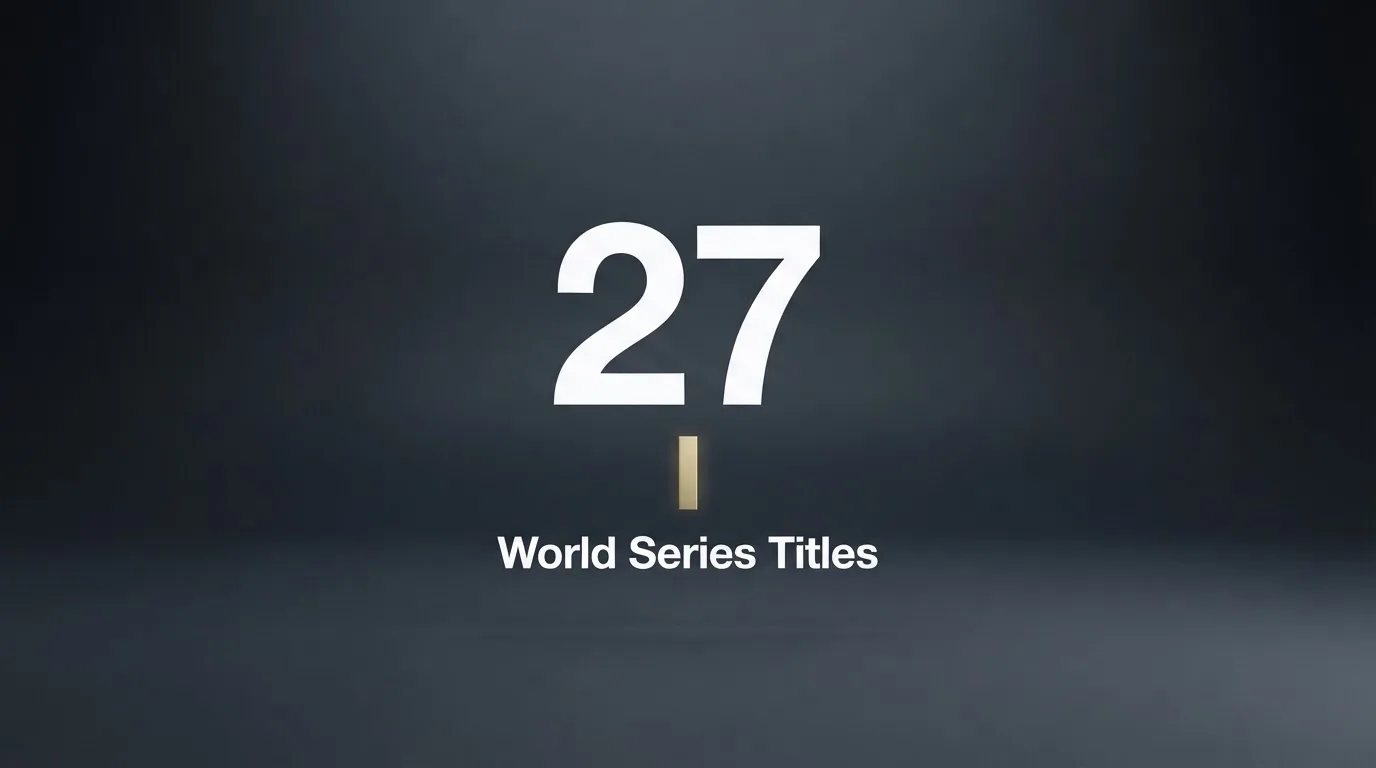
The 2025 World Series went to the Los Angeles Dodgers, who beat the Toronto Blue Jays 4 games to 3, clinching on 1 November 2025 with a 5-4 win in 11 innings in Game 7. Yoshinobu Yamamoto was named MVP. The result matters for the page because it is the most recent settled championship, and the futures markets for the next World Series open against it. The Yankees, with 27 titles, are the most-decorated franchise in MLB history; the Dodgers’ 2025 win was their eighth.
What baseball looks like on the field
Nine innings, three outs per half-inning, nine players in the field. Three strikes is a strikeout, four balls is a walk. If the score is tied after nine innings, extra innings are played until the tie is broken. A baseball game can end in a tie only if the game is called early and the result stands — most commonly by rain in the regular season, with a statutory minimum of five innings for a called game.
The structural shape matters for the punter. A game that goes to extra innings is a longer bet than a nine-inning game. A starting pitcher who gets pulled in the fifth is a different bet from the same pitcher going seven. The market prices these contingencies, but the punter who knows the shape of the game reads the price better than the punter who does not.
The 10 baseball bookmakers we compared
The ranking below is a shortlist of UK-licensed bookmakers with a baseball product, ordered alphabetically by brand. Every entry holds a Gambling Commission remote licence, every entry is named as a baseball option, and the closing line on each is the judgement of how the brand stacks up against the others on this list — not against the market as a whole.
| Brand | Licence | What the operator’s own terms state on baseball |
|---|---|---|
| 888sport | Remote general betting standard (real events); 888 UK Limited; Commission account 39028 | Pre-match and in-play baseball markets, Cash Out, Bet Builder, daily boosted odds and a live bet feed |
| Betboro | Remote general betting standard (real events); Webmedia Development N.V.; Commission account 44181 | Baseball listed among the sports covered; welcome offer is a 100% matched free bet of up to £25 on the first qualifying wager |
| BetGoodwin | Remote general betting standard (real events); Goodwin Racing Limited; Commission account 2927 | Baseball markets offered; sports welcome offer is “Bet £10, Get £15 in Free Bets” split across a £5 sports bet, a £5 acca and a £5 Sub-Cover bet |
| Betmaster | Remote general betting standard (real events); BM Solutions GB Ltd; Commission account 65699 | Baseball covered alongside football, cricket, horse racing, NFL and eSports |
| DAZN Bet | Remote general betting standard (real events); DZBT Limited; Commission account 48756 | Baseball markets priced; deposits start at £5 by debit card, Apple Pay, Paysafecard, Trustly and Skrill, and £20 by PayPal |
| Fafabet | Remote general betting standard (real events); Taichi Tech Limited; Commission account 57385 | Baseball markets offered; Best Odds Guaranteed on UK and Irish horse racing win and each-way bets from 9am on race days |
| Fitzwilliam Sports | Remote general betting standard (real events); SBKI Limited; Commission account 48760 | Baseball covered; instant deposits, fast withdrawals, timeouts and deposit limits |
| Lottoland | Remote general betting standard (real events); EU Lotto Limited; Commission account 38991 | Sports betting including baseball alongside casino, lottery betting and scratchcards |
| Matchbook | Remote general betting standard (real events), remote betting intermediary; Triplebet Limited; Commission account 39504 | Baseball priced as an exchange; customers bet against other users, with Bet Builder, multiples and in-play betting |
| NetBet | Remote general betting standard (real events); Netbet Enterprises Limited; Commission account 39170 | Baseball covered; Daily Boosts, Profit Boosts, free bet offers, a Bet Builder with instant dynamic odds and sports stats for major leagues |
888sport
A long-standing UK-licensed sportsbook with a full pre-match and in-play baseball product, Cash Out, Bet Builder, daily boosted odds and a live bet feed. The feature set is broad and the baseball offering is part of a wider sportsbook that covers most major markets. The MLB product sits inside the same app that handles the Premier League and the Champions League, and the punter who uses 888sport for football will find the baseball markets in the same place. The Bet Builder is the differentiator of the brand: it covers player props and game markets inside one bet, and the dynamic odds update as the punter adds legs.
The closing line: 888sport is a solid choice for a full-feature British sportsbook with a baseball product inside it, and the Bet Builder is a clear advantage over brands with thinner in-play offerings.
Betboro
A licensed sportsbook with baseball listed among the sports it covers, and a welcome offer built around a 100% matched free bet of up to £25 on the first qualifying wager. The qualifying condition is specific: a debit card deposit of at least £10, a first bet of £5 to £25 with at least three selections, each at 3/5 (1.60) or higher. The minimum-price floor is the kind of condition a punter reading the headline can miss, and a first bet on a heavy favourite below 1.60 will not qualify.
The closing line: Betboro provides a structured welcome for the diligent punter, as the three-leg minimum at 1.60 creates a specific threshold that separates a qualifying first bet from a non-qualifying one.
BetGoodwin
A British-licensed bookmaker with baseball markets, and a sports welcome offer of “Bet £10, Get £15 in Free Bets” split across three tokens — a £5 sports bet, a £5 acca and a £5 Sub-Cover bet. The headline number is one figure; the actual credit is three tokens with three sets of rules. A punter who treats the welcome as a £15 free bet has read half the sentence.
The closing line: BetGoodwin offers a welcome built on three separate tokens, where the real value lies in using each one effectively rather than banking on the headline figure.
Betmaster
A licensed sportsbook whose app covers baseball alongside football, cricket, horse racing, NFL and eSports (League of Legends, Dota 2). The product is a wider sportsbook with baseball as one of several sports, and the punter who comes for baseball will also see the cricket and the NFL. The breadth is the offering.
The closing line: Betmaster integrates baseball into a wider British sportsbook alongside eSports, focusing on a broad portfolio rather than specialising in the depth of a single sport.
DAZN Bet
A licensed sportsbook with baseball priced among its sports, and a deposit floor that runs at £5 for most methods and £20 for PayPal. The PayPal floor is double the other rails, and a punter who plans to fund from PayPal will see the deposit minimum move accordingly. The cashier is the differentiator: five rails at the lower floor, one at the higher.
The closing line: DAZN Bet suits the payment-conscious punter who prefers a £5 floor on most methods, though PayPal users should note the £20 minimum requirement.
Fafabet
A licensed sportsbook with baseball markets and a Best Odds Guaranteed promotion on UK and Irish horse racing win and each-way bets from 9am on race days. The BOG applies to horse racing, not baseball, and a punter who comes for the MLB season will not see BOG on a baseball bet. The brand is built around racing with a baseball product sitting inside the wider sportsbook.
The closing line: Fafabet combines horse racing and baseball in one account, though punters should note that the Best Odds Guaranteed feature is limited to the racing side.
Fitzwilliam Sports
A Dublin bookmaker with capped membership, licensed by the Gambling Commission, and a baseball product inside its wider offering. The welcome offer is described as a “High Stakes Welcome” subject to compliance criteria — the headline suggests a high-value offer for a high-stake first bet, and the criteria are the part the punter reads before claiming. The brand also offers instant deposits, fast withdrawals, timeouts and deposit limits, and links to GambleAware, GamStop and Gamblers Anonymous.
The closing line: Fitzwilliam Sports operates as a Dublin bookmaker with capped membership, making the “High Stakes Welcome” a headline that requires careful attention to the specific compliance criteria.
Lottoland
A licensed operator whose UK app combines casino, lottery betting, sports betting and scratchcards, with baseball priced inside the sportsbook. The brand’s identity is lottery betting, and the sports product is one of several verticals. A punter who comes for baseball will find the sportsbook alongside the lottery and the casino.
The closing line: Lottoland bundles sports betting, including baseball, into a wider offering that also covers lottery and casino, making it a good fit for the all-in-one punter.
Matchbook
A licensed betting exchange where customers bet against other users, with baseball priced alongside Bet Builder, multiples and in-play betting. The exchange model is the differentiator: a punter can back a team at one price and lay the same team at another, and the price the punter gets is set by other users rather than by the bookmaker’s margin. Live streaming is offered on horse racing and greyhounds, not on MLB.
The closing line: Matchbook offers an exchange model where the baseball price is set by other users, meaning the punter gets the exchange price rather than a bookmaker’s margin.
NetBet
A licensed sportsbook with baseball markets and a promotions lineup built around Daily Boosts, Profit Boosts and free bet offers, a Bet Builder with instant dynamic odds, and sports stats for major leagues. The stats page is the differentiator: the punter who wants the underlying data can read it inside the app.
The closing line: NetBet caters to the stats-driven punter with in-app data and a robust promotions schedule, standing out against competitors who offer fewer research tools.
How baseball betting works in Great Britain
The legal frame around a baseball bet in Great Britain is the legal frame around any bet with a licensed bookmaker, with one structural feature: there is no statutory list of permitted sports or markets, and the question of what may be bet on is the operator’s question, not the regulator’s.
The Gambling Commission and the licence
The Gambling Commission licenses the whole commercial market in Great Britain under the Gambling Act 2005. Since the Gambling (Licensing and Advertising) Act 2014, an operator whose remote facilities are used in Great Britain needs a Commission licence wherever it is based, and a Curaçao, Maltese or Gibraltar licence is not a substitute. The Commission’s public register can be searched by business name, trading name, domain or account number, and the register is the whole test of who holds a licence. A licensed operator may use a .com or a .co.uk domain — the domain proves nothing on its own.
The minimum age is 18. Name, address and date of birth are verified before a customer can deposit or gamble, and the rule has covered free bets and bonuses since 7 May 2019. No anonymous play at a licensed site. A financial vulnerability check applies to licensed remote betting when a customer’s deposits minus withdrawals exceed £150 in a rolling 30 days, in force since 28 February 2025; the check is a public-record check, not an income check and not a credit reference check. Financial risk assessments, the affordability checks of the press, are announced in a staged plan, with no start date — write “announced, staged, no start date”, not “in force”.
What may be bet on
No statutory list of permitted bets or markets exists. An operator holds a licence for a category (remote general betting standard for real events, remote betting intermediary for an exchange, remote general betting standard for virtual events, remote pool betting, remote general betting limited) and offers markets under its own rules and the Licence Conditions and Codes of Practice. In-play baseball is offered by GB bookmakers and the controls are the operator’s licence conditions and customer-protection duties. Esports are treated like any other event; virtual events are a separate licence category; bets on politics, TV shows and novelty markets are offered by GB bookmakers and no statutory prohibition was found.
Player protection
GAMSTOP is the national multi-operator online self-exclusion scheme and a mandatory licence condition for online operators since 31 March 2020; the periods are six months, one year, five years, or five years with auto-renewal, and after the minimum period the exclusion stays in place for a further seven years unless the customer asks GAMSTOP to remove it. The scheme covers online sites and apps; betting shops use a separate service.
A deposit limit (RTS 12) is a customer-set limit on a fixed time frame, and the first changes came in on 31 October 2025; a second phase has been postponed to 30 September 2026, and whether it is live is not established. There is no state-set deposit or loss ceiling: limits are the customer’s choice, and the licensed operator has to offer the limit, not to set it.
The help lines are GamCare (the National Gambling Helpline), GambleAware, the NHS gambling clinics, and Gamblers Anonymous. A licensed operator’s safer-gambling page links out to them, and a punter who wants the contact details should be able to find them in two clicks from the home page.
Bonuses and the 10x cap
Promotion rules in force since 19 January 2026 cap wagering requirements on bonuses at 10x. A £10 bonus at 50x needs £500 of bets to clear; under the cap no more than £100 is required to clear the same £10 bonus. Mixed-product promotions — an offer that requires gambling on two or more product types — are banned. The cap covers bonuses with a wagering condition; whether it applies to free bets with no wagering condition is not established, and any cap on the money value of a bonus is not established either.
Payments
Credit cards are banned for gambling in Great Britain since 14 April 2020, including credit-card-funded payments through an e-wallet. Debit cards and bank-based payments are not covered by the ban. Identity verification before the first deposit means no anonymous play at a licensed site. A British named-account rule, a state list of permitted payment methods, and any rule for or against cryptocurrency deposits at licensed operators are not established: describe payments qualitatively and only from each operator’s terms.
Advertising
Advertising is not licensed by the Commission. The CAP Code (non-broadcast) and the BCAP Code (broadcast) cover marketing, enforced by the ASA, alongside the LCCP marketing conditions. CAP Code section 16 requires marketing to be socially responsible, not of strong appeal to under-18s, and no one who is or seems to be under 25 may be featured gambling or play a significant role in the advertisement, with an exception for marketing placed where a bet can be made directly. The rule concerns who may appear in the advertisement, not who may bet. “Whistle-to-whistle” is an industry code, not law: since 1 August 2019, betting advertisements are not shown on TV from five minutes before a live sporting event to five minutes after it, before the 9pm watershed, with horse and greyhound racing excluded.
Tax
The player pays no tax on betting winnings in Great Britain. General Betting Duty is the operator’s tax on gross profits, currently 15%; from 1 April 2027 a new remote betting rate of 25% applies within it, while remote bets on UK horse racing, bets on self-service betting terminals in licensed premises, pool betting and in-person betting stay at 15%. Until 1 April 2027 the remote rate stays at 15%. Spread betting has its own rates: 3% on financial spread betting, 10% on other spread betting. The Commission’s statutory levy is a separate charge.
Offshore
A GB licence is compulsory at the point of consumption. Providing gambling facilities in Great Britain without the licence the Act requires is an offence under section 33 of the Gambling Act 2005 — aimed at the operator. No offence aimed at a customer who merely bets on an unlicensed site was found: state the loss of protection (no GAMSTOP coverage, no Commission complaints route, no approved dispute-resolution body, no British consumer redress if funds are withheld, not bound by the 10x bonus cap or the £150 vulnerability check) and never “legal to use”. Enforcement is disruption, not blocking: cease-and-desist notices, search-engine referrals, work with registrars, hosts and payment providers. ISP blocking is not in operation.
Safer gambling around baseball
The safer-gambling tools around baseball are the safer-gambling tools around any licensed UK sportsbook, with one feature of the sport worth flagging: a 162-game season and a long postseason give the punter six months of near-daily fixtures, and a daily-bet habit is easier to build than the punter thinks.
GAMSTOP and the multi-operator exclusion
GAMSTOP is the self-exclusion scheme that covers every brand on this list. A punter who signs up with GAMSTOP is excluded from every UK-licensed online operator for the period they choose — six months, one year, five years, or five years with auto-renewal. The exclusion covers the account the punter has and any account the punter opens in the period, and the operator has to enforce the exclusion as a condition of holding a licence.
A punter who has signed up with GAMSTOP and finds a way to open a new account at a licensed operator has found a gap the operator is responsible for closing. The punter who uses the gap has used a tool to avoid a tool, and the operator’s job is to detect and block the new account.
Deposit limits, timeouts and reality checks
A licensed operator has to offer a deposit limit on a fixed time frame — daily, weekly or monthly. The limit is the customer’s choice, and the operator’s job is to apply it. A punter who sets a weekly limit at £100 and tries to deposit £120 has hit a limit the operator has to honour. A punter who wants to raise the limit has to wait for the operator’s process, and the operator’s process is part of the safer-gambling product.
A timeout is a short self-exclusion — 24 hours, 48 hours, a week — that cools the punter off without committing to the GAMSTOP period. A reality check is a pop-up that tells the punter how long they have been on the app and what they have spent; the pop-up is not a block, and the punter can dismiss it, but the pop-up is the operator’s way of surfacing the session length before the customer returns to the bet slip.
Help and the safer-gambling pages
GamCare runs the National Gambling Helpline. GambleAware funds treatment and education. The NHS gambling clinics offer face-to-face support. Gamblers Anonymous runs peer-support meetings. A licensed operator’s safer-gambling page links out to each of them, and a punter who cannot find the links in two clicks from the home page has missed a step the operator is responsible for.
The links are not a guarantee that the punter will use them. The links are the route for the punter who wants them, and the operator’s job is to keep the route open.
Where the offshore option leaves the punter
A punter at an offshore brand has none of the above. No GAMSTOP, no Commission complaints route, no approved dispute-resolution body, no British consumer redress if funds are withheld. The punter who values the protections above and chooses an offshore brand has made a real choice against those protections, and the choice is the punter’s to make — but the choice is a choice, not a free upgrade.
How bookmakers’ margins sit inside baseball odds
A bookmaker’s margin is the slice of every pound staked that the bookmaker keeps on a market, regardless of the result. It is the cost of betting, hidden inside the price, and the punter who knows the margin on a market is the punter who knows the price.
How a margin is built
On a two-way market — a baseball money line with no draw, or an over/under total — the bookmaker prices each side at decimal odds that imply a payout share. A balanced book at 1.90 / 1.90 implies a payout share of 1 ÷ (1/1.90 + 1/1.90), which works out at 0.95, or 95%. The remaining 5% is the margin. A market priced at 1.85 / 1.95 implies a tighter payout share (around 95.1%) and a similar margin. The punter’s expected return per pound staked is the payout share; the bookmaker’s expected profit per pound staked is 1 minus the payout share.
The margin is what makes the bookmaker’s business work. The punter who bets on a market with a 5% margin is, in expectation, paying 5p per pound staked for the privilege of betting. The bookmaker’s edge is built into every line.
A worked example on a baseball money line
Consider an illustrative two-way market at decimal odds of 1.90 on each side. The payout share is 1 ÷ (1/1.90 + 1/1.90), which simplifies to 1.90 ÷ 2, or 0.95 — 95%. The margin is 1 minus 0.95, or 5%. On a £10 stake at 1.90, a winning bet returns £19; the punter keeps £9 of profit after the £10 stake. Over a long sequence of bets at the same margin, the punter’s expected return is £9.50 per £10 staked: a £0.50 expected loss per bet, on average, before any skill is considered.
The 5% margin is a band, not a single figure. A bookmaker with a sharper line on a baseball game may run 3% on the main money line and 6% on the player props. A bookmaker with a less-sharp line may run 8% on the money line and 12% on the props. The margin is the price the punter pays for the price the punter is offered, and the punter who knows the margin on a market is the punter who knows the cost.
Where the margin shows in the price
A market at 1.90 / 1.90 has a 5% margin. A market at 1.80 / 2.00 also has a 5% margin: the payout share is the same, and the margin is the same, because the bookmaker has shifted the price to manage the book rather than to change the edge. A market at 1.70 / 2.20 has a higher margin — the prices are further from evens, and the implied probabilities add to more than 100%.
The punter’s read on the margin is the punter’s read on the price. A price that looks too good to be true is, often, a price that does not last, because the bookmaker has to manage the book.
Why the margin differs by market
The main baseball lines — money line, run line, total, first five — carry the lowest margins because the bookmaker has the data and the liquidity to price them tightly. Player props carry wider margins because the data is thinner and the limits are lower. Futures carry wider margins still because the outcome is months away and the bookmaker’s exposure is hard to manage.
The punter who wants the lowest margin bets on the main lines. The punter who wants the variety bets on the props and the futures and pays the wider margin for it.
Frequently asked questions about baseball betting
Where can baseball be bet on in the UK?
Baseball can be bet on with any bookmaker that holds a Gambling Commission remote licence and lists MLB among its sports. The book’s licence is the test; the Commission’s public register is searchable by business name, trading name, domain or account number. A licensed operator may use a .com or a .co.uk domain, so the domain on its own does not prove the licence. Offshore brands run on different licences and offer no British consumer protection, no GAMSTOP and no Commission complaints route if funds are withheld.
How does a baseball bet work?
A baseball bet is a stake on a selection — a team to win, a total to go over, a player to record a strikeout — at a price the bookmaker has set. If the selection wins, the punter receives the stake multiplied by the odds; the profit is the return minus the stake. If the selection loses, the stake is forfeit. A bet on a money line is settled on the final score; a bet on the run line is settled on the score adjusted by 1.5 runs; a bet on a total is settled on the combined score.
How are bets placed on individual baseball games?
Bets are placed through the bookmaker’s website, app or, for an exchange like Matchbook, against other users. The punter selects the game, the market and the selection, enters the stake, and confirms the bet. The bet is recorded in the bet slip; the punter can track it in the open-bets section of the account; the bet is settled at the conclusion of the event, with the result credited to the account balance. Live bets are placed during the game at the live price, and the live price moves as the game moves.
How is a Gambling Commission licence checked?
The Commission’s public register is searchable at the regulator’s website by business name, trading name, domain or account number. The punter enters one of these and reviews the result: licence number, categories, status, licence holder. A status of “active” is the test. The register is the only authoritative source, and a bookmaker’s own statement of licence is not a substitute for the register check.
How is the return on a bet worked out from the stake and the odds?
The return on a winning bet is the stake multiplied by the decimal odds. The profit is the return minus the stake. A £10 stake at decimal odds of 3.75 returns £37.50; the profit is £27.50. Fractional odds convert to decimal by adding the numerator and denominator and dividing: 5/1 is 6.00, 11/4 is 3.75, evens is 2.00. The return includes the stake; the profit does not.
What is the bookmaker’s margin and how does it appear in the odds?
The margin is the slice of every pound staked that the bookmaker keeps on a market, regardless of the result. It is the cost of betting, hidden inside the price. On a two-way market at decimal odds of 1.90 / 1.90, the implied payout share is 1 ÷ (1/1.90 + 1/1.90), or 0.95, and the margin is 1 minus the payout share, or 5%. The margin is the price the punter pays for the privilege of betting, and the punter who knows the margin on a market is the punter who knows the cost.
US & other team sports – systembetsguide.com
Content created by the «systembetsguide.com» team
