
Football accumulator bets in Great Britain: how accas price up and where to place them
 Available in US
Data current as of 30 October 2026; Gambling Commission public register, GB-licensed remote betting operators.
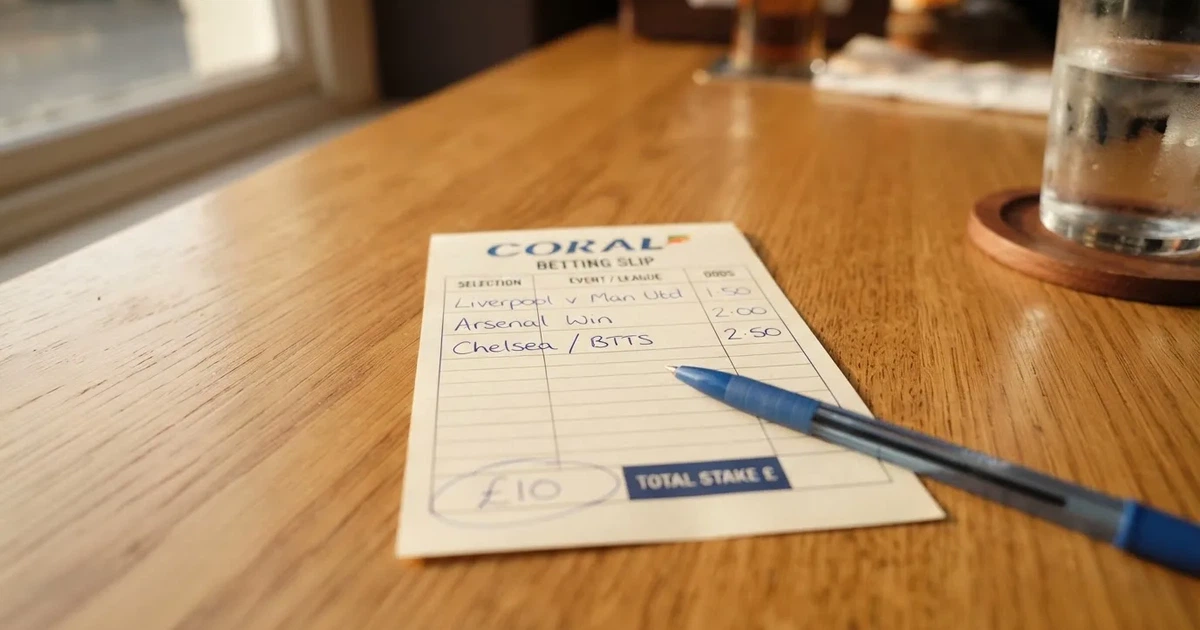
An accumulator is a single bet that strings two or more selections into one price, and it pays out only when every leg wins. That single sentence carries the lot: the appeal (the price climbs fast as more legs are added) and the trap (one loser kills the whole stake). What follows is the working of an acca in Great Britain — how the odds are built, what counts as a win, how the bookmaker’s margin sits inside the price, what a full-cover bet such as a Trixie or a Heinz actually does, where responsibility sits if a series of accas starts to bite, and which ten licensed bookmakers offer acca products today. The page closes with a worked payout so the arithmetic behind an acca price is plain.
Responsible Gambling Around Football Accumulators
Accumulator bets lend themselves to exactly the kind of impulse a punter regrets later. A six-fold that lands pays twenty, thirty, sometimes fifty times the stake; a six-fold that misses pays nothing, and a string of small misses looks identical to “almost” only on the betting app. That is where the harm lives — in the gap between the price the marketing shouts about and the quiet line in the terms that says what the bonus costs to clear, what the minimum odds are, and how long the free bet stays alive.

In Great Britain the safety net starts before the first bet. Every online bookmaker is required to verify name, address and date of birth before a customer can deposit or place a bet, and that check covers free bets and bonus credits too — there is no anonymous play at a licensed site. Once the customer is in, GAMSTOP is the national multi-operator self-exclusion scheme and a mandatory licence condition for every remote bookmaker; opting out is a six-month minimum, with one-year, five-year, and five-year auto-renewal periods available, and after the minimum term the exclusion stays in place for a further seven years unless the customer asks GAMSTOP to remove it. Betting shops use a separate, over-the-counter scheme, not GAMSTOP.
Two newer checks run alongside that. A financial vulnerability check fires when a customer’s deposits minus withdrawals top £150 in any rolling 30-day window — it is a public-record check (bankruptcy, county court judgments, that sort of thing), not an income check, and it is not a credit-reference search. Financial risk assessments — the “affordability checks” of the press — have been announced in a staged plan with no start date. Deposit limits are the customer’s choice; the operator must offer one on a fixed time frame, and the second phase of the framework was postponed to 30 September 2026, so what is live today and what comes next is a moving picture.
Practical guardrails that have already bitten. Credit cards have been banned for gambling in Great Britain since 14 April 2020, and the ban reaches credit-card-funded payments through an e-wallet; debit cards and bank transfers are not covered by it. Wagering requirements on bonuses are capped at 10× the bonus amount (a £10 bonus at 50× needed £500 of bets; under the cap no more than £100). Mixed-product promotions — an offer that requires betting on football to unlock free spins, or wagering across casino and sports in one chain — are banned as of 19 January 2026. None of these rules removes the risk; they put a frame around it.
Where to get help. GamCare runs the National Gambling Helpline. GambleAware funds treatment and the public-facing information on safer gambling. The NHS runs gambling clinics across England. Gamblers Anonymous runs group meetings. None of these is a substitute for the punt decision itself; the decision is the punter’s.
Predictions, Tips and Strategy — What Acca Forecasts Can and Cannot Do
A tipster sells a forecast. The forecast looks like analysis: form, head-to-head, line-ups, weather. The accumulator wraps several forecasts together and pays out only if each one lands. Both steps have their own kind of risk, and neither step removes the bookmaker’s margin that sits inside every price.

What an acca tip genuinely does. A good tip narrows a market — it tells you which side of a price the tipster thinks the bookmaker has got wrong, and that is a real judgement, made with real information. A single tip, treated as a single bet, has the same expected return as any other single bet at the same odds. The tip becomes a problem when it is stacked. Six tips in one acca multiply six margins together; a market with a 5% margin compounded six times leaves roughly a 26% margin in the acca price, which is what the bookmaker keeps of every pound staked on that six-fold. The price climbs because the margin climbs, not because the tipster has found six free bets.
The honest reading of a tipster record. A tipster’s strike rate and average odds describe the record, not the edge. A tipster quoting 30% winners at average odds of 4/1 (5.00) sits roughly at break-even after margin; the same record at 5/2 (3.50) loses in the long run, and at 6/1 (7.00) it wins. The number that matters is the implied margin of the markets the tipster picks from, and most tipster pages do not show it. A punter who treats a tipster’s record as a probability rather than as a track record is paying for the marketing without paying for the maths.
Bankroll, staking and the acca habit. Three working rules come up in serious staking guides. Set a bankroll — a fixed sum that can be lost without changing life; never top it up from the household budget mid-month. Set a unit stake — usually one to two per cent of the bankroll — and stake the unit on singles, two or three units on doubles and trebles, scaling down as the legs multiply. Keep a record: every bet, the price taken, the closing price, the result. A punter who keeps a record sees, after a few hundred bets, what their own margin actually is — which tipsters earn their keep, which sports they lose more on than they thought, which hours of the day their judgement is poorest.
The trap the page returns to several times: a price boost or an acca insurance offer looks like a tipster’s edge. It is not. It is a marketing budget that the operator recoups across the margin of the boosted book, the wagering requirement of any free bet, or the cap on free-bet winnings. The honest comparison is what the offer costs against what the same stake on the same selections would have returned without it.
Bet Types and Odds — How an Acca Is Built, Priced and Settled
The mechanics are simple and they have not changed in decades. The terms around them have, and they are where the cost hides.
What an Accumulator Is
An accumulator — also called a parlay, acca, combo or multi — is a single bet that links two or more individual wagers into one. The price is the product of the prices of each selection, the stake is paid once, and the bet wins only when every leg wins. A losing leg loses the whole stake. A tie (a “push” in American usage, “void” or “dead heat” depending on the market) is removed and the payout odds drop to match the remaining selections. That is the whole of the core mechanic.
Decimal odds suit accumulators because the multiplication is direct. The bettor reads each price as the total return per pound staked, multiplies them together, and that is the acca’s price. Fractional odds work the same way once converted: 5/1 is 6.00 in decimal, 11/4 is 3.75, evens is 2.00. British bookmakers display both forms on the same slip; the bettor pays attention to the decimal when working out a price.
Worked Example — a Treble
Three selections at 1.50, 2.00 and 2.50. The decimal prices multiply: 1.50 × 2.00 × 2.50 = 7.50. A £10 treble pays £75 if all three win; that is £65 profit on top of the £10 stake. The same three in two doubles and a single, staked the same way, are three separate bets and pay differently — the doubles only need two legs to win, the single only needs one.
Full-Cover Bets — When the Acca Wants Insurance
A full-cover bet spreads a stake across every possible combination of a fixed number of selections. The stake is multiplied by the number of bets inside the cover. The classic British set:
- Trixie — three selections, four bets (three doubles and a treble). One winner pays the double; two winners pay two doubles; three pay the treble plus three doubles.
- Patent — three selections, seven bets (three singles, three doubles, a treble). A single winner still pays.
- Yankee — four selections, eleven bets (six doubles, four trebles, a four-fold).
- Lucky 15 — four selections, fifteen bets (the Yankee plus four singles). A bookmaker often pays a bonus on a Lucky 15 with all four winners.
- Canadian (also called Super Yankee) — five selections, twenty-six bets.
- Heinz — six selections, fifty-seven bets.
- Super Heinz — seven selections, one hundred and twenty bets.
- Goliath — eight selections, two hundred and forty-seven bets.
A £2 Patent costs £14 in total stake (seven bets at £2); a £2 Heinz costs £114; a £2 Super Heinz £240. The full-cover bet buys a consolation return when one leg loses — a Trixie still pays if two of the three selections win — and that is what the extra stake buys.
Cash Out, Bet Builder and the Other Tools
Cash out is the bookmaker’s offer to settle an open bet early at a price it sets; the bookmaker keeps a margin on the cash-out figure, and the price it offers is rarely as good as waiting for the bet to settle on its own merits. Bet Builder (or “same-game multi”) strings markets from one match into one acca — first goalscorer, total goals, corners, cards — and most licensed bookmakers price it inside the bet, not as a separate product. Best Odds Guaranteed (BOG) is the racing-side promise: if the starting price is bigger than the price taken, the bigger odds are paid; it applies to horse racing win and each-way bets at the operators that offer it. None of these tools changes the fact that the bookmaker’s margin sits inside every price.
The Margin, and Where It Lives in the Price
Every market has a margin, also called overround. The margin is what the bookmaker keeps of every pound staked on that market; the rest is paid back as winnings. Take a 1X2 market — home, draw, away — priced at 2.10 / 3.40 / 3.60 in decimal. The payout share is 1 ÷ (1/2.10 + 1/3.40 + 1/3.60) = 1 ÷ (0.476 + 0.294 + 0.278) = 1 ÷ 1.048 ≈ 95.4%, so the margin is roughly 4.6%. On a market at 1.80 / 3.75 / 4.50 the payout share is closer to 92% and the margin 8%. Football’s Premier League sits in the low single digits on the 1X2; smaller leagues, exotic markets and in-play prices run higher. The acca compounds it again: a 5% margin compounded across four legs leaves roughly an 18% margin in the four-fold, and the price the bettor sees reflects it.
Top 10 Bookmakers for Football Accumulators in 2026
The ten brands below all hold a remote general betting licence from the Gambling Commission for Great Britain and appear in the public register. Each is reviewed as an accumulator bookmaker — the range of football markets, the acca features (Cash Out, Bet Builder, Acca Boosts, Best Odds Guaranteed where it applies to football rather than racing), the welcome offer in broad terms, and the verdict that follows from those specifics. None of them is “the only” licensed brand; the register lists many more, and the ten here are the comparison set the page covers.
| Operator | Gambling Commission remote licence number and licence holder | What the operator’s own terms state on accas and acca-related features |
|---|---|---|
| Betfred | Remote licence 039544-R-319290-010; Petfre (Gibraltar) Limited | Bet Builder, Extra Places, in-play; the operator’s own acca mechanics are inside the Betfred app |
| Lottoland | Remote licence 038991-R-319408-020; EU Lotto Limited | Sports betting, casino, lottery and scratchcards inside one app; football acca terms are stated on the sports product |
| Sporting Index | Remote licence 027343-R-308898-011; Sporting Index Limited | Fixed-odds and spread betting side by side; spread-bet losses can exceed the deposit on the spread book |
| Swifty Sports | Remote licence 058957-R-334734-006; Swifty Global (UK) Ltd | Cash Out on horse racing and football, daily price boosts, live streaming, in-play; Bet Builder listed as coming soon at the snapshot date |
| BetMGM | Remote licence 039198-R-319450-029; LeoVegas Gaming PLC | Acca-friendly welcome structure that pays free bets split between two football accumulators (4+ selections each) and two sports multiples (2+); minimum odds apply and free bets are valid for 7 days |
| Fafabet | Remote licence 057385-R-333191-006; Taichi Tech Limited | Best Odds Guaranteed on UK and Irish horse racing win and each-way bets from 9am on race days; football acca terms sit on the sports product |
| Ladbrokes | Remote licence 054743-R-330863-014; LC International Limited | Acca Boosts on football multiples, in-play and Cash Out; operates under the same licensee as Coral — not an independent operator |
| DAZN Bet | Remote licence 048756-R-327274-019; DZBT Limited | Cash Out (availability not guaranteed — bets stand if Cash Out is unavailable), Bet Builder, daily bet boosts, in-play |
| Dabble | Remote licence 065677-R-340363-005; Dabble Sports UK Ltd | Welcome offer pays £10 in free bets for a £10 first deposit; minimum odds apply, free bets expire after 7 days and the stake is not returned |
| Fitzwilliam Sports | Remote licence 048760-R-335434-009; SBKI Limited | Prices based on Oddschecker’s average price per selection; football acca mechanics are stated inside the sports product |
Betfred
Betfred is one of the bigger British high-street names turned online, and the app stacks Bet Builder, Extra Places, Racing Post data, live casino and bingo into one product. Acca features run on the same engine as the rest of the sportsbook — Cash Out and in-play are the mainstays, and football accas are priced the same way the book has always priced football. The welcome offer is stated in the operator’s own terms and is not a recommendation to claim it; it carries its own wagering and minimum-odds conditions. For a punter who already has a Betfred shop habit, the app does the same job on the phone.
Lottoland
Lottoland’s UK app is unusual on this list because the headline product is lottery betting — betting on the outcome of a foreign lottery draw — with casino, scratchcards and a sportsbook wrapped around it. The sportsbook takes football, the acca engine inside it prices football accumulators like any other, and the licence covers both. The package works for the lottery player who wants a sportsbook on the same app, but for a punter who only wants sports, the lottery features are just extra noise.
Sporting Index
Sporting Index is the split product on the list. The fixed-odds side takes a standard acca; the spread-betting side runs Total Goals, Winning Favourites and Race Index markets where the loss can exceed the deposit. The welcome offer bundles fixed-odds free bets with spread-bet free bets; the qualifying bet cannot be placed in-play and cannot be cashed out early. For a punter who wants spread betting as well as fixed odds, the bundle is the point. For a punter who wants only fixed-odds accas, the spread side is risk that does not need to be there.
Swifty Sports
Swifty Sports is the newer name in this comparison and the thinnest on features at the snapshot date — Cash Out, daily price boosts, live streaming and in-play are present, Bet Builder is listed as coming soon. Football accas run on the sportsbook’s standard product, and the welcome offer is stated in the operator’s own terms. For a punter who likes a small book with the basics and does not need a Bet Builder today, Swifty sits in the shortlist.
BetMGM
BetMGM UK runs on LeoVegas Gaming’s licence and the app is published by the same group. The sports welcome offer pays four £10 free bets split two ways: two football accumulators of four or more selections each, and two sports multiples of two or more. The free bets expire after 7 days, minimum odds apply, and the qualifying bet must be placed within 7 days of depositing £10 or more. Opt-in is required. The structure tells a punter what the operator values, which is the long acca rather than the short one. For a punter who plays four-folds and longer, the welcome offer lines up with what they bet on. For a punter who plays doubles and trebles, the structure wastes two of the four free bets.
Fafabet
Fafabet’s Best Odds Guaranteed covers UK and Irish horse racing win and each-way bets from 9am on race days — if the starting price is bigger than the price taken, the bigger odds are paid. Football is not inside that promise, and the football acca engine runs on the operator’s standard product. For a punter who bets across football and horse racing, the racing side has a clear edge. For a football-only punter, the headline feature does not apply.
Ladbrokes
Ladbrokes runs under the same licensee as Coral (LC International Limited), and the two brands are not independent operators in the legal sense — a punt on Ladbrokes sits on the same Ladbrokes-Coral platform. Acca Boosts on football multiples, in-play, Cash Out and Best Odds Guaranteed on horse racing are the headline acca-friendly features. For a punter who wants the biggest British high-street name on the app and the acca Boosts that come with it, Ladbrokes is the obvious fit. The Ladbrokes-Coral umbrella matters for complaints: a complaint to Ladbrokes goes to LC International, not to a separate Ladbrokes company.
DAZN Bet
DAZN Bet’s acca mechanics include Cash Out (with the published caveat that Cash Out is not guaranteed and a bet stands if Cash Out is unavailable), Bet Builder, daily bet boosts and in-play. Football accas price up on the standard sportsbook. The bundle suits the DAZN subscriber who wants a convenient sportsbook, but the streaming integration offers little extra value to a punter looking purely for a standalone acca product.
Dabble
Dabble’s welcome offer pays £10 in free bets for a £10 first deposit; minimum odds apply, the free bets expire after 7 days and the stake is not returned. That last clause is the one to read twice: a winning £10 free bet pays only the profit, not the stake, so a 5.00 acca that lands returns £40, not £50. For a small-stake punter who wants a clean welcome, the offer is plain to read. For a punter who treats a “free bet” as a stake-back bet, the offer is smaller than it looks.
Fitzwilliam Sports
Fitzwilliam Sports is the smallest name on this list and the most explicit on how it prices. Each selection’s price is based on Oddschecker’s average price, which means the bookmaker is not making its own margin call on the football prices — it is publishing the market’s average. Apple and Google apps carry the product. For a punter who values a transparent price source over a marketing budget, Fitzwilliam is the honest fit. For a punter who wants a Bet Builder, a Cash Out and a price boost on the same screen, Fitzwilliam is thin.
Overview — The Acca Landscape in Great Britain
An accumulator is the simplest combination bet and the most-marketed one. The product has not changed since fixed-odds betting moved online — what has changed is the wrapper around it, and the wrapper is where the cost hides. The mechanical change that mattered most is the move to decimal odds across British price boards; a punt at 6/1 (7.00) and a punt at 5/1 (6.00) used to need a fraction in the head; they now need a multiplication on the slip.
The market around the acca is bigger than the bet itself. Cash Out is sold as a tool and read as a way to lock in profit before the last leg kicks off; in practice the cash-out figure carries a margin wider than the margin on the bet itself, and a punter who routinely takes it gives back the edge they took with the original price. Bet Builder is sold as a way to build an acca from one match — first goalscorer, total goals, corners, both teams to score — and it is genuinely useful for matches where one stat stands out. The price still carries a margin; the bet is not cheaper because it is on one match.
Best Odds Guaranteed is the racing-side promise and it does what it says on horse racing: a back price at 5/1 (6.00) becomes 6/1 (7.00) if the horse drifts on course and the starting price is bigger. It does not apply to football. Enhanced odds, price boosts, acca insurance and free-bet refunds are all marketing budgets in different shapes — they refund part of a losing stake or boost a winning one, and the operator recoups the cost somewhere: in the boosted book’s margin, in the free bet’s minimum odds, in the cap on free-bet winnings, in the wagering requirement that has to be cleared before any withdrawal.
For a punt in Great Britain, the practical landscape is short. Every licensed online bookmaker offers a football acca. Most offer Cash Out on football. A smaller set offers Bet Builder. A still smaller set offers meaningful acca boosts on football specifically (Ladbrokes and BetMGM lead here in their own terms). Best Odds Guaranteed does not apply to football. Spread betting on football (Total Goals, Winning Margins) is a separate product at Sporting Index and at Spreadex, and the loss on a spread bet can exceed the deposit, which is the line the FCA rules require both firms to publish.
The licence test for any of this is the Gambling Commission public register. A brand can run a .com domain and still be GB-licensed; a brand on a .co.uk domain with no Commission licence is still unlicensed for the GB market. The page that follows carries the licence detail for each of the ten featured operators; the register itself is the test a punter runs against any other brand they meet.
Legality and Regulation — The Frame Around Football Acca Betting in Great Britain
The frame around a football acca in Great Britain is the Gambling Act 2005, the Gambling (Licensing and Advertising) Act 2014 and the Licence Conditions and Codes of Practice the Commission publishes under the Act. The Act covers Great Britain — England, Scotland and Wales. Northern Ireland is outside the Act and has its own older law; a GB licence does not regulate Northern Ireland, and a Northern Ireland brand is licensed separately. A punt in Northern Ireland on a GB-licensed site is the operator’s problem, not the punter’s, but the page writes “Great Britain” wherever the licence matters.
A bookmaker serving customers in Great Britain needs a Gambling Commission licence wherever it is based. Since the 2014 Act an operator whose remote facilities are used in Britain is in scope regardless of where the company sits, so a Curaçao, Maltese or Gibraltar licence is not a substitute for a GB licence. The Commission’s public register is searchable by business name, trading name, domain or account number and is the whole test of who holds one; no count of licensed operators is given without an access date, and a licence check against the register is the practical first step before opening an account.
Licence categories that matter for football accas. Remote general betting standard (real events) is the standard remote sports-betting licence. Remote betting intermediary is the licence for betting exchanges. Pool betting is its own category and applies to horse and dog racing pools. Financial spread betting is regulated by the Financial Conduct Authority, not the Commission, and that is what makes Spreadex’s spread side an FCA-regulated product even though the firm’s fixed-odds side sits on a Commission licence. There is no statutory cap on stakes in sports betting; the operator sets its own maximums and may restrict a customer it considers risky. There is no statutory list of permitted markets; the operator offers markets under its own licence conditions and the LCCP.
What may be bet on. Football, horse racing, greyhound racing, basketball, tennis, golf, esports, politics, TV shows, novelty markets — no statutory prohibition was found on any of these, and GB bookmakers offer all of them. In-play betting is offered and is governed by the operator’s licence conditions and customer-protection duties; the page does not write that in-play is “unrestricted” because that is a legal conclusion only a court can draw. Esports are treated like any other event. Virtual events are a separate licence category.
Player-protection framework. Identity verification before the first deposit has been in force since 7 May 2019 and applies to free bets and bonus credits, so no anonymous play at a licensed site. GAMSTOP is mandatory for every licensed remote operator since 31 March 2020, with the periods listed earlier. The financial vulnerability check (LCCP condition 3.4.4) has been in force since 30 August 2024 and the £150 rolling-30-day trigger since 28 February 2025; it is a public-record check, not an income or credit-reference search. Financial risk assessments have been announced in a staged plan as of a Commission article of 7 July 2026 with no start date; the page writes “announced, staged, no start date” and not “in force”. Deposit limits are a customer choice inside a framework the operator must offer.
Bonuses and marketing. The Commission does not licence advertising; advertising runs through the CAP Code (non-broadcast) and BCAP Code (broadcast), enforced by the ASA, alongside the LCCP marketing conditions. CAP Code section 16 sets the social-responsibility rules on appeal to under-18s and on who may appear in an advertisement (no one who is or seems to be under 25 may feature in marketing that places a bet directly, with a narrow exception). The bonus cap has been in force since 19 January 2026: wagering requirements are capped at 10× the bonus amount. Mixed-product promotions are banned. Whether the cap applies to free bets with no wagering condition and any cap on the money value of a bonus are not established in the public materials the page reads.
The tax side. The player pays no tax on betting winnings in Great Britain — that is general information, not tax advice, and a professional gambler should ask HMRC or an adviser. General Betting Duty is the operator’s tax on gross profits, currently 15%, with a remote rate of 25% from 1 April 2027 applying to remote bets that are not on UK horse racing, not on self-service betting terminals in licensed premises, not pool betting and not in-person. Until that date the remote rate stays at 15%. Spread betting has its own rates (3% financial, 10% other). Whether operators pass duty on through odds is not established.
Offshore, unlicensed brands. A GB licence is compulsory at the point of consumption. Providing gambling facilities in Great Britain without the licence the Act requires is an offence under section 33 of the Gambling Act 2005 (on summary conviction up to 51 weeks’ imprisonment, a fine up to level 5, or both; six months in Scotland), aimed at the operator. The customer who bets on an unlicensed site is not the target of a statutory offence. The cost the customer pays is the loss of protection: no GAMSTOP coverage, no Commission complaints route, no approved dispute-resolution body, no British consumer redress if funds are withheld, and the offer is not bound by the 10× bonus cap or the £150 vulnerability check. Enforcement is disruption — cease-and-desist notices, search-engine referrals, registrar and host work — not blanket blocking; the Commission has been given, or is about to receive, court-order DNS blocking powers, and the page does not write that ISP blocking is in operation today.
Worked Payouts — What an Acca Returns and What a Full-Cover Bet Costs
The arithmetic below uses illustrative prices: 1.50 (1/2), 2.00 (evens) and 2.50 (6/4). The numbers are examples, not quoted prices, and the same arithmetic holds for any other set of prices with the multiplication done across them.
A £10 Accumulator on Three Selections
Take three selections at 1.50, 2.00 and 2.50. The acca price is 1.50 × 2.00 × 2.50 = 7.50. A £10 stake returns £75 (the £10 stake plus £65 profit) if all three selections win. The same three selections at 2.00, 3.00 and 4.00 give a price of 24.00, so a £10 stake returns £240; the price climbs because each leg multiplies in. The illustration that was given as part of the wider reading of how American books display accas quoted a $100 parlay paying out at $100 × (210/110)^N on a -110 line, but that is one operator’s pricing convention in one country and the rule is the same: multiply the leg prices together.
The Same Three Selections as a Patent (Seven Bets at £2)
A Patent covers three selections with three singles, three doubles and a treble — seven bets in total. A £2 unit stake costs £14. If only one selection wins, the £2 single on that selection pays; the rest lose. If two selections win, the two winning doubles pay. If all three win, the three doubles plus the treble pay. The Patent never returns the kind of headline price a £10 straight treble does on three winners, but it pays something on a one-winner weekend, and that is what the extra stake buys.
The Same Three, a Trixie (Four Bets at £2)
A Trixie covers three selections with three doubles and a treble — four bets in total. A £2 unit stake costs £8. There are no singles in a Trixie; one winner pays nothing. Two winners pay the winning double; three winners pay the three doubles plus the treble. The Trixie is cheaper than the Patent because it has no singles; it is also less forgiving because one winner returns nothing.
A Heinz at £1 a Bet (Six Selections, Fifty-Seven Bets)
A Heinz covers six selections in fifty-seven bets. At £1 a bet the total stake is £57. The book of bets includes fifteen doubles, twenty trebles, fifteen four-folds, six five-folds and the one six-fold. A Heinz returns nothing on one winner; it returns the winning double on two winners; it scales up from there. A £1 Super Heinz at seven selections costs £120 and a £1 Goliath at eight costs £247. Full-cover bets are popular at small unit stakes — the headline stake looks small, the total stake does not.
The Margin in a Four-Fold
A market with a 5% margin on the 1X2 has a roughly 18.5% margin in a four-fold built from it; a market with an 8% margin on the 1X2 has roughly a 28% margin in the same four-fold. The price the bettor sees on the slip already carries that compounded margin. The honest comparison between an acca and its singles is that the singles have a lower compounded margin and pay out more often; the acca has a higher compounded margin and pays out rarely, but pays more when it does. None of those numbers is a forecast of a winner; they describe what the bookmaker keeps of every pound on that market.
A Brief Note on Calculation Methods
Two things a punter can do without a tipster. First, work out the price an accumulator pays by multiplying the leg prices together — the slip already does this, but the punter who checks against the slip has a habit that catches errors. Second, work out the bookmaker’s margin in a single market from the prices on offer: payout share = 1 ÷ (sum of 1/odds over all outcomes); margin = 1 − payout share. The margin compounds across acca legs. None of this is a tip; it is the arithmetic that sits behind every price the punter sees.
Frequently Asked Questions
How do football accumulator bets work?
An accumulator links two or more selections into a single bet. The price is the product of the prices of each selection, the stake is paid once, and the bet wins only if every leg wins. A losing leg loses the whole stake; a void leg is removed and the price is recalculated from what remains.
Where can I place football accumulator bets?
Every bookmaker licensed by the Gambling Commission for remote general betting in Great Britain offers football accumulators. The Commission’s public register lists every licensed brand; the comparison set on this page covers ten of them — Betfred, Lottoland, Sporting Index, Swifty Sports, BetMGM, Fafabet, Ladbrokes, DAZN Bet, Dabble and Fitzwilliam Sports — and each holds a current GB remote licence.
How does an accumulator work in football betting?
The mechanics are the same as in any other sport: pick two or more selections, multiply the leg prices together to get the acca price, place one stake, and the bet pays out only if every leg wins. Football’s 1X2 market (home, draw, away), the both-teams-to-score market, the total goals market and any player market are common acca legs.
How can it be checked that a bookmaker holds a Gambling Commission licence?
Search the Commission’s public register by business name, trading name, domain or account number. The register is the whole test of who holds a licence for Great Britain; the licence detail on this page gives the account number for each of the ten featured operators.
How is the return on a bet worked out from the stake and the odds?
The return on a winning bet is the stake multiplied by the decimal odds; the profit is the return minus the stake. A £10 single at 3.50 returns £35 (£25 profit); a £10 four-fold at a price of 30 returns £300 (£290 profit). A free bet usually does not return the stake — a winning £10 free bet at 5.00 returns £40 (£40 profit, no stake back).
What is the bookmaker’s margin and how can it be seen in the odds?
The margin is what the bookmaker keeps of every pound staked on a market. It is calculated as 1 minus the payout share, where the payout share is 1 divided by the sum of 1/odds over every outcome of the market. A market with a 5% margin returns 95p of every pound staked, on average, as winnings. The margin compounds across accumulator legs, so a market with a 5% margin in a four-fold has a margin of roughly 18.5% inside the four-fold price.
Bet types & in-play – systembetsguide.com
Content created by the «systembetsguide.com» team
