
Field hockey betting tips for 2026: how to read form, find value, and stop the bookmaker's margin from eating your stake
 Available in US
Current as of 30 October 2026, checked against the Gambling Commission’s public register.

The page below explains how a tip is built from form, statistics, line-ups and the bookmaker’s own odds, what makes a price a value price once the margin is stripped out, and why no prediction is a guarantee. No concrete matches, picks or predicted results are named here, because nobody can name them in advance and any site that claims otherwise is selling certainty that does not exist. What a punter can control is the process, and the process is what this guide walks through.
How field hockey predictions are actually built
The shape of the sport
A field hockey side fields ten outfield players and one goalkeeper, so eleven take the pitch from each side. Since 2017, matches have been played in four fifteen-minute periods, adding up to sixty minutes of action, with a two-minute interval between each quarter and a longer break at half-time. The team with more goals after sixty minutes wins. Depending on the competition, a tied match may stand, go to extra time or be settled by a penalty shoot-out; since March 2013, FIH regulations send tied classification matches straight to a shoot-out, without extra time.

Those basics matter for anyone sizing up a fixture. A two-minute break between quarters is not a long stoppage — momentum rarely resets the way it does at half-time in football. A red card or a green card in the third quarter tends to compound rather than unwind, because tired legs cannot chase the way they could in the first fifteen minutes. Shoot-outs are more common in this sport than in football, so a market that prices a draw heavily should be read with that in mind.
Pitch, goals, and the geometry that shapes corners and short corners
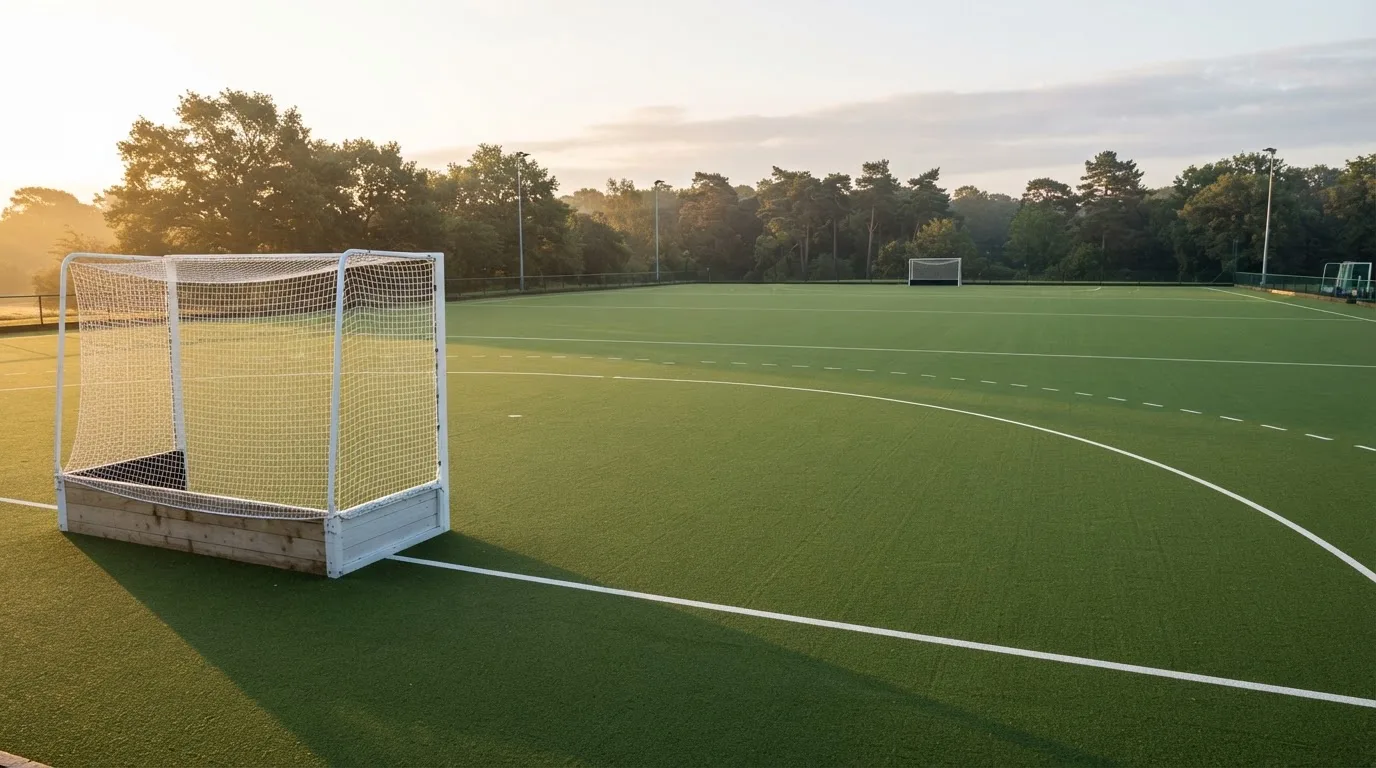
A field hockey pitch measures 91.4 metres by 55 metres, and each goal is 2.14 metres high and 3.66 metres wide. That width is the reason penalty corners, the sport’s signature set piece, score at a rate that other set pieces rarely match. The narrow goal also explains why goalkeeper saves and post hits look more spectacular than the scoreline suggests, and why a half-time lead of one goal in this sport is famously fragile. Anyone pricing corners or counting on a goalkeeper to keep a clean sheet should hold that geometry in mind before the whistle.
Form that means something, and form that does not
Form in field hockey is thinner than in football, for two reasons. The club calendar is short, and the international windows pull players out of domestic sides for weeks at a stretch. A side that won five on the bounce in October can lose three in November simply because its best defender is in India or the Netherlands for a Pro League round.
The form that means something is recent, specific and at the same level. A team’s last six matches against opponents ranked within fifteen places of them tell you more than a season-long unbeaten run that included a string of fixtures against promoted sides. Form that does not mean much is the run a club website publishes: win, win, win, with no opposition noted.
Head-to-head records are weaker than punters often assume. International sides meet rarely, and continental leagues have been reshuffled enough times that a fixture from three seasons ago tells you little about the squad on the pitch today.
Statistics worth weighing
A short list of statistics moves the price more than the rest:
- Shots on target and shots from the top of the circle, not total shots. A side can take twenty shots from outside the D and still lose.
- Penalty corner conversion, both attack and defence. A team that converts a third of its corners is a different beast from one that converts a tenth.
- Cards. A green card is a two-minute suspension, and a side playing short from minute forty onwards is more vulnerable than the same side at minute five.
- Goals per game and goals conceded per game, split home and away where the data shows it.
Statistics to treat with caution include possession percentage — field hockey possession is contested territory that does not always convert into territory in the circle — and pass completion, which rewards safe sideways play.
Line-ups and the news that actually moves a price
Two pieces of team news move a field hockey price more than any other: the availability of the first-choice goalkeeper, and the absence of the team’s primary penalty corner drag-flicker. Both are concentrated, repeatable skills, and a side without either loses a measurable share of its expected goals.
The squad a manager names two hours before pushback is the one that prices the market. Anything reported earlier — on social media or on a club’s website the day before — is provisional until the team sheet is posted.
Why no tip is ever certain
Field hockey is a low-scoring sport with high variance. A single deflection off a defender’s stick can flip a match in a way that no model would predict from form alone. That is the honest framing: a tip is a view on probability, not a forecast of the result. The value of a tip is not in being right but in being right more often than the price implies, once the margin is taken out.
The mechanics of a field hockey price
How a bet pays out
For a single bet, the return is the stake multiplied by the decimal odds, and the net profit is the stake multiplied by the odds minus one. A £10 bet at decimal odds of 2.50 returns £25, of which £15 is profit. For a combination bet — a double, a treble, an accumulator — the odds of the legs multiply into a single price, and the stake is multiplied once by that combined price.
Field hockey is well suited to accumulators because fixtures cluster around international windows, and a punter who follows several leagues can build an acca from two or three matches that look independent. The risk is the same as in any other sport: one leg lets you down and the whole ticket loses.
The margin and how it hides in the price
Every bookmaker builds a margin into its prices. On a two-way market at decimal odds of 1.90 and 1.90, the implied probability of each outcome is one divided by 1.90, which is roughly 52.63 per cent. Two outcomes add up to 105.26 per cent — that five-point-two-six excess over one hundred is the bookmaker’s margin. As a payout share, the punter gets back about 95 per cent of every pound staked on this market; the bookmaker keeps about five pence in the pound.
The same arithmetic works on the three-way market for a match result: home, draw, away. Each outcome carries an implied probability, the three add up to more than one hundred per cent, and the excess is the overround. The larger the excess, the worse the price for the punter.
Value, defined
A price is a value price when the implied probability, stripped of the margin, is lower than the punter’s own estimate of the true probability. On a market at 2.10, the implied probability is about 47.6 per cent. If the punter’s own model puts the chance of that outcome at, say, 55 per cent, the price is value. If the model puts it at 40 per cent, the price is poor.
The market’s job is to converge on true probability across thousands of punters; the punter’s job is to find the prices where the market has mispriced. That is harder than it sounds, because bookmakers compete on Premier League football and Champions League fixtures, but on a Tuesday-night indoor league match in January the price is set by a single trader’s judgement. The mispricings cluster there.
What the price moves on
A field hockey price moves on three things: team news, weather, and the weight of money. Team news is the most predictable. Weather matters more than in football: a wet pitch slows the ball, suppresses drag-flicks, and tilts the match towards defences. Weight of money is the least predictable — a £10,000 bet from a known sharp account can move a price by ten per cent inside an hour, and there is no way to know that has happened until the price moves.
Markets and bet types a punter will actually see
The three-way result
Home, draw, away. Field hockey draws more often than football, because the scoring is lower and the geometry rewards a disciplined defence. A punter who underweights draws in their model will overpay for favourites.
Totals and handicap lines
Most major bookmakers price a totals line on the number of goals, typically set between 2.5 and 4.5 depending on the competition and the sides involved. Handicap lines, sometimes called the “spread”, give one side a head start of one and a half or two and a half goals. The punter pays a margin on every one of these markets, and the margin is wider on totals than on the three-way result because fewer punters price the totals market.
Player markets
Goalscorer markets exist for international fixtures and the top club leagues. The punter should treat goalscorer prices as a marketing product: the margin is wide, the favourite is overbet, and longshots are pushed out further than the underlying probability justifies. Field hockey’s low scoring makes any first-goalscorer bet a long shot on paper, and the margin on top of that compounds.
Each-way and outright markets
Each-way bets split the stake in two: one on the win, one on the place. The place terms depend on the number of runners and the bookmaker’s rules. Outright markets on league winners and tournament winners are priced months ahead, and the early prices carry a larger margin than the day-of-market price — partly because the bookmaker is hedging uncertainty, partly because the early money is small and the per-unit margin is higher.
Bet builders and accumulators
A bet builder lets the punter combine several selections from the same match into one ticket: result, total goals, first goalscorer, cards. The combined price multiplies, but so does the margin on each leg. A four-leg builder on one match carries four layers of margin, and the punter is paying for the convenience of the combined price. Accumulators across different matches are a different product — the margin applies once to the combined price — and the punter’s edge per leg still has to beat the market’s per-leg margin.
Spread betting, briefly
Spread betting on field hockey is offered by a small number of firms, and it is a different product from fixed-odds betting. The punter does not back an outcome at a price; they bet on a margin — total goals, corners, cards — and their win or loss is the difference between the spread and the actual outcome, multiplied by their stake. Losses can exceed the deposit, and the punter should read the firm’s product disclosure before sizing a stake.
Tournaments and competitions the bookmakers price
The international pinnacle
The Olympic tournament is the sport’s biggest stage. Men’s field hockey featured at the 1908 and 1920 Games, was dropped in 1924, then reinstated in 1928, with women’s hockey added in 1980. India dominated the early decades: the side won all five matches at the 1928 Olympic tournament without conceding a goal and took men’s gold in 1932, 1936, 1948, 1952, 1956, 1964 and 1980. Those records set a benchmark the modern game still measures itself against.
The FIH Hockey World Cup runs on a four-year cycle, and the Pro League runs annually between World Cup and Olympic cycles. Both are priced by major bookmakers, with the World Cup carrying the widest range of markets and the deepest liquidity.
Continental championships and club leagues
The EuroHockey Championship, the Hockey Champions Trophy (now succeeded by the FIH Champions Trophy in its current form), and the top domestic leagues in the Netherlands, Germany, India, Australia and England all carry prices at the major bookmakers. Coverage thins below the top tier — a second-division Dutch match is rarely priced at all — and the punter should expect markets to be narrower and margins wider the further down the pyramid they go.
Where the schedule leaves gaps
Field hockey is not a year-round sport. International windows cluster around the Pro League rounds, the continental championships and the World Cup. Outside those windows, only the strongest club leagues carry daily markets, and even those markets can be thin. A punter who only follows the international game will sit out long stretches of the year with nothing to bet on; a punter who follows club hockey has more fixtures but a thinner price.
How the top UK bookmakers line up for field hockey
The set below lists ten UK-licensed bookmakers that price field hockey markets, with the licence that backs each one and the terms that matter for a punter choosing between them. The order is editorial; it is not a ranking by odds quality and it is not a recommendation. Several of these brands run on similar technology and price similar markets, so the differences below sit in the terms, the in-play depth and the safer-gambling tools, not in the headline price.
| Brand | Licence (Number & Holder) | Terms and Market Focus |
|---|---|---|
| BetGoodwin | 002927-R-327985-008 (Goodwin Racing Limited) | Best Odds Guaranteed; fixed-odds racing focus. |
| Sky Bet | 067370-R-341330-005 (SBG Sports Limited) | International markets; bet builder; sports integration. |
| 10bet | 043173-R-322899-023 (Blue Star Planet Limited) | Features cash out and bet builder; broad sports offering. |
| bet365 | 055148-R-331498-002 (Hillside (UK Sports) ENC) | Extensive in-play betting and live streaming. |
| Copybet | 053774-R-330743-010 (Copybet UK Limited) | Best Odds Guaranteed; copy-following features. |
| BoyleSports | 039469-R-319383-025 (Boylesports Enterprise) | Acca insurance on selected bets. |
| Betmaster | 065699-R-339929-002 (BM Solutions GB Ltd) | Sportsbook with cash out and bet builder. |
| VBet | 044662-R-324273-022 (SCGO Limited) | Live streaming and calendar statistics. |
| BetVictor | 039576-R-319370-028 (BV Gaming Limited) | Best Odds Guaranteed; racing and stats features. |
| Spreadex | 008835-R-104580-022 (Spreadex Limited) | Fixed-odds and spread betting on sports metrics. |
BetGoodwin
BetGoodwin runs on a Gambling Commission remote licence held by Goodwin Racing Limited, with the brand’s domain listed against the licence on the Commission’s public register. The brand pays Best Odds Guaranteed on all UK and Irish horse and greyhound racing, up to £1,000. For a field hockey punter the brand is a fixed-odds bookmaker with a racing-heavy heritage; field hockey markets are offered but they are not the centre of the product. The safer-gambling tools follow the licence conditions: deposit limits, time-outs, self-exclusion through GAMSTOP. A punter who already has a Goodwin Racing account will find it familiar; a punter whose primary interest is field hockey may find the in-play depth thin.
Sky Bet
Sky Bet’s UK site runs under SBG Sports Limited on a Commission remote licence. The welcome offer for new customers is £30 in free bets, credited as three £10 free bet tokens after a deposit of at least £5 and a first single or each-way bet of at least 5p at odds of 1/1 or greater. Field hockey markets are offered around international windows and the top club leagues, with a bet builder on selected fixtures. A punter who already watches Sky’s coverage of the sport will find the integration familiar.
10bet
10bet runs under Blue Star Planet Limited on a Commission remote licence. The sportsbook covers football, tennis and horse racing, with cash out, a bet builder and live streaming. Field hockey sits alongside the larger sports with a market offering that expands during international windows. A punter who wants a bet builder and cash out on every fixture will find 10bet’s feature set standard for the segment.
bet365
bet365 runs under Hillside (UK Sports) ENC on a Commission remote licence. The brand offers in-play betting and live streaming of events worldwide, plus bet-tracking features that let a punter follow open bets through a live graphic. Field hockey in-play markets are offered during the international windows and the top club leagues, with the depth of market a punter expects from a major bookmaker. The combination of live streaming and in-play markets is the brand’s strength on a sport like field hockey, where momentum can swing inside a single quarter.
Copybet
Copybet runs under Copybet UK Limited on a Commission remote licence. The brand pays Best Odds Guaranteed all day, every day, on all UK and Irish racing, and pays first past the post on horse racing even if the winner is later disqualified. Field hockey markets are offered but they are not the headline product; the brand’s reputation sits with racing and with copy-following features on the exchange side. A punter whose interest in field hockey is occasional will find the offering sufficient.
BoyleSports
BoyleSports runs under Boylesports Enterprise on a Commission remote licence. The brand’s acca insurance requires opt-in, a minimum stake of £5, minimum odds of 1/2 and pays a maximum refund of £20 as a free bet that expires in seven days; bets must be placed and settled on the same day. For a punter building field hockey accumulators, the insurance softens a single-leg letdown but the cap is modest and the deadline is tight.
Betmaster
Betmaster is operated by BM Solutions GB Ltd, registered in Malta, and holds a Commission remote licence under account 65699. The brand offers a sportsbook with cash out and a bet builder, and field hockey is among the priced sports. A punter comparing Betmaster against a major will find a thinner in-play offering and a narrower market range, with prices that may sit a tick behind the sharper books on big fixtures.
VBet
VBet’s UK app is published by SCGO Limited under a Commission remote licence. The product offers bet builder, pre-match and in-play betting, live streaming and a live calendar with results and stats. For a field hockey punter, the in-play depth and the live calendar are the features to test against the alternatives.
BetVictor
BetVictor runs under BV Gaming Limited on a Commission remote licence. The brand offers Best Odds Guaranteed on UK and Irish horse racing, enhanced live race streaming and a BetFinder feature for racing bets, alongside Smart Stats. Field hockey markets are offered, with the racing heritage evident in the product. A punter whose interest in field hockey is international will find BetVictor’s market range reasonable.
Spreadex
Spreadex is regulated by the Financial Conduct Authority for spread betting and by the Gambling Commission for fixed-odds betting; spread betting losses can exceed the deposit, and a punter should size a stake with that in mind. The brand’s new customer offer is £60 in free bets for a £10 fixed-odds bet, with the free bets usable across fixed odds and spread betting; the qualifying bet must be placed within 28 days of opening the account. For a punter who wants spread betting on field hockey metrics like total goals or corners, Spreadex is one of the few UK-licensed firms that prices that product.
The licensing frame a UK punter sits inside
What the licence actually does
The Gambling Commission, a non-departmental public body sponsored by the Department for Culture, Media and Sport, licenses the whole commercial market under the Gambling Act 2005, which covers Great Britain. Since the Gambling (Licensing and Advertising) Act 2014, an operator whose remote facilities are used in Great Britain needs a Commission licence wherever it is based — sections 33 and 36 of the 2005 Act, as amended. A Curaçao, Maltese or Gibraltar licence is not a substitute for a GB licence; the point of consumption is the test, not the point of incorporation.
The minimum age is 18, and identity verification — name, address and date of birth — is required before a customer can deposit or gamble, including with a free bet or bonus. There is no anonymous play at a licensed site, and a punter who wants to keep their betting private from a bank statement cannot do so at a GB-licensed operator.
How to check a brand’s licence
The Commission’s public register can be searched by business name, trading name, domain or account number, and it is the whole test of whether a brand holds a licence. The register shows the licence holder, the licence number, the categories of licence held and the trading names that fall under each licence. Several brands can run under one licensee, and a punter who sees two familiar brands share a licence number should not be surprised.
A domain proves nothing on its own. Licensed operators use .com as well as .co.uk, and the absence of .co.uk does not mean the absence of a licence. The register is the only reliable test.
What may be bet on, and what may not
There is no statutory list of permitted bets or markets. An operator holds a licence for a category — remote general betting standard for real events, the standard sports-betting licence — and offers markets under its own rules and the Licence Conditions and Codes of Practice. In-play betting is offered by GB bookmakers and the controls are the operator’s licence conditions and customer-protection duties; a legal conclusion that in-play is “unrestricted” is not supported by the framework. Esports are treated like any other event, virtual events sit under a separate licence category, and bets on politics, TV shows and novelty markets are offered by GB bookmakers with no statutory prohibition found.
Betting exchanges run under a betting intermediary licence, and rates and rules specific to exchanges are set out in each exchange’s own terms. No statutory cap on stakes in sports betting exists, and operators set their own maximum stakes and may restrict customers.
Tax
A player pays no tax on betting winnings in Great Britain. General Betting Duty is the operator’s tax on gross profits, currently 15 per cent; from 1 April 2027 a new remote betting rate of 25 per cent applies within it, while remote bets on UK horse racing, bets on self-service betting terminals, pool betting and in-person betting stay at 15 per cent. Until 1 April 2027 the remote rate stays at 15 per cent, and whether operators pass duty on through odds is not established.
A professional gambler should ask HMRC or an adviser; general information here is not tax advice.
Credit cards
Credit cards are banned for gambling in Great Britain since 14 April 2020, including credit-card-funded payments through an e-wallet. Debit cards and bank-based payments are not covered by the ban, and a punter who relies on a credit card to fund a betting account will need to switch.
The advertising rules that shape what you see
Advertising is not licensed by the Commission; it runs through the CAP Code for non-broadcast marketing and the BCAP Code for broadcast, enforced by the ASA, alongside the LCCP marketing conditions. The CAP Code requires marketing to be socially responsible, to be of no strong appeal to under-18s, and to feature no one who is or seems to be under 25 gambling or playing a significant role, with an exception for marketing placed where a bet can be made directly. The rule concerns who may appear in the advertisement, not who may bet.
Wagering requirements on bonuses are capped at 10x since 19 January 2026: a £10 bonus at 50x needed £500 of bets; under the cap no more than £100. Mixed-product promotions — an offer that requires gambling on two or more product types, such as betting and casino — are banned. The cap applies to bonuses with a wagering condition; free bets with no wagering condition and any cap on the money value of a bonus are not established.
Offshore and what is lost
A GB licence is compulsory at the point of consumption. Providing gambling facilities in Great Britain without the licence the Act requires is an offence under section 33 of the Gambling Act 2005, aimed at the operator; no offence aimed at the customer who merely bets on an unlicensed site was found in the framework. A punter using an unlicensed site loses the protection the GB framework provides: no GAMSTOP coverage, no Commission complaints route, no approved dispute-resolution body, no British consumer redress if funds are withheld, and no application of the 10x bonus cap or the £150 vulnerability check. Enforcement is disruption rather than blocking: cease-and-desist notices, search-engine referrals, work with registrars, hosts and payment providers.
Responsible gambling tools and where to get help
What every licensed bookmaker has to offer
A licensed bookmaker has to offer safer-gambling tools, and the framework has tightened in stages. The headline features every punter should expect to find on a licensed site:
- Deposit limits, set by the punter, on a daily, weekly or monthly basis.
- Time-outs, short self-exclusion breaks from twenty-four hours to several weeks.
- Self-exclusion through GAMSTOP, the national multi-operator scheme, with periods of six months, one year, five years, or five years with auto-renewal; after the minimum period the exclusion stays in place for a further seven years unless the customer asks GAMSTOP to remove it.
- Reality checks, pop-up reminders of how long a punter has been on the site.
- Product restrictions, where the punter blocks themselves from casino, for instance, while keeping sports betting open.
- A player profile test that asks about gambling behaviour and flags risk patterns.
The safer-gambling offering at the major brands follows a common standard because the licence conditions apply across the board.
The financial vulnerability check
A financial vulnerability check applies to licensed remote betting when a customer’s deposits minus withdrawals exceed £150 in a rolling thirty days, since 28 February 2025. It is a public-record check — for example, bankruptcy or county court judgments — not an income check and not a credit reference check. Financial risk assessments, the affordability checks of the press coverage, are announced in a staged plan with no start date. A punter whose deposits stay under £150 a month will not be asked for a public-record check.
Where to get help
Help is free and confidential, and the routes below are open to anyone who feels their betting is no longer under control:
- GamCare runs the National Gambling Helpline.
- GambleAware funds treatment and supports research.
- NHS gambling clinics offer treatment through the health service in selected regions.
- Gamblers Anonymous runs peer-support meetings across the country.
A punter who wants to stop can self-exclude through GAMSTOP in one registration; a punter who wants to cut back can set a deposit limit on any licensed site in a couple of minutes.
Bonuses, free bets and what they are actually worth
The shape of a field hockey offer
Field hockey offers at UK bookmakers follow the same shape as offers on other sports: a free bet on first deposit, a price boost on a selected fixture, acca insurance on a multi-leg ticket, or a bet-and-get promotion tied to a minimum stake. The marketing wraps the offer in the language of “free” and “guaranteed”, which deserves unpacking.
A free bet whose stake is not paid back with a win is worth less than its face value, because the punter’s stake is forfeit. A £10 free bet at decimal odds of 3.00 returns £30 of profit on a win — the £10 stake is not returned — and the punter’s expected value depends on the probability the bet wins and the margin on the market the bet is placed on.
The wagering cap and what it changed
Wagering requirements on bonuses are capped at 10x since 19 January 2026. A £10 bonus at 50x needed £500 of bets before withdrawal; under the cap, a £10 bonus requires no more than £100 of bets. The cap is a material change in the value of a bonus, and a punter who took offers before the cap and is comparing notes with a punter who took offers after the cap is comparing two different products.
Mixed-product promotions are banned: an offer that requires gambling on two or more product types, such as betting and casino, is no longer permitted. The cap applies to bonuses with a wagering condition; free bets with no wagering condition and any cap on the money value of a bonus are not established.
Reading the small print
Three lines of small print matter more than the headline:
- The minimum odds on the qualifying bet. A free bet that requires a first bet at 1/1 or greater is a different product from one that requires odds of evens, and the difference excludes a large slice of markets.
- The expiry. Free bet tokens expire; an offer that gives thirty days is more generous than one that gives seven.
- The payment method. Some offers exclude deposits by Skrill, Neteller or PayPal, and a punter who prefers a particular e-wallet will be paid less attention by the offer.
A punter who reads the small print and accepts the offer on its actual terms keeps the difference between the marketing and the reality.
Live betting and cash out on field hockey
How in-play works on the sport
Live betting on field hockey is offered by the major UK bookmakers during international windows and the top club leagues. The market is narrower than the pre-match market, with the three-way result and the next-goal markets usually available; totals, corners and player markets thin or disappear as the match progresses. The punter’s edge is in spotting momentum shifts before the price catches up — a side down to ten after a green card at minute thirty-five is more vulnerable than the price implies, because the next goal market will take a minute to adjust.
Cash out
Cash out lets the punter close a bet before the match settles, at a price the bookmaker sets in real time. The cash-out price carries its own margin, layered on top of the margin in the original bet, and the punter should treat cash out as a separate transaction. Used to lock in profit on an acca when the first three legs have won, cash out is a useful tool; used to chase losses on a losing position, it is a fast way to lock in a smaller loss rather than let the bet ride.
Live streaming and the in-play experience
Live streaming of field hockey is offered by selected bookmakers — bet365 lists in-play streaming of events worldwide, and others carry rights to specific leagues — and the combination of live video, an in-play market and a cash-out button is the modern in-play experience. A punter without a streaming subscription is reading the market through odds movements alone, and the odds are slower to reflect what the video is showing.
How to keep your bankroll intact
Staking discipline
A punter who sizes every stake at a fixed percentage of the bankroll — one or two per cent is the common starting point — survives the losing runs that even a long-run profitable strategy will hit. A punter who sizes stakes by feel, chasing losses or betting on outcomes as if they were guaranteed, goes through the bankroll fast. The first rule of staking is the dull one: keep the stake small relative to the bank.
The role of the record
A second punter who keeps a record of every bet — the match, the market, the price, the stake, the outcome — knows after a thousand bets whether their process is profitable. A punter who bets on memory and instinct does not. The record does not have to be elaborate; a spreadsheet with five columns is enough.
The line you should not cross
A punter who bets money they cannot afford to lose has already lost, regardless of the outcome. Betting should be paid for out of disposable income, and a punter whose budget is tight should set a deposit limit before opening an account. The deposit limit is the cheapest piece of insurance on the page.
Stopping when the run is bad
A losing run in field hockey can be longer than in higher-scoring sports, because goals come less often and one late deflection can flip a settled bet. A punter who has lost five in a row should halve the stake for the next session, not double it. The doubling-up instinct is the one that empties bankrolls.
How to evaluate a bookmaker for field hockey
What to check
Three checks tell a punter more than any marketing claim. First, does the bookmaker price field hockey outside the international windows, and how deep is the market when it does? Second, is the in-play offering available on a phone, with cash out and live streaming where the rights allow? Third, what are the safer-gambling tools, and how easy is it to set a deposit limit or self-exclude through GAMSTOP?
What to ignore
A bookmaker’s welcome offer tells you little about what betting on field hockey is like once the welcome period is over. A bookmaker’s sponsorship of a major tournament tells you nothing about the margin on a Pro League fixture. A bookmaker’s reputation in football or horse racing tells you less about field hockey than the punter assumes, because the product teams and the trading desks are different.
What a punter with a small budget should look for
A punter with a small budget should look for a bookmaker that offers low minimum stakes — five pence at some brands — and that lets the punter set a tight deposit limit on a daily basis. The welcome offer matters less here than the everyday price, because the small-budget punter will spend more over a year on the everyday price than on the welcome offer.
What a punter who follows the international game should look for
A punter who follows the international game should look for a bookmaker that prices Pro League, World Cup and Olympic qualification markets, with live streaming of the matches and an in-play market that runs through all four quarters. A bookmaker that drops the in-play market at half-time, as some do, is a poor fit for this punter.
What a punter who builds accumulators should look for
A punter who builds accumulators should look for acca insurance, the bet builder, and the early payout offer on selected markets. The acca insurance matters because one leg lets down more often than a punter remembers, and the cap on the insurance is the number to read.
Frequently asked questions
What is a value bet and why is no tip ever certain?
A value bet is a price that is higher than the probability of the outcome justifies, once the bookmaker’s margin is taken out. The bookmaker’s price implies a probability — 2.50 implies 40 per cent — and the punter’s own model says the true chance is, say, 50 per cent. That gap is value. No tip is certain because field hockey is a low-scoring, high-variance sport in which a single deflection can flip a result, and even a strong favourite loses often enough that any “certainty” claim is marketing, not analysis.
What is the bookmaker’s margin and how can it be seen in the odds?
The margin is the cut the bookmaker keeps from every pound staked. On a two-way market priced at 1.90 and 1.90, each outcome implies a probability of about 52.6 per cent, the two add up to 105.3 per cent, and the 5.3-point excess is the margin. As a payout share, the punter gets back about 95 pence of every pound bet on this market; the bookmaker keeps about 5 pence. The larger the excess across a market’s outcomes, the worse the price for the punter.
How is the return on a bet worked out from the stake and the odds?
For a single bet, the return is the stake multiplied by the decimal odds, and the net profit is the stake multiplied by the odds minus one. A £10 bet at decimal odds of 2.50 returns £25, of which £15 is profit. For a combination bet — a double, a treble, an accumulator — the odds of the legs multiply into one combined price, and the stake is multiplied once by that combined price.
How can it be checked that a bookmaker holds a Gambling Commission licence?
The Gambling Commission’s public register, on the Commission’s website, can be searched by business name, trading name, domain or account number, and it shows the licence holder, the licence number, the categories of licence and the trading names under each licence. The register is the only reliable test; a domain proves nothing, and a brand without a listing on the register should not be treated as licensed.
Which tools for controlling play does a licensed bookmaker have to offer?
A licensed bookmaker has to offer deposit limits, time-outs, self-exclusion through GAMSTOP, reality checks, product restrictions, and a player profile test. The safer-gambling offering is set by the licence conditions, so it is broadly similar across licensed brands, and the punter should expect to find these tools on every licensed site.
How do fractional odds such as 5/1 convert to decimal odds such as 6.00?
Fractional odds of a divided by b convert to decimal odds of a divided by b plus one. Fractional odds of 5/1 give decimal odds of 5 divided by 1 plus 1 = 6.00. Fractional odds of 11/4 give decimal odds of 11 divided by 4 plus 1 = 3.75. The conversion works in both directions and is the same arithmetic whether the punter is reading a football price or a field hockey price.
US & other team sports – systembetsguide.com
Content created by the «systembetsguide.com» team
