
Online motorsport betting in Great Britain: 2026 markets, bookmakers and odds
 Available in US
Motorsport is not one sport but a handful of championships with their own calendars, their own competitive formats and their own market menus. Formula One still carries the global audience. IndyCar anchors the American oval and road-course tradition. The World Endurance Championship runs multi-class races over six, twelve and twenty-four hours. Formula E fills the winter indoor calendar. MotoGP and World Superbikes speak for motorcycling. The FIA, founded in 1904, governs four-wheeled motor sport internationally; the FIM governs motorcycle racing. Each of those is, to a licensed British bookmaker, a distinct column on the sportsbook with its own margins, its own settlement rules and its own set of bet types — and the price the punter sees already contains the bookmaker’s edge on top of the outcome probabilities.
Current as of 30 October 2026 against the Gambling Commission’s public register and the named operators’ own terms pages.
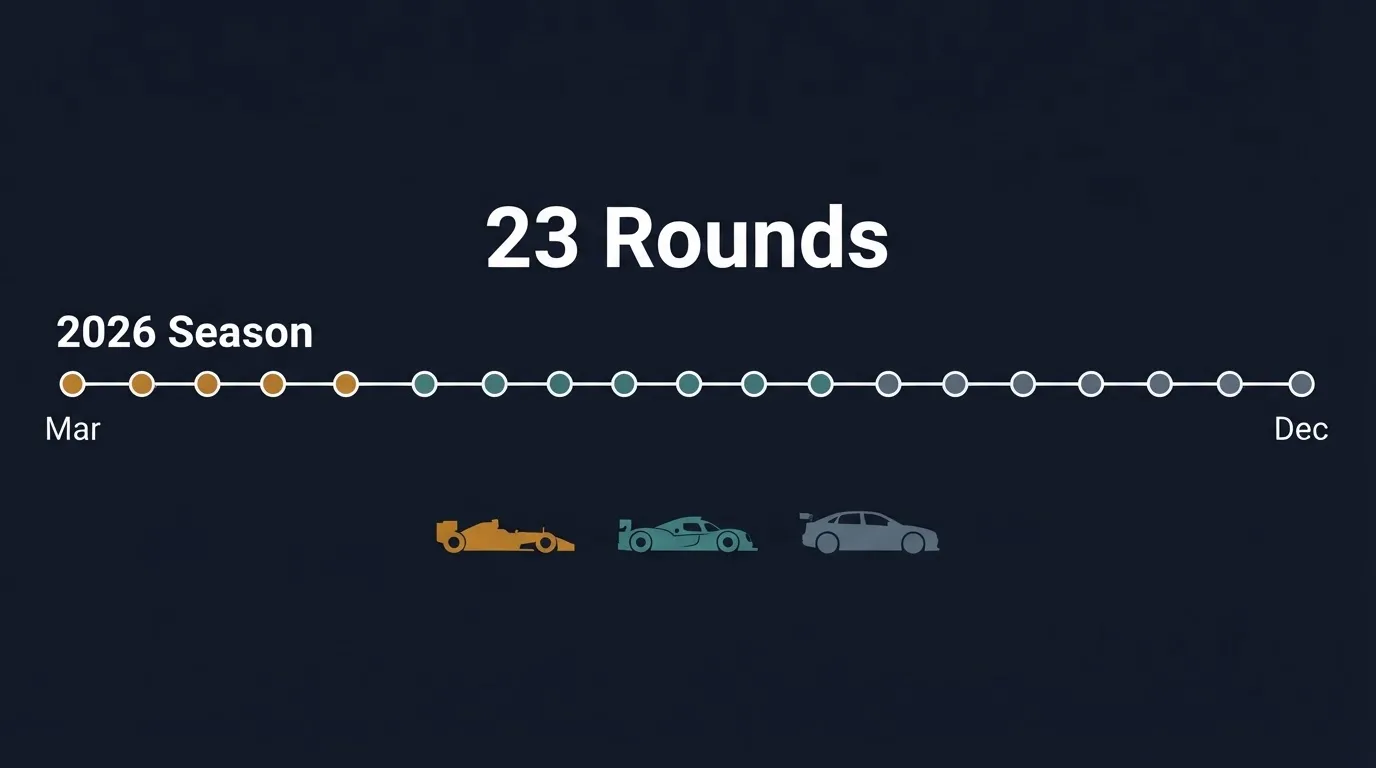
The point of this guide is to make that edge visible and to put it beside the practical decisions a bettor actually faces. Which bookmakers hold a Gambling Commission licence, what the licence buys in terms of consumer protection, what motorsport markets typically look like on each site, how odds convert and what a margin costs, and which welcome offers are worth reading before claiming. The 2026 Formula One season opens on 8 March at Albert Park and runs through twenty-three Grands Prix to Abu Dhabi on 6 December, with Cadillac joining as the eleventh team and Audi entering as a works team through its acquisition of Sauber; an entirely new chassis-and-power-unit regulation package changes how the cars race, which in turn changes how the markets are priced. None of that removes the basic arithmetic — the overround, the each-way stake, the wagering turnover — that governs any motorsport bet placed through a British bookmaker.
The motorsport landscape: from open-wheel to motorcycle, and where the market sits
The motorsport category is broader than most casual readers assume. Open-wheel racing — Formula One, Formula E, IndyCar — runs the highest-profile single-seater championships. Touring car championships run production-based cars on circuits and street tracks, from the British Touring Car Championship to the World Touring Car Cup. Endurance racing covers multi-class, multi-hour events, of which the 24 Hours of Le Mans, held each June in France as part of the FIA World Endurance Championship, is the most famous. Rallying covers tarmac, gravel and snow stages across a wide range of national and regional championships. Motorcycle racing, governed separately by the FIM, includes MotoGP, Moto2, Moto3, World Superbikes, British Superbikes and the wider support categories.

The same British bookmaker will list a different menu under each of those headings, and the menu changes with the calendar. During a Formula One race weekend, an F1-dedicated bookmaker will price every session — practice, sprint qualifying where the format applies, qualifying, the race — and dozens of driver markets within each session: race winner, podium, points finish, fastest lap, retirement, head-to-head driver matchups, fastest lap in each stint, finishing position bands. NASCAR markets thicken around its own calendar. MotoGP markets thicken from March to November. IndyCar runs in parallel with F1 across the European summer. The 24 Hours of Le Mans is priced from market open in spring through to the race in June and the result in the small hours of a French Sunday morning.
The reason a motorsport column is built separately on the larger sportsbooks rather than buried inside a generic “specials” tab is the depth of in-race information available. Timing feeds carry sector splits, lap deltas, pit-stop windows and tyre stints. That data feeds the in-play markets — the markets priced while the race is running — and turns a race into a continuous stream of odds movements a punter can read. Some British bookmakers carry out-of-race markets for a few days after an event, settling on official results once steward’s decisions and time penalties are applied; that delay is normal in a sport where the timing screens can take an hour to settle a finish photo.
How the British market is licensed, and what that licence actually buys
A bookmaker that accepts bets from customers in Great Britain needs a Gambling Commission licence issued under the Gambling Act 2005; a Curaçao, Maltese or Gibraltar licence is not a substitute. The test is not the licence held elsewhere but the licence held in the British register: the Gambling Commission’s public register, searchable by business name, trading name, domain or account number, is the whole proof of who holds one. Since the Gambling (Licensing and Advertising) Act 2014, an operator whose remote facilities are used in Great Britain needs a Commission licence wherever it is incorporated. That means a brand operating from Malta, Gibraltar or any other jurisdiction still has to clear a Commission licence to take bets from a customer sitting in London, Edinburgh or Cardiff.
Licence categories are specific. The remote general betting standard (real events) licence is the licence that covers the bulk of mainstream sportsbook activity at British-licensed operators: pre-match and in-play fixed-odds betting on real sporting events. Remote pool betting covers pool products on horse and dog racing, run as a separate licence. The remote betting intermediary licence is the licence under which betting exchanges operate. A separate remote general betting limited licence covers smaller, more restricted operations. Where multiple brands run under one licence, as Ladbrokes and Coral do, or Paddy Power and Betfair do, they are not independent operators for regulatory purposes — they sit on the same Commission account and bear the same holder’s name on the register.
What the licence buys the customer, concretely, is a set of obligations on the operator that an unlicensed site does not have. Identity verification runs before the first deposit, before a free bet can be claimed and before any stake is accepted; punters name, address and date of birth are checked, and since 7 May 2019 the test runs before gambling, not after. Credit cards are banned for any gambling transaction at a British-licensed operator, including credit-card-funded payments through an e-wallet; debit cards and direct bank-based payments such as bank transfer and open-banking rails are not covered by that ban. GAMSTOP, the national multi-operator online self-exclusion scheme, is a mandatory licence condition for every British-licensed online operator; once a customer registers with GAMSTOP they are blocked at every participating brand for their chosen exclusion period and for at least seven years after that period ends.
Those obligations cost the operator and tighten the experience of using the site. They also produce the consumer-protection infrastructure that an offshore brand cannot match: a complaint to the Gambling Commission if a dispute cannot be resolved with the operator, approved alternative dispute resolution, a duty of care on customer funds, identity-checked play. The reader’s working test remains the Commission’s public register — a brand claiming to hold a licence that does not appear in the register is making a claim the register does not support.
Financial spread betting is a separate regime from sports betting. Spreadex, for instance, is regulated for spread betting by the Financial Conduct Authority and for fixed-odds betting by the Gambling Commission; spread betting losses can exceed the deposit. That distinction matters for motorsport, where a small number of spread-betting firms still publish point-spread markets on Formula One driver finishing positions and on race-win indices; the punter is dealing with a different regulatory regime and a different duty.
The responsible-gambling layer: limits, checks and the help available
Every British-licensed operator has to offer a baseline of safer-gambling tools, and the Commission’s licence conditions and codes of practice set out what that baseline is. Deposit limits are a remote technical standards requirement, and operators must offer a gross deposit limit on a fixed time frame. Self-exclusion is mandatory through GAMSTOP for the online channel and through multi-operator self-exclusion arrangements for the retail channel; the periods on GAMSTOP are six months, one year, five years or five years with auto-renewal, and once the minimum period has run, the exclusion stays in place for a further seven years unless the customer asks GAMSTOP to remove it. Time-outs and reality checks sit alongside deposit limits on most operators’ safer-gambling pages, and most operators also offer product-level blocks — the ability to disable casino, slots, sportsbook or specific verticals — without closing the account entirely.
Two recent additions to the framework are worth understanding because they affect how a motorsport customer’s account behaves over a normal betting week. A financial vulnerability check has applied since 30 August 2024, with the trigger threshold — when the requirement to run the check becomes mandatory — in force since 28 February 2025: when a remote customer’s deposits minus withdrawals exceed £150 in a rolling thirty-day period, the operator must run a public-record check covering sources such as bankruptcy orders or county court judgments before accepting further deposits. This is not an income check and it is not a credit-reference check; it is a public-record scan. A separate set of financial risk assessments — the more comprehensive affordability reviews familiar from news coverage — has been announced as a staged plan, with no start date written into the rules yet. Treating the vulnerability check as settled and the broader affordability review as announced-but-not-yet-live is the reading that matches the published conditions.
Help outside the operators sits at GamCare — the National Gambling Helpline is part of GamCare — GambleAware, the NHS gambling clinics, and Gamblers Anonymous. Most British-licensed bookmakers link each of those services from a safer-gambling footer or a dedicated page; a brand that does not surface those links is unusual at this level of the licensed market. The reader’s working rule is that the safer-gambling layer is not an optional feature dressed up as one — at a British-licensed operator, it is part of the licence and it is part of what makes the licence worth having.
There is no state-set deposit or loss ceiling in Great Britain. Operators set maximum stakes; customers set deposit limits. The arithmetic of those limits is the customer’s alone to work out: a punter setting a monthly deposit limit needs to know how much they intend to stake before any bonus turnover, and any turnover requirement runs on top of normal betting turnover rather than replacing it. A free bet’s qualifying condition, where a minimum price and a minimum stake apply, eats into the same monthly envelope.
Bonuses and free bets: what the marketing word is worth in turnover
Welcome offers on the British market vary widely in shape, but they cluster into three groups. The matched-deposit bonus — “bet £10, get £30 in free bets” or similar — credits the account with free bets whose stake is not returned with a winning payout. The stake-not-returned free bet is the standard at most British operators; its real value is the free-bet amount multiplied by the odds-minus-one and divided by the odds, multiplied by the relevant market payout share. A £10 free bet at decimal odds of 4.00 on a market with a 95 per cent payout share is worth roughly £7.13 in expected returns to the punter, before any market outcomes fall the other way; the same free bet at odds of 2.00 is worth about £4.74. The offered headline number is not the realised value.
The enhanced-odds welcome — “bet £5, get £30 in free bets if your horse wins” or similar — converts a small cash stake into a larger free-bet bundle if the qualifying cash bet wins; the qualifying cash bet usually carries a minimum price, often around evens or 1.50 in decimal terms, and the offer is structured so that the customer gets most of the value back as free bets rather than cash. The bet-credit refund — “money back as a free bet if your first bet loses” — gives a stake-matched refund in free-bet form rather than cash; the refunded amount is stake-not-returned, and the cash wager has to lose for the refund to land at all. Each of those three shapes asks the customer to read the small print, where the minimum price, the expiry window, the wagering cap and the market exclusions sit.
The wagering cap has changed materially. From 19 January 2026, wagering requirements on bonuses at British-licensed operators are capped at 10x the bonus amount — a £10 bonus can require no more than £100 of qualifying bets to clear. The cap also kills mixed-product promotions: an offer that asks for gambling on two or more product types, say a sportsbook bet to unlock casino spins or a sportsbook bet to unlock bingo bonus funds, is not permitted. Free bets whose only condition is that they be used as a stake do not carry a wagering requirement in the conventional sense, and the cap’s effect on that product type is less clear in the published rules than on the headline deposit match. None of that alters one underlying rule: the wagering requirement is a turnover test, and a punter’s expected cost of clearing a bonus equals the turnover requirement multiplied by the margin of the markets they bet on. A £10 bonus at the 10x cap on markets with a 6 per cent average margin costs roughly £6 in expected value to clear before any other constraint binds.
There is a wider point about offers and motorsport specifically. Most British operators run a motorsport price boost at some point in the Formula One calendar, often with the race winner or a podium finish as the boosted leg. The boosted leg is usually subject to a maximum stake, often in single pounds rather than tens of pounds; a £10 stake-limit boost at enhanced odds offers a much smaller expected uplift than a deposit match at the same brand. Free bet credits at most operators can be used on motorsport markets, but a small handful of operators restrict free-bet use to specific sports or to single bets, ruling out each-way, accumulator or bet-builder use of the credit. The bettor reading the small print looks for four things — minimum price on the qualifying bet, expiry window on the free bet, maximum stake on a boosted leg, and any market exclusion that removes the sport they actually bet on from the offer.
Bet types and odds: how motorsport markets are constructed and priced
The motorsport column at a British-licensed sportsbook is dense for Formula One and progressively thinner for the secondary championships. Within Formula One, the race-weekend menu breaks into pre-race markets — outright championship winner, race winner, podium, points finish, fastest lap, driver head-to-head, finishing-position band, qualifying — and in-race markets — leader after five laps, leader at the end of lap one, fastest pit stop, retirement, safety-car periods, race control flags. The bookmaker’s margin is wider in the secondary markets (qualifying, finishing bands, fastest lap) than in the headline markets (race winner, podium), because the secondary markets attract less volume and the bookmaker runs a wider overround to cover the additional model uncertainty.
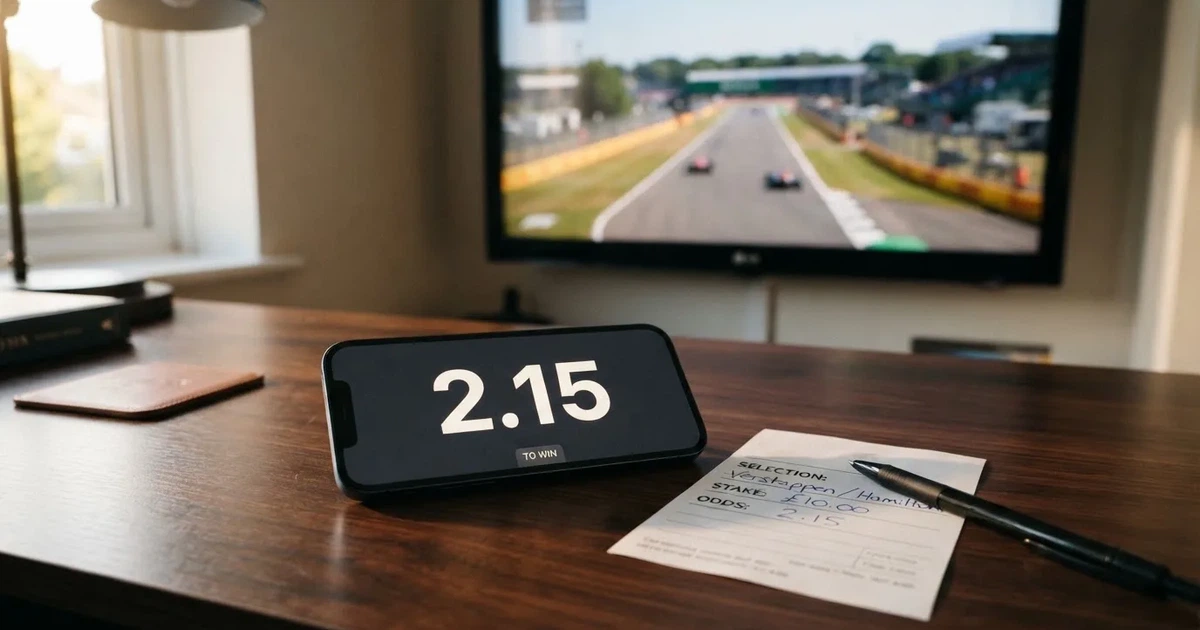
Odds in British motorsport are written in fractional form, the 5/1 and 11/10 of the betting shop and the printed racecard, and increasingly shown in decimal form at the same time on operator websites and apps. The conversion is mechanical: fractional odds of a divided by b convert to decimal odds of a ÷ b + 1. 5/1 is 6.00; 11/4 is 3.75; evens is 2.00; 4/6 — a short price, odds-on — is 1.67. Some bookmakers show fractional by default and allow the customer to switch to decimal, some show both side by side, and a few — usually newer operators — show decimal only. The conversion is the same in both directions because it is the same number; the formats differ in the way the punter reads favourites and outsiders.
Margin is the bookmaker’s edge inside the price. In a two-way market with decimal odds of 1.90 on either side, the payout share is one divided by one over 1.90 plus one over 1.90 — the implied probability of each outcome, summed — and the margin is one minus that payout share. Worked through: 1.90 on each side implies a probability of about 52.63 per cent on each outcome; the two implied probabilities added together come to about 105.26 per cent; the payout share is therefore 1 ÷ 1.0526, or about 95 per cent, and the margin is about 5.26 per cent. The reader’s working rule: the more balanced the implied probabilities on either side, the more visible the margin becomes when both sides are summed.
For a three-way market — a Formula One race with several realistic winners priced in the 4/1 to 10/1 band — the margin is calculated across all the runners priced, and a 23-driver field can carry margins in the 25 to 40 per cent range depending on how each bookmaker prices the back of the field. The back of the field at decimal odds of 500.00 and 750.00 adds almost nothing to the implied probability sum while sitting visibly in the menu; the practical margin is built from the front of the field where most of the volume runs. A bettor interested in longshots should look for a brand that prices the back of the field efficiently, but most of the value at the long end sits in the small chance of a chaotic race outcome, not in the spread.
Combination bets work by multiplying the decimal odds of each leg into a single price. A four-leg Formula One accumulator — picking four race winners at decimal odds of 2.50, 3.00, 4.00 and 5.00 — carries combined odds of 150.00, and a £1 stake returns £150 including the stake. The each-way equivalent on motorsport is rare because most championships do not offer each-way terms the way horse racing does; outright championship markets are settled on the official championship result rather than place terms, and qualifying markets settle on the official qualifying order with no place dividend.
Bet builder and same-game multi products let the punter combine markets from a single race — race winner plus fastest lap plus podium finish — into a single slip. The combined price is calculated by the bookmaker using a reduced-correlation model rather than the simple multiplication of two or three separate prices, and the margin on the combined price is usually wider than on either leg separately. Where a bet builder is supported on motorsport, the same-race combinations tend to be cheaper than cross-race combinations because the cross-race combo has the smaller combined correlation; the same-race combo has the larger correlation, which the bookmaker prices into a tighter margin. The cash-out button on a same-race multi settles at a price derived from current in-play markets rather than at the original price, and partial cash-out lets the punter settle a portion of the stake while letting the rest ride.
In-play markets on motorsport are deep at the front of an F1 race and thin during a long yellow-flag period. The bookmaker suspends pricing when the safety car is deployed and resumes it once the timing screen has caught up with the running order; the punter who wants to lock in a price in those gaps pays a wider spread than on green-flag running. Some British bookmakers offer a “leader after lap one” market that settles only once the race reaches its first full lap, and that market is the easiest of the in-race markets to read because the timing data is fresh and the outcome distribution is narrow.
The 2026 motorsport calendar: which races, when, and how the markets sit around them
The headline of the 2026 British market’s motorsport calendar is the Formula One season: twenty-three Grands Prix beginning on 8 March at Albert Park in Australia and scheduled to end on 6 December at the Yas Marina circuit in Abu Dhabi. The 2026 grid runs eleven teams. Cadillac joins as the eleventh team, and Audi enters as a works team after acquiring Sauber; Lando Norris is the reigning Drivers’ Champion going into the season. The 2026 technical regulations drop the MGU-H, raise the MGU-K output to 470 brake horsepower (350 kilowatts), and replace DRS with active aerodynamics including an overtake mode that becomes available within one second of the car ahead. The team cost cap for 2026 is 215 million US dollars. Those four points will shape how bookmakers set markets through March and into the European summer, because driver head-to-head markets depend on which car has the stronger power unit and which has the stronger aero package, and qualifying markets depend on how active aerodynamics trade off against tyre preparation in a single lap.
IndyCar runs in parallel through the American spring, summer and autumn. The Indianapolis 500 sits at the end of May and is priced widely on British books; markets include outright winner, podium, top Chevrolet, top Honda, lead changes, lead lap finishers and various driver specials tied to the speed of the run. Formula E moves onto its own winter calendar that runs from late autumn into the following summer with races on street circuits and at indoor venues. The World Endurance Championship runs a calendar that includes the 24 Hours of Le Mans in June, with separate markets on overall victory, class victory and finishing position; the Le Mans menu at a British bookmaker is one of the deeper motorsport markets of the year, because the multi-class format produces dozens of distinct betting propositions per car.
The motorcycle calendar — MotoGP, Moto2, Moto3, World Superbikes, British Superbikes — has its own rhythm. MotoGP runs from March to November and is the second-biggest motorsport column at most British sportsbooks. World Superbikes has a tightly structured round-by-round season and is priced by race winner, podium and head-to-head. British Superbikes carries some domestic depth, especially on Saturdays at British circuits. NASCAR’s Cup Series is followed on the larger books; markets on Daytona 500, the playoff rounds and the championship outright are common, but the in-race depth is thinner than F1 because the timing feeds and live sector data available to a retail punter are thinner.
Rallying rounds — the World Rally Championship and selected national championships — sit on most British books as outright markets on rally winners and manufacturer championships. The Dakar Rally in January and other long-distance events have their own pre-race outright menus. The British Touring Car Championship runs on Sundays from April to October and is priced on race-one, race-two and race-three winners, with some books offering qualifying and fastest-lap markets. None of those secondary championships carries the in-race depth of a Formula One weekend, but most of them have at least one outright market and a small set of head-to-head driver markets on each race day.
How the bookmakers compare: ten reviewed brands and what each one is worth
The ten brands below all hold a remote general betting standard (real events) licence from the Gambling Commission, all appear on the Commission’s public register, and all are members of GAMSTOP. The table at the foot of this section gives the licence number, the licence-holder entity and what each operator’s own terms state on motorsport — the licence is the test of whether the brand can take a bet from a Great Britain customer; the terms of motorsport coverage are what each operator chooses to publish.
NetBet — comprehensive markets and a builder that prices on the fly
NetBet carries a deep motorsport column with Formula One, MotoGP, IndyCar, World Superbikes, NASCAR and the World Endurance Championship listed across the calendar. The site offers Daily Boosts and Profit Boosts on selected markets, free bet offers running alongside the sportsbook, a Bet Builder with instant dynamic odds, and a sports-stats section on the major leagues. The bet builder’s “instant dynamic odds” feature is the relevant detail for motorsport, because it reprices the multi-leg bet as each leg is added rather than waiting until the slip is closed; for a customer combining race winner, podium and fastest lap into one slip, that repricing matters because the multi-leg correlation is priced live into the combined slip. NetBet’s licence sits with Netbet Enterprises Limited under Commission account 39170. The brand suits a punter who wants a broad motorsport menu across multiple championships and is happy to use a builder that prices each leg as it goes.
Star Sports — the phone-driven trader model
Star Sports runs an unusual on-course and online bookmaker model in which customers speak to a trader directly by phone — the published number is 08000 521 321 — to open an account, place a bet or ask a customer-services query, with email support at [email protected] alongside the phone line. The phone-driven model gives the trader the option to lay off larger bets personally, and it tends to suit a customer with a specific stake size or a specific bet type in mind. Star Sports is licensed for motorsport markets at the standard real-events category under Star Racing Limited, Commission account 9177. Its motorsport menu, as reported on industry listings, runs the major championships; the way in which a particular market is priced on a particular weekend has to be checked against the operator’s own slip rather than against a generic listing.
DragonBet — Welsh football and rugby first, motorsport as the wider column
DragonBet is published by DragonBet Ltd and carries motorsport alongside its better-known coverage of Welsh football and rugby, racing and American football; in-play betting and bet-builder markets are part of the published offering. The brand’s strength is its Welsh-football and Welsh-rugby depth, and the motorsport column runs as a competent mainstream menu rather than a specialist one. The licence is with DragonBet Ltd under Commission account 64908. A punter whose primary sports are Welsh football or rugby but who also bets on Formula One, MotoGP and the World Endurance Championship will find DragonBet a reasonable fit; a punter whose entire betting interest is motorsport will find more depth at the F1-led sportsbooks.
William Hill — best odds guaranteed on racing, motorsport on the wider column
William Hill offers Best Odds Guaranteed on UK and Irish horse racing from 8 AM on the day of the race, on both single and multiple bets, and the rule does not apply to ante-post, tote or pari-mutuel bets. Best Odds Guaranteed is a horse-racing product rather than a motorsport one — the rule pays the bigger of the price taken and the starting price if the starting price is larger — but it is the detail most customers notice first when they read the William Hill terms, and it is what shapes the brand’s reputation for racing-friendly pricing. For motorsport specifically, William Hill runs a mainstream motorsport column across Formula One, MotoGP, IndyCar and NASCAR, and the licence sits with WHG (International) Limited under Commission account 39225. A punter whose betting interest straddles racing and motorsport will read the racing terms first and the motorsport menu second; the motorsport offering is broad rather than specialist.
DAZN Bet — the sports-broadcast partnership carrying into a sportsbook
DAZN Bet runs as a sportsbook brand with a media parentage rather than as a heritage bookmaker, and its published deposit menu starts at £5 by debit card, Apple Pay, Paysafecard, Trustly and Skrill, with a £20 minimum for PayPal deposits; no processing fees are published on the deposit-methods page. The minimums and the fee-free framing matter for a small-stake motorsport punter, because a £5 deposit makes the brand reachable for a customer who only wants a weekend race-winner stake without committing to a larger bankroll. DAZN Bet is licensed with DZBT Limited under Commission account 48756. The motorsport menu runs the standard championships, and a punter willing to test a newer sportsbook brand at low stake size will read the brand’s own motorsport page for current depth.
Fafabet — best odds guaranteed and a focused racing-plus-sports blend
Fafabet runs Best Odds Guaranteed on UK and Irish horse racing win and each-way bets from 9 AM on race days, paying the bigger of the original price and the starting price when the starting price is larger. The cutoff is later in the morning than William Hill’s 8 AM cutoff, which is a small but visible difference for a customer who likes to place racing bets shortly before the off. For motorsport, Fafabet runs a mainstream column and the licence sits with Taichi Tech Limited under Commission account 57385. The brand suits a punter whose primary interest is horse racing but who also bets on the major motorsport championships across Formula One, MotoGP and selected secondary series; the motorsport offering is broad rather than deep.
BoyleSports — the £10-qualifying free-bet welcome
BoyleSports runs a sports welcome offer for UK players that credits £20 in free bets when a £10 bet is placed, with a separate €30-in-free-bets offer for €10 in Ireland. The free bets are stake-not-returned, and the qualifying stake has a minimum price requirement that any punter reading the small print will check before placing it. BoyleSports is licensed with Boylesports Enterprise under Commission account 39469 and carries a wide motorsport menu across Formula One, MotoGP, IndyCar and the World Endurance Championship. A punter looking for a small qualifying stake paired with a meaningful free-bet bundle will find the offer worth modelling; a punter uninterested in the welcome offer will read the brand for its base-price competitiveness on the headline motorsport markets.
BetTom — the 50%-back-as-a-free-bet shape
BetTom runs a sports welcome offer of 50 per cent back as a free bet of up to £50, with a matching 50 per cent back as free slot funds of up to £50 for casino play; full terms apply on each side of the offer. The matched-cashback-as-free-bet shape is more useful to a punter already placing at the qualifying stake level, because the refund only fires if the qualifying bet loses. The free-bet stake is not returned with a winning payout, and the qualifying bet usually carries a minimum price requirement. BetTom is licensed with Bet Tom Limited under Commission account 64959. The motorsport menu at BetTom runs the major championships; the welcome shape and the qualifying-bet mechanics are what a new customer checks before signing up.
Fitzwilliam Sports — capped membership and a Dublin heritage
Fitzwilliam Sports describes itself as a Dublin bookmaker with capped membership and operates a “High Stakes Welcome” subject to compliance criteria. The capped-membership model is unusual on the British market, where most sportsbooks run unlimited customer bases, and the welcome is positioned for the higher-stake customer rather than the small-stake one. The published safer-gambling offering includes instant deposits, fast withdrawals, timeouts and deposit limits, with links to GambleAware, GAMSTOP and Gamblers Anonymous. The licence is with SBKI Limited under Commission account 48760. A punter whose motorsport staking sits at the higher end will read the brand’s terms for the qualifying criteria on the welcome, and for the depth of the F1 and MotoGP menus.
BetGoodwin — a three-bundle free-bet welcome
BetGoodwin runs a sports welcome offer of “Bet £10 and Get £15 in Free Bets”, made up of a £5 sports bet, a £5 acca and a £5 Sub-Cover bet. The three-bundle structure exposes the customer to three different bet types from the welcome — a standard single, an accumulator and a Sub-Cover bet, which is a brand-specific market in which the stake is refunded as a free bet if a chosen leg voids — and each bundle has its own expiry window and minimum-price requirement. BetGoodwin is licensed with Goodwin Racing Limited under Commission account 2927. The motorsport menu runs the major championships and the welcome structure is read against the qualifying stake, the minimum price, the expiry windows and the market exclusions that apply to each of the three bundles.
Reading the comparison across the ten brands
Three of the ten brands — Star Sports, Fitzwilliam Sports and BetGoodwin — are smaller operators with distinctive shapes: a phone-driven trader model, a capped-membership high-stakes welcome, and a three-bundle welcome respectively. Four of the ten — William Hill, BoyleSports, NetBet and BetTom — sit in the broad-market sportsbook group with mainstream menus and mainstream welcome offers. Three sit between those poles — DragonBet as a Welsh-specialist brand with motorsport as a wider column, DAZN Bet as a newer sportsbook with low deposit minimums, and Fafabet as a racing-led brand with a 9 AM best-odds-guaranteed cutoff. The licence number sits beside each brand in the table below; the relevant terms column states what each operator’s own page says about motorsport or about the wider context in which motorsport sits. None of that turns any single brand into “the only” licensed choice for motorsport in Great Britain — the wider licensed market runs to many more brands than these ten — and a punter shopping for a motorsport-specific brand should compare two or three of the menus against the current calendar before settling.
| Brand | Gambling Commission remote licence | What the operator’s own terms state on the relevant subject |
|---|---|---|
| NetBet | Netbet Enterprises Limited · account 39170 | Daily Boosts, Profit Boosts and free bet offers alongside a Bet Builder with instant dynamic odds and sports stats for the major leagues |
| Star Sports | Star Racing Limited · account 9177 | Customers can open an account, place bets and ask customer queries by phoning 08000 521 321, with email support at [email protected] |
| DragonBet | DragonBet Ltd · account 64908 | Welsh football and rugby markets run alongside racing, American football, in-play betting and bet-builder markets in the published app |
| William Hill | WHG (International) Limited · account 39225 | Best Odds Guaranteed applies to UK and Irish horse racing from 8 AM on race days, on single and multiple bets; ante-post, tote and pari-mutuel bets are excluded |
| DAZN Bet | DZBT Limited · account 48756 | Deposits start at £5 by debit card, Apple Pay, Paysafecard, Trustly and Skrill and at £20 by PayPal, with no processing fees |
| Fafabet | Taichi Tech Limited · account 57385 | Best Odds Guaranteed on UK and Irish horse racing win and each-way bets from 9 AM on race days, paying the bigger of the original price and the starting price when the starting price is larger |
| BoyleSports | Boylesports Enterprise · account 39469 | UK sports welcome offer credits £20 in free bets when a £10 bet is placed |
| BetTom | Bet Tom Limited · account 64959 | Sports welcome offer credits 50% back as a free bet of up to £50, with a matching 50% back as free slot funds for casino play; full terms apply |
| Fitzwilliam Sports | SBKI Limited · account 48760 | A Dublin bookmaker with capped membership, instant deposits and fast withdrawals, timeouts and deposit limits, and a “High Stakes Welcome” subject to compliance criteria |
| BetGoodwin | Goodwin Racing Limited · account 2927 | Sports welcome offer is “Bet £10 and Get £15 in Free Bets” split into a £5 sports bet, a £5 acca and a £5 Sub-Cover bet |
How the bookmaker’s margin shows up in the price the punter sees
Every price on a British motorsport market contains an overround — a built-in margin in favour of the bookmaker — that turns the implied probability of every outcome from below 100 per cent to above 100 per cent when all outcomes are added together. The two-way market is the cleanest illustration. Decimal odds of 1.90 on each outcome imply a probability of about 52.63 per cent on either side; the two probabilities added together come to about 105.26 per cent; the payout share is therefore 1 ÷ 1.0526, or about 95 per cent, and the margin is the remaining 5.26 per cent. That is the bookmaker’s edge inside the price: for every pound that crosses the market in aggregate, the bookmaker keeps about five and a half pence.
The same arithmetic at a different price set reframes the point. Decimal odds of 1.80 on either side imply 55.56 per cent on each outcome, the implied probabilities add to 111.11 per cent, the payout share is 1 ÷ 1.1111, or 90 per cent, and the margin is 10 per cent. Decimal odds of 2.00 on either side imply 50 per cent each, the implied probabilities add to 100 per cent, the payout share is 100 per cent and the margin is zero — a notional “fair” market in which the bookmaker breaks even on the overround. Real British markets on a tight two-way proposition, such as a head-to-head driver matchup between two evenly priced drivers, will typically sit between 1.83 and 1.91 on each side, giving margins between roughly 4.7 per cent and 8.5 per cent.
A three-way market — race winner with three realistic contenders — widens the picture. Implied probabilities on each side of 35 per cent, 33 per cent and 32 per cent add to 100 per cent without margin; the same three at 37 per cent, 34 per cent and 33 per cent add to 104 per cent for a margin of about 4 per cent; the same three at 38 per cent, 35 per cent and 33 per cent add to 106 per cent for a margin of about 5.66 per cent. In a wide-field Formula One race, a 23-driver book adds every driver’s implied probability into the sum, and a typical bookmaker’s overround on a pre-race race-winner market runs between 25 per cent and 40 per cent depending on how the back of the field is priced. The bulk of the overround is built into the front of the field, because that is where the volume sits; the longshots at decimal odds of several hundred contribute very little to the implied-probability sum because their implied probabilities individually are tiny.
The reason the margin matters to a punter is that it sets the expected cost of being right. A punter clearing a £100 bonus with a 10x wagering requirement through £1,000 of qualifying bets at a 5 per cent average margin will, on average, lose £50 to the margin — and the bonus credited at £100 yields an expected profit of about £50 before any other constraint binds, giving an expected cost of clearing the bonus that is roughly half the face value of the bonus. A punter clearing the same £100 through markets with a 7 per cent average margin loses an expected £70 and turns the expected profit on the bonus into roughly £30 before any expiry window or maximum-stake rule binds. The bonus headline is not the realised value; the realised value is set by the margin on the markets the bonus is cleared through.
There are three practical consequences for a motorsport punter. First, the deeper the market — the more runners priced and the more in-race markets — the narrower the margin tends to run on each market, because the bookmaker has more data to work with and more confidence in the price; a headline F1 race-winner market runs at a lower margin than a secondary qualifying market at the same brand. Second, the longer the price, the wider the implied margin tends to run, because the model uncertainty grows faster than the implied probability falls at the long end; a 50/1 shot on an F1 race winner carries a wider proportional margin than a 3/1 shot, but the contribution to the overall overround from the back of the field is small. Third, in-play margins open wider than pre-race margins because the bookmaker is repricing under time pressure with a model that has not caught up with the latest timing screens; a punter who likes in-play markets accepts that the price is the price the bookmaker can stand behind, and a tighter pre-race price is what a punter reads rather than a deeper in-play one.
Working out a return from stake and odds: the punter’s basic arithmetic
The return on a winning single bet is the stake multiplied by the decimal odds. The net profit is the stake multiplied by the decimal odds minus one. A £10 stake at decimal odds of 4.50 returns £45 — that is the stake plus the profit of £35 — and the same £10 stake at decimal odds of 1.67 (4/6 in fractional form, an odds-on price) returns £16.70, of which £6.70 is the profit and £10 is the original stake. The punters who work in fractional odds convert first: 5/1 is 6.00 decimal, so a £10 stake at 5/1 returns £60 and yields a profit of £50; 11/4 is 3.75 decimal, so a £10 stake at 11/4 returns £37.50 and yields £27.50 in profit; evens is 2.00 decimal, so a £10 stake at evens returns £20 and yields £10 in profit.
The same arithmetic for a combination bet treats the decimal odds of each leg as multipliers. A £5 treble at decimal odds of 2.50, 3.00 and 4.00 carries combined odds of 30.00 and returns £150 if all three legs win; a £1 accumulator at decimal odds of 2.00, 2.50, 3.00 and 5.00 carries combined odds of 75.00 and returns £75 if all four legs win. The margin compounds at each leg, and the combined margin of a four-leg accumulator is wider than the margin of any single leg taken on its own. The bettor pricing a combined bet reads the combined price as one price and the combined margin as one margin, not as a chain of four separate numbers.
Each-way betting is standard on horse racing and not standard on motorsport. Where each-way terms are published on a motorsport market, the stake is doubled: a £10 each-way bet costs £20 total and is treated as a £10 win bet plus a £10 place bet. The place dividend is a fraction of the win dividend, usually a quarter or a fifth, depending on the number of runners. The number of runners is irrelevant on motorsport because the place terms are set by the bookmaker rather than by the field size; the punter reads the each-way terms on the specific market rather than assuming a horse-racing place-fraction convention.
Cash-out is the tool the punter uses to close a bet before the result is settled, at a price the bookmaker derives from current in-play markets; partial cash-out lets the punter settle part of the stake while letting the rest ride. Cash-out is settled at a price that includes the bookmaker’s margin on the in-play market at that moment, and the margin is wider in-play than pre-match. The punter using cash-out pays the wider in-play margin in exchange for locking in a known outcome before the result settles; the punter not using cash-out accepts a wider pre-match-style margin in exchange for letting the bet settle on the official result.
Marketing words and what they actually cost: reading offers on motorsport markets
The vocabulary on the welcome-page banner is not a description — it is a sales pitch, and the small print is the description. “Risk-free” usually means a refund as a free bet if the qualifying bet loses, with the free bet stake not returned with a winning payout; the “risk-free” word applies to the qualifying cash stake, not to the refunded credit. “Free bet” usually means a stake-not-returned credit; the customer does not get the stake back on a win and the headline £30 in free bets is therefore worth less than the £30 figure implies. “Best odds guaranteed” applies only to specific markets and only to bets placed before a published cutoff; the rule pays the bigger of the original price and the starting price when the starting price is larger, and it excludes ante-post, tote and pari-mutuel bets at most British operators. “Boosted odds” applies to a maximum stake and is paid at the boosted price only up to that stake; the punter reading the small print looks for the maximum stake figure.
The wagering cap announced for 19 January 2026 changes how offers read. Wagering requirements on bonuses are capped at 10x the bonus, which means a £10 bonus requires at most £100 in qualifying bets to clear; a £100 bonus would require £1,000 in qualifying bets at the cap, and no wagering requirement above 10x is permitted. The cap also bans mixed-product promotions — an offer that asks for gambling on more than one product type, such as a sportsbook bet to unlock casino bonus funds — outright. Whether the cap applies to free-bet credits that carry no conventional wagering requirement is not established in the same rule; the punter reads the operator’s offer terms for that specific case.
A punter reading the small print for a motorsport-specific offer checks four things. The minimum price on the qualifying bet excludes the heavily favoured outcomes: a welcome offer that requires a qualifying bet at minimum odds of 1.50 is generous; an offer that requires a minimum of 2.00 is restrictive on a heavily favoured race winner. The expiry window on the free bet sets the time horizon: a seven-day expiry on a free bet credit pushes the customer to lock in the bet within a single race weekend; a thirty-day expiry on the same credit allows the customer to wait for a market they actually want to bet on. The maximum stake on a boosted leg sets the practical value of the boost: a £1 maximum on a boosted leg at enhanced odds yields a smaller expected uplift than a £10 maximum at the same odds. The market exclusion on the free bet sets the usable markets: a free bet that cannot be used on motorsport is useless to a motorsport-only customer.
Picking a bookmaker for the 2026 motorsport calendar
The choice of bookmaker is shaped by what the punter actually bets on. A punter whose main interest is the Formula One championship across twenty-three Grands Prix, with a deep menu on race winner, podium, head-to-head, fastest lap and qualifying, will read the motorsport-specific depth of each brand rather than the welcome offer. A punter whose interest spans Formula One, MotoGP and the World Endurance Championship will pick a brand with a broad menu across all three rather than a brand that runs only F1 to specialist depth. A punter who bets on motorsport only on race days and otherwise runs an in-play-driven account will pick a brand with competitive in-play pricing and a usable cash-out. A punter whose primary interest is horse racing but who also bets on the headline motorsport markets will pick a brand whose racing terms and best-odds-guaranteed rules suit their racing book first and whose motorsport menu is broad rather than specialist.
The tax position is unchanged from any other British betting activity. The punter pays no tax on betting winnings in Great Britain; General Betting Duty is the operator’s tax on gross profits, currently 15 per cent at the headline rate and rising to 25 per cent from 1 April 2027 within a defined scope of remote bets; spread betting has its own rates. The punter is not charged duty by the operator, and the rate change from 2027 does not change what the customer is paid on a winning bet. Whether operators pass duty on through odds is not established; the punter reads the price they are given rather than assuming how it has been constructed.
The licence position is the only test of whether the brand is a British brand at all. The Gambling Commission’s public register is searchable by business name, trading name, domain or account number; every operator whose card sits in the table above is on that register against the licence-holder entity named in the second column. The minimum age is 18, identity is verified before the first deposit or the first free-bet claim, and a customer registered with GAMSTOP is blocked at every participating brand for the duration of the chosen exclusion period. A brand claiming to hold a Commission licence that does not appear in the register is making a claim the register does not support; the punter’s first check, before signing up, is the register entry itself.
A short list for a typical 2026 motorsport punter, working through the calendar: William Hill or BoyleSports for a customer who wants a broad sportsbook with a meaningful free-bet welcome and a mainstream motorsport menu; NetBet for a customer who wants the bet-builder depth on motorsport combinations and the daily odds movement; DAZN Bet for a customer who wants a low-deposit-minimum brand to test the menu without committing to a large bankroll; DragonBet for a customer whose primary interest is Welsh football and rugby and who takes motorsport as a wider column; Fitzwilliam Sports for a customer at the higher end of staking who wants a capped-membership model with a high-stakes welcome; BetGoodwin, BetTom, Fafabet or Star Sports for a customer whose choice is shaped by the welcome offer’s structure rather than the menu’s depth. None of that is the only licensed brand for any of those customer shapes — the wider licensed market runs to many more brands than these ten — and a punter shopping for the best menu for a specific 2026 race weekend should compare two or three of the menus against the calendar before settling.
Looking ahead through the calendar
The 2026 Formula One season is the centre of gravity for motorsport markets through the year. Albert Park on 8 March is the first pricing event; Bahrain, Saudi Arabia and the early-season flyaways set the first driver-head-to-head markets; the European summer — Imola, Monaco, Spain, Canada, Austria, Silverstone, Hungary, Belgium, the Netherlands, Italy, Spain again — runs nine Grands Prix in roughly sixteen weeks and produces the densest cluster of qualifying and race-winner markets. The Baku, Singapore, Austin and Mexico rounds feed into the championship run-in; Las Vegas, Qatar and Abu Dhabi close the year. A new active-aerodynamics overtake mode available within one second of the car ahead changes the in-race model and the qualifying model simultaneously: the bookmaker has to price the chance of an overtake being used within a lap and the chance of a qualifying lap being interrupted by traffic. Cadillac’s arrival as the eleventh team and Audi’s works-team entry add two new constructors whose early-season pace is hard to call; the back-of-the-field pricing on race winner is therefore wider than usual for a season opener.
The 24 Hours of Le Mans in mid-June carries a dense multi-class menu and a settlement delay: the multi-class format produces dozens of distinct betting propositions per car, the race takes twenty-four hours to run, and the result can take an hour or more to settle after the timing screens confirm the final classification. A punter betting on Le Mans markets should expect a longer settlement window than for a Formula One race and should not expect cash-out to be available continuously across the full twenty-four hours. IndyCar’s Indianapolis 500 at the end of May is the second-biggest single-race motorsport event of the year on British books; markets run on outright winner, podium, lead changes, top Chevrolet and top Honda, and the race’s tendency for late caution periods makes in-play depth thinner than at F1.
Formula E’s winter calendar keeps motorsport columns populated from late autumn into the early summer. MotoGP runs from March to November. World Superbikes run a tighter round-by-round calendar. British Superbikes run on Saturdays at British circuits from April to October; British bookmakers price the championship with mainstream depth. NASCAR carries season-long outright markets and selected race-winner markets, with in-race depth thinner than F1; the Daytona 500 and the playoffs are the busiest pricing days. The British Touring Car Championship runs on Sundays from April to October and is priced by race-one, race-two and race-three winners at most British books. Every one of those calendars has its own busy moments and its own quieter stretches, and the punter’s odds comparison between operators can be done outside of the headline race weekends when the in-play margin narrows.
A practical checklist for motorsport betting with a British bookmaker
The mechanics of a motorsport bet at a British-licensed bookmaker run through a short, well-known sequence. Confirm the brand sits on the Gambling Commission’s public register against a remote general betting standard (real events) licence, naming the licence-holder entity. Verify identity before the first deposit because verification is required by licence condition before the first stake can be accepted. Set a deposit limit on first contact rather than after a first losing weekend; the limit is a customer-controlled tool and the maximum is the customer’s choice. Check the market menu for the specific race or championship in mind; F1 and MotoGP run year-round, but the secondary championships come and go with the calendar.
Read the small print on the welcome offer before claiming. Confirm the minimum price on the qualifying bet, the expiry window on any free bet, the maximum stake on any boosted leg, and the market exclusion list. Place the qualifying bet on a market the punter actually wants to bet on rather than on a token event just to clear the qualifying condition. Use the free bet within the expiry window on a market on which the free bet is permitted and at a price that satisfies any minimum-price requirement attached to the credit. Settle at the result or via cash-out according to whichever closure makes sense for the running position.
In-race, treat the in-play menu as its own market. The price moves while the safety car runs, the timing screens catch up, and the bookmaker reopens markets once the running order stabilises. The cash-out figure is a derived price rather than a market price and the margin is wider than on pre-race markets; partial cash-out lets the punter settle a portion and let the rest ride. A non-runner in a Formula One race-winner market voids the bet at most British operators, regardless of the price taken; a race abandonment settles as a void at most British operators unless the result is determined at the point of abandonment.
For the long term, the licence test does not change. The punter’s safety net is the register; the safer-gambling tools are the operator’s mandatory offering; the safer-gambling help is GamCare, GambleAware, the NHS gambling clinics and Gamblers Anonymous. Every British-licensed brand is in GAMSTOP; an offshore brand is not. That single difference is the working distinction between two regulatory regimes, and the punter’s whole framework of consumer protection follows from it.
Frequently asked questions
How can it be checked that a bookmaker holds a Gambling Commission licence?
The Gambling Commission’s public register is searchable by business name, trading name, domain or account number, and it is the only test that confirms whether a brand holds a British licence. Find the brand in the register, confirm the licence category is remote general betting standard (real events) for a sportsbook, and check the licence-holder entity matches the brand. A brand that does not appear in the register has not cleared the British licensing test, whatever its home jurisdiction’s licence says.
How is the return on a bet worked out from the stake and the odds?
The return is the stake multiplied by the decimal odds. A £10 stake at decimal odds of 3.50 returns £35 in total; that includes the £10 stake and a profit of £25. The net profit on its own is the stake multiplied by the decimal odds minus one. The same calculation in fractional odds converts first: 5/2 is 3.50 decimal, evens is 2.00, 4/6 is 1.67.
What is the bookmaker’s margin and how can it be seen in the odds?
The margin is the bookmaker’s edge built into the prices on a market. Add up the implied probability of each outcome — the reciprocal of the decimal odds — and the sum will be above 100 per cent. The amount above 100 per cent is the margin. On a two-way market at 1.90 on each side, the implied probabilities are roughly 52.6 per cent each, summing to about 105.3 per cent, and the margin is about 5.3 per cent.
How do fractional odds such as 5/1 convert to decimal odds such as 6.00?
Divide the numerator by the denominator and add one. 5/1 is 5 divided by 1 plus 1, which equals 6.00. 11/4 is 11 divided by 4 plus 1, which equals 3.75. Evens, written as 1/1, is 1 divided by 1 plus 1, which equals 2.00. A short price, an odds-on price, is one whose numerator is smaller than its denominator, like 4/6 or 5/6.
Which tools for controlling play does a licensed bookmaker have to offer?
Every British-licensed remote operator must offer deposit limits, timeouts, reality checks and GAMSTOP self-exclusion, and the licence conditions make those tools mandatory rather than optional. A financial vulnerability check applies once a customer’s deposits minus withdrawals exceed £150 across a rolling thirty-day period, and the operator must run a public-record check before accepting further deposits. Wider affordability reviews, sometimes called financial risk assessments, have been announced in a staged plan with no start date written into the rules yet.
Are betting winnings taxed in Great Britain, and who pays General Betting Duty?
No tax is payable by the punter on betting winnings in Great Britain; that position is general information rather than personal tax advice, and a professional gambler should ask HMRC or a tax adviser. General Betting Duty is charged on the operator’s gross profits, currently at a 15 per cent headline rate with a 25 per cent remote betting rate applying from 1 April 2027 within a defined scope of remote bets. The punter is not charged duty by the operator.
Combat & motorsport – systembetsguide.com
Content created by the «systembetsguide.com» team
