
Best Betting Sites With Accumulators: UK-Licensed Acca Bookmakers Compared
 Available in US
Current as of 30 October 2026 against the Gambling Commission’s public register.
What an Accumulator Bet Actually Does to Your Stake
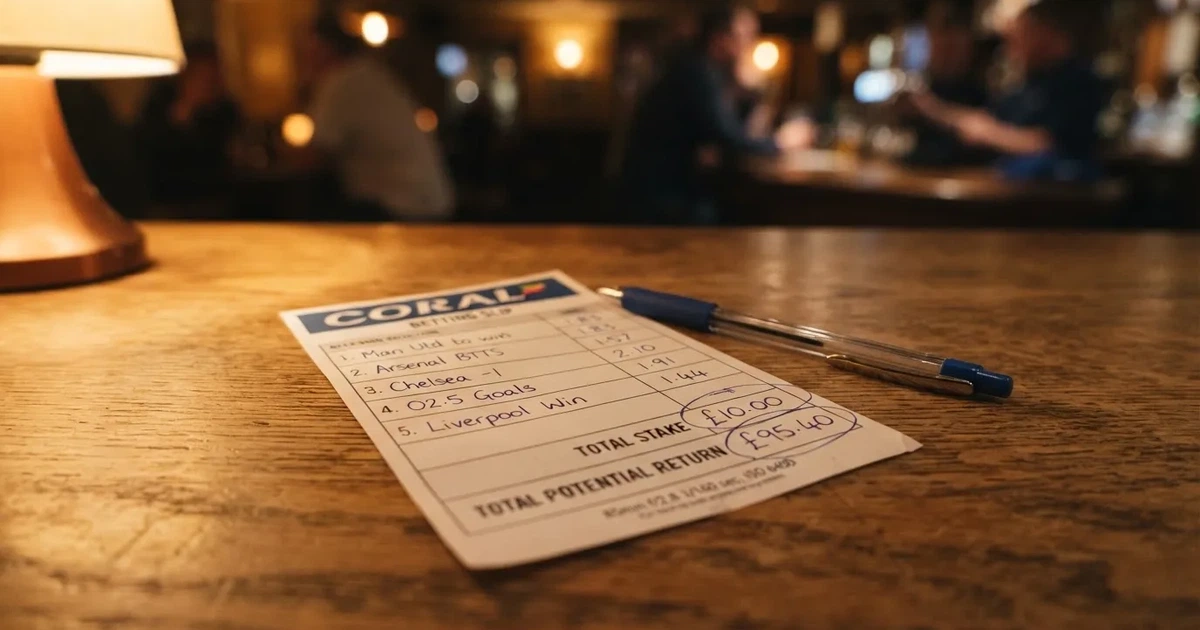
An accumulator — acca to anyone who has filled in a betting slip in a British bookmaker — is a single wager that links two or more selections. The price of the bet is the product of every leg’s odds, which is why even a short four-fold at modest prices pays more than any single in it would. The mechanic is plain: every selection has to win, or the whole bet loses. There is no half-way house, no partial payout when one leg comes up.
That second point is the one that catches first-time acca punters. A treble at 2.00, 2.00 and 2.00 looks like a friendly price of 8.00, but a single losing leg at any point in the sequence drops the whole stake to zero. The same three singles would have lost one stake on a loser and kept the others live. An acca is the trade a punter makes in exchange for a longer price: more risk per leg, more return when nothing slips.

When decimal odds are used, the multiplication is direct: a stake of £10 on three selections priced 1.50, 2.00 and 2.50 returns £10 × 1.50 × 2.00 × 2.50 = £75 if all three win. Using a different stake per leg of the same match — say £2 each on four lines of a full-cover bet — works the same way per line, with the total outlay spread across whichever combination structure the punter picks.
A few terms sit around this. A double links two selections; a treble links three. Once the bet reaches four or more legs, every British bookmaker on the market calls it an accumulator. Football is the sport where accas are most popular, because fixture lists produce enough short-priced favourites in one afternoon to build a ticket with ten or fifteen legs that still settles into a four or five-figure price.
Pushes, voids and what they do
A leg that ties — a push in American terminology, a dead heat or a referee-awarded walkover at the bookmaker — is taken out of the bet rather than treated as a loss. The acca is re-priced across the remaining legs. A six-fold where one selection is voided becomes a five-fold, and the punters who had it on their slip carry on. It does not become a single: the voided leg is removed, not converted into the win needed to keep the chain going. A four-place accumulator with one selection made void settles as a treble, and the multiplication above runs across three legs instead of four.

Each-way accumulators
An each-way acca is two bets of the same stake. The “win” part pays out on the full price when every leg wins; the “place” part pays out at a fraction of that price — most commonly a quarter or a fifth of the win odds — when every leg places. Each-way is built for horse racing, where place terms vary by race type and number of runners, and applies to football accumulators only where the bookmaker offers a place concession on the market. The total stake doubles, because the punter is paying for both halves of the bet.
Full-cover bets: when an acca insurer enters
A bookmaker’s full-cover range answers a different question: what if I want most of the legs to come good but accept some insurance against one slip-up. Trixie, Yankee, Heinz, Goliath — each name covers a fixed number of selections across every combination. A Trixie covers 3 selections in 4 bets (three doubles and a treble). A Yankee covers 4 selections in 11 bets. A Heinz covers 6 selections in 57 bets; a Super Heinz covers 7 selections in 120. The trade is clear: more bets, more chances of a return when one leg fails, and a bigger total stake. A £2 stake on a Lucky 15 is fifteen lines at £2 each, so £30 out of pocket before a ball is kicked. Full-cover bets are an acca-adjacent product rather than a substitute; the formula above still applies per line.
How an Accumulator Is Built, Placed and Settled
The mechanics vary by bookmaker, but the steps are the same on every British site.
Selection. A punter adds picks to a bet slip one at a time. Football match result, both teams to score, over/under, each-way place in a horse race — the market and the price depend on the sport and the bookmaker’s offering. The slip shows each leg’s decimal odds and the running price of the combined bet, multiplied live as picks are added.
Stake. The punter enters one stake, which applies to the acca as a whole. The slip confirms the stake and the potential return, both inclusive of the stake. For a full-cover bet like a Lucky 15, the punter enters a unit stake and the slip multiplies it across the lines: a unit stake of £1 on a Lucky 15 is £15 total outlay.
Placement. The bet is confirmed and recorded. From this moment it is on the bookmaker’s side, and the cash leaves the punter’s available balance. Most licensed bookmakers let the punter place an acca both pre-match and in-play, with in-play prices updating as events unfold.
Settlement. Each leg is settled in turn. As soon as one leg loses, the bet is graded as lost and the stake retained. As legs win, the running potential return updates. Once the final leg settles, the bet is graded as won or lost; a winning acca pays the return into the cash balance, minus any commission on a betting exchange.
Cash Out, where the bookmaker offers it, lets a punter close the bet before the final leg settles. The price offered is the bookmaker’s own calculation of what the remaining legs are worth — never an exchange. Most often the offered price is below the running potential, because the bookmaker keeps a margin in the cash-out quote the same way it does in pre-match odds.
The Top 10 UK-Licensed Acca Bookmakers
Each bookmaker below holds a remote operating licence from the Gambling Commission for Great Britain. The reference number quoted comes from the Commission’s public register, and the licence categories stated are the categories under which the operator is permitted to offer online betting.
| Bookmaker | Gambling Commission licence | What the operator’s own terms state on accumulators |
|---|---|---|
| BetUK | 039198-R-319450-029 (account 39198); LeoVegas Gaming PLC | Free bets exclude virtual sports, esports and non-UK/IE horse racing; minimum odds apply |
| Midnite | 101839-R-342850-001 (account 101839); Midnite Limited | Acca builder, popular accas, price boosts with maximum-stake limits |
| Bet Ahoy | 100094-R-341742-003 (account 100094); Bet Ahoy Ltd | Acca component as part of the welcome free-bet package |
| Smarkets | 039173-R-319366-011 (account 39173); Smarkets (Malta) Limited | Exchange model: lay accas; standard commission 2% on eligible bets |
| BetGoodwin | 002927-R-327985-008 (account 2927); Goodwin Racing Limited | Acca component as part of the welcome free-bet package |
| Kalooki Sportsbook | 057730-R-333396-005 (account 57730); Kalooki Sportsbook Limited | Standard pre-match and in-play betting; no published acca-specific terms |
| 888sport | 039028-R-319297-014 (account 39028); 888 UK Limited | Bet Builder, daily boosted odds, Cash Out on accas |
| Swifty Sports | 058957-R-334734-006 (account 58957); Swifty Global (UK) Ltd | Best Odds Guaranteed, Cash Out, daily price boosts; Bet Builder noted as coming soon |
| Spreadex | 008835-R-104580-022 (account 8835); Spreadex Limited | Fixed-odds and spread-betting on the same account; FCA-regulated spread book |
| Betfair | 039439-R-319330-013 (account 39439); PPB Counterparty Services Limited | Bet Builder, in-play, 90 Minute Payout market; exchange sits under the same licence holder |
Two patterns are worth noticing from the table. First, most of the operators in the set sit on the same platform underneath the licence — BetUK shares the LeoVegas account with BetMGM, and Betfair’s sportsbook is paired with Paddy Power under PPB Counterparty Services. The register, not the trading name, decides who holds a licence. Second, only Smarkets runs as an exchange in this group; the rest are traditional sportsbooks. That difference shows up in how an accumulator works: at an exchange the punter either backs an acca assembled from individual selections or lays the multi against other customers, and the commission cut sits inside the return.
What the differences mean for the punters the brands suit
A bettor who wants a traditional fixed-odds acca with Cash Out, Bet Builder and acca insurance has the widest choice from the set. 888sport, Betfair, Swifty Sports and Midnite all list those features publicly. A bettor who wants to lay an acca — to be the bookmaker, in effect, with a stake against a customer backing the multi — needs an exchange, and Smarkets is the only one of the ten that fits. A bettor who wants spread betting and fixed-odds on one account ends up at Spreadex, where the licence covers both fixed-odds betting and FCA-regulated spread betting; the catch is that spread betting losses can exceed the deposit.
The age and account-verification rules apply to every name in the table. Identity is checked before the first deposit or the first bet, and an acca placed before verification is not allowed at any licensed site.
How UK Gambling Licensing Works for an Acca Site
In Great Britain, the regulator is the Gambling Commission (the UKGC), a non-departmental public body. The market is licensed under the Gambling Act 2005, which covers England, Scotland and Wales. Northern Ireland is outside the Act and runs its own older law, so a “GB licence” does not extend to customers in Northern Ireland — bookmakers serving that market follow the local regime separately.
The framework as of 2026 is this: since the Gambling (Licensing and Advertising) Act 2014, any operator whose remote facilities are used in Great Britain needs a Commission licence wherever it is based. A Curaçao, Maltese or Gibraltar licence is not a substitute. The Commission’s public register is the only place that confirms whether a brand holds one, and the register is searchable by business name, trading name, domain or account number. None of the bookmakers in the top-10 table above should be joined on the basis of a marketing claim alone — the register is the check.
Licence categories matter. An operator that holds a remote general betting standard (real events) licence can offer accumulators on real sporting events. A separate virtual-events licence covers simulated fixtures; the two are not the same, and a brand licensed for one is not licensed for the other without the additional category on the register. Pool betting has its own category; betting exchanges run under a betting intermediary licence. Several trading names can sit on a single licence — Paddy Power and Betfair under PPB Counterparty Services, BetMGM and BetUK under LeoVegas Gaming — and the register, not the trading name, is the basis for what the operator is licensed to do.
The minimum age at every licensed site is 18. Identity is checked before the first deposit or the first bet, a rule in force since 7 May 2019, including on a free bet or bonus. There is no anonymous play at a GB-licensed site.
What a GB licence forces on the operator that an offshore licence does not
The conditions sit in the Licence Conditions and Codes of Practice (LCCP). Bonuses at GB-licensed operators carry wagering requirements capped at 10x under promotion rules in force since 19 January 2026: a £10 bonus at 50x wagering was £500 of bets under the old regime; under the cap it is £100. Mixed-product promotions — for example “bet on football to receive free spins” — are banned. Credit cards cannot be used to fund gambling, including through an e-wallet; debit cards and bank transfers are not covered by that ban.
GAMSTOP, the national online self-exclusion scheme, is a mandatory licence condition for online operators — every brand in the table above is in the scheme. Exclusion periods run six months, one year, five years, or five years with auto-renewal. After the minimum period the exclusion stays in place for a further seven years unless the customer asks GAMSTOP to remove it. Cover applies to online sites and apps; betting shops use a separate service.
A financial vulnerability check applies to licensed remote betting when a customer’s deposits minus withdrawals cross £150 in a rolling 30 days; the rule has been in force since 28 February 2026. It is a public-record check, not an income check, not a credit reference check. A second, lighter regime of financial risk assessments — sometimes called affordability checks in the press — has been announced in stages, with no start date confirmed. Off the register, none of these conditions apply: an offshore acca site is not required to GAMSTOP-register a customer, is not bound by the 10x bonus cap and is not subject to the £150 vulnerability check.
Staking Safely on Accumulators in Great Britain
A bookmaker’s offer can look like it is on the punter’s side and not be. The arithmetic that matters is not the headline free-bet number; it is what clearing the offer takes in bets, at the minimum price the bookmaker accepts, in the time the offer allows.
A punter who joins for a “bet £10, get £10 in free bets” offer is not £10 up. The qualifying bet is settled on the first wager, and the free-bet value arrives under its own conditions. The stake of a free bet is usually not returned with a win: a £10 free bet at 3.00 returns £30 in winnings, not £40. The conditions attached to the offer — a minimum odds line, a deadline, a list of excluded markets — decide how much of the headline is recoverable.
Two headline numbers to check before joining an acca-specific offer are the minimum odds and the expiry. A £10 free bet that requires 2.00 minimum odds gives the punter a real choice of where to place it; a free bet that requires 5.00 minimum odds is harder to place without risking the value. A free bet that expires in 7 days is a sharper deadline than a 30-day window, and a deadline that falls during a quiet sporting weekend leaves less room to use the value.
Where most acca punters fall short
The most common mistake is to build the largest acca the slip will allow, then watch the first leg lose. A punter who treats an accumulator as a single bet is treating the longest price on the slip as their main pick. The size of the bet should match the confidence across every leg, not the longest shot at the bottom.
The second mistake is to add boosted legs without checking the boost. A price boost is the bookmaker’s quote at a longer price than the same selection elsewhere; the boost is real when the price is genuinely better than the rest of the market, and not when the same selection sits at a shorter price on the same bookmaker. A punter who adds a “boosted” leg to a slip is well-advised to check the selection’s price on at least one other site first. Where research carries no figure for a specific boost, the check has to be on the day.
The third mistake is to chase a free-bet offer by staking more than the qualifying bet. The deposit-gated welcome packages at British bookmakers ask for a first stake of £5 to £10, and the punter who stakes £100 to claim an offer advertised at the £10 tier is staking at least nine-tenths of it on the offer rather than the bet. Where research gives the qualifying stake, it is the one to use.
Bonuses, Free Bets and Acca-Specific Offers
A welcome offer at a British acca bookmaker is structured as a fixed-odds free bet, an acca component, or both. Reading each structure the way the operator’s own terms state it avoids the picture painted by the headline.
Midnite’s welcome package on the App Store listing is structured as a £5 qualifying bet at minimum odds of EVS (2.00) or greater, placed within 14 days of sign-up, returning £25 in free bets and 50 free spins, valid for 7 days. Bet Ahoy’s package is structured as a £10 qualifying bet returning £10 in free bets, split between a £5 sports bet and a £5 acca. BetGoodwin is structured similarly, with a £10 qualifying bet returning £15 in free bets: a £5 sports bet, a £5 acca and a £5 Sub-Cover bet. Spreadex’s package is structured as £60 in free bets on a £10 fixed-odds qualifying bet, with the free bets usable across fixed odds and spread betting and a 28-day window to place the qualifying bet.
Free bets at licensed operators carry their own terms. Two general rules apply. First, the stake of a free bet is usually not returned on a win — a £10 free bet at 3.00 returns £30, not £40. Second, the wagering requirement of any bonus attached to the free bet is capped at 10x under the promotion rules in force since 19 January 2026 — the cap has been the binding rule on offer design across the set.
Smarkets runs a different model. The standard commission on eligible exchange bets is 2%, with new customers previously offered 0% commission for 60 days against a minimum first deposit of £10. On an exchange, the punter pays commission on net winnings rather than staking through a bonus; the £10 monthly deposit requirement is the closest analogue to a qualifying stake.
Promo codes do not appear on this page. Where a brand runs a working code at a given moment, that code lives on the operator’s promotion page and not anywhere else; describing the offer qualitatively is the rule.
Betting Apps, Bet Builders and Acca Builders on Mobile
A bet builder is the bookmaker’s tool that lets a punter compose a multi on a single event — usually a football match — from markets that would not normally combine. Pick the result, both teams to score, total goals, player to score first; the builder assembles a single price. The acca builder is the same idea across more than one match: the bookmaker surfaces popular picks and recent accumulators from its customers as a starting point. Both tools exist on the app version of every major British bookmaker.
Midnite’s site lists an acca builder, popular accas and price boosts, with maximum-stake limits displayed per leg. 888sport lists pre-match and in-play, Cash Out, Bet Builder, racing streams, BetFinder form tools, a live bet feed and daily boosted odds across its App Store listing. Swifty Sports lists Best Odds Guaranteed, Cash Out on horse racing and football, daily price boosts, live streaming and in-play, with Bet Builder listed as coming soon at the time the listing was read. Betfair Sportsbook lists in-play, Bet Builder, free live streaming of UK and Irish horse racing and football inside the app, and a 90 Minute Payout market on football.
What the app adds that the desktop site does not
Push notifications let a punter watch a price move without sitting on the site, and a biometric login shortens the time between seeing a price and placing the bet. Cash Out settles the bet inside the app when the network is good enough; on a slow connection the offer can be in the slip for tens of seconds, and a punter who relies on it for an in-play accumulator wants a strong mobile signal.
Where the app is the only way to access a feature — Bet Builder on Spreadex, for example, or live streaming on Betfair — the bookmaker is signalling that mobile is the primary platform. Where the app mirrors the desktop site’s features, the choice is about the interface rather than what is on offer. Both run on the same licence and the same account; the differences sit in the experience.
Acca Tips, Predictions and the Strategies That Actually Work
An accumulator tip is a forecast of an outcome the tipster is willing to publish; an accumulator strategy is a way of building a bet that changes the risk, not the outcome. A punter who reads both needs to know which one they are looking at.
Bankroll. A bankroll is the amount a punter sets aside to bet with. Staking a fixed percentage per acca — one or two per cent of the bankroll — keeps a losing streak from running the bank down. The size of the stake is mechanical and is decided before the bet is built; the size of the price comes from the legs.
Forecast. A forecast is a single pick on a single event. The accumulation is downstream of the forecast; the quality of the bet is the quality of the legs, not the structure on top of them. There is no strategy that improves a forecast, only strategies that change the way forecasts combine.
Combination. A treble at three short prices pays less than a treble at three longer prices, with the same number of legs to win. Two cheap favourites at 1.40 each, plus one at 1.80, prices the treble at 3.53. Two picks at 2.00 and one at 2.50 prices the treble at 10.00. The combination is the call, and the only honest guide to combining is what the punter thinks will happen.
Insurance. Acca insurance is the bookmaker’s marketing word for a refund of the stake when exactly one leg fails, usually as a free bet. The refund comes with its own expiry and minimum odds on the use. Where research carries no figure for a specific bookmaker’s insurance product, the term is the kind a punter reads in the offer’s small print before building a slip around it.
What no tipster can promise
A prediction of who will win is a forecast, not a result. The bookmaker’s margin is in every price, and the bookmaker has set those prices to keep a long-term edge; the punter pays for that edge on every bet, winning or losing. A tipster service that promises wins is selling a forecast dressed as a result, and the result is unknowable.
A punter building their own acca chooses the legs themselves and accepts the consequence of every pick. The strategy — bankroll management, sensible combining, refusing to chase — sits on top of the picks and is under the punter’s control; the picks themselves are forecasts and are not.
Frequently Asked Questions
What is an accumulator bet?
An accumulator is a single bet that links two or more selections, with the price of the bet worked out by multiplying the odds of every leg. All selections must win for the bet to pay out; if any one leg loses, the entire stake is lost. A push or void on a leg is taken out of the bet and the price is recalculated over the remaining selections. Double and treble are the two- and three-leg versions; the four-leg version is the first to be called an accumulator by most British bookmakers.
How do football accumulator bets work?
A football accumulator bundles selections from one or more matches — match result, both teams to score, over/under, player markets — onto one slip. The price of the accumulator is the product of the odds on every leg. The bet loses as soon as one leg fails; it pays out in full when every leg wins. Football is the most popular sport for accas because a Saturday fixture list gives the punter enough short-priced favourites to assemble a four-leg ticket that still settles at a price of 5.00 or more.
What is accumulator bet?
The two phrases — “accumulator bet” and “accumulator bet?” in their grammatical form — mean the same thing: a single bet whose payout depends on every selection winning. Bookmakers also call the same bet a parlay, an acca, a combo bet or a multi. Decimal odds are easier to combine than fractional odds because the price is the product of each leg’s decimal number; bookmaker sites running in the UK display decimal prices alongside the fractional format as standard.
How can it be checked that a bookmaker holds a Gambling Commission licence?
The Commission’s public register is the test. It is searchable by business name, trading name, domain or account number. A site displaying a UKGC badge in its footer should still be checked against the register — the badge is a self-attestation, and the register is the authority. The licence number, the licence holder and the licence categories are the three things to compare before joining. A bookmaker licensed for casino only is not licensed to take a sports bet, and a bookmaker licensed for fixed-odds betting only is not licensed for virtual events.
How is the return on a bet worked out from the stake and the odds?
The return is the stake multiplied by the decimal odds — the full payout, including the stake. A £10 bet at decimal odds of 3.00 returns £30; the stake is the £10 already at risk, so the net profit is £20. For an accumulator, the same multiplication runs across every leg — a £10 stake on three legs at 1.50, 2.00 and 2.50 returns £10 × 1.50 × 2.00 × 2.50 = £75. The profit in that case is £75 minus £10, or £65. For fractional odds of, say, 5/2, the decimal equivalent is 3.50 and the same formula applies.
What is the bookmaker’s margin and how can it be seen in the odds?
The margin is what the bookmaker keeps from every unit staked on a market. On a two-outcome market (a tennis match, a basketball handicap), fair decimal prices on each side would have a payout share of 100% — that is, 1 ÷ (1/odds₁ + 1/odds₂) would equal 1. In practice the prices the bookmaker offers add up to less return than a 100% payout share, and the gap between the implied 100% and the actual share is the margin. The lower the margin, the more of every pound staked comes back to punters across the long run. Comparing margins across bookmakers — rather than headline prices — is the comparison that does most of the work.
Bet types & in-play – systembetsguide.com
Content created by the «systembetsguide.com» team
