
Rugby league betting in Great Britain: a guide for the punter who reads the fine print first
 Available in US
Bookmakers run thousands of rugby league markets every weekend between February and October. Marketing wraps the offer in “tips” and “predictions”, but the long-term edge a bettor can build comes from something quieter: reading form, knowing the competition’s shape, spotting when a price is shorter than it should be, and walking away from a bet that asks more than it pays. This guide sits on that line. It explains how a rugby league tip is constructed from raw material — statistics, line-ups, the bookmaker’s own price — and how a value bet is defined once the bookmaker’s margin is taken out. It then walks through every bet type the GB-licensed market offers for Super League, the NRL, the Championships and international rugby, and lays out the ten bookmakers worth comparing for the 2026 season. Staking, bankroll discipline and the limits licensed operators attach to their bonus money are covered in their own sections, because they decide what a tip costs the punter who actually follows it.
Current as of 30 October 2026; licences and named operator features were checked against the Gambling Commission’s public register.
Building a tip: what a prediction is actually made of
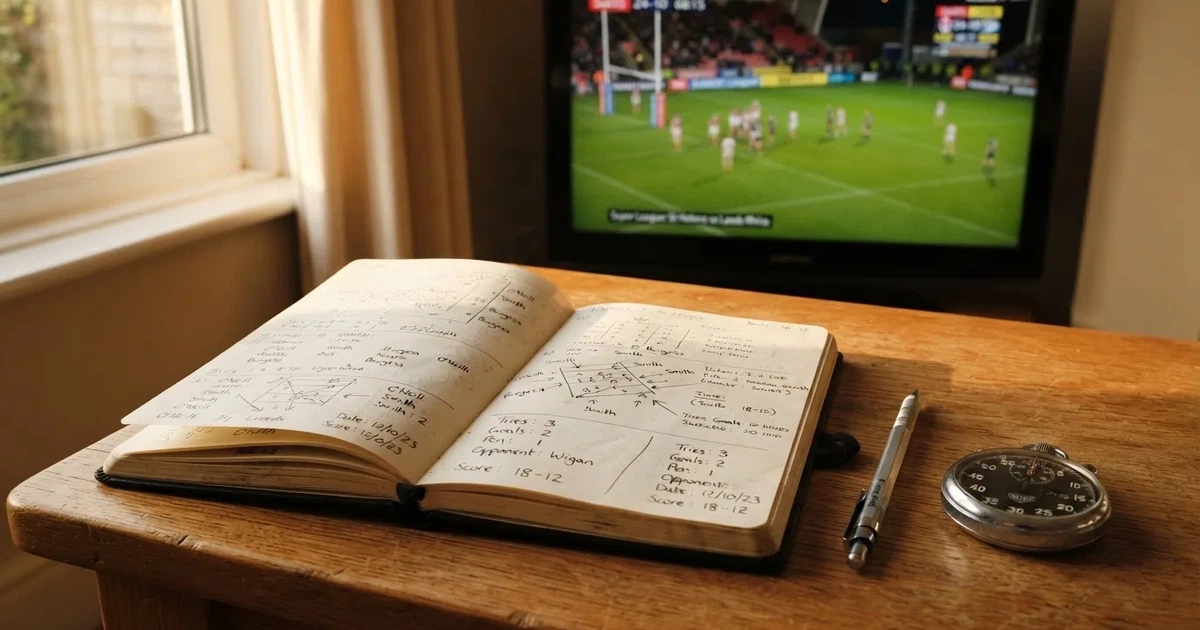
A “tip” in rugby league betting is a forecasting exercise built from a handful of inputs. Form over the last four to six matches carries the most weight, especially home and away. Head-to-head history is loud but cheap to misuse — NRL sides change year on year, and a 2019 result tells a reader little about a current starting line-up. Team news is decisive: a side missing its hooker and first-choice half-back is a different side from the one that won three in a row. Weather and venue matter more in rugby league than in almost any other football code. A wet, heavy pitch narrows the game, cuts the value of broken-field tries and lifts the importance of goal-kicking, which lifts the importance of penalty goals and so changes how a +6.5 handicap line is priced. None of those inputs is a tip in itself. The tip is what the punter concludes from them, weighed against the bookmaker’s own price.
Statistics deepen the inputs but rarely replace them. Completed tackle percentage, post-contact metres, error count and effective offload rate have all crossed from coaching analysis into the punter’s vocabulary; Sky Sports’ coverage and the BBC’s weekly recap make most of them accessible without a paid subscription. The risk is treating the spreadsheet as the answer. A side with the better completion rate can still be the worse price if the line has caught up to the same picture the bettor is reading. What statistics do is force the punter to ask a sharper question of the price: not “who wins?” but “is this 1.62 honest?”
The bookmaker’s odds are the other half of the equation, and they encode something the tip does not: the rest of the market’s view of the same match. Sharps and exchanges move early; the price a punter sees at 9am on Saturday is rarely the price they see at kick-off. A move from 1.80 to 1.60 in the home win is a piece of information. It says someone with money and information expected the favourite to shorten, and did. The job of the tip is to either follow that move (because the tip agrees with the new view) or disagree with it cleanly (because the tip has a reason the market has not priced). “Agreeing without a reason” is the most common way a tip loses.
> A tip is a reasoned disagreement with the bookmaker’s price, expressed in a stake.
The shape of a solid rugby league tip is short. Team news considered, venue read, the price checked against the prices the same firms quote on similar matches in the same round. If the analysis cannot explain why the price is wrong, the tip is a hope and the stake should be the smallest one the bookmaker allows. Nothing about that recipe wins more than it loses — it just keeps the losses from doing damage a small punter cannot afford.
What a value bet actually is
A value bet is a bet whose odds are higher than the true probability of the outcome, once the bookmaker’s margin has been removed. A coin tossed at 2.10 each side is not value, because the true probability is 50% and 2.10 prices it as 47.6%. A coin tossed at 2.20 each side is barely value, because the margin sits inside the price. The price has to overpay the true chance enough to beat the margin and still leave something on top. That something on top is what makes the bet worth taking.

Two terms matter. *True probability* is the chance the event happens, which nobody knows exactly. *Implied probability* is what the odds say once the overround is stripped out. The overround is the slice the bookmaker keeps on every market; it is the difference between the implied probabilities of all outcomes added together and 100%. A two-way market priced at 1.90 / 1.90 implies 52.6% + 52.6% = 105.3%; the 5.3% above 100% is the overround, also called the margin or vig. A value bet is one where the punter’s estimate of true probability is higher than the implied probability by enough to clear that margin on every bet taken together, not on one bet.
The reason a value bet is rare in practice is that the market is efficient on liquid matches. Super League Saturday afternoon matches and NRL Friday and Saturday fixtures are priced by enough sharp money that finding an edge is hard. Cup ties, early-season NRL trials and rescheduled matches are softer because the bookmaker’s models have less data to work with. That is also where rumours travel further than the form book, and why value hunting there requires more discipline, not less.
Why no tip is ever certain
A rugby league match is a stochastic event. Each carry is partly luck — a slip, a knock-on, a referee decision, a ball that bounces off a post — and even a very strong favourite loses more often than the punter who follows them wants to admit. The bookmaker’s price already prices that uncertainty in. A 1.20 home favourite wins about 80% of the time and loses 20% — a fifth of the bets laid at that price will be a losing single. Multiplied across a season, even the sharpest tipster runs at a loss roughly one weekend in five.
The discipline that protects a bankroll from that 20% is staking. Flat staking — the same unit on every selection — survives long losing runs because no single loss is a catastrophe. Proportional staking — a percentage of the current bank — survives bad runs mathematically but requires the punter to record the bankroll accurately, which most do not. The discipline that does not survive is the one that grows the stake after a loss to “win it back”. That one is called a chase; it is the same pattern of behaviour every bookmaker’s safer-gambling tools are designed to interrupt.
Bet types and odds: how the rugby league market is shaped
The bookmaker’s rugby league menu is built from a small number of market families. Each family prices a different question, settles on a different definition of “the result”, and carries a different margin. A punter who knows the family before they place the bet avoids the kind of error that turns a winning team into a losing bet.
Match result (home / draw / away). The base market. Two-way in Super League and NRL at most operators (no draw after 80 minutes, with extra time used to decide the result where the rules require it). Three-way in competitions that allow a draw. Settles on the official result: in one GB bookmaker’s rules, Super League and NRL Match Betting settles on 80 minutes’ play, while most other rugby league markets settle on the official result including extra time. The wording matters; the same fixture has a different priced match under each rule.
Handicap. A line is set to even out the chances of either side, expressed in points plus or minus the favourite. A -6.5 handicap on a Super League favourite pays out only if the favourite wins by seven or more. Whole-number lines have a fourth state where the handicap is hit exactly; in that case, all wagers on that line are refunded under standard GB bookmaker rules. Handicaps are where sharp money sits and where the sharpest margins sit, because the price has to balance true probability against line value at the same time.
Total points (over / under). A line on the combined score, set by the bookmaker, settled on the official total. Total points markets can be settled including or excluding extra time depending on the operator and the competition. Rugby league totals are famously volatile — a single late try can flip an under — so the margin here tends to be wider than for match result.
Try scorers and first try. A bet on a named player to score at any point, or to score first. The first-try market carries an enormous margin because the result is essentially random within the first ten minutes; the any-time market is sharper. A punter chasing a first-try longshot on a star winger is paying for the romance more than the value.
Race to 10 / 20 points. A market on which side reaches the named total first. Liquidity is lower than for match result; the margin is correspondingly wider. Useful for in-play trading rather than as the entry point for a new punter.
Half-time / full-time. The result at half-time combined with the result at full-time, giving nine combinations in a code that allows a draw. Margin is wide; value, when it appears, is wide too.
Combination bets (accas / parlays). A single bet combining two or more selections, each of which must win. The odds multiply: a £10 treble at 2.00 / 2.00 / 2.00 returns £80 (profit £70). The margin compounds across the legs, which is why an accumulator of short-odds favourites is a worse bet than two singles at the same price. Acca insurance — a stake refunded as a free bet when one leg loses — does not change the underlying odds; it changes what happens when the bet loses.
Bet Builder / same-game multi. A combination bet built from selections on the same match. Available on most major rugby league fixtures. The legs do not correlate as a punter expects: a try scorer for Team A and Team A -6.5 are not independent, and the bookmaker’s pricing reflects the dependence. Bet Builders are popular because they let a punter build “the match they want to watch”; they are not, structurally, better value than singles and they usually carry a wider margin.
Settling rules every punter should know
The bookmaker’s settling rules are the contract a punter signs by placing the bet. Three points come up repeatedly in rugby league and matter whenever the result is not the cleanest read.
- 80 minutes versus official result. Super League and NRL match betting markets typically settle on 80 minutes’ play; most other rugby league markets settle on the official result including extra time. A punter who reads the headline market without reading its definition is the punter who complains when the rules are applied.
- Postponed matches. Bets on a postponed match stand for 48 hours from the original kick-off and then become void. A fixture moved from Saturday afternoon to Sunday afternoon within that window still stands; a fixture moved to midweek voids.
- Abandoned matches. A match abandoned mid-play is treated differently by different bookmakers. Some settle if the result is determined by the rules of the competition (for example a league table adjustment after 60 minutes); others void regardless. The punter’s protection is to check before staking.
The wider point is straightforward. Each market is a small contract with its own terms, and the price already accounts for how punters typically violate those terms. Reading the rules once, in advance, costs nothing; reading them after a dispute has begun costs the stake.
Rugby league in 2026: competitions, fixtures and where the action sits
Rugby league divides into two professional hemispheres and a network of international competitions. The shape of the season — when Super League and NRL run, when the international calendar opens up — is the calendar against which a punter plans a year’s betting.
Super League. The main European club competition, running from February to the Grand Final in October. Twelve teams in 2026, with promotion and relegation to and from the Championship. Coverage on Sky Sports in the UK; live streams on each of the major bookmakers’ sites and apps. The bulk of the GB punter’s rugby league action sits here, and the largest menu of markets sits with it.
NRL. The Australian and New Zealand club competition, running from March to the Grand Final in early October. Sixteen teams. Live coverage on Sky Sports; bookmakers price every round, with the strongest markets on Thursday and Friday night fixtures that suit the UK time zone. The NRL is technically sharper than Super League because the talent pool is concentrated and the form cycles are easier to read.
The Championships and League One. Below Super League in the British pyramid, with promotion on offer. Markets exist but the menu is thinner; bookmakers that do not run their own model rely on data feeds and the prices are less efficient. Value can sit in these fixtures precisely because the prices have caught up less quickly.
Challenge Cup. The knockout cup, running from January to the final at Wembley in August. Open to Super League, Championship and community side entrants. Markets exist on each round from the fourth round onward.
International Rugby League. Governed by the International Rugby League (IRL) body. The Rugby League World Cup, the Ashes series between England and Australia, and the Pacific Championships sit on this calendar. Markets appear closer to the match than for club competitions and disappear quickly afterwards.
State of Origin. The annual three-match series between Queensland and New South Wales. Run mid-season in Australia. Markets are deep on sportsbook and exchange platforms; UK coverage is via late-night live streams and extensive pre-match coverage the morning after. A niche market that punts well outside it.
The punter’s calendar is straightforward. Super League and NRL between February and October. The Ashes and World Cup in the international windows. Mid-November to mid-February is the close season and the market thins to nothing outside the southern hemisphere.
How the ten bookmakers compare for rugby league in 2026
This section covers ten Gambling-Commission-licensed operators whose bookmaker offering includes Super League, the NRL or both. The list is not a recommendation and not a ranking; it is a comparison of what each operator publishes about its own platform and what its licence record shows. A punter choosing among them needs to know what each does better and what each charges for it, then decide which trade matters most for the kind of rugby league betting they actually do.
| Brand | Gambling Commission licence and holder | What the operator’s own terms state on rugby league |
|---|---|---|
| William Hill | Commission account 39225, held by WHG (International) Limited | Horse racing-focused Best Odds Guaranteed from 8am on race day across UK and Irish racing, on both single and multiple bets; ante-post, tote and pari-mutuel bets excluded; major rugby league menu with settle-on-80-minutes markets on Super League and NRL match betting |
| Geoff Banks | Commission account 54095, held by GB Sports Advisors Limited | In-app and online bookmaker with live in-play prices on the major matches and ante-post prices on future events; thinner pre-match menu outside the headline rounds |
| Midnite | Commission account 101839, held by Midnite Limited | In-play markets shown site-wide on rugby league fixtures, acca builder, popular accas and price boosts with maximum-stake limits displayed per market; free-bet-and-spins welcome package tied to qualifying bet at minimum price |
| Betfred | Commission account 39544, held by Petfre (Gibraltar) Limited | Bet Builder, Sub Switch (substitution-related markets), live streaming on selected sports, Extra Places on named horse races; comprehensive rugby league menu across Super League and NRL |
| Hollywoodbets | Commission account 53028, held by Hollywoodbets International UK Limited | Free-bet welcome tied to a first losing accumulator subject to minimum stake, minimum leg count and minimum combined odds; one welcome free bet per customer |
| BetVictor | Commission account 39576, held by BV Gaming Limited | Best Odds Guaranteed on UK and Irish horse racing, enhanced live race streaming, BetFinder tool for racing, Smart Stats for fixture-level analysis; rugby league markets sit on the main menu |
| Bet Ahoy | Commission account 100094, held by Bet Ahoy Ltd | Acca Bonus of up to 10% on winning accumulators to a stated cap; Sub-Cover covering named-player substitutions; Best Odds Guaranteed on UK and Irish horse and greyhound racing to £100; Double Result payout on UK and Irish racing |
| Betfair | Commission account 39439, held by PPB Counterparty Services Limited | Sportsbook with in-play, Bet Builder, free in-app live streaming on UK and Irish racing and football, a 90-minute payout market on selected sports; exchange platform under separate betting-intermediary licence |
| Bar One Racing | Commission account 56516, held by Bar-One Racing Limited | Irish independent bookmaker with shops across Ireland and horse racing sponsorships; sportsbook covers rugby league with a smaller menu than the larger firms |
| Betway | Commission account 39372, held by Betway Limited | Free-bet welcome tokens credited on settlement of a first qualifying bet above a minimum stake and minimum price, with a stated expiry and a debit-card deposit condition; sportsbook covers the major rugby league competitions |
Two cross-cutting notes apply to the table. First, each operator holds a separate licence under section 33 of the Gambling Act 2005, every licence is searchable by business name, trading name, domain or account number on the Commission’s public register, and each operator’s licence status was confirmed against that register for this comparison. Second, the welcome terms in the table are quoted from each operator’s own published conditions; they describe only the operator’s own statement and are not an endorsement. Where a welcome package is refund-style (“stake returned as a free bet”), the stake itself is not recoverable — the punter pays for the bet to lose in order to receive the credit.
William Hill — depth and an unmatched horse-racing spine
William Hill is the longest-running name on the list and operates under the WHG (International) Limited licence. Its rugby league menu is among the deepest in the British market, with full Super League and NRL coverage including match betting, handicaps, total points, half-time markets and a wide set of player props. The combination of long-running brand and serious market depth is what most established GB punters reach for first. The firm’s standalone defining feature is Best Odds Guaranteed on UK and Irish horse racing from 8am on race day for both single and multiple bets, excluding ante-post, tote and pari-mutuel pools; the rugby league side of the platform does not lean on that feature, but the broader point stands — William Hill is a generalist bookmaker built around strong coverage of both codes and racing, with the GB licence to match. For the punter who wants one account that handles rugby league Saturday, NRL Friday night and racing Saturday afternoon in equal measure, William Hill is the obvious fit. For the punter who wants a platform engineered entirely around price boosts and Bet Builders, the next brand on the list reads sharper.
Geoff Banks — independent and bettor-led
Geoff Banks operates under GB Sports Advisors Limited and runs a smaller platform in scale but with the appetite of an independent bookie. Ante-post prices on future rugby league events sit on the app from the moment the draw is made, and the live in-play menu covers the headline Super League and NRL fixtures. The platform is best for the punter who likes to lock in outright views early and watch the price move, rather than the punter who turns up on Saturday morning and wants every market the bigger firms price. The trade-off is depth: Geoff Banks does not run the same menu size as William Hill or Betfred, and the punter who needs a half-time / full-time combo or a niche player prop should look at the bookmaker above or below before staking.
Midnite — built for the modern bet builder
Midnite is the youngest operator on this list and the one most visibly engineered around the bettor’s Saturday afternoon. Rugby league fixtures carry in-play markets site-wide, acca builder tools for combining selections on the same match, price boosts advertised alongside the major events and stated maximum-stake limits for the boost markets. The welcome package is a £25 free-bet-and-free-spins bundle credited after a qualifying bet at minimum odds of 2.0 or greater, with a 14-day qualifying window and a 7-day validity on the credit. The shape of the offer reflects the platform’s shape: it expects the punter to place a small qualifying bet on a short-odds favourite and then build accas on the Saturday card. Where Midnite loses to the older firms is in horse racing BOG and in racing-specific tools; where it wins is in the modern acca-first menu the younger betting cohort prefers. For the punter whose Saturday is built around Bet Builders and price boosts, Midnite is the most direct fit on this list.
Betfred — feature-rich generalist with strong GB roots
Betfred operates under Petfre (Gibraltar) Limited and ships one of the more feature-heavy apps in the GB market. Bet Builder, Sub Switch (the firm’s tool for substitution-affected markets), Racing Post data integrated into the racing tab, Extra Places on named races, live casino and bingo sit on the same platform. The rugby league menu is comprehensive across Super League and NRL. For the punter who wants one account that handles racing, sports and casino under a GB licence, Betfred is the obvious fit; for the punter who wants pure rugby league specialism, the trade-off is the breadth of the platform — many features a rugby league punter will never use. A mid-sized punter who dabbles across sports is the best fit.
Hollywoodbets — the accumulator-first welcome
Hollywoodbets operates under Hollywoodbets International UK Limited and runs a sports welcome offer aimed at the accumulator punter. New players who deposit £10 or more by card get their stake back as a free bet of up to £30 on their first qualifying losing accumulator, with a minimum stake of £10, three or more legs and minimum combined odds of 4/1 (5.0), settled within seven days; one free bet per customer. The structure is the platform — accumulate first, qualify second, take the free bet only on a loss. It suits the punter whose weekend betting is one carefully constructed acca; it does not suit the punter who places a dozen singles across the day. The licence is in good standing and the menu covers the standard rugby league slate.
BetVictor — analysis-led for the fixture-by-fixture punter
BetVictor operates under BV Gaming Limited and ships one of the more analysis-friendly apps in the market. Best Odds Guaranteed on UK and Irish horse racing, enhanced live race streaming, BetFinder for finding racing bets and Smart Stats for fixture-level form data together put BetVictor in the “data-rich generalist” category. The rugby league menu sits on the main sportsbook tab with the standard market set; the platform’s edge is the analysis surface around it. For the punter who reads form before staking and wants a bookmaker that ships the data alongside the market, BetVictor is a strong fit. For the punter whose betting is acca-first and price-boost-led, the platform reads heavier than the modern alternative.
Bet Ahoy — longshot-friendly with the racing features to match
Bet Ahoy operates under Bet Ahoy Ltd and positions itself around a wider set of small-feature wins. A 10% Acca Bonus up to £1,000 adds to winning accumulators, Sub-Cover covers named-player substitutions, Best Odds Guaranteed applies to UK and Irish horse and greyhound racing up to £100, and a Double Result payout runs on UK and Irish racing. The acca bonus is the headline differentiator and runs to a higher cap than most competitors’ acca insurance offers; the £100 BOG cap is correspondingly tighter than BetVictor’s or William Hill’s. The platform’s football product is the busiest, but the rugby league menu is functional. For the punter who runs a winning acca most weeks and wants the extra 10% on top, Bet Ahoy is the natural fit. For the punter who plays single bets and punts once a week, the bonus structure is mostly wasted.
Betfair — the sportsbook-and-exchange combination
Betfair operates under PPB Counterparty Services Limited and ships both the sportsbook and the betting exchange. The sportsbook side offers in-play, Bet Builder, free in-app live streaming on UK and Irish horse racing and football, and a 90-minute payout market on selected sports. The exchange runs under a separate betting-intermediary licence, where punters can back and lay against each other and the margin is structurally lower. The rugby league menu on the sportsbook is competitive on the headline fixtures; on the exchange it goes deeper than most competitors because other punters populate the markets. For the punter who uses an exchange anyway, the value of having the sportsbook under one roof is real. For the punter who prefers a single simple platform, the dual structure reads as complexity they do not need.
Bar One Racing — independent Irish bookmaker
Bar One Racing has rebranded to BAR 1 Betting and operates under Bar-One Racing Limited as an Irish independent bookmaker with shops across Ireland and horse racing sponsorships at Dundalk, Fairyhouse, Navan, The Curragh, Curraheen Park and Cork. The online platform is functional and offers a sportsbook with a standard rugby league menu. The brand’s edge is local Irish knowledge and a racing-led platform; the trade-off is a thinner rugby league product than the British-based larger firms, particularly on player props and niche lines. For the punter who wants an Irish account with a GB licence, BAR 1 is the fit. For the punter whose rugby league action is the main event of the weekend, the menu will feel small.
Betway — the straightforward welcome
Betway operates under Betway Limited and runs a sports welcome offer aimed at the single-bet punter. £40 in free bet tokens across four £10 credits, credited on settlement of a first bet of at least £10 at minimum odds of 2.0, with a seven-day expiry and a debit-card deposit condition. The shape of the welcome package reflects the platform’s shape: one qualifying bet, four credits to deploy, modest expiry. The sportsbook covers the major rugby league competitions; the app is functional rather than feature-heavy. Betway is the right fit for the punter who wants a licensed UK bookmaker with a clean welcome and a standard menu; it is not the right fit for the punter who wants a bet builder, acca bonus or BOG spine. The licence record is clean and the platform ships what it says.
How a margin works out: the arithmetic inside every price
The bookmaker’s margin is the slice of every market the operator keeps on average. It is the difference between what a perfectly efficient market would return and what the published odds do return. In rugby league the two-way markets — match betting, handicap, total points — are typically priced with a margin in the 5% to 8% range; the markets with more outcomes (first try scorer, half-time / full-time, exact score) carry a wider margin because the result is harder to call precisely.
The arithmetic for a two-way market at 1.90 / 1.90 is the cleanest worked example. Implied probability from decimal odds is 1 divided by the odds. For a market priced at 1.90 / 1.90, each side implies 1 ÷ 1.90 = 0.5263, or 52.63%. Adding the two sides gives 1.0526, or 105.26%. The slice above 100% is the overround and the bookmaker’s margin: roughly 5.26% on this example, give or take rounding. The payout share — what an efficient market at true probabilities would return on a winning bet — is the inverse of the overround, around 94.74% on this example. In a two-way market the symmetry makes the calculation read exactly; the same shape of margin sits inside every multi-outcome market, just hidden across the selections.
> Margin: roughly 5.3% in this example, meaning the bookmaker keeps about 5p of every £1 staked across all outcomes combined, returning the rest in winning payouts on average.
The condition that sits beside that figure is the first sentence of this page restated: it is the average across all outcomes and all bets at that price. A losing bet returns zero. A winning bet returns more than the stake, but only if the winning price matches the implied probability the punter bet at. A market priced at 1.90 / 1.90 over a long run returns about 95p for every £1 staked on the winning side, and the other 5p sits in the bookmaker’s margin. That figure does not move on a single bet; it only emerges across many bets.
The reason the margin matters is that it is what a tip has to beat. A punter who estimates a true probability of 55% on a side priced at 1.90 (implied 52.6%) is estimating a value edge of 2.4%. Before the bookmaker’s margin that edge would be enough; after the margin that edge barely clears. A value bet at 1.90 / 1.90 needs the punter’s true probability estimate to clear the margin and still leave a positive expectation. Most of the time, it does not.
A practical reading of the figure: a margin in the 5% band is competitive for a two-way rugby league market. A margin above 8% on a major fixture (Super League Saturday, NRL Friday night) is suspicious — the bookmaker is leaving room for promotional offers, price boosts and Bet Builder margins, or the market is priced loosely because the firm has a thinner trading team on it. A margin below 5% on a liquid match is a sharp line from a firm that wants sharp money on its books. None of that means the punter cannot win; the margin is what the punter has to beat on average, not on any one bet.
Legal frame for rugby league betting in Great Britain
The legal frame for rugby league betting in Great Britain is the same legal frame as every other form of sports betting under a GB-licensed operator. The Gambling Commission licenses the whole commercial market under the Gambling Act 2005, which covers England, Scotland and Wales. Northern Ireland is outside the Act and is governed by older legislation. A bookmaker whose remote facilities are used in Great Britain needs a Commission licence wherever it is based, since the Gambling (Licensing and Advertising) Act 2014; a Curaçao, Maltese or Gibraltar licence is not a substitute.
There is no statutory list of permitted bets or markets. An operator holds a licence for a category and offers markets under its own rules and the Licence Conditions and Codes of Practice (LCCP). In-play betting is allowed at licensed operators and is controlled by the operator’s licence conditions and customer-protection duties. Esports are treated like any other event; virtual events sit on a separate licence category. Bets on politics, TV shows and novelty markets are offered by GB bookmakers with no statutory prohibition found.
Minimum age is 18. Name, address and date of birth are verified before a customer can deposit or gamble (since 7 May 2019), including with a free bet or bonus. There is no anonymous play at a licensed site. Credit cards are banned for gambling in Great Britain since 14 April 2020 (LCCP condition 6.1.2), including credit-card-funded payments through an e-wallet; debit cards and bank-based payments are not covered. The player pays no tax on betting winnings in Great Britain; General Betting Duty is the operator’s tax on gross profits, currently 15%, with a new remote rate of 25% inside it applying from 1 April 2027, while remote bets on UK horse racing, bets on self-service betting terminals, pool betting and in-person betting stay at 15%.
A GB licence is compulsory at the point of consumption. Providing gambling facilities in Great Britain without the licence the Act requires is an offence under section 33 of the Gambling Act 2005. The offence is aimed at the operator, not the customer; a punter who uses an unlicensed site is not prosecuted but loses the protections a GB licence brings. No GAMSTOP coverage, no Commission complaints route, no approved dispute-resolution body, no British consumer redress if funds are withheld. The honest framing: licensed = checks, limits, GAMSTOP, the bonus cap, but verification before the first bet; unlicensed = none of those protections and possible loss of funds.
Player protection in GB: limits, checks and the help that is there
The Gambling Commission’s player-protection regime rests on three pillars: self-exclusion, deposit limits and financial checks. Each of them has a public register, a regulated procedure and a separate route to help.
GAMSTOP
GAMSTOP is the national multi-operator online self-exclusion scheme and a mandatory licence condition for online operators since 31 March 2020. Exclusion periods are six months, one year, five years, or five years with auto-renewal. After the minimum period the exclusion stays in place for a further seven years unless the customer asks GAMSTOP to remove it. GAMSTOP covers online sites and apps; betting shops use a separate service. Every operator on the comparison list in this guide is a GAMSTOP member.
Deposit limits
Operators must offer a gross deposit limit on a fixed time frame under RTS 12. The first changes to those defaults applied since 31 October 2025; a second phase was postponed to 30 September 2026, and whether it is live was not established at the time of writing. There is no state-set deposit or loss ceiling for betting; limits are the customer’s own choice.
Financial checks
A financial vulnerability check (LCCP condition 3.4.4, in force since 30 August 2024) applies to licensed remote betting when a customer’s deposits minus withdrawals exceed £150 in a rolling 30 days (since 28 February 2025). It is a public-record check — bankruptcy, county court judgments — not an income check and not a credit reference check. Financial risk assessments (the affordability checks of the press) are announced in a staged plan (Commission article of 7 July 2026), with no start date at this stage.
Help that is reachable
GamCare runs the National Gambling Helpline. GambleAware funds treatment and prevention. NHS gambling clinics run across the regions. Gamblers Anonymous runs meetings in person and online. Each of these is free, confidential and reachable from the safer-gambling pages of every licensed operator and from the Commission’s own website.
The point is not that the punter will need any of these; most never do. The point is that they are present, regulated and reachable when they are needed — and they are a structural feature of a GB-licensed account that no offshore account provides.
Bonuses and free bets in rugby league: what an offer actually costs
A bonus in GB sports betting is a marketing device tied to a stake the punter was going to place anyway. The “free” in “free bet” is the bookmaker’s word, and it is generally true only in the narrow sense that the punter does not write a separate cheque for the bet. The cost sits elsewhere — in the minimum price of the qualifying bet, in the wagering requirement on bonus money, in the expiry, in the cap on free-bet winnings, in the markets the bonus can be spent on.
Welcome offers on this list
The welcome offers above the comparison table describe what each operator publishes. The generic shape across the list is a free-bet bundle — four £10 tokens at Betway, £25 free bets and 50 free spins at Midnite, a stake-returned-as-free-bet welcome at Hollywoodbets. None of the welcome packages above is paid as cash. In every case the stake itself is not recoverable on a free bet; a winning free bet returns the winnings only, not the credit.
The GB welcome market has tightened in 2026. Wagering requirements on bonuses are capped at 10x (a £10 bonus at 50x needed £500 of bets under the old rules; under the cap no more than £100 is required), and mixed-product promotions — an offer that requires gambling on two or more product types such as betting and casino — are banned. Whether the cap applies to free bets with no wagering condition, and whether there is any cap on the money value of a bonus, remain unclear.
What a stake-returned-as-free-bet offer really costs
The Hollywoodbets welcome is the cleanest illustration on this list: a deposit of £10 or more by card, a first losing accumulator of three or more legs at minimum combined odds of 4/1 (5.0), returns the stake as a free bet of up to £30. The punter pays for the bet first, in the stake they are risking; if the accumulator wins, the punter wins in the normal way and no free bet is paid out; if the accumulator loses, the stake is returned as a free bet rather than as cash.
The economics are not what they look like at first glance. The acca has to be a losing acca for the offer to pay — the punter is, in a precise sense, paying for a losing outcome to receive a credit. The free bet is not cash; it can only be spent as a free bet, it is one per customer, and it expires in seven days. It is a marketing instrument rather than a transfer of value. For a punter whose weekend betting is already accumulators, the offer is a small insurance policy on a losing outcome; for a punter whose weekend betting is singles, the offer is wasted on them.
Wagering requirements when they apply
Where a bonus carries wagering — a credit that has to be turned over a stated number of times at a stated minimum price before withdrawals are allowed — the maths works out as follows. Required turnover = bonus amount × wagering factor; bets needed = turnover ÷ average stake; expected cost = required turnover × margin of the market chosen. The costs compound quickly when the wagering factor is high or the minimum price is short. The £10-at-50x example above required £500 of bets; under the 10x cap, no more than £100 is required. The intended behavioural effect is the same: the punter wagers more than they otherwise would. The cap limits how much more.
> The headline figure on a bonus is the marketing; the numbers inside it are the contract. A punter who does not read the contract pays the marketing.
Accumulator insurance and acca bonuses
Two features appear in the comparison above and on the menu of most major bookmakers. Acca insurance refunds the stake as a free bet when one leg of a multi-leg accumulator loses — typically one free bet per customer, capped at a stated maximum, with a stated minimum number of legs and a stated minimum combined odds. The acca bonus applies to winning accumulators — typically a percentage added on top of winnings, to a stated cap, with the same structural conditions. Both shift what happens at the edges (one leg down, final score up) without changing the underlying odds; both are best read as small cushions on the kind of betting the punter is already doing. A punter who runs no accas takes no value from either.
The features are described qualitatively from each operator’s published offering.
A rule on the rest
Wherever an offer was researched in detail — the £40 token welcome at Betway, the £25 free-bet-and-spins bundle at Midnite, the Hollywoodbets acca welcome, the Bet Ahoy 10% acca bonus to £1,000 — the headline figure is at best the upper bound of what the punter can extract, and only on the condition that every one of the offer’s constraints is satisfied. The wider rule is honest: most welcome packages are designed to look like cash transfers and to actually be marketing incentives with a real value below their headline number. The free bet is the cleanest case. An honest reader of the terms knows that, and bets accordingly.
Live betting and cash out: when the price moves with the match
In-play betting is the family of markets priced after a rugby league match has kicked off. GB bookmakers offer it; the controls are the operator’s licence conditions and customer-protection duties. The experience has three parts: the markets, the cash-out mechanism, and the limits around them.
In-play markets and how they behave
The in-play menu narrows as the match goes on. The full pre-match menu opens at kick-off (match result, handicap, total points, first try scorer, half-time / full-time); the menu contracts within minutes as the first points are scored and some markets settle. The last twenty minutes of a close match typically offer match result, next try scorer and a narrow band of handicap and total lines, priced constantly by the bookmaker’s trading team.
In-play pricing in rugby league is fast and somewhat rough-edged. The bookmaker’s margin sits inside the in-play prices, sometimes wider than in pre-match because the cost of updating the line is higher. A side that scores three tries in the first ten minutes and leads 16-0 will be priced at match odds of 1.05 or shorter; the punter who backs the trailing side at 12.0 or longer is paying for a longshot that rarely lands. A punter who treats in-play as a place to lay the favourite when the favourite scores early is the punter reading the worst line on the menu.
Cash out
The cash-out feature lets the bookmaker buy a bet back from the punter at a price the bookmaker calculates mid-match. The price is always worse than the equivalent position at a betting exchange, because the bookmaker is taking a margin both sides of the book. For a punter who wants to lock in a profit when the favourite takes an early lead, cash out does that — at a price the punter does not set and that includes a fee they did not negotiate.
The honest framing is that cash out is a convenience product rather than a value product. It is useful when the punter cannot or does not want to manage their own exit (for example during a parallel live event on the same screen), and it is a loss-making transaction relative to managing the bet directly. A punter who uses it sparingly uses it well; a punter who uses it on every position bleeds the margin out of every bet.
Live streaming and the licensed-route advantage
Free live streaming on UK and Irish horse racing and football is offered in-app by several operators above, including Betfair and BetVictor; a smaller set streams rugby league fixtures depending on the rights each firm has paid for. The licensed-route advantage is the GB-licence-mandated KYC and the safer-gambling infrastructure the punter can reach inside the same app; both of these sit unobtrusively in the background of a normal betting session and are a structural feature of a GB account.
A specific staking mechanic for in-play rugby league was not researched. A punter new to in-play is best served by treating the first half-dozen bets as observational: back the market once at a small stake, see how the price and the cash-out behave, and only then consider building a strategy around the in-play menu.
Frequently asked questions about rugby league betting
Is one bookmaker the best for rugby league World Cup betting in the UK?
No single GB-licensed bookmaker is the only one with a rugby league World Cup market. The major firms — William Hill, Betfred, BetVictor and Betfair — all price World Cup fixtures with match result, handicap, total points and outright markets. Betfair’s exchange goes deeper on World Cup outrights because other punters populate the market. The right bookmaker for World Cup betting is the one whose welcome package and platform features suit the punter’s normal betting, not the one with the loudest World Cup marketing — markets converge across the licensed firms in 2026.
How does a punter place a bet on rugby league?
Step one is opening an account with a Gambling-Commission-licensed bookmaker and completing the standard KYC verification — name, address and date of birth, with photo ID and proof of address in the GB regulatory frame. Step two is funding the account by a permitted payment method (debit card, bank transfer or an accepted e-wallet; credit cards are banned). Step three is choosing a fixture and a market — match result, handicap, total points, first try scorer, or a combination bet. Step four is setting the stake; step five is confirming the bet and keeping the bookmaker’s confirmation. The entire flow takes a couple of minutes for a returning punter and somewhat longer for a new punter on the first deposit.
What is a value bet and why can no tip guarantee a win?
A value bet is one whose decimal odds are higher than the true probability of the outcome, after the bookmaker’s margin has been taken out. The bookmaker’s odds imply a probability — 1.90 implies 52.6% — and the punter’s estimate of true probability has to beat that implied number for the bet to be value. No tip guarantees a win because each outcome is partly chance. A 1.20 favourite wins roughly 80% of the time and loses 20%; a value bet at 1.20 has to clear the margin and leave a positive expectation, which on average it does — over many bets, not every bet.
What is the bookmaker’s margin and how is it visible in the odds?
The bookmaker’s margin is the slice of every market the operator keeps on average. It is visible by turning odds into implied probabilities and adding them up. A two-way market priced at 1.90 / 1.90 implies 52.6% + 52.6% = 105.3%; the 5.3% above 100% is the overround and the margin. In the worked example this page discusses the margin sits around 5.3%, with about 94.7% returned on average as payouts to winning bets over the long run. Margin below 5% is competitive on a major rugby league fixture; margin above 8% is loose.
How is the return on a bet worked out from the stake and the odds?
Return on a single bet = stake multiplied by the decimal odds. On a £10 bet at 3.50 the return is £35 (net profit £25, because the stake is returned alongside the winnings). Net profit on a single bet = stake multiplied by (odds minus one); on the same bet that is £10 multiplied by 2.50 = £25. On a combination bet the odds of each leg multiply into one price — three legs at 2.00 / 2.00 / 2.00 give a combined price of 8.00, and a £10 treble returns £80 (net profit £70). Each leg has to win; one losing leg voids the whole combination.
How does a punter check a bookmaker’s Gambling Commission licence?
Every GB-licensed bookmaker appears on the Commission’s public register, searchable by business name, trading name, domain or account number. The register is the test of whether a brand holds the licence the Act requires. A punter enters the brand or domain name, confirms the account number against the figure the operator publishes, and only then places a bet. Any brand whose name does not appear on the register is operating outside the GB licensing regime and forfeits the protections a GB licence brings — no GAMSTOP coverage, no Commission complaints route, no British dispute-resolution body — though placing a bet with such a brand is not an offence for the customer.
Rugby, cricket & Gaelic – systembetsguide.com
Content created by the «systembetsguide.com» team
