
Where to bet on futsal online in Great Britain this year
 Available in US
Futsal lives at the seam between football and indoor sport, and the betting market around it sits in a peculiar place: fans who want it know the sport inside out, while many casual bettors still treat it as a smaller cousin of football with the same coupon. Both views miss what is on the operator’s site. Futsal has its own rulebook, its own clock and its own set of standard markets, and the licensed bookmakers who carry it in Great Britain tend to fit it into the football tab rather than give it its own column. The result is that the same brand can look like a serious futsal outlet one week and a thin one the next, depending on which tournament is on.

This page works through what is actually on offer: how to read a futsal price, which markets tend to settle cleanly, which live-betting tools survive the dead-ball clock, and where the bigger British bookmakers stand on the welcome offer. The ten operators reviewed here all hold a Gambling Commission remote licence for real-event betting, so the comparison is about what each one does on top of the licence rather than whether it has one. The angle is choice — ten paths into the same market, each built for a different kind of punter.
Current as of 30 October 2026 and checked against the Gambling Commission’s public register.
Futsal betting predictions and how to read them
Punters who arrive at futsal from a football background tend to over-import two habits. The first is treating the league table like a football table, when futsal score lines skew heavily because a five-on-five game on a 40 m by 20 m court produces far more goals per minute than eleven-a-side football does. The second is reading team form as if it carried between seasons, when the player churn in the smaller leagues is dramatic and a side that dominated one year can be functionally a new side the next. Both habits push a bettor toward “tips” — a daily preview column, a tipster’s WhatsApp group, a YouTube short — and that is where the first analytical mistake tends to sit.

A futsal tip, in the sense a tipster sells one, is a forecast on a match outcome. Forecasts have a hit rate and a price, and the price is what they are worth. A tipster who claims a 70% strike rate at average odds of even money is publishing an underround: at those prices a 70% strike rate returns 70p per pound staked and leaves 30p to the bookmaker. No model has been publicly audited to that level on futsal specifically, and a bettor who treats any tip as a system is funding the tipster rather than the punting. The honest framing is that a tip is a starting hypothesis for a bet you check yourself, not a position to take unverified.
What can be done properly is research layered onto the betting slip. The fundamentals worth knowing:
- Squad rotation in the bigger futsal leagues is heavy, and a side resting two regulars for a midweek game is a different side than the one that played at the weekend.
- Discipline records matter more than in football because the accumulated-foul rule (six fouls per period, direct free kick from the second penalty mark, no wall) turns a carelessly ill-disciplined side into a near-certain concession of a ten-metre penalty.
- Goalkeeper rotation — the “flying goalkeeper” ploy — is common at trailing sides, and most bookmakers adjust totals and match-result markets when that substitution lands, but only the ones that price in-play will let a bettor trade it.
- Head-to-head past meetings tell you less in futsal than in football because clubs change coaches more often than they change kit suppliers.
The boring truth behind most prediction services is that the edge, if there is one, comes from doing the homework others skip. Match previews on the league’s own site or federation page list injuries; live streams (where rights allow) let you watch a side press before you back it; a model’s expected-goals output on futsal is shallow, so the disciplinaries, the starting keeper and the home-court crowd are doing more of the analytical work than the statistics do.
For a bettor who treats futsal as a side bet rather than a specialist interest, the practical path is narrower than football: pick one league, learn three or four sides in depth, and only bet the matches where one of those sides plays. Specialisation beats breadth at this scale of market.
Futsal bet types and how the odds are built
The starting point of every futsal bet is the same starting point as every football bet: a market with two or three outcomes, a price on each, and a margin the bookmaker keeps on the round. Futsal markets come in a slightly smaller set than football — match result, double chance, total goals, both teams to score, handicaps, and a handful of player props where rosters are stable enough to settle them — but the mechanics are identical.
A three-way match result (home win, draw, away win) at decimal odds of 2.10 / 3.40 / 3.60 is a typical quote on a competitive futsal league fixture. To find the margin, divide 1 by each price and sum the results (1/2.10 + 1/3.40 + 1/3.60 = 0.476 + 0.294 + 0.278 = 1.048). The overround is about 4.8% (1.048 − 1), while the margin—the bookmaker’s share—is roughly 4.6% (1 − 1/1.048). A two-way market at even money (1.90 / 1.90 in decimal, 9/10 in fractions) sums to 1.053; here the overround is about 5.3%, and the margin is 5.0%. Both are normal for an unfancied sport where the bookmaker’s handicapping cost is higher than for a Premier League match.
Once the margin is known, the value question is sharp: a market with a 5% margin returns 95p on the pound over a long run, and any punter who finds a true edge above that 5% is in profit. Most recreational bettors do not, which is why the margin matters more than the form. The arithmetic of two clean numbers on a two-way market at 1.90 / 1.90 gives an overround of 5.3% and a margin of 5.0% (the payout share is 95.0%). The headline figure is the margin, not the overround; even the cleanest pair of quotes rounds slightly differently at different operators, and a 0.2-point spread across bookmakers is the difference between a market you can beat and a market you cannot.
Outside the basics, the same market family used in football applies:
- Match result (1X2): settled on regular time, which in futsal is the two 20-minute periods with the clock stopping at dead balls. Extra time only applies in knockout fixtures where the competition specifies it.
- Double chance: covers two of the three outcomes in one bet, at a shorter price than the longest of them outright.
- Totals (over/under goals): most operators offer a 4.5 line on competitive futsal, with 3.5 and 5.5 as alternates where the side’s profile skews high or low.
- Both teams to score: offered by most major books, settles on whether each side scores at least once in regulation.
- Asian and European handicaps: a level or half-goal line, with the half-goal version eliminating the draw.
- Player props: where rosters are stable enough, anytime-goalscorer and first-goalscorer markets appear; elsewhere, the bookmaker declines to price them.
Bet builders and same-game multis let a punter combine several selections from one fixture into a single wager at multiplied odds. LiveScore Bet’s Bet Builder permits up to 10 selections across match result, both teams to score, corners, total goals, player scoring and card markets. On a futsal fixture the practical selections are slimmer — card markets and corners get thin on a court with no corners as football knows them — so most bet builders reduce to match result plus totals plus BTTS, occasionally with a player prop on a known finisher.
The settled-margin thinking generalises. A bet builder is a series of legs each priced with its own margin, and the margins multiply into a larger total overround than any single leg. A four-leg builder at 5% per leg has a total margin well above 18% before the legs are correct. A punter who backs builders frequently pays a structural tax that single bets do not.
Futsal as a sport and what comes on the calendar
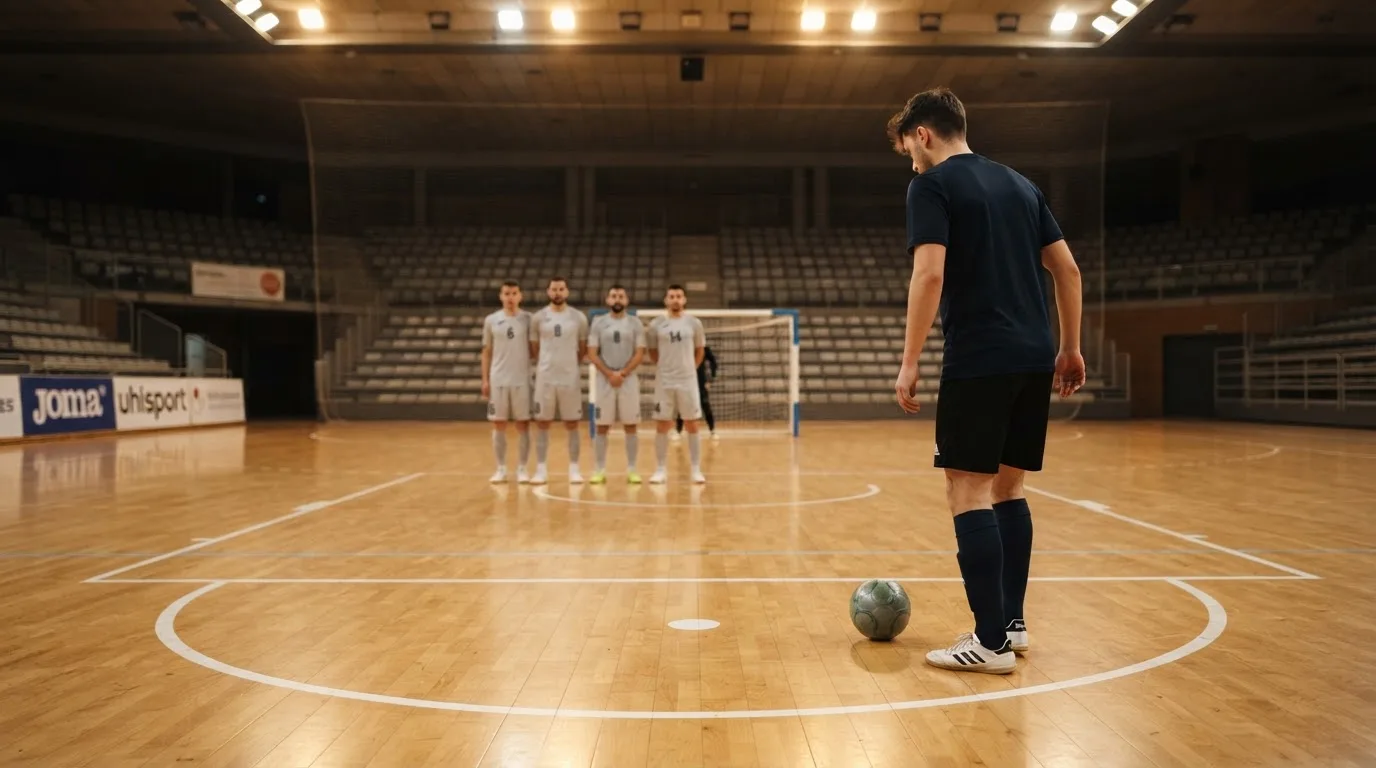
Futsal is, in the simplest reading, football played indoors with five players a side. The Wikipedia entry on the sport is the cleanest reference: two teams of five (one of them the goalkeeper), with up to nine substitutes and unlimited substitutions allowed. The court is 40 m by 20 m in international play, the ball is a size 4 (smaller and heavier than a football with a lower bounce), and matches are two 20-minute periods with a clock that stops at dead-ball situations. Each team has one one-minute timeout per period. The origins sit in 1930s Montevideo, where Juan Carlos Ceriani drew the format up for YMCA competitions; FIFA is now the highest governing body.
The rule that matters most to a bettor is the accumulated-foul rule. From the sixth foul committed in a period, the opposing team is awarded a direct free kick from the second penalty mark (10 m from goal) with no wall permitted. In practical terms, a side that reaches the foul threshold first gives away a near-certain scoring chance every subsequent foul, and the match swings fast. Most licensed bookmakers reflect this in totals pricing — disciplined sides allow fewer chances per game — but in-play traders tend to react more sharply to a fourth and fifth foul than the pre-match price accounted for.
The tournament calendar is denser than football’s:
- FIFA Futsal World Cup: first held in 1989; the 2025 FIFA Futsal Women’s World Cup was held in the Philippines, and the men’s edition runs on a four-year cycle.
- UEFA Futsal Champions League: the European club championship; bookmakers run outright, group-stage and individual-match markets during the finals phase.
- Continental championships: UEFA Futsal Euro, CONMEBOL Copa América de Futsal, AFC Futsal Asian Cup, plus regional qualifiers for the world stage.
- Domestic leagues: Spain’s Primera División de Futsal, Brazil’s Liga Futsal, the Russian and Portuguese top flights, and Japan’s F.League are the most heavily covered by European books. The English Futsal Premier League sits lower on the list, but a few bookmakers price selected matches.
- National-team windows: friendlies and qualifiers run throughout the year; market depth varies.
A practical note on how a bookmaker’s menu behaves: a brand that quotes the Spanish league and the UEFA Futsal Euro may go silent on the Iranian or Thai leagues entirely. That is a feature of the rights and data feeds, not a quality judgement on the sport. A punter who follows a smaller league ends up checking the operator’s site in the days before a fixture rather than assuming coverage.
The ten licensed bookmakers for futsal in Great Britain
The choice on this page is ten GB-licensed bookmakers that price real-event sports and have a working online product. The list is a comparison, not a ranking: licence standing is uniform across them (each is on the Gambling Commission’s public register for remote general betting on real events), so what sets one apart from another is the offer on top — the welcome structure, the in-play depth, the bet builder, the free-bet club.
| Brand | Gambling Commission licence (account) | Notes from the operator’s own terms |
|---|---|---|
| NetBet | Netbet Enterprises Limited (39170) | Daily Boosts, Profit Boosts and free bet offers; Bet Builder with instant dynamic odds; sports stats for major leagues |
| Kwiff | Eaton Gate Gaming Limited (44448) | Brand is a trademark operated by Spryme Ltd; app carries a 17+ rating |
| LiveScore Bet | LiveScore Betting and Gaming (Gibraltar) Limited (56859) | Bet Builder up to 10 selections across match result, BTTS, corners, total goals, player scoring and cards |
| BetTom | Bet Tom Limited (64959) | 50% back as a free bet up to £50 with a matching 50% up to £50 as free slot funds for casino |
| Octobet | Octopus Game Limited (62545) | 50% back as a free bet up to £50 plus a £10 casino bonus for new customers |
| Betway | Betway Limited (39372) | Free Bet Club gives up to £10 weekly after opt-in; £25 of sports spend earns 2 x £5 free bets |
| Coral | LC International Limited (54743) | Get £40 in free bets when you bet £20; minimum odds 2.0 (1/1); free bets valid 7 days |
| Betfred | Petfre (Gibraltar) Limited (39544) | Sports, casino and games app; 21 sports and over 2,000 casino-style games |
| BetUK | LeoVegas Gaming PLC (39198) | Deposit £10+ and place a sports bet within 7 days for 4 x £10 free bets (2 football accas 4+, 2 multiples 2+) |
| DAZN Bet | DZBT Limited (48756) | Deposits from £5 by debit card, Apple Pay, Paysafecard, Trustly, Skrill; £20 by PayPal; no processing fees |
Two qualifications sit beside the table. The first is that several of these brands share a parent: Ladbrokes and Coral share LC International, for instance, and operators behind two consumer brands run as one commercial entity on the Commission’s register even when the brands compete on marketing. The second is that an offer the operator’s terms describe one quarter may be revised the next, and the table records what each operator publishes rather than what each will publish when the reader arrives. The single number worth holding onto from each offer is its qualifying mechanic — the minimum odds, the expiry, the wagering multiple — because that is the part that costs the bettor if misread.
For a fuller pitch on each brand the rest of this page works through them one by one. The licences stand uniform, so the judgement turns on which welcome package suits the budget, which in-play product handles the futsal clock, and where the Bet Builder structure gives most room.
How online futsal betting sits in the British market
Futsal betting in Great Britain sits inside the wider online sports-betting market rather than as its own segment. The Gambling Commission’s framework licenses real-event betting as a category; futsal falls under it the same way football, tennis and basketball do, and no statutory list of permitted sports exists. What changes the picture brand by brand is the depth of the in-house trading and the data feeds the operator has paid for. A few British books run their own futsal traders; many take a feed from a third-party supplier whose market depth is shallower than the football one. The result, on a Tuesday night in the Spanish league, can be a betting menu of four markets on one book and twenty on another for the same fixture.
The clusters that shape the market outside the licence itself are predictable:
- Welcome offer structures focused on football and racing, with futsal usually counting toward the wagering requirement but rarely the headline product.
- A standard bet builder model that pulls in football-style selections, sometimes with the futsal fixture accepted without a futsal-specific market.
- In-play coverage is uneven: bigger books price the regular football-style markets (match result, next goal, totals) and let the bettor work with what is there.
- Payments and withdrawals sit on each operator’s standard rails; minimum deposits tend to be £5 to £10 across the licensed set.
What the regulator has not done is set a stake ceiling for futsal, a margin floor, or a market list. Limits and market depth are the operator’s call, and the Commission’s interest is in licence standing, marketing conduct and customer protection rather than product design. A punter comparing brands on futsal effectively compares each one’s commercial judgement on a small slice of the menu, and the variation between books on the same Tuesday night can be material.
The broader framing is that futsal is a niche within a niche: a sport whose dedicated following is real but whose UK betting base is modest, so the licensed bookmakers serve it without competing hard on price the way they do in the Premier League. That said, the same gambler protections apply — age checks, identity verification, GAMSTOP self-exclusion, deposit limits — because the operator carries a GB licence for the whole of its real-event offering, not just the headline sports.
Legality and regulation of futsal betting in Great Britain
Futsal betting in Great Britain is licensed under the Gambling Act 2005, with the Gambling Commission (UKGC) as the regulator. The Act covers England, Scotland and Wales; Northern Ireland runs a separate older law, so the correct framing for a UK-wide discussion is “Great Britain” rather than “the UK”. Since the Gambling (Licensing and Advertising) Act 2014 came into force, an operator serving customers in Great Britain needs a Gambling Commission remote licence wherever the operator itself is based, and a Curaçao, Malta or Gibraltar licence does not stand in for one.
The categories of licence that matter for futsal are remote general betting standard (real events) — which covers pre-match and in-play sports betting on events run by humans in real time — and remote betting intermediary, the category a betting exchange operates under. A spread-betting firm that is regulated by the Financial Conduct Authority rather than the Commission handles its sports spread products under financial-services law, which is a separate regulatory regime with its own conduct rules and redress routes.
The conditions on each operator follow the Licence Conditions and Codes of Practice (LCCP), which the Commission publishes and updates. The codes cover social responsibility, marketing, self-exclusion, financial vulnerability checks, and the technical standards remote operators must meet. The Commission’s public register is the test of whether a brand holds a licence: anyone can search by business name, trading name, domain or account number, and the entry lists the licensee, the trading names, and the licence categories. Where the licence is held matters because the same brand on a .com and a .co.uk domain is the same licensed entity; the domain alone tells a reader nothing about licence standing.
No statutory list of permitted bets or markets exists under the Act, and no cap on the number of licensed operators. Marketing is regulated through the LCCP and through the CAP Code (non-broadcast) and BCAP Code (broadcast), both enforced by the Advertising Standards Authority. A licence condition introduced in the years since the 2005 Act makes it mandatory for online operators to integrate GAMSTOP, the national multi-operator self-exclusion scheme. The minimum age for gambling in Great Britain is 18; identity is verified before the first deposit, and that verification covers free bets and bonuses as well as cash play.
The legal frame is therefore well-defined: licensed operators comply with a duty of customer protection that is genuinely demanding by international standards, unlicensed ones do not, and the difference between them is not legality in the criminal sense for the customer — section 33 of the Act targets the operator — but a real loss of recourse if funds are withheld, a complaint needs a hearing, or a self-exclusion agreement is ignored. Offshore brands accept British customers; their terms still bind them; the British protection regime does not.
Responsible gambling tools at licensed futsal bookmakers
Every licensed brand integrates GAMSTOP, a national multi-operator self-exclusion scheme. A bettor who registers with GAMSTOP excludes themselves from every GB-licensed online operator for six months, one year, five years, or five years with auto-renewal. After the minimum period the exclusion stays in place for a further seven years unless the customer asks GAMSTOP to remove it. GAMSTOP covers online sites and apps; betting shops run a separate service, and that is one practical limitation a high-street regular should know about. Registration is free and reversible only by contacting GAMSTOP at the end of the period.
Inside each operator, the safer-gambling controls are the standard set:
- Deposit limits: a gross deposit limit on a fixed time frame is required, with the customer able to set and adjust their own cap. The first changes in how operators must offer and apply limits applied from 31 October 2025; a further phase has been postponed to 30 September 2026.
- Time-outs: short breaks of 24 hours, 48 hours, a week or longer, set inside the operator’s account.
- Reality checks: pop-up reminders of session length and net position while the customer is logged in.
- Activity statements: account-level records of deposits, withdrawals and net outcome, exportable from the operator’s site.
- Marketing opt-outs: a single customer can turn off bonus offers and free-bet promotions entirely; the operator is obliged to honour the opt-out.
The Commission has brought in a financial vulnerability check (LCCP condition 3.4.4) that took effect for licensed remote betting on 30 August 2024 and became operative in practice from 28 February 2025. Once a customer’s deposits minus withdrawals exceed £150 in a rolling 30 days, the operator runs a public-record check — county court judgments, bankruptcy registers and the like — before accepting further deposits. It is not an income check, not a credit-reference check and not a request for payslips. A second, more intrusive “financial risk assessment” (the press term is “affordability checks”) has been announced in a staged plan and has no start date; if it comes in, it will sit behind a higher trigger and ask for more information than the current vulnerability check does.
Where help is most often needed, the welfare routes are the same on every licensed brand’s safer-gambling page: GamCare runs the National Gambling Helpline; GambleAware funds treatment and education; NHS gambling clinics offer cognitive-behavioural support without charge; Gamblers Anonymous runs peer support meetings around the country. Self-exclusion through GAMSTOP does not require a customer to be in problem gambling — people use it as a budgeting tool — but for those who are, the onward referral from GAMSTOP into treatment is the practical next step.
A word about the offshore alternative. An unlicensed brand cannot, by definition, integrate GAMSTOP, and most do not. A customer who has self-excluded through GAMSTOP and still has access to an offshore brand has not finished the exclusion — they have not closed the side door. For that reason, blocking software and a frank conversation with anyone helping the customer on safer gambling tend to come up alongside the GAMSTOP registration rather than as a substitute.
Futsal betting bonuses and free bets
Welcome bonuses at British bookmakers tend to be framed as “bet £X, get £Y in free bets”, a smaller percentage-back structure, or a free-bet club attached to ongoing play. Coral’s headline is the cleanest example on this page: get £40 in free bets when you bet £20, settled as four £10 free bets issued within seven days and expiring seven days after issue, minimum odds 2.0 (1/1) on the qualifying bet. The qualifying mechanic is the part a bettor reads twice: minimum odds on the wager that earns the bonus, and expiry on the bonus itself, which is the part that turns into a quiet loss when forgotten.
The deeper point on free bets is that a free bet is, almost always, not a refund of the stake. A free £10 bet at evens, if it wins, pays £10 in winnings (the £10 stake is not returned). At longer prices the proportion of “free” money rises: a free £10 bet at 4.00 pays £30 in winnings because the stake is forfeit; a free £10 bet at 1.50 pays £5 in winnings because the stake is forfeit and the win is small. A free-bet club that hands out £5 in free bets each week at minimum odds effectively gives a bettor who has already staked £25 of their own cash a chance at £5 of additional winnings, and the per-fiver value depends entirely on what price the free bet is placed at.
Promotion rules in force since 19 January 2026 cap wagering requirements on bonuses at 10x — a £10 bonus at 50x wagering, requiring £500 of bets, is now outside the cap and no longer permitted; under the cap the maximum bonus with a 10x turnover is £100. Mixed-product promotions are also banned, meaning an offer that requires the customer to gamble on two product types (for example, “bet on football to get free casino spins”) is no longer allowed at British-licensed brands. The cap applies to bonuses with a wagering condition; free bets with no turnover attached sit outside it, and the British code on whether the cap also binds no-turnover free bets is not fully settled.
A bettor’s check on any welcome structure is identical regardless of brand:
- What is the qualifying bet (stake, minimum odds, qualifying market)?
- How is the bonus paid (free bet stake returned? cash? casino credit? both?)?
- What is the expiry on the bonus?
- Is there a wagering multiple on bonus-derived winnings, and on what minimum price?
- Are there any game- or market-weighting exclusions (casino games counting at a reduced percentage, certain sports excluded)?
The brands in the table that follow give the headline terms plainly; reading the small print for the wagering multiple and the minimum price is what saves the offer from looking more generous than it is.
Live futsal betting and cash out
Futsal’s dead-ball clock gives live betting a different shape than football’s. Each period runs 20 minutes of action time, with the clock paused at every dead ball, and the standard in-play markets — next goal, match result after a goal — react to fewer events than a 90-minute football match would. That is not necessarily a problem for live betting: the clock stopping means a goal at a critical moment carries more weight than a goal at the same minute in football would, and a disciplined side’s foul count creates a tradable signal from the sixth foul onwards.
Cash out works in this market in the standard way: the operator offers to settle the bet early at a quoted price, with the price reflecting the live state of the market and the operator’s margin on that quote. Cash out tends to be available on singles and on most accumulators, with pre-match and in-play markets both usually eligible. A few operators exclude certain bet builders from cash out because pricing them in real time is harder; LiveScore Bet’s help pages note that the bet builder has up to 10 selections across the markets already listed. Cash out’s value to a bettor depends on how the operator’s quote compares to a fair-value re-pricing — and because the operator knows both legs of the transaction, that comparison tends to favour the operator across a long run.
Live streaming is the harder feature to find. Some licensed bookmakers offer it on selected sports and selected events, gated by account standing (a funded account, a recent bet, or simply a logged-in session). Futsal is rarely the headline product on a stream; where it appears, it usually sits as an option on a multi-sport stream feed during a major tournament. A bettor who watches the stream before betting is making a sharper call than one who bets off a stat block, and that advantage compounds at the lower end of the football market where the bookmaker’s edge is structural.
The practical advice is to treat live betting on futsal as a small-stakes product rather than a bankroll driver. The markets respond to fewer events per hour than football, so the pattern is fewer trades with bigger stakes per trade; the margin on in-play markets is structurally higher than the pre-match equivalent, so the bettor needs a real read on the game to overcome it. A bettor who watches a stream, follows one team in one league and trades the foul count is doing more analytical work than the in-play margin deserves to give away for free.
The licensed operators, reviewed
The write-ups below carry the same fare as the table at the top of this section — what the operator says on its own terms, the licence standing, and the practical points a bettor should hold onto. The verdict at the end of each is the judgment of this page, not a summary of the preceding figures.
NetBet
NetBet’s UK remote licence sits with Netbet Enterprises Limited (Commission account 39170) for remote general betting on real events. The brand offers Daily Boosts, Profit Boosts and free bet offers, a Bet Builder with instant dynamic odds, and sports stats for the major leagues. Futsal coverage leans on the football tab, and the Bet Builder’s market depth on a futsal fixture ends up being match result plus the standard totals and BTTS rather than deeper props.
The headline strengths are the booster structure and the in-app stats layer. Where NetBet is thin is on the niche: a Spanish-league match on a Tuesday in November is more likely to carry five to eight markets than twenty. A bettor who follows one league and bets only on it will not feel that thinness; a bettor who scans the futsal coupon for value will.
Verdict. NetBet fits a bettor who wants a single licensed brand with broader football coverage and is happy to follow futsal inside the football product. The profit-boost features earn more on accumulators than on singles, which is the trade-off a regular futsal punter should weigh.
Kwiff
Kwiff runs under Eaton Gate Gaming Limited (Commission account 44448) and describes itself as a trademark operated by Spryme Ltd. The app carries a 17+ rating on the UK App Store, reflecting the operator’s age-verification posture. The product positions itself as a “surprise” book, where stake winnings can be randomly boosted through a feature the operator markets under its own name.
The appeal is the boost mechanic on selected bets, which can lift a settled return above the headline price without the bettor needing to opt in. The trade-off is the same lift requires the bettor to be in the app at the time, and the boosts are not negotiable in cash. Futbal coverage exists but is harder to map at a glance because of how the brand markets its markets.
Verdict. Kwiff is for the bettor who likes surprise mechanics and is comfortable with the brand’s marketing layer between them and a settled bet. The licence standing is sound; the read on the futsal menu is more nuanced than at a brand with a clearer football tab.
LiveScore Bet
LiveScore Bet sits on a Gambling Commission licence held by LiveScore Betting and Gaming (Gibraltar) Limited (Commission account 56859) for remote general betting on real events. The brand’s Bet Builder permits up to 10 selections across match result, both teams to score, corners, total goals, player scoring and card markets. The card market and corners market work less cleanly on a futsal fixture than on a football one (cards settle, corners are anomalous), but the deeper selections on the scoring side give the brand room that a smaller bookmaker does not.
The product naturally fits a follower of live score feeds, and the in-play experience is one of the cleaner ones in this set. A bettor who watches live scores by default will find the app matches their habit; a bettor who wants a deep statistics layer for futsal specifically will find less here than at a brand with a dedicated stats product.
Verdict. LiveScore Bet earns its place for a bettor who follows live scores and wants the bet builder’s room on a fixture. On futsal specifically, the card and corner selections thin out; the totals and BTTS selections carry most of the analytical weight.
BetTom
BetTom is licensed under Bet Tom Limited (Commission account 64959) for remote general betting on real events. The brand’s sports welcome offer is 50% back as a free bet up to £50, with a matching 50% back as free slot funds up to £50 for casino play, and the full terms apply. The pairing of the sports offer with a casino side is a common British pattern, and BetTom follows it cleanly.
The qualifying stake and minimum-odds figure matters more than the headline percentage. At 50% back on a stake up to £50 the qualifying stake is itself £50 with the qualifying bet carrying a minimum-odds condition, and the free bet carries the standard no-stake-return structure. Reading the small print for the wagering multiple on the casino side is the part that gives the bonus its real cost.
Verdict. BetTom is a reasonable choice for a bettor who wants a modest welcome structure and is comfortable taking the casino side. For the bettor who only wants the sports half, the structure compares less well than Coral’s headline offer on raw value at the qualifying stake.
Octobet
Octobet runs under Octopus Game Limited (Commission account 62545). The sportsbook welcome offer is 50% back as a free bet up to £50, plus a £10 casino bonus for new customers. The pattern mirrors BetTom’s structure at a smaller scale on the casino side, and the qualifying terms on the sportsbook free bet drive most of the practical value.
Where Octobet differs from the closest comparable is in how thin the futsal product feels. The brand covers the major sports well; on futsal, the menu tends to be the standard slice without the bet-builder depth a brand like LiveScore Bet carries. A bettor who wants a clean welcome offer with manageable terms and bets only on major sports will not notice the gap; a futsal follower will.
Verdict. Octobet fits a bettor who wants a compact welcome offer and bets on the headline sports without needing a deep niche menu. The brand is a sound choice on its own terms; it is not the first port of call for a futsal specialist.
Betway
Betway holds its UK remote licence through Betway Limited (Commission account 39372) for remote general betting on real events. The Free Bet Club gives up to £10 in free bets every week after opt-in; spending £25 or more on sports earns 2 x £5 free bets in the following week. The structure is the clearest free-bet club on this page, and the £25 qualifying spend per week is set at a level a recreational bettor can clear without forcing the betting pattern.
The brand’s wider coverage is well-stocked on the headline sports, with football markets leading. Futsal is part of the football tab rather than its own section. The advantage of an established brand with a free-bet club is the continuity: a £10-a-week free bet, placed at a price the bettor has priced themselves, builds up over a season faster than most welcome offers.
Verdict. Betway is the strongest pick on this page for a bettor who plans to bet regularly rather than once. The free-bet club rewards ongoing play in a way a welcome offer does not, and the qualifying spend is set at a workable level for a small-stakes punter.
Coral
Coral sits under LC International Limited (Commission account 54743) for remote general betting on real events and remote betting intermediary. The sports welcome offer is the cleanest headline on this page: get £40 in free bets when you bet £20. The qualifying bet must be on minimum odds of 2.0 (1/1); the £40 in free bets is issued within 7 days and expires 7 days after issue, available to new GB customers who opt in.
The terms are clear, the qualifying stake is small, and the minimum-odds threshold is set at a level that a futsal bettor clears naturally. The expiry on the free bets is the part that costs real money if forgotten — 7 days is short, and a free bet that expires unused is the cleanest possible loss. Coral’s wider product covers football deeply, and the parent LC International also operates Ladbrokes, so the licensed entity behind the brand is among the largest in the British market.
Verdict. Coral is the headline play for a bettor taking a welcome offer with a small qualifying stake. The £40 in free bets at minimum odds 2.0 on a £20 qualifying bet is a clean structure with a short expiry; using it within the week is what makes the offer worth more than the paper headline.
Betfred
Betfred is licensed by the Commission under Petfre (Gibraltar) Limited (Commission account 39544) for remote general betting on real events. The Betfred Sports, Casino and Games app covers 21 sports and over 2,000 casino-style games. The product mix is breadth-first rather than depth-first, with the sportsbook carrying football, horse racing and the standard set.
For a futsal bettor the brand is a credible choice on the headline sports and an average one on futsal specifically. The welcome structure and free-bet promotions tend to be tied to horse racing and football more than to smaller sports, and reading the terms on a futsal-specific bonus is the way to avoid disappointment. The licensed entity behind the brand carries both sportsbook and casino products, so the safer-gambling controls apply across the whole account.
Verdict. Betfred fits a bettor who wants a high-street heritage brand with a familiar product. On futsal the coverage is the standard football-tab slice rather than deeper; the value for a futsal specialist is in how the brand’s bonuses and free bets apply to that slice, not in a futsal-specific product.
BetUK
BetUK’s licence runs with LeoVegas Gaming PLC (Commission account 39198) for remote general betting on real events. The sports welcome offer gives four £10 free bets to a new customer who deposits £10 or more and places a sports bet within 7 days of registering, with two of the free bets structured as football accumulators of 4+ selections and two as multiples of 2+. The 7-day window is the qualifying clock, and the structure of the free bets themselves (two accas, two multis) is unusual on this page.
The complexity is the trade-off. The headline value is £40 in free bets for a £10 qualifying deposit and one qualifying bet; the per-f-bet structure rewards a bettor who is comfortable building accas rather than a bettor who backs singles. A futsal bettor who builds 4-fold accas from futsal fixtures can use the structure well; one who bets singles cannot.
Verdict. BetUK fits a bettor who builds accumulators and is comfortable with the 7-day qualifying window. For a singles-only bettor the structure gets in the way of its own value; for an acca builder it is one of the more interesting offers on this page.
DAZN Bet
DAZN Bet is licensed under DZBT Limited (Commission account 48756) for remote general betting on real events. The deposit minimum is £5 by debit card, Apple Pay, Paysafecard, Trustly and Skrill, and £20 by PayPal, with no processing fees. The low deposit floor is meaningful for a bettor trying a brand for the first time; the payments coverage is broad.
The product positions itself as the betting arm of the DAZN streaming brand, and the cross-sell with the streaming subscription is the structural feature. Futsal coverage sits inside the sportsbook’s standard menu rather than as a dedicated vertical. A bettor who already watches DAZN’s other sports content will find the integration natural; one who has no DAZN account will experience the brand as another licensed bookmaker.
Verdict. DAZN Bet earns its place on payments rather than sports product, with a £5 deposit floor that is among the lowest on this page. For a bettor building a small first stake across several brands, the deposit minimum is a clean reason to include it.
Frequently asked questions
How is a futsal league bet settled?
A futsal league match is settled on regulation time — two 20-minute periods with the clock stopping at dead balls — unless the competition specifies extra time. Markets settle on the score at the end of normal time, with totals, both-teams-to-score and handicap markets all working off that score. Knockout fixtures that go to extra time and penalties settle on the regulation-time result for the 1X2 market by default; an “to qualify” or “lift the trophy” market runs separately, and a bettor should check which market they are on before placing.
How can a bookmaker’s Gambling Commission licence be checked?
The Commission’s public register at gamblingcommission.gov.uk is searchable by business name, trading name, domain and licence account number. A brand’s entry lists the licensee, the trading names under that licence, and the categories the licence covers. A real test of a licence is the account number — the same licensee may run multiple brands, and a .com and a .co.uk domain can sit on the same licence. Where a brand’s website is silent on its licence, the register is the source of truth rather than the operator’s own marketing.
How is the return on a bet worked out from stake and odds?
The arithmetic is stake × odds, with the result the total returned (stake plus profit) at the betting site’s stated odds. For a £10 bet at 2.50 decimal the total return is £25, of which £15 is net profit; the stake is included in the return but not in the profit figure. For a combination bet the prices multiply: a double at 2.00 and 3.00 carries combined odds of 6.00. Fractional odds such as 5/1 convert to decimal by dividing the first number by the second and adding 1, so 5/1 becomes 6.00, and 9/10 (the 1.90 pair from earlier) becomes 1.90.
What is the bookmaker’s margin and how does it sit in the odds?
The margin is the percentage of every pound staked that the bookmaker keeps, on average, across the outcomes of a market. It is calculated as 1 minus the reciprocal of the sum of 1/odds across the outcomes; on a two-way market at 1.90 / 1.90 the sum of the reciprocals is about 1.053, giving an overround of 5.3% and a margin of 5.0%. A three-way futsal match result at 2.10 / 3.40 / 3.60 sums to 1.048, giving an overround of 4.8% and a margin of roughly 4.6%. The margin is hidden in the prices themselves; the only way a bettor beats it over a long run is by finding outcomes whose true probability is higher than the price implies.
Which safer-gambling tools does a licensed bookmaker have to offer?
Licensed remote operators must offer a gross deposit limit on a fixed time frame, time-out periods, reality checks, account activity statements and a marketing opt-out. They must integrate GAMSTOP for online self-exclusion. They must run a financial vulnerability check once deposits minus withdrawals cross £150 in a rolling 30 days, in the form of a public-record check. Help services are signposted on the safer-gambling page: GamCare (National Gambling Helpline), GambleAware, NHS gambling clinics, Gamblers Anonymous.
Football – systembetsguide.com
Content created by the «systembetsguide.com» team
