
UFC betting odds in 2026 — what the prices hide and where the licensed market lines up
 Available in US
Money on a UFC fight week lands at a licensed bookmaker, on a betting exchange, or at no one’s expense on an unlicensed site that may or may not pay out. The same applies to the odds themselves: a headline price masks a margin — the slice the bookmaker keeps — and that margin tells the reader what the bet is really worth before the first punch is thrown. This page walks through how UFC betting odds are set, what each market costs the punter, which promotions actually pay out, and which of the ten GB-licensed brands in this comparison suit which kind of bettor.

Data current as of 30 October 2026, verified against the Gambling Commission’s public register.
Anonymous, crypto and decentralised paths to a UFC bet
Crypto is the route most associated with paid anonymity, and several offshore sportsbooks accept Bitcoin, Ethereum and a handful of stablecoins for UFC cards. None of those brands sits on the Commission’s register. A British customer who funds an account that way loses the protections of a GB licence: no GAMSTOP membership, no Commission complaints route, no approved dispute-resolution service, and no recourse if funds are withheld. The bookmaker’s own terms govern everything.
Identity is the first casualty. Licensed sites verify name, address and date of birth before the first deposit — verification is a condition of holding a licence, not a marketing choice. The credit-card ban in force since 14 April 2020 closes one funding route, but the ban does not touch debit cards, bank transfers or e-wallets at licensed brands. Cryptocurrency at an unlicensed site is the only path that preserves pseudonymity; a reader who values that pays for it in lost protection.
Some offshore outfits run on-chain staking or ledger-based verification that promises faster settlement than bank rails. The arithmetic behind that promise usually comes with a margin that licensed books would not tolerate — losing the protection is not the same as losing the juice, and the spread on a Bitcoin-funded line is rarely tighter than the spread on a debit-card line at a GB-licensed brand.
The honest frame: anonymity and GB licensing are mutually exclusive. A punt on an unlicensed site is not “illegal to use” — the offence under section 33 of the Gambling Act 2005 is aimed at the operator — but it is unprotected, and a bettor who needs it anonymous chooses that loss knowingly.
Welcome packages, free bets and how much they actually cost
A welcome offer is a price the operator charges for the first deposit, paid in a bonus or free bets rather than in points. The headline number — “Bet £10, Get £30” — is the gross amount; the real cost is what the operator requires before any of it can be withdrawn. Since 19 January 2026 wagering requirements on bonuses at GB-licensed operators are capped at 10x. A £10 bonus at the cap demands no more than £100 of qualifying bets before withdrawal.

The cap does not apply to every promotion: free bets issued with no wagering condition sit outside it. Whether a particular brand’s free-bet offer has a turnover attached is a per-terms-page question, and the answer varies. Several on the licensed shortlist — BoyleSports, Bet Ahoy, Betboro, Unibet — describe free-bet bundles with no wagering requirement on the bonus, which means the headline price is closer to the cash value than the old model used to be.
The mechanics differ brand by brand. BoyleSports’ sports welcome offers £20 in free bets against a £10 qualifying bet, with Irish customers getting the euro equivalent. Unibet’s version pairs a £20 qualifying bet at minimum odds of 2.0 (1/1) with £40 in free bets that expire within seven days of issue. Betboro matches the first qualifying wager up to £25 as a free bet, requiring a debit card deposit of at least £10 and a first bet between £5 and £25 with at least three legs each at 3/5 (1.60) or higher. Bet Ahoy issues £10 in free bets for a £10 qualifying bet, split as a £5 sports bet and a £5 acca.
A free bet whose stake is not returned on a win is worth less than its face value. The formula is:
Free-bet value = stake × (odds − 1) ÷ odds × payout share of the market.
Plug in a £10 free bet at evens (odds of 2.0) on a market where the bookmaker’s margin gives a 95% payout share, and the free bet is worth £9.50 in expected return. The free bet is not “free” in any honest reading; it is a stake the operator has paid for, with the winning team’s stake held back.
For a bookmaker bonus with a turnover attached, the maths runs the other way:
Required turnover = bonus × wagering factor.
A £25 bonus at the 10x cap means £250 of qualifying bets before withdrawal. At £5 each, that is fifty bets. Bets placed at minimum odds higher than the operator’s threshold count; bets below it do not. Promotions requiring play on two or more product types — a “bet on football, get casino spins” construction — were banned outright under the same January 2026 rules, so any offer still running at a licensed brand should be single-product.
The pinch point for the licence is the seven-day expiry on Unibet’s free bets, and the five-day rule that several others apply. A reader who deposits on Saturday and gets free bets that expire the following Friday has a narrow window in which to place them on a card, and any unused portion disappears. Welcome offers reward speed; the read of “value” comes from the actual stake behaviour, not the headline number.
The handset, the app and what to expect from both
A betting app is the front door most GB punters use. William Hill and bet365 dominate the download charts — bet365’s app is reported as the most downloaded sports betting app in the UK, and the brand runs as the official global betting partner of the UEFA Champions League, which keeps the live-betting rails warm year-round. Matchbook, Lottoland and Fitzwilliam Sports all sit on the Apple App Store with GB-localised builds.
A UFC event card usually has more markets than any one screen can show at once, and the app’s job is to filter the noise. The well-built ones lay Method of Victory alongside Fight Winner and Over/Under rounds on a single bout, with the live market opening as the first fight starts. The poorly-built ones bury the in-play tab two layers deep and rely on the text search to find anything.
Browser access is the fallback. All ten brands in this comparison run a fully-functional web client that mirrors the app’s odds without the push notifications and biometrics. The desktop experience is also where cash-out tends to be more visible — the same in-play button on a phone is sometimes a swipe on a laptop.
Fitzwilliam Sports describes its offer as a Dublin bookmaker with capped membership, instant deposits and fast withdrawals; that description suggests a higher-touch service for fewer accounts. Midnite’s site stacks in-play events, an acca builder, popular accas and price boosts with maximum-stake limits — a shop window for the kind of punt who likes building bets leg by leg. Lottoland’s UK app combines casino, lottery betting, sports betting and scratchcards, which is a one-stop-shop framing rather than a sports specialist’s.
Live betting, cash-out and timing the punch
UFC fights are short and the odds move with them. A fighter who lands a heavy first-round combination can shift Method of Victory from submission to knockout in under a second; the in-play market has to keep up, and a bookmaker whose feed lags is one a sharp punter does not use.
GB-licensed bookmakers offer in-play UFC as they offer any other live sport. Matchbook runs as a betting exchange where customers back and lay against each other; the in-play tab updates with the same wording as the pre-match tab, only with prices that respond second-by-second to the fight’s state. Betfair, Paddy Power and the exchanges carry this best — the model’s reason for being is matching live bets during the event.
Cash-out is a separate lever. A bookmaker offers to buy back the bet before the fight ends, at a price that reflects the current market and the bookmaker’s margin on that buy-back. The price is rarely fair — the bookmaker needs the cushion to make the offer worthwhile — but it is real money on a bet that has gone either way, and for a punter who wants to lock in a partial win before a late rally, it serves.
Live streams are a bonus, not a right. Several licensed brands stream UFC events through their own platforms when rights allow. Matchbook streams horse racing and greyhound racing live under its exchange terms; the boxing and MMA offer depends on the operator’s deal. A punter who cannot watch the fight should not punt live on it.
The honest frame: in-play offers real edges on a fast-moving market, and the licence protects the customer whose bet is mis-settled, but the price of that protection is a margin built into every live quote that is typically wider than the pre-match margin. Live is a tool, not a price advantage.
Predictions, models and what “tips” actually mean
A tip is an opinion about who wins. The market makes a price and the price is a probability — the kind of probability implied by margin and overround. A tipster’s job is to find prices that under-rate a fighter; the job is rarely done by reading form alone, and certainly not by following a YouTube pick.
What helps is reading the markets together. A Method of Victory line priced at 5.0 implies something about the fight’s expected ground state; a 2.0 Fight Winner price and a 3.5 Method of Victory price together suggest the bookmaker does not see those legs as correlated the way the public does. Building the model from the prices is sounder than building it from the tipsters.
UFC fight cards are dense. A 13-bout card has 13 Method of Victory markets, 13 Fight Winner markets, over/under rounds on each bout, and a live market on whatever the broadcast calls the main event. The number of decisions to make is bigger than any single punter has time for, and the discipline is fewer bets at the right prices rather than more bets across the card.
The “best bets” framing on a tipster site is editorial — somebody chose those bets, and there is no requirement that those bets win. The honest frame: a tip is information about a tipster, not information about a fight. A punter who follows tips without a model is following a tipster.
The bankroll is the discipline. Most serious MMA punters stake 1-3% of the bank on any single bet, build the bank from many small wins rather than a few large ones, and accept that the long-term edge is small if it exists at all. The bets are the easy part; the bankroll management is what separates a punter who is still punting five years later from one who isn’t.
Odds, markets and what they cost the punter
A UFC fight has more markets than the headline fight-winner line. The full shelf usually includes:
- Fight Winner — the simplest market, two-way or three-way depending on whether a draw is offered.
- Method of Victory — picks the winning method: knockout, technical knockout, submission, or decision, with sub-markets for each.
- Over/Under rounds — bets on the total number of rounds the fight lasts.
- Will the fight go the distance — a yes/no on whether all scheduled rounds are completed.
- Round grouping — the round in which the fight ends (1, 2, 3 or 4/5, depending on the card).
The Method of Victory market is the sharpest because it carries more information than the headline. A fighter’s first-round knockout record versus a grappler who has never been submitted in twelve fights is a model the market prices, and the price often lags the public’s impression of which is the harder fight. Over/Under rounds is more speculative; markets price the Over more cheaply than the Under because the favourite’s win usually comes inside the distance.
A bet builder combines several markets on one fight into one price. Midnite’s site shows an acca builder that stacks markets on one bout; Betfair’s same-game multi does the same. The odds multiply, which makes the headline price look generous, but the marginal benefit of combining markets the market already knows are correlated is smaller than the multiplication suggests.
The exchange model is different. Matchbook lets punters back and lay the same outcome — laying is betting that something does not happen, and the market is between customers. The exchange’s margin is the commission on net winnings, not the spread between back and lay prices. For a fight with high liquidity, the exchange’s effective margin can be lower than a bookmaker’s.
A working example of the margin mechanics on a simple two-way market:
Take a UFC fight priced at decimal odds of 1.90 / 1.90. The payout share is 1 ÷ (1/1.90 + 1/1.90) = 1 ÷ (0.526 + 0.526) = 1 ÷ 1.053 = 0.9498, or about 94.98%. The margin is 1 − 0.9498 = 0.0502, or roughly 5%.
A 5% margin on a 1.90 / 1.90 line is the ballpark a sharp bookmaker runs on a UFC fight winner market. Real lines sit anywhere between 3% on a bet builder leg to 8% on a niche Method of Victory sub-market — the headline price looks similar to the reader, the margin tells the tale.
A winning £10 single at decimal odds of 1.90 returns £10 × 1.90 = £19, or a net profit of £10 × (1.90 − 1.9 − 1) = £9. The maths is identical for every market: stake × odds is the return; stake × (odds − 1) is the profit.
For an accumulator with three legs at 1.90 each, the odds multiply to 1.90 × 1.90 × 1.90 = 6.859. A £10 acca returns £68.59 if all three legs win. The headline price looks good; the margin across three legs is roughly 15% in expectation, which is why accas are the most profitable market for the bookmaker.
The UFC: structure, schedule and what the licence protects
The Ultimate Fighting Championship is a mixed-martial-arts promotion founded on 12 November 1993 in Denver, Colorado. It has run continuously since, and is now owned and operated by TKO Group Holdings, with Dana White as president since 2001.
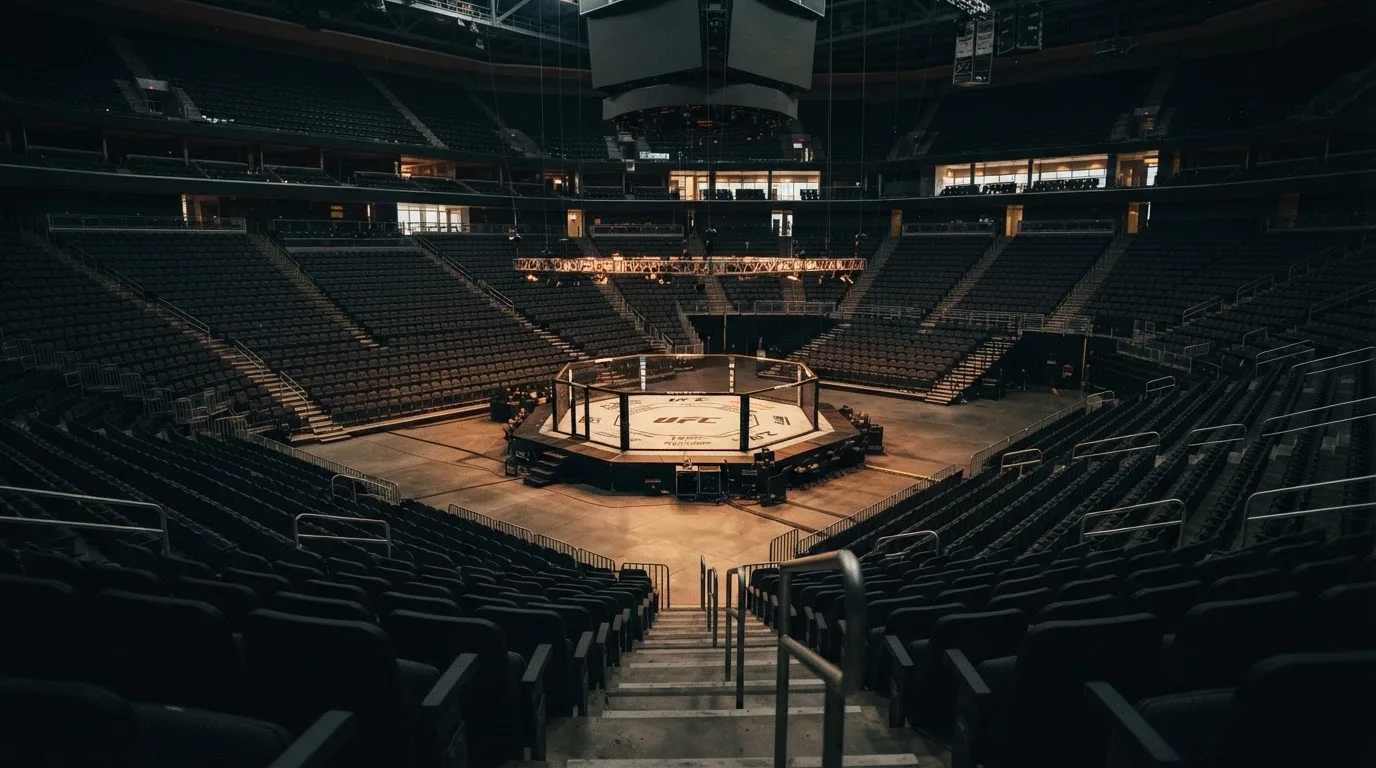
A UFC bout is held inside an octagon and is contested under the Unified Rules of MMA. Each round is a maximum of five minutes with one minute’s rest between rounds. Championship fights and non-title main events are scheduled for a maximum of five rounds; other bouts for three. The bout ends by knockout, technical knockout, submission, judges’ decision (unanimous, majority, split or technical) or disqualification; a no contest is possible under specific rules.
Scoring uses the ten-point must system familiar from boxing: three judges score each round, the winner receiving ten points and the loser nine or fewer. A 10-8 round is typical when one fighter dominates; 10-9 is the standard. If a UFC title fight ends in a draw, the defending champion retains the belt.
The promotion runs eight men’s and three women’s divisions, and has held over 750 events by 2026. The schedule is dense — numbered events run every few weeks, with Fight Night cards in between. Two specific cards in late 2026: UFC 334 (Gane vs. Hokit) on 14 November 2026 at Madison Square Garden, and UFC 335 (Oliveira vs. Lopes) on 12 December 2026 at T-Mobile Arena.
A licensed bookmaker offers UFC lines because the fights are real events under the Gambling Commission’s “remote general betting standard (real events)” licence category. The licence does not name permitted sports; the Commission registers licences by category, not by sport. The brand’s own terms and the LCCP govern the markets that go on offer.
Reading the licensed field: how ten brands compare
The table below covers ten operators that hold a Gambling Commission remote licence at the time of writing. The licence number and account number are taken from the public register; the “operator-terms note” is what each brand’s own promotional page states for a sports welcome or its most visible UFC-relevant feature. Several brands run under one licensee; this comparison treats each domain as a separate market-facing brand.
| Brand | Gambling Commission licence note | What the operator’s own terms state on UFC and welcome offer |
|---|---|---|
| Bet600 | 044731-R-323941-016, account 44731; holder Tyche Tech Limited | Best Odds Guaranteed on UK and Irish horse racing; beginning of sport book at a smaller operator |
| BoyleSports | 039469-R-319383-025, account 39469; holder Boylesports Enterprise | £20 in free bets on a £10 qualifying sports bet for GB players (€30 in free bets for €10 qualifying bet in Ireland) |
| Matchbook | 039504-R-319407-024, account 39504; holder Triplebet Limited | Betting exchange with bet builder, multiples, in-play and live streaming of horse racing and greyhounds |
| Betboro | 044181-R-324363-007, account 44181; holder Webmedia Development N.V. | 100% matched free bet up to £25, debit card deposit ≥£10, first bet £5-£25, three legs at 3/5 (1.60)+ |
| Tote | 054779-R-331321-008, account 54779; holder TDCO Limited | Pool-betting heritage; widely marketed for horse racing; UFC markets available on its sportsbook |
| Fitzwilliam Sports | 048760-R-335434-009, account 48760; holder SBKI Limited | Dublin-based, capped membership; “High Stakes Welcome” subject to compliance criteria; instant deposits, fast withdrawals |
| Bet Ahoy | 100094-R-341742-003, account 100094; holder Bet Ahoy Ltd | “Bet £10 & Get £10 in Free Bets” — £5 sports bet plus £5 acca for new customers |
| Unibet | 045322-R-324275-019, account 45322; holder Platinum Gaming Limited | Operated since 1999; “Get £40 in Free Bets when you bet £20” — minimum odds 2.0, 7-day expiry, debit card or instant bank transfer |
| Kalooki Sportsbook | 057730-R-333396-005, account 57730; holder Kalooki Sportsbook Ltd | Verifies name, address and date of birth before first deposit; GAMSTOP member |
| Copybet | 053774-R-330743-010, account 53774; holder Copybet UK Limited | Best Odds Guaranteed all day on UK and Irish racing; pays first past the post even if a winner is later disqualified |
A note on scope: this is not the licensed market. The Commission’s register lists hundreds of remote betting brands, several of which are running the same betting engine under different domains. What the table shows is the comparison set — ten brands selected for variety across welcome offer, market type and operating model — not an exhaustive list.
A note on the exchange model: Matchbook runs as a betting exchange where customers back and lay against each other under a “remote betting intermediary” licence, a separate category from the “remote general betting standard (real events)” that the other nine brands hold. The exchange’s margin sits in commission rather than the spread, and the markets look different in the app.
A note on the welcome-offer terms: every bonus or free-bet value above is described as the operator’s own terms state it. Several of these offers change weekly; what is current at one moment is not current at the next. The audit window is the brand’s own promotional page on the day of writing.
What UFC betting looks like in the GB regulatory frame
A bookmaker serving customers in Great Britain needs a Gambling Commission licence — that is the only test. Since the Gambling (Licensing and Advertising) Act 2014 the licence applies wherever the operator is based, so a Curaçao or Malta licence is not a substitute when the brand’s customers are in England, Scotland or Wales. Northern Ireland runs under older law and is outside the Act; a GB licence does not regulate Northern Irish customers, and a Northern Irish bookmaker may need its own arrangements.
The Commission’s public register is the test. It can be searched by business name, trading name, domain or account number. The register lists the licence number, the licence holder, and the categories of remote betting the holder is licensed for: remote general betting standard (real events), remote general betting standard (virtual events), remote general betting limited, remote pool betting, and remote betting intermediary. There is no statutory list of permitted sports; the categories govern the operator’s frame, and the markets inside that frame are the operator’s choice.
Inside that frame, in-play UFC is offered by GB-licensed bookmakers, esports and virtual events follow the licence category they sit under, and bets on politics, TV shows and novelty markets are also offered where the operator’s licence and its own terms permit. There is no statutory cap on stakes; the operator sets its own maximums and may restrict customers it considers higher risk.
The financial vulnerability check is the rule most punters meet without realising it. Where a customer’s deposits minus withdrawals exceeds £150 in any rolling 30 days, the operator must run a public-record check for markers of financial distress — bankruptcy, county court judgments, similar registers. The check is not a credit reference and not an income check; it is a flag for further questions. A punter whose deposits stay modest never meets the threshold.
Identity is the front door. Since 7 May 2019 GB-licensed remote operators verify name, address and date of birth before the first deposit, and a free bet or bonus triggers the same check. The credit-card ban in force since 14 April 2020 closes one funding route; debit cards, bank transfers and e-wallets are unaffected. An anonymous play is not on the table at a licensed site.
Player protection runs through GAMSTOP, the national multi-operator online self-exclusion scheme and a mandatory licence condition for online operators since 31 March 2020. Periods are six months, one year, five years, or five years with auto-renewal; the exclusion stays in place for a further seven years after the minimum period unless the customer asks GAMSTOP to remove it. The scheme covers sites and apps; betting shops use a separate service.
Help outside the operator sits with GamCare (which runs the National Gambling Helpline), GambleAware, the NHS gambling clinics and Gamblers Anonymous. Every licensed operator’s safer-gambling page links to those services — Fitzwilliam Sports’ site, for example, explicitly does so.
Safer gambling: where the protection sits
The protection on a GB-licensed site is layered. The operator verifies identity before the first deposit; the operator is a GAMSTOP member; the operator’s safer-gambling controls set deposit limits and timeouts; the regulator’s register makes the licence check public; the dispute-resolution service is available where the operator’s own route fails. None of these protections applies at an offshore site, and the cost of losing them is invisible until a fund withdrawal problem makes it visible.
Deposit limits are the punter’s tool. Operators must offer a gross deposit limit on a fixed time frame; the first set of changes took effect on 31 October 2025, and a second phase was postponed to 30 September 2026. The operator has to offer the limit; the punter has to set it. A punter who sets a £200 weekly deposit cap and stays under it cannot be surprised by the next month’s statement.
Timeouts and self-exclusion are the heavier tools. A 24-hour cooldown buys a pause; a six-month exclusion buys a year. GAMSTOP, the multi-operator scheme, is the strongest — it covers every licensed online operator at once and survives attempts to open a new account elsewhere.
The financial vulnerability check is the safety net for the punter who has not set a limit. Once the £150-in-30-days threshold trips, the operator runs a public-record check and asks further questions where the check flags trouble. The check’s purpose is not to refuse service but to surface the conversation the punter has not had.
Gambling harm is real and follows no income line. NHS clinics treat it as a health problem; GamCare runs the helpline (0808 8020 133) twenty-four hours a day. A reader who recognises a pattern of escalating stakes, chasing losses or hiding gambling activity from family should call that line before the next deposit.
Operatori reviewed
1. Bet600
A smaller bookmaker running under Tyche Tech Limited, licensed by the Gambling Commission under account 44731. The brand’s own terms highlight Best Odds Guaranteed on horse racing — the headline feature — and Bet600 is a useful option for a bettor whose interest in UFC extends to the wider sportsbook rather than the headline fight card. Welcome offer details belong to the brand’s own terms page. Verdict: a niche pick in a competitive field; useful for the racing-crossover punter rather than the UFC specialist.
2. BoyleSports
A Boylesports Enterprise brand on the Commission’s register under account 39469. The sports welcome pairs a £10 qualifying bet with £20 in free bets for GB players, with Irish customers seeing the euro equivalent; the bonus keeps the single-product construction the January 2026 rules permit. The BoyleSports app sits on the Apple App Store with a GB-localised build, and the brand has a long history in Irish racing and football. Verdict: the cleaner welcome-offer mechanics on this list; the free bets land close to cash value because there is no wagering cap to clear.
3. Matchbook
A betting exchange operating under Triplebet Limited, licence account 39504. The “remote betting intermediary” licence puts Matchbook in a different category from the other nine brands on this list; customers back and lay against each other rather than against the bookmaker, the market’s margin lives in commission, and the live tabs update second-by-second. Matchbook streams horse racing and greyhound racing live and offers bet builder, multiples and in-play. Verdict: the sharpest tool in the comparison for a UFC punter who can size a lay bet; not the friendliest entry for a customer new to the exchange’s mechanics.
4. Betboro
Webmedia Development N.V. sits behind Betboro on the register under account 44181. The 100% matched free bet up to £25 lands on the first qualifying wager of £5-£25, with three legs at minimum 3/5 (1.60) and a debit card deposit of at least £10. The structure is more demanding than BoyleSports’ or Bet Ahoy’s — three legs adds acca risk to the qualifying bet itself — but the matched free bet is the headline price. Verdict: the bonus looks bigger than several competitors but the qualifying bet is heavier; the value calculation depends on whether the first bet would have been an acca anyway.
5. Tote
TDCO Limited runs Tote under licence account 54779. The brand’s pool-betting heritage is on horse racing, and the sportsbook offers UFC markets alongside it. Tote does not run a sports welcome offer with the same fanfare the fixed-odds bookmakers do. Verdict: a brand for the racing-led punter who treats UFC as one of several markets; less obvious a pick for a UFC-only customer.
6. Fitzwilliam Sports
SBKI Limited runs Fitzwilliam Sports under licence account 48760. The brand describes itself as Dublin-based with capped membership; the safer-gambling controls include instant deposits, fast withdrawals, timeouts and deposit limits, and the site links explicitly to GambleAware, GamStop and Gamblers Anonymous. The welcome is described as a “High Stakes Welcome” subject to compliance criteria — a different shape from the £10-get-£30 model. Verdict: a higher-touch service for fewer accounts; the appeal is membership caps and faster payouts, not headline welcome bonuses.
7. Bet Ahoy
Bet Ahoy Ltd runs the brand under licence account 100094. The welcome offer pairs a £10 qualifying bet with £10 in free bets, split into a £5 sports bet and a £5 acca — a smaller headline than BoyleSports’ but a clearer single-product construction. UFC coverage sits within the sportsbook at the same scale as most fixed-odds brands. Verdict: the parsimonious welcome; the value is the clean two-bet structure (sports + acca) rather than the headline number.
8. Unibet
Platinum Gaming Limited runs Unibet UK under licence account 45322; the brand has operated since 1999. The sports welcome pairs a £20 qualifying bet at minimum odds of 2.0 (1/1) with £40 in free bets that expire within seven days of issue, for GB customers using a debit card or instant bank transfer. The seven-day expiry is a pinch point on a UFC fight card that may sit outside the window. Verdict: the biggest headline welcome on this list by stake size; the seven-day window is the constraint and matters most for a punter whose free bets would land on a card too late to use them.
9. Kalooki Sportsbook
Kalooki Sportsbook Limited (company number 12938274) holds licence account 57730. The site verifies name, address and date of birth before the first deposit — a licence condition, not a marketing choice — and is a GAMSTOP member. The brand sits at the smaller end of the licensed sportsbook field. Verdict: a licensed, identity-verified bookmaker for the punter whose priority is the Commission’s register rather than the headline welcome offer.
10. Copybet
Copybet UK Limited runs the brand under licence account 53774. The brand offers Best Odds Guaranteed all day on UK and Irish racing — a more generous framing than the morning-only offers that competitors run — and pays first past the post on horse racing even when a winner is later disqualified. The sports welcome offer terms are stated on the brand’s site. Verdict: a sharper Best Odds Guaranteed than most of the field; the UFC offering is the same scale as the other licensed sportsbooks, and the differentiation is on the racing side.
FAQ
Where to bet on UFC fights?
At a bookmaker licensed by the Gambling Commission under the “remote general betting standard (real events)” or “remote betting intermediary” category, checked on the Commission’s public register. The brand’s domain should match the licence; if it does not, the brand is either unlicensed or running through a white-label arrangement that should be transparent in the terms.
Where to bet on UFC?
The same question, with a different country filter — anywhere the Gambling Commission’s register lists a holder whose licence covers remote betting on real events for customers in Great Britain. There is no statutory list of permitted sports, so “where” is “at any operator whose licence covers the market the punter wants to bet on”, and that is the register.
Where can I bet on UFC fights?
The same answer again: a GB-licensed remote bookmaker. Offshore brands accept UK customers at their own risk, and a punter who values the Commission’s complaints route, GAMSTOP coverage and approved dispute-resolution service chooses licensed.
How is it checked that a bookmaker holds a Gambling Commission licence?
The Commission’s public register can be searched by business name, trading name, domain or licence account number. The register lists the licence number, the licence holder and the categories of remote betting. If the brand’s domain does not appear in the search, the brand is either unlicensed or running through a licensee whose name the customer can find by searching the trade name.
How is the return on a bet worked out from the stake and the odds?
Return = stake × odds, where odds are decimal. Net profit = stake × (odds − 1). For a combination bet the odds of each leg multiply into one price, and the same formulas apply. Fractional odds (5/1, 11/4, evens) convert to decimal as a ÷ b + 1.
What is the bookmaker’s margin and how can it be seen in the odds?
A two-way market’s payout share is 1 ÷ (1/odds₁ + 1/odds₂); the margin is 1 minus the payout share. A market priced at decimal odds of 1.90 / 1.90 gives a payout share of about 94.98% and a margin of about 5.02%. The margin is what the bookmaker keeps of every unit bet on that market, and a smaller margin means a cheaper line for the punter.
Combat & motorsport – systembetsguide.com
Content created by the «systembetsguide.com» team
