
What is a Trixie bet and how does the four-line structure actually pay out?
 Available in US
A Trixie is a full cover bet built on three picks that runs as four separate wagers: three doubles covering every two-leg pairing, plus one treble that ties all three together. The same unit stake goes on each line, so a £2 Trixie means £8 of stake in total — £2 to win if any two picks land, and the chance of a fuller payout when all three come home. The Trixie is the smallest full-cover combination bet the bookmakers price as a standard product, one rung under the Patent (four picks, seven lines) and the Lucky 15 (four picks, fifteen lines). Every Trixie lives or dies on at least two of the three legs winning; with one leg gone all four lines lose together. That single structural fact is what makes the bet interesting, and what makes its pricing worth understanding before staking money on it.
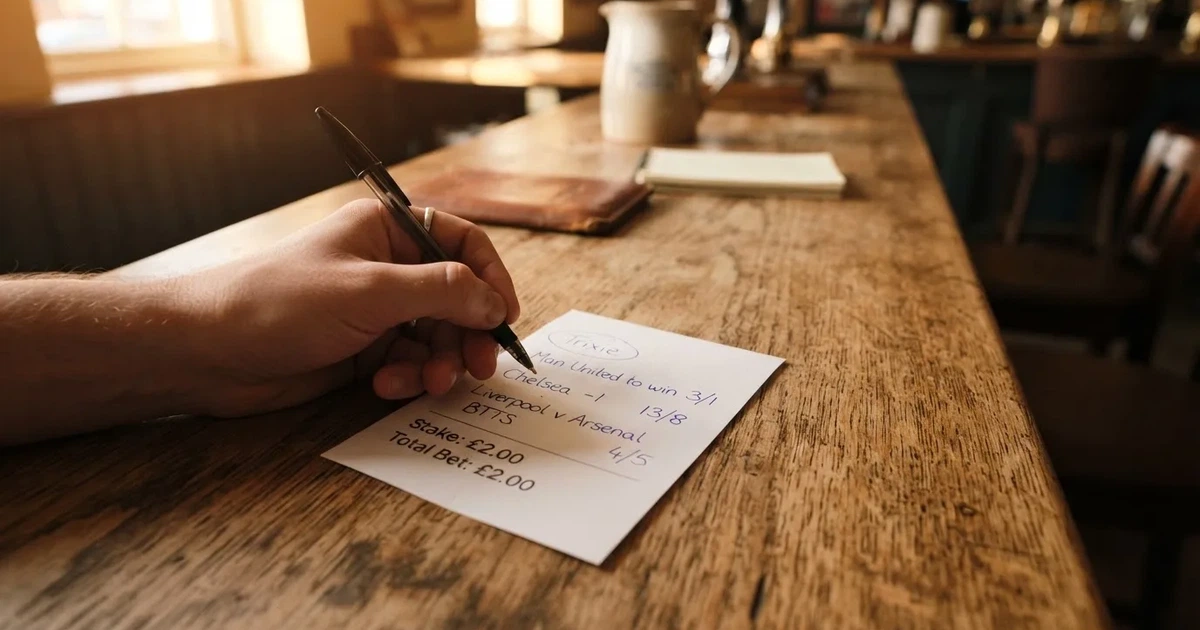
Data current as of 30 October 2026, verified against the UK Gambling Commission’s public register.
How a Trixie is built and settled
Four wagers hide inside what looks like one bet. The structure is rigid: pick three outcomes, then the bookmaker generates one line per two-leg combination plus the three-leg combination. There is no single-pick line in the Trixie; that is the difference between a Trixie and a Patent. If only one of the three picks wins, nothing comes back. Two picks winning produces a payout from whichever double contains those two — there are three such doubles covering every pairing — but the treble and the double containing the loser both drop out. Three picks winning lights up every line: three doubles pay, the treble pays on top.
That asymmetric settlement is the bet’s defining characteristic, and it is why a punter ever takes a Trixie instead of a straight treble. The straight treble ties everything to a single line: one loser and the whole thing dies. The Trixie gives the same treble plus three doubles, so if one pick lets the side down the bettor can still walk away with a return from one of the doubles — assuming the other two both win. The trade is exposed stake for breathing room: a trebble’s stake lives on one line, a Trixie’s stake lives on four.
The four lines and their conditions, in plain language:
- Double on Picks 1 and 2. Pays only if both win.
- Double on Picks 1 and 3. Pays only if both win.
- Double on Picks 2 and 3. Pays only if both win.
- Treble on Picks 1, 2 and 3. Pays only if all three win.
The minimum winning footprint is two legs on a winning double. One winning leg returns nothing. Zero winning legs returns nothing. The treble is the line that does the heavy lifting on a winning day: across three legs the three doubles share the doubles’ returns, but the treble stacks the three prices into a single payout that dwarfs the doubles when it lands.
A worked example anchors the structure in numbers. Take three picks at decimal prices of 2.0, 3.0 and 4.0, and stake £1 per line for a total outlay of £4. If the first and second picks win but the third loses, the only live leg is the double on Picks 1 and 2: that returns £1 × 2.0 × 3.0 = £6, the other three lines lose, profit on the round is £2. If all three win, the doubles return £6, £8 and £12 (those are 2.0×3.0, 2.0×4.0 and 3.0×4.0 at a £1 unit stake) and the treble returns £1 × 2.0 × 3.0 × 4.0 = £24, totalling £50 on a £4 stake. That figure — £50 from £4 — is the headline the marketing copy circles. The £2 number from the two-winner scenario is the more honest figure, because it is the outcome a punter is far likelier to see.
Where a Trixie sits among full cover bets
Trixies live in a family of bets that cover every multiple combination of a given number of picks, sometimes with the singles added in. Each has its own total number of lines:
- Patent (3 picks): 7 lines — 3 singles, 3 doubles, 1 treble.
- Trixie (3 picks): 4 lines — 3 doubles, 1 treble.
- Yankee (4 picks): 11 lines — 6 doubles, 4 trebles, 1 fourfold.
- Lucky 15 (4 picks): 15 lines — 4 singles, 6 doubles, 4 trebles, 1 fourfold.
- Super Yankee or Canadian (5 picks): 26 lines.
- Heinz (6 picks): 57 lines.
- Goliath (7 picks): 247 lines.
The Trixie omits the singles because singles would each fire on a single winning pick, and the bet is priced as a combination-only structure. Adding the three singles on a £1 unit stake would give the punter a Patent at £7 unit stake, not a Trixie at £4. The Patent returns more often (any single winner pays something), but it costs more per round and dilutes the higher-end payoff because each single takes a sliver of stake that the treble could otherwise have grown. A Trixie is the punter’s choice when they want combination-only coverage on three picks without paying for live singles. A Patent is the choice when at least one of the three picks looks a near-certainty and the punter wants a return on a single winner.
The price arithmetic, for those who want it made explicit, runs as follows. Each decimal odds number is the total return per £1 staked, including the £1 of stake returned. So a price of 3.0 pays £3 for every £1, with £2 of profit; a price of 2.0 pays £2 per £1, with £1 of profit. The fractional form — 2/1, evens (1/1), 6/4 — takes a moment longer to read but follows the same logic once converted. A double’s decimal price is the product of the two legs’ prices; a treble’s decimal price is the product of the three. The bookmaker’s margin (overround) sits inside every one of those prices: even when the sum of implied probabilities looks like 100%, it usually runs a few percentage points higher because the prices are short of a fair reflection.
The bookmaker’s margin and what it costs the combination
Every price on a betting market carries the bookmaker’s margin. The margin is the slice of every pound staked that the book keeps on average across all outcomes, and it is built into the prices by shortening each outcome relative to its true probability. A two-outcome market at decimal prices of 1.91 and 1.91 has a margin of about 4.5%; the same market at 2.0 and 2.0 has no margin at all, because the implied probabilities sum to exactly 100%. In the real world no GB bookmaker on a real market publishes a zero-margin line, because the margin is the bookmaker’s edge.
For a Trixie the margin matters more than for a single, and here is why. A single bet’s price carries the margin once: the bettor gets the shortened price on the one outcome they pick. A Trixie’s treble price carries the margin three times, because three legs are each individually shortened, and those three shortenings multiply into the treble’s headline price. The doubles carry it twice each. So a three-leg Trixie that looks fair from the leg prices alone has already built the book’s edge into every line, and the more legs a combination bet has, the more the cumulative margin erodes the headline figure that greets the punter on their betting slip.
For a punter, the practical reading is straightforward. Treat any Trixie as four bets whose combined true price is meaningfully lower than the product of the displayed leg prices. The arithmetic does not need to be done to the third decimal; even rounding it to “a few percent shaved off each leg, multiplied through” gives the right sense of what the combination actually costs over many bets. Where the margin is unusually tight on the legs you want, the Trixie is closer to fair value. Where individual leg margins are fat, the Trixie’s “true” price has already been shaved before the betting slip ever opens.
What the law says about combination betting in Great Britain
The Gambling Act 2005 is the framework, and the Gambling Commission is the regulator. Operators serving customers in Great Britain need a Commission licence regardless of where the operator is based — that rule came in with the Gambling (Licensing and Advertising) Act 2014 and is the reason a brand operating out of Malta or Gibraltar still holds a Commission account number if it takes GB customers. There is no statutory list of permitted bets or markets; an operator holds a licence for a category (remote general betting standard, real events, being the typical one for a Trixie) and prices markets under its own rules within the Commission’s Licence Conditions and Codes of Practice. No statute caps the stake on a combination bet; the unit-stake and total-stake figures on a Trixie are the operator’s choice, not a regulatory floor or ceiling.
The page’s licence framing is mostly about who is licensed, not what bet types are permitted. A Trixie is a long-standing, fully standard combination bet, priced on essentially every GB sportsbook; it is not a fringe product. The legal angle that matters to a punter is the licence check, not the bet’s standing: every brand reviewed later on this page holds a Gambling Commission remote betting licence for real events, and a punter should expect to verify that licence on the Commission’s public register before depositing.
The public register is searchable by business name, trading name, domain or account number. Where this page lists an account number for a brand, that is the figure to put into the search box. Two checks matter: that the account number matches, and that the licences listed on the register include remote general betting standard (real events). The Commission does not separately approve each bet type a bookmaker offers; it licenses the activity and the operator, and the combination bet is part of the standard product set.
For a punter, the only other rule that bites the bet itself is the credit card ban. Since 14 April 2020 no GB-licensed operator accepts credit cards for gambling, including credit-card-funded e-wallet deposits, and that rule applies just as much to the four lines of a Trixie as to a single. Identity checks (name, address, date of birth) run before the first deposit and may run again at higher spend under money-laundering rules. None of this prevents the bet; it just sets the perimeter around it.
Responsible gambling and the rules around Trixie betting
The protections are operator duties on every GB-licensed site, and they apply identically to a Trixie as to a single. Every online operator in GB is part of GAMSTOP, the multi-operator self-exclusion scheme: a punter who excludes themselves through GAMSTOP blocks themselves from every licensed site and app simultaneously, for a minimum of six months. The bigger exclusion periods are one year, five years, or five years with auto-renewal; at the end of the period the exclusion stays in force for a further seven years unless the customer asks GAMSTOP to lift it. Betting shops use a separate, in-shop self-exclusion.
The financial vulnerability check is a public-record check — bankruptcy, county court judgments, that sort of thing — that kicks in for remote customers whose net deposits cross £150 in a rolling 30 days. It is not an income check and not a credit reference check, but it is a real feature of the licensed-only regime; offshore sites are not running it. The next-stage checks, called financial risk assessments in the press, are announced in a staged plan with no start date.
There is no state-set deposit or loss ceiling in GB betting: limits are the customer’s choice, supported by the operator’s deposit-limit tools. A Trixie punter who sets a £50 weekly deposit limit has the same £50 cap whether they place one £50 straight treble or twenty-five £2 Trixies over the same week (the latter costs £200 in stake). The cap is on money in, not on combinations chosen. Help comes from GamCare and the National Gambling Helpline, GambleAware, the NHS gambling clinics and Gamblers Anonymous — none of it specific to combination betting, all of it available to anyone who wants it.
Offshore sites are a different question for the protections and the bet itself. A site licensed only in Curaçao, Malta or Gibraltar and aimed at GB customers is operating without a GB licence; the bet still works mathematically, but the punter loses GAMSTOP coverage, the Commission’s complaints route, an approved dispute-resolution body, and access to British consumer redress if funds are withheld. Bonus terms are different too: the 10x wagering cap, the £150 vulnerability check, and the mixed-product promotions ban apply only to GB-licensed sites. The framing to keep in mind: a Trixie is a Trixie anywhere; the surrounding duties belong to the GB licence.
Bonuses, free bets and the Trixie
Free bets, deposit bonuses and “boosted odds” offers are how GB bookmakers compete for new sign-ups. The Trixie is a frequent target for these offers because a four-line structure multiplies up the stake and the qualifying turnover quickly, and operators often write their terms to either include or exclude combination bets in explicit language. The reader-facing point that matters is the condition, not the headline.
The £10-or-£50 free bet is paid as a free bet, not as withdrawable cash. A winning free-bet selection typically returns winnings only, with the stake not returned; a £10 free bet at decimal odds of 4.0 returns £30 of profit, not £40, because the £10 of stake is forfeit. That detail sits in the operator’s free-bet terms and is the single biggest difference between a free bet and a cash bonus. On a Trixie the stake-not-returned rule applies on each line the free bet funds, so the four-line payoff is correspondingly reduced.
Bonus wagering caps and minimum-price rules are the terms most likely to bite a Trixie. The Commission’s rule since 19 January 2026 caps wagering requirements on bonuses at 10x. A £10 bonus with a 50x wagering requirement was once not unusual; under the cap, a £10 bonus can carry no more than £100 of required betting. Whether that rule applies to free bets without a wagering condition is not established. “Mixed-product promotions” — bonuses that require gambling on two product types such as betting plus casino, or betting plus bingo — are banned in GB under the same set of rules, so the gambit of “bet £10 on football, get free casino spins” is no longer offered by GB-licensed brands.
Free bet minimum-odds rules often read like a gate. QuinnBet’s free bets, for example, are valid for seven days from credit and can be used at fractional odds of 1/2 (decimal 1.5) or greater with a maximum of 50/1 (decimal 51.0), and the rules state that Trixies, Patents and Yankees are not eligible for the offer’s free-bet stake while straight accumulators are. That is a specific brand’s house rule — the brand writes the rule, not the regulator — but it tells a Trixie punter two things. First, the brand has thought about which bet types qualify, which means the small print is worth reading before claiming. Second, other Trixie-friendly brands exist; the choice of operator is also a choice of eligible bet types. The same QuinnBet terms apply similar logic to other full-cover combinations: the brand takes the position that the qualifying stake in the offer cannot fund combination bets whose multiple lines might all clear at once.
Other operators’ bonus terms run similar plays in their own way. A few specifics from the rank of GB-licensed bookmakers matter for a Trixie punter.
- BetTom’s sports welcome offer is half the qualifying stake back as a free bet, capped at £50, with a matching half back as free slot funds for casino play. The “full terms apply” line is where the Trixie eligibility sits.
- Dabble’s welcome offer is “bet £10, get £10 in free bets” for new customers on first deposit, with a seven-day free bet expiry, minimum odds for the qualifying bet and the stake not returned on a winning free bet.
- BetUK’s free bet terms exclude virtual sports, esports and non-UK/Irish horse racing, with minimum odds for the qualifying bet, and the restrictions sit on what’s bet on, not on the bet structure.
- William Hill’s best-odds-guaranteed concession applies from 8 AM on the day of UK and Irish horse racing, on both single and multiple bets; the exclusion list for BOG is ante-post, tote and pari-mutuel bets, so a Trixie built on horse races can benefit from BOG on each leg if the conditions are met.
The pattern to read for is the qualifying-bet clause: what minimum price, what sport, what combination types. The headline offer is largely marketing; the qualifying rule is what determines whether a Trixie punter can ever claim it.
A worked read of what a “free £10 bet” actually pays on a Trixie, at the page’s stake level, looks like this. Take four legs of a £2.50 free bet at decimal odds of 3.0 per leg (a half-cover combination, used because a free bet is normally not fundable on each of the four lines of a Trixie at once under many operators’ rules, but the arithmetic scales). A single line wins back £7.50 of profit, stake forfeit. A treble on three of those at the same price returns 2 × (3.0×3.0×3.0 − 1) = £52 of profit with the unit stake not paid back. Doubles multiply similarly across the remaining pairs. The headline figure on the betting slip is still impressive; the stake-not-returned fact erodes it by exactly the size of the free bet at stake on each winning line. A punter should never look at the headline number on a free-bet Trixie without checking what the qualifying rules do to the payout.
Strategy, staking and what a Trixie actually does for a bankroll
The Trixie sits between two strategies: the single-line accumulator’s all-or-nothing structure and the all-in Patent’s singles coverage. It is what a punter chooses when they want combination-style coverage without paying for live singles, and that choice has consequences on both ends of the outcome spectrum.
On the losing end, the Trixie’s footprint is narrowest among full-cover bets: with only three picks, a single lost leg kicks out three of the four lines and the bet reduces to one of the three doubles. The punter makes a small recovery from that double or takes nothing at all. A Patent at the same picks gives back a single-winner return on any single landing, but pays for that with three singles’ worth of stake and a smaller payoff on the winning day because each single has eaten into the stake that would otherwise have compounded into a treble.
On the winning end, the Trixie’s payoff comes from the treble. With three wins, the doubles add up but the treble dominates the headline figure — the example from earlier shows the £50 headline, of which £24 of the total comes from the treble alone. The punter’s experience of a winning Trixie is usually a “back of the envelope” moment: each pair of picks looked strong, the third looked strong enough, and the treble’s compounding is what made the bet worth running in the first place.
The right bankroll framing for a Trixie is unit-stake-based. A £1 Trixie costs £4 across the four lines; a £5 Trixie costs £20; a £10 Trixie costs £40. Betting shops and online apps let a punter set the unit stake to nearly any figure the operator accepts, so the total outlay grows with the unit stake linearly. A punter who wants to limit exposure to ten per cent of their betting bank on a single Trixie round is staking a unit figure equal to 2.5 per cent of that bank. The discipline is straightforward: bank sized, unit stake sized, and the four-line cost managed by arithmetic, not feeling.
What the strategy does NOT do is make a short-priced pick into a value pick. A Trixie built on three legs at 1.2, 1.3 and 1.5 wins often and pays little per round; one upset kills it entirely. The punter who builds a Trixie for safety-of-touch needs to think about how often all four lines win; the punter who builds a Trixie for a treble’s compounding is stacking the structure against themselves if they pick three short-priced outcomes. Both strategies have a place; they are not the same place. Knowing which one is being run is the strategic question the Trixie answers, and the answer is usually visible only after three or four rounds of staking.
A further practical note: a Trixie is not a bet on the runner who might come second any more than a treble is. Adding place terms to each leg is a separate bet class (an each-way Trixie, eight lines rather than four), and that doubling of the line count is its own arithmetic. Treating a Trixie as a single bet to be split between win and place is a common slip that doubles cost without doubling the structural protection the bet offers.
Bets and odds: the family around the Trixie
The Trixie is one of a number of named combinations, each with a fixed number of lines that depend only on the pick count. The list, with line counts:
- 3 picks: Trixie (4), Patent (7).
- 4 picks: Yankee (11), Lucky 15.
- 5 picks: Super Yankee / Canadian (26).
- 6 picks: Heinz (57).
- 7 picks: Goliath (247).
What unifies them is that each covers every combination of picks at a given level, with optional singles added at lower picks or removed at higher ones. What separates them is the unit-stake bill at the bottom of the betting slip: a £1 Lucky 15 costs £15, a £1 Heinz costs £57, a £1 Goliath costs £247. The punter’s choice between them is the choice between coverage and concentration — more lines spread the stake thinner, fewer lines let the higher-tier accumulators dominate the payoff.
For a Trixie specifically, the bet type shows up on a sportsbook’s “combination” or “multi” tab. Most GB-licensed operators price Trixies as a standard product and let a punter add picks from any market the bookmaker offers (subject to the rules of any promotion running). The combination bet’s selection from one match — known as a same-game multi or bet builder — is a different product, although it is sometimes displayed in the same place on the betting slip. The Trixie’s structure is across match boundaries by convention; a Trixie with two legs from the same match and one from another is structurally valid but is often constrained by individual operator rules.
The odds carried on the betting slip are decimal by convention in the modern GB product, although fractional form (5/1, evens, 11/4) remains standard in horse racing and on some legacy sports pages. Decimal odds quote the total return including stake; fractional odds quote the profit, with stake separate. The conversion from fractional a/b to decimal is a ÷ b + 1: 5/1 is 6.00, evens (1/1) is 2.00, 6/4 (1.5/1) is 2.50. Where this page quotes prices, they are in decimal unless noted, because the page’s worked example maths depends on the multiplication of decimals.
Settled bets follow two patterns on GB operators: most simply pay out the moment the final leg is settled, with the betting slip updated in real time as each leg wins or loses, and a payout message sent once all four lines have been resolved. Cash out, where offered, lets a punter close the bet before all legs are settled at a price the operator quotes. Cash out is not guaranteed: an operator’s terms routinely say “cash out availability is not guaranteed and bets stand if it is unavailable”, and that wording is standard, not exceptional. Cash-out value is set by the operator, and a punter should treat it as another price with the operator’s margin embedded.
The settled Trixie’s payout, where all four lines win, arrives on the betting balance within seconds of the last leg settling, and is then subject to the standard withdrawal process at the operator. Where a free bet funded one or more of the lines, the payout lands as winnings only, with the free-bet stake forfeit.
How to spot a Trixie on the page or app and how to check the licence
The Trixie appears in a few places on a GB sportsbook. On a desktop, it is usually a checkbox under the bet slip labelled “Trixie” or “4 bets” alongside Patent, Yankee and Lucky 15. On mobile apps, the same toggle sits above or beside the picks. The punter types in the unit stake, the slip multiplies by four to show total outlay, and the bet is confirmed in a single tap.
Checking the licence is the routine every punter should keep. The Gambling Commission’s public register is searchable free of charge by brand name, trading name, domain or account number. For each operator named in the rank that follows, this page lists the Commission’s account number; inputting that number into the search box confirms the licence and the licence categories — the all-important remote general betting standard (real events) sits on the register entry for every GB-licensed sportsbook. If a number does not resolve in the register, or the licence categories do not include remote betting on real events, that is a brand not licensed to take the bet in GB.
The ten reviewed bookmakers and how each sits on a Trixie
The following ten brands all hold a Gambling Commission remote licence for real-event betting. Each is reviewed below on what its own terms and product say about combination betting, free bets and features a Trixie punter is most likely to use. The order is the order in this site’s ranking; it is one take, drawn from the brand’s published terms and product page, not a list of recommendations.
A short table brings these side by side before the reviews.
| Brand | Gambling Commission account | Holder | Own terms on key |
|---|---|---|---|
| NetBet | 39170 | Netbet Enterprises Limited | Daily Boosts, Profit Boosts, free bet offers, Bet Builder with instant dynamic odds, sports stats |
| QuinnBet | 61011 | QuinnBet (Gibraltar) Limited | Free bets valid 7 days, 1/2 minimum odds, 50/1 cap; Trixies, Patents, Yankees excluded from free-bet stake; accumulators allowed |
| BetTom | 64959 | Bet Tom Limited | 50% back as free bet up to £50 plus matching 50% as free slot funds, full terms apply |
| Dabble | 65677 | Dabble Sports UK Ltd | “Bet £10, Get £10 in Free Bets” on first deposit; 7-day free bet expiry; stake not returned |
| BetUK | 39198 | LeoVegas Gaming PLC | Free bets exclude virtual sports, esports and non-UK/IE horse racing; minimum odds apply |
| DAZN Bet | 48756 | DZBT Limited | Cash Out, Bet Builder, daily bet boosts, in-play; cash out availability not guaranteed |
| 10bet | 43173 | Blue Star Planet Limited | Football, tennis, horse racing; Cash Out, Bet Builder, Live Streaming |
| Tote | 54779 | TDCO Limited | William Hill BOG applied on UK and Irish horse racing from 8 AM on race day for singles and multiples; BOG excludes ante-post, tote, pari-mutuel |
| Betfred | 39544 | Petfre (Gibraltar) Limited | Bet Builder, Sub Switch, Racing Post data, Extra Places, live casino, bingo |
| Fitzdares | 400 | Fitzdares Limited | Cash out, accumulators, Lucky 15s, specials, antepost, in-play live odds |
Each operator is then discussed in turn.
NetBet
NetBet runs a wide catalogue of sports and bet types, with a Bet Builder wired to instant dynamic odds on each leg update and a separate stack of price boosts: Daily Boosts and Profit Boosts sit in the promotions tab. A Trixie punter is not blocked from combination betting here, and the brand operates under Commission account 39170 as a remote general betting standard (real events) bookmaker. The free bet and boost terms are where the Trixie meets the offers; published restriction language matters more than the headline at the top of the page. NetBet’s product is a strong fit for the punter who likes building custom-price combinations across many leagues — the sports-stats overlay on major leagues supports the price-checking work the Trixie normally demands.
QuinnBet
QuinnBet’s free bet terms are unusually specific on combination bets: free bets are valid for seven days from credit, run at minimum fractional odds of 1/2 (decimal 1.5), cap at a maximum of 50/1 (decimal 51.0), and exclude Trixies, Patents and Yankees from the offer’s qualifying stake while straight accumulators are allowed. The licence sits under Commission account 61011, with QuinnBet (Gibraltar) Limited as the holder — a GB-licensed brand operating from Gibraltar, allowed under the post-2014 licensing regime. The Trixie exclusion in the free bet offer is a house rule of this brand only; a Trixie punter who values the free-bet concession picks a brand whose qualifying rules permit Trixies, and a punter happy to use QuinnBet’s offer knows the Trixie stake comes from their own cash, not the offer’s free bet.
BetTom
BetTom runs a sports welcome offer that is a 50% back as a free bet up to £50 with a matching 50% back as free slot funds for casino play. “Full terms apply” is where the eligibility sits — including for the Trixie. The brand holds a Commission account under 64959, with Bet Tom Limited as the licence holder. The Trixie punter reading the small print at BetTom is checking whether the offer’s qualifying bet is met by a £1 Trixie in the same way as a £1 single, and whether the free bet, when issued, can be split across the four lines or remains a single-line free bet. That detail decides whether the headline offer is also usable on a Trixie round.
Dabble
Dabble’s welcome offer is “Bet £10, Get £10 in Free Bets” on the first deposit for new customers, with a seven-day free bet expiry and the stake not returned on a winning free bet. The brand is GB-licensed under Commission account 65677, with Dabble Sports UK Ltd as the holder. A Trixie punter is reading the qualifying bet — what minimum price, what sport — and the structure of the issued free bet. With seven days to clear, the punter’s window is wide enough to run the free bet on a well-considered combination, and the stake-not-returned rule applies to whatever line the free bet ends up on. The rest of the product is a standard GB sportsbook.
BetUK
BetUK’s free bet terms exclude virtual sports, esports and non-UK or Irish horse racing, and minimum odds conditions apply. The brand runs under Commission account 39198, with LeoVegas Gaming PLC as the licence holder, which means BetUK is part of a larger group (LeoVegas) operating a GB sportsbook as a separately branded entity. The sport exclusions are the betting-relevant detail for the Trixie punter: any horse racing combination built on non-UK/IE races does not qualify for the free bet, even if the same combination built on UK and Irish racing does. The Trixie’s eligibility is not directly restricted; it is the legs of the Trixie that matter here.
DAZN Bet
DAZN Bet offers Cash Out, Bet Builder, daily bet boosts and in-play, with cash-out availability not guaranteed: the brand’s own terms say “bets stand if it is unavailable”. Commission account 48756, holder DZBT Limited. For a Trixie punter, the cash-out disclaimer is the central point: an in-running Trixie can sometimes be closed early if the operator offers a price, but the cash-out button is a feature rather than a right, and the offer can disappear mid-bet if the operator pulls the feature on a given event. A punter who likes running a Trixie to settlement, rather than locking in early profit, ignores this entirely; a punter who wants the option should expect it to be available some of the time and not at others.
10bet
10bet runs a sportsbook covering football, tennis and horse racing, with Cash Out, Bet Builder and Live Streaming features. Licence is Commission account 43173, with Blue Star Planet Limited as the holder. The Trixie punter reading 10bet is checking the markets the brand carries — football and tennis cover most Trixies comfortably; horse racing fits with the same caveat that all horse-racing brands carry (each-way doubles, non-runner rules, Rule 4 deductions — all separate calculations). The bet builder feature is for same-game combos and is separate from a Trixie’s structural combination across matches.
Tote
Tote is a pool-betting heritage brand now running as a GB-licensed remote sportsbook under Commission account 54779, with TDCO Limited as the holder. The best-odds-guaranteed concession (also offered by William Hill) applies to UK and Irish horse racing from 8 AM on the day of the race for both singles and multiples, with ante-post, tote and pari-mutuel bets excluded. A Trixie punter on the racing side gets BOG consideration on each leg where the conditions are met, and pool-betting rules do not interact with the combination structure on the sports side. The Tote’s deeper standing in UK racing — and the dividend-based pool product running alongside the fixed-odds book — sets it apart from a generic GB sportsbook, and that heritage is the brand’s selling point for racing-led Trixies.
Betfred
Betfred is a GB sportsbook heritage brand running under Commission account 39544, with Petfre (Gibraltar) Limited as the holder. The app carries Bet Builder, Sub Switch, Racing Post data, Extra Places, live casino and bingo. The Trixie’s interaction with the brand is straightforward: the product is a standard GB sportsbook, the bet is priced as a standard combination, and the promotions tab is where the welcome offer and ongoing free bets sit. Extra Places is racing-specific and matters for each-way combinations rather than win-only Trixies. The bonus on the page is not part of this page’s scope; what matters is the structure of the offer’s qualifying rules.
Fitzdares
Fitzdares is a premium-positioned GB sportsbook running under Commission account 400, with Fitzdares Limited as the holder. The product carries cash out, accumulators, Lucky 15s, specials and antepost markets on horse racing, football, tennis, rugby, cricket, golf and American football, with in-play live odds. The Trixie punter reads the brand through its Lucky 15 emphasis — Lucky 15s are the four-pick, fifteen-line full cover, one rung above the Yankee. A Trixie is built and settled here as a standard combination; the antepost market depth and the in-play odds are what the brand’s own product description leans on.
A worked payout in the page’s calculation
The page runs one calculation, and it is the payout a Trixie pays on a winning four-line round. The illustrative picks sit at decimal odds of 1.50 (fractional 1/2), 2.00 (evens) and 2.50 (6/4); the unit stake for a Trixie is £2 per line, so the total outlay is £8.
If all three picks win, the four lines pay out as follows:
- Double on Picks 1 and 2: £2 × 1.50 × 2.00 = £6.00 returned (£4.00 profit above stake).
- Double on Picks 1 and 3: £2 × 1.50 × 2.50 = £7.50 returned (£5.50 profit).
- Double on Picks 2 and 3: £2 × 2.00 × 2.50 = £10.00 returned (£8.00 profit).
- Treble on all three: £2 × 1.50 × 2.00 × 2.50 = £15.00 returned (£13.00 profit).
Total return on a winning four-line round: £6.00 + £7.50 + £10.00 + £15.00 = £38.50. Profit above the £8 outlay: £30.50. The figure sits in a band — three picks at 1.50/2.00/2.50 returning roughly £38 to £39 on a winning eight-pound stake — and the band’s condition is straightforward: the three picks win, the prices hold from placement to settlement, and the operator pays each line at the price the bet was struck. A two-pick winning round (one double pays, the others lose) returns somewhere between £6 and £10 on the same unit stake, depending on which pair wins, and a single-winning-pick round returns nothing.
That is the headline the marketing copy circles, and it is the same conclusion the maths arrives at without the spin. The £30.50 profit figure is not a prediction; it is a calculation under the assumption the picks win. The implied probability that all three win is the product of the three legs’ true probabilities, with each bookmaker-shortened, and that probability is the only honest way to read the bet’s expected value. A Trixie punter who wants to think in expected value is welcome to multiply the £30.50 profit by the chance all three win and subtract the four-way losses weighted by their respective probabilities; the answer sits somewhere below zero once the margin is fully accounted for, because every GB bookmaker runs a margin on every leg.
Frequently asked questions
What is a Trixie bet?
A Trixie is a combination bet on three picks made up of four separate wagers: three doubles covering every two-pick pair, plus one treble covering all three together. The same unit stake goes on each of the four lines, so a £1 Trixie costs £4 in total. At least two of the three picks must win for any return; one winning pick returns nothing. The structure is the smallest full-cover combination priced by GB sportsbooks as a standard product, one rung below the Patent (which adds three singles for seven lines total).
How does a Trixie bet work?
A punter picks three outcomes and places a unit stake, the operator generates the four lines automatically, and the bet settles leg by leg as each pick is decided. When two picks win, the double containing those two pays out while the other three lines lose; when all three win, every line pays and the treble adds the bulk of the total return. The Trixie’s defining feature is its asymmetric settlement: a single losing leg ends all lines except one double, and the punter walks away with that double’s return or nothing.
What’s a Trixie bet in plain British betting terms?
In plain British betting terms, a Trixie is four bets run as one: three doubles and a treble over the same three selections. The total stake is unit stake multiplied by four, and a winning payout above £8 on the £2 unit-stake example depends on the legs landing and the prices holding. The Trixie is a full cover bet, which means it covers every combination bet available on the picks above the single level; it sits below the Patent (which adds the singles) and the Lucky 15 (which runs the same coverage on four picks for fifteen lines).
How is it checked that a bookmaker holds a Gambling Commission licence?
The check is free and runs on the Commission’s public register, searchable by business name, trading name, domain or account number. The register entry confirms the licence holder’s name and the licence categories held. For Trixie betting on real sporting events, the all-important category is remote general betting standard (real events), and a brand without that category on its register entry is not licensed for the bet. Account numbers quoted on the licensed brand’s own site should match the figure on the register; mismatches are the one finding that warrants walking away.
How is the return on a bet worked out from the stake and the odds?
Return on a single = stake multiplied by the decimal price. Profit above stake = stake multiplied by (decimal price minus 1). On a double the price is the product of the two legs’ decimal prices; on a treble the three legs multiply into one price; on a Trixie those products are stacked across the four lines, and the total return is the sum of each line’s return. Decimal prices are the total-return-quoting form; fractional prices quote only profit, with stake separate. A £10 bet at decimal 4.00 returns £40, of which £30 is profit; a £10 bet at 3/1 returns £40 too, with £30 profit. Same bet, same number, different written form.
Bet types & in-play – systembetsguide.com
Content created by the «systembetsguide.com» team
