
Best betting sites with acca bets in the UK
 Available in US
Current as of 30 October 2026 against the Gambling Commission’s public register. A linked acca turns four near-certainties into a long shot, and the long shot pays well when it lands — but the bookmaker already built its slice into every leg. The bookmaker’s margin is the first thing to understand about accumulators, and the second is that a “free bet” on an acca is rarely a free anything. This page covers both, then works through ten UK-licensed bookmakers on what their acca offer actually does for a punter who places one.
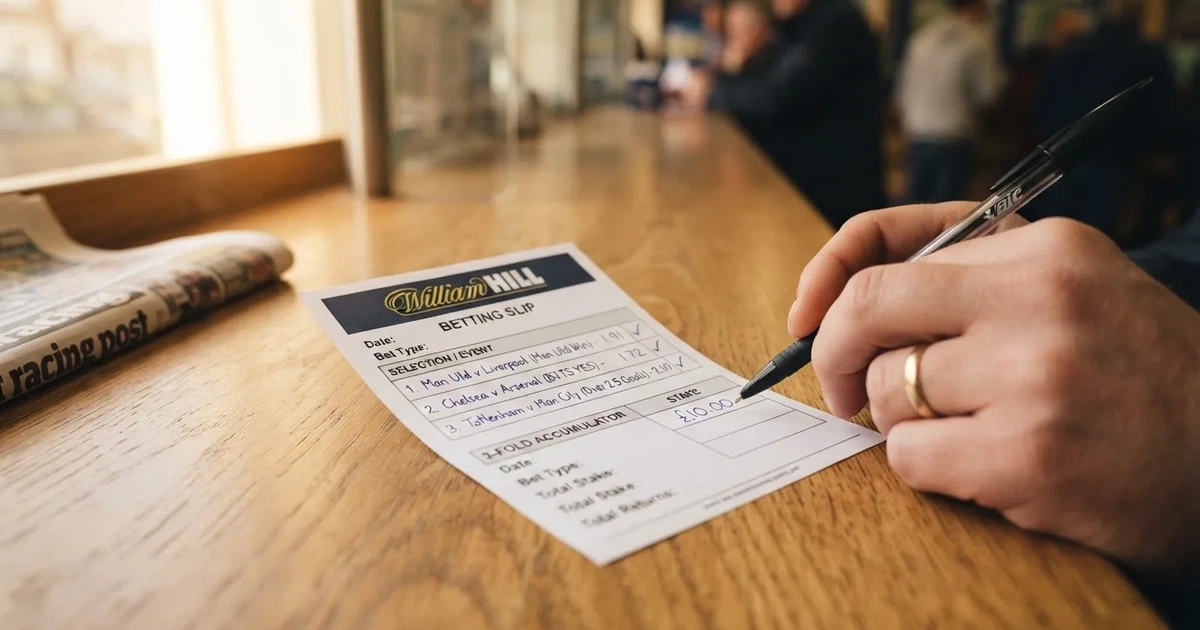
The accumulator in plain terms
An accumulator — acca for short, also called a parlay, multi or combo bet — is a single bet whose outcome depends on every one of its selections winning. Two selections is a double; three is a treble; four or more is an accumulator in the strict sense. The return on a winning acca is the stake multiplied by the product of the decimal odds of each leg. A push — a selection that ties — drops out of the calculation, and the acca is settled at the shorter price of what is left. A losing leg loses the whole bet, regardless of what the others did. That all-or-nothing shape is the whole point, and it is why the price climbs so quickly: every leg adds its own margin, and the bookmaker keeps a slice on each multiplied with each multiplied with the next.
Decimal odds suit accumulators because the arithmetic is one multiplication. Fractional odds of 5/1 are 6.00 in decimal, and a treble on 6/4 (2.50), evens (2.00) and 1/2 (1.50) on a £10 stake pays back £10 × 2.50 × 2.00 × 1.50 = £75 — which is the same as a £10 stake returning £75 including the original £10, leaving a £65 profit. The price climbs fast with each added leg: a fourth at 3/1 (4.00) takes the same £10 to £300, and a fifth at 10/1 (11.00) takes it to £3,300. None of those figures account for the bookmaker’s margin, and the margin is what makes the difference between a price that looks generous and one that is.
Each-way accumulators
Each-way betting is two bets of equal stake: one on the win part, one on the place part. Place terms are set by the bookmaker and vary by race, sport and field size — a horse race with eight runners typically pays a quarter of the odds for the place part, but a twelve-runner race may pay a fifth. On an each-way acca the win and place parts are settled as two separate accumulators, and the stake doubles. A £10 each-way treble is £20 in total, the property returning the win accumulator in full if every selection wins and the place accumulator if every selection places. Most bookmakers apply each-way only to outright markets — race winners, tournament goals — and refuse to apply it to bet builders, handicaps or in-play lines.

Full-cover bets
A full-cover bet bundles an accumulator with every possible smaller combination of the same selections. The unit stake multiplies by the number of bets in the cover, so a Trixie at £1 a line costs £4 in total. A Trixie covers three selections in four bets (three doubles plus a treble); a Yankee covers four selections in eleven bets (six doubles, four trebles and the fourfold accumulator); a Heinz covers six selections in fifty-seven bets and a Super Heinz covers seven selections in one hundred and twenty. The advantage over a straight accumulator is that one losing leg does not necessarily lose the whole stake — a Trixie still pays out on a treble if two of the three doubles survive — but the overall cost rises sharply with each added selection, and a Lucky 15 on four lines at £1 each is £15 down before a ball is in play.
How settlement handles an edge case
Bookmakers spell out edge cases in their own terms, and the ones that come up most often on accas are non-runners, abandoned events and late withdrawals. A non-runner in a horse race removes the leg entirely; an abandoned match that is not resettled within the operator’s cut-off (commonly twenty-four to forty-eight hours) voids that leg; a Rule 4 deduction — applied when a horse withdraws after the final declarations — trims the price of every remaining runner by a fixed percentage set by the racing industry. These are operator rules, and one bookmaker’s generosity on a Rule 4 is not another’s.

How an acca is priced — and where the bookmaker’s slice lives
Every decimal price carries a margin, and an acca compounds it across every leg. Take a one-market example: a tennis match priced at 1.91 / 1.91 carries roughly 4.5% of margin in each market, because the implied probabilities add up to 1.05 (52.4% + 52.6%), and one minus the reciprocal sum is the margin. The bookmaker keeps that 4.5% of every unit staked on this market in the long run, regardless of who wins. A five-leg acca on five such markets compounds five slices of margin into the final price, and the gap between what the bet looks like and what it really is widens with every leg. The page comes back to this point wherever a feature claims to “boost” the price: the boost starts from a price whose margin the bookmaker is not giving away.
Where a margin hides on a popular accumulator
Football is the dominant acca sport in Great Britain, and the dominant football acca is a Saturday Premier League coupon of short-priced favourites. A typical home-win / draw / away-win market at 1.50 / 3.75 / 6.00 carries an implied probability of 66.7% + 26.7% + 16.7% = 110.1%, which is a 9.2% margin on this market — close to the bookmaker’s wider range. Build a four-fold acca from four such markets and the margin compounds into the price without the punter seeing it, the way interest compounds into a loan. The bet pays a generous-looking price because each leg is short, but the odds on each short-priced leg are the bookmaker’s margin working in their favour, and an acca of four short favourites has been structured to lose more often than its price suggests.
How “enhanced odds” and “acca boosts” work against that
Most acca features are versions of one of three things: a boosted price on a chosen acca, free bet credit tied to a stake, or a money-back rule if one leg lets the bet down. Each is a marketing layout: the price, the bonus and the insurance are all paid by tightening the underlying margin. A “Winnings Boost” that adds 10% to a winning acca is funded out of the margin on the boosted legs; an “acca insurance” that refunds the stake as a free bet when one leg loses is funded by tightening the price of every other leg, the way a “free bet” attached to a deposit is funded out of the bonus’s wagering requirement. The arithmetic that determines whether a feature helps or costs is the arithmetic the next section puts on its place.
The arithmetic behind the payout
The payout on a winning acca follows the multiplication described above. With three legs at 1.50, 2.00 and 2.50 and a stake of £10, the return is £75 including the stake, for a £65 profit. Add a fourth leg at 4.00 and the same £10 pays £300, for a £290 profit. Add a fifth at 11.00 and the £10 pays £3,300, for a £3,290 profit. The price climbs steeply because multiplication is steeper than addition — that is the engine of the acca and the reason the bookmaker’s margin compounds with it.
The spread of likely payouts from a typical five-leg acca is wide. A conservative five-legger built from short-priced favourites (legs averaging around 1.50) returns roughly £7.60 for every £1 staked; a five-legger of middling legs (around 3.00 each) returns around £240 for every £1 staked; a five-legger of long shots (around 6.00 each) returns close to £7,800 for every £1 staked. None of those figures is a forecast of what the bet will pay, because most accas of that length do not win — that is the point of the price — but the band shows how much variance the structure carries.
What a “free bet” is worth in arithmetic
A free bet on an acca is rarely a free anything. Most bookmakers do not return the free-bet stake on a win — only the winnings — so the value of a £10 free bet at odds of 5.00 is £10 × (5.00 − 1) = £40 in winnings, before the operator’s margin is taken into account. Apply a 5% margin to the same market and the value is roughly £38. The free bet looks free but is paid for by the rest of the offer — the qualifying deposit, the minimum odds, the wagering requirement — and the rule that the stake is not returned is what makes a “free bet” a marketing term rather than a gift.
What the law requires of a UK acca bookmaker
Every bookmaker in this comparison holds a Gambling Commission licence to take bets remotely from customers in Great Britain, and that licence is the whole test of who is licensed. The Commission’s public register can be searched by business name, trading name, domain or account number, and a brand whose name does not come back on the register is not licensed to take a bet from a customer in England, Scotland or Wales. Northern Ireland is outside the Gambling Act 2005 and runs under older law; a GB licence does not authorise a Northern Ireland service.
The relevant statute is the Gambling Act 2005, supplemented by the Gambling (Licensing and Advertising) Act 2014. Since 2014, an operator whose remote facilities are used in customers in Great Britain needs a Commission licence wherever the operator itself is based, so a Curaçao or Malta licence is not a substitute. The Commission has five betting licence categories: remote general betting standard (real events), remote general betting standard (virtual events), remote general betting limited, remote pool betting, and remote betting intermediary (the licence for betting exchanges). Every bookmaker in this comparison holds the first of those — remote general betting standard (real events) — which covers accumulators on real sporting events.
What verification looks like at the first deposit
Since 7 May 2019, every customer has to pass name, address and date-of-birth verification before a first deposit or a first bet, including with a free bet or a bonus. That check uses public data and a credit-reference check is not required for it. Source-of-funds questions come later, when a customer’s deposits minus withdrawals pass £150 in a rolling thirty days — the financial vulnerability check under LCCP condition 3.4.4, in force since 30 August 2024. It is a public-record check (bankruptcy, county court judgments) rather than an income or credit check, and is not the same as the financial risk assessments the Commission announced in a staged plan of 7 July 2026 — those have no published start date. None of this is a barrier for the registered customer who passes the checks; it is a barrier for the anonymous account that no licensed bookmaker is permitted to operate.
What an accumulator requires that the law does not
The law sets no stake ceiling on a sports bet and no minimum on the number of legs in an acca. Operators set their own maximum stakes, and they may restrict a customer whose pattern of play they consider risky. The bookmakers in this comparison cap free-bet stakes at the level of the offer and acca boosts at a ceiling that varies by brand. None of those are rules published with the Act — they are the operator’s own terms — and the practical limits on a winning acca are the bookmaker’s payout ceiling rather than the law’s.
Responsible gambling and acca play
An accumulator is a high-variance product, and high variance is exactly what the responsible-gambling framework flags. The tools a licensed bookmaker must offer — GAMSTOP self-exclusion, deposit limits, time-outs, reality checks — exist because an acca that pays £10 a stake is the same acca that takes £10 a stake from the next customer.
GAMSTOP is the national multi-operator online self-exclusion scheme. It is a mandatory licence condition for online operators, in force since 31 March 2020, and the periods are six months, one year, five years, or five years with auto-renewal. After the minimum period the exclusion stays in place for a further seven years unless the customer asks GAMSTOP to remove it. GAMSTOP covers online sites and apps; betting shops use a separate scheme. Every bookmaker in this comparison takes part, because every licensed online operator has to.
Deposit limits are the operator’s mechanism, not the state’s. Operators must offer a gross deposit limit on a fixed time frame under the Remote Technical Standards (RTS 12), with the first phase applying since 31 October 2025 and a second phase postponed to 30 September 2026. No state-set deposit or loss ceiling exists for betting: the limit is the customer’s choice, and a customer who sets a £50 weekly deposit limit has set their own ceiling, which the operator must respect.
The help line for a customer whose acca play has become something else is the National Gambling Helpline, run by GamCare. GambleAware funds treatment and education; the NHS runs gambling clinics in several regions; Gamblers Anonymous runs peer-support meetings. These are the routes a customer in Great Britain is to take, and they are the routes that exist precisely because the licensed market is the market that funds them.
What an offshore site does not offer
A bookmaker licensed only outside Great Britain is not bound by any of the above. There is no GAMSTOP coverage, no Commission complaints route, no approved dispute-resolution body and no British consumer redress if funds are withheld. The 10x bonus cap does not apply, the £150 vulnerability check does not apply, and the credit-card ban does not apply. It is not illegal for a customer in Great Britain to bet on an unlicensed site, but the protections that come with a GB licence are absent. This page does not list unlicensed operators because the comparison is between licensed ones.
Bonuses and free bets on accumulators
A bonus on an acca is one of three shapes: a free bet tied to a stake, a price boost on a chosen acca, or a money-back rule if one leg loses. Each is paid for out of the rest of the offer, and the cost is in the small print rather than the headline.
A free bet on an acca — Dabble’s “Bet £10, Get £10 in Free Bets” — costs the customer a £10 qualifying stake at the minimum odds the bookmaker sets, plus the seven-day expiry during which the free bet must be used, plus the rule that the free-bet stake is not returned. The arithmetic of a free bet on an acca is the same as the arithmetic of a free bet on a single: value equals stake × (odds − 1) ÷ odds × payout share, where the payout share is one minus the market margin. A £10 free bet at odds of 5.00 on a 95% market is £10 × 4 ÷ 5 × 0.95 = £7.60 in expected value; the headline “£10 free bet” is not what the bet is worth.
A price boost on an acca — the daily price boosts on offer from most bookmakers in this comparison — is funded by the bookmaker taking a tighter margin on the boosted legs. The boost is real on the bet it names; it is paid for by every other bet the bookmaker offers at the same time. The arithmetic of a boost is the arithmetic of a higher price on one bet and a tighter price on others; the offer is not free, and the question is whether the boosted price is generous enough to outweigh the tighter price the bookmaker takes elsewhere.
An acca insurance — the money-back-if-one-leg-loses rule several bookmakers run on football — refunds the stake as a free bet when one leg lets the bet down. The refund is in free-bet credit, not money, and the free bet carries its own minimum odds and its own expiry. The insurance is paid for by tightening the margin on the protected legs; the question is whether the insurance is worth the price the bookmaker is charging for it.
The bonus cap and what it changes
The promotion rules in force since 19 January 2026 cap wagering requirements on bonuses at 10x — a £10 bonus at 50x requires £500 of qualifying bets; under the cap no more than £100. Mixed-product promotions — an offer that requires gambling on two or more product types such as betting, casino, bingo and lottery, for example “bet on football to get free spins” — are banned. The cap applies to bonuses with a wagering condition; whether it applies to free bets with no wagering condition is not established, and no cap on the money value of a bonus is in force.
The cap changes the arithmetic of an acca bonus materially. A 50x wagering requirement on a £10 free bet would require £500 of qualifying bets at the minimum odds; under the cap, no more than £100. The cap makes the qualifying bet cheaper, but it does not change the rule that the free-bet stake is not returned, and the headline price of the free bet is still the headline price. What changed is the route to clearing the offer, not the offer itself.
Predictions, tips and the things they cannot do
A tipster is someone who picks selections. A tip is a recommendation. An acca is a bet that links those recommendations together. None of those definitions tells the reader who will win, because nobody knows.
The pages that sell “best acca bets today” or “best football acca bets today” are picking selections for the day’s fixtures, often priced up by a single bookmaker or aggregated across several, and the price the punter pays is the bookmaker’s price after the margin. The tip itself is free at the point of consumption; the price the punter pays is the difference between the tip’s value and the bookmaker’s price. Where the tipster is paid a commission by the bookmaker — affiliate revenue, revenue share on losses — the tipster has an interest in the bettor placing the bet, and the tip’s framing follows from that. That is not a reason to refuse the tip, but it is a reason to read the tip with the bookmaker’s margin in mind.
A “bankroll” strategy is a staking plan: a fixed unit, a fraction of bank, a Kelly fraction. A bankroll plan does not predict outcomes; it manages the variance of those outcomes. A punter who stakes 2% of a £500 bank on each leg of an acca, and limits the total acca stake to one unit, is managing the variance of high-variance bets. A punter who doubles the stake after each loss is doing the opposite, and the second punter goes broke long before the first. The arithmetic of a bankroll plan is the arithmetic of variance, and an acca is high variance by construction.
What “today’s acca” actually is
A bookmaker’s “acca of the day” is a curated four-fold or five-fold built from short-priced favourites and pushed as the day’s headline bet. The price looks generous because each leg is short; the price looks generous because of the same compounding of margin the rest of this page has already described. The acca of the day is a marketing feature, not a forecast, and the punter who reads it as a forecast has mistaken the marketing for the analysis.
Bet types, odds and the acca feature set
An acca is the dominant multi-leg bet, but it is not the only one. The bookmakers in this comparison offer several variants that belong on the same shelf.
A Bet Builder — bet365’s “Bet Builder+” is the named version — combines several markets from one event into a single bet. A football Bet Builder on a single match might combine match result, total goals, both teams to score, and the first goalscorer. The combined price is the product of the individual prices, and the bet is settled as one. The bookmaker’s margin compounds into the Bet Builder just as it compounds into an acca, and a Bet Builder on a heavily-priced-up match can carry 8 to 10% of margin in the final price. Bet Builders are not all available in-play; bet365’s Bet Builder+ is, and most others are not.
A Lucky 15 / Lucky 31 / Lucky 63 is a 4-, 5- or 6-line full-cover bet with single bets added. A Lucky 15 on four selections is fifteen bets in total: four singles, six doubles, four trebles and the fourfold accumulator. The unit stake multiplies by fifteen, so a £1 Lucky 15 costs £15. The bookmakers’ “Lucky 15 bonuses” — a percentage on top of winning Lucky 15s — are paid for by the same margin tightening that pays for any other feature.
Cash Out is the bookmaker’s offer to settle a bet before the last leg is decided, at a price set by the bookmaker. The Cash Out price is the bookmaker’s price, with the bookmaker’s margin, and a punder who cashes out before the last leg has accepted the bookmaker’s price rather than waiting for the event. Cash Out is a feature on a multi-leg bet; it is not a forecast of the last leg.
Best Odds Guaranteed — Swifty Sports and Octobet both run it — pays the higher of the price taken and the starting price on UK and Irish racing. It is paid for out of the operator’s margin on the rest of the book, and it is the kind of feature a punter who bets horses should know about.
Comparing ten UK bookmakers on acca play
The table that follows summarises each operator’s Gambling Commission licence and what the operator’s own terms say about acca-related features. The columns are the operator, the Gambling Commission licence number and the named licence holder, and the feature set that bears on accumulators. An em dash means the operator’s own terms did not name that feature for the comparison. The figures and features are the operator’s own statements; the licence number is on the Commission’s public register.
| Operator | Licence number and holder | Acca-related terms |
|---|---|---|
| bet365 | 055148-R-331498-002 — Hillside (UK Sports) ENC | Bet Builder+ on one event pre-match and in-play; Super Boosts; Winnings Boosts on Bet Builders and selected singles; daily Bet Boosts |
| Geoff Banks | 054095-R-330366-010 — GB Sports Advisors Limited | Live in-play prices and ante-post prices on future events; no named acca feature |
| Kwiff | 044448-R-323408-017 — Eaton Gate Gaming Limited | Supercharge feature that can boost odds from 2/1 to 20/1 on singles or multis; UK Gambling Commission licensed |
| Fitzwilliam Sports | 048760-R-335434-009 — SBKI Limited | Prices set against Oddschecker average for each selection; Apple and Google mobile apps |
| Dabble | 065677-R-340363-005 — Dabble Sports UK Ltd | “Bet £10, Get £10 in Free Bets” on first deposit for new customers; minimum odds; 7-day free bet expiry; stake not returned |
| Swifty Sports | 058957-R-334734-006 — Swifty Global (UK) Ltd | Best Odds Guaranteed; Cash Out on horse racing and football; daily price boosts; live streaming; in-play; Bet Builder listed as coming soon |
| Octobet | 062545-R-337248-006 — Octopus Game Limited | Best Odds Guaranteed on UK and Irish horse racing, up to £150 per customer per race |
| BetGoodwin | 002927-R-327985-008 — Goodwin Racing Limited | “Bet £10 & Get £15 in Free Bets” split into a £5 sports bet, a £5 acca and a £5 Sub-Cover bet |
| Betfred | 039544-R-319290-010 — Petfre (Gibraltar) Limited | Bet Builder; Sub Switch; Racing Post data; Extra Places; live casino and bingo |
| BetUK | 039198-R-319450-029 — LeoVegas Gaming PLC | Free bets excluding virtual sports, esports and non-UK/IE horse racing; minimum odds apply |
bet365
Bet365 holds Commission account 55148 with Hillside (UK Sports) ENC as licence holder, and the licence covers remote general betting standard (real events). The acca-relevant feature set is the deepest in the comparison: Bet Builder+ lets a punter combine markets from one event into a single bet and is available both pre-match and in-play, which is unusual. Super Boosts and the daily Bet Boosts are curated price boosts on selected bets, and the Winnings Boosts add a percentage on top of winning Bet Builders and selected singles. The combination is a strong choice for a punter who bets singles and Bet Builders, and the in-play Bet Builder+ is what sets bet365 apart on multi-leg play. Verdict: a high-feature acca site for the pre-match and in-play punter.
Geoff Banks
Geoff Banks’ app is published by GB Sports Advisors Limited, which holds Commission account 54095, and the licence covers remote general betting standard (real events). The named feature set is narrower than the larger brands: live in-play prices and ante-post prices on future events. Ante-post is the racing and sporting term for a bet placed before the final declarations, and a Geoff Banks ante-post acca on a season’s outrights carries the same accumulator arithmetic as any other. The brand suits a punter who values an independent bookmaker over a feature catalogue. Verdict: a small, independent bookmaker with racing depth; the acca feature set is light and that is the trade.
Kwiff
Kwiff’s licence is held by Eaton Gate Gaming Limited under Commission account 44448. The feature that names Kwiff is Supercharge, which the operator’s app describes as capable of boosting the odds on a bet “from 2/1 to 20/1” on singles or multis. The boost is randomised rather than scheduled, and it can apply to any sport. Supercharge is paid for out of the operator’s margin on the same bet, which means a boosted bet at 20/1 is not the same bet as the un-boosted price would imply — the boost is the marketing, and the margin is the cost. Verdict: a randomised boost feature for the punter who likes the surprise; the randomness is the point, and the rest of the offer is plain.
Fitzwilliam Sports
Fitzwilliam Sports’ licence is held by SBKI Limited under Commission account 48760, and the licence covers remote general betting standard (real events). The operator’s distinctive claim is that prices are set against Oddschecker’s average price for each selection, which is a transparent pricing model and unusual for a licensed bookmaker. The mobile app is on Apple and Google. The acca feature set is light in the public terms, but the pricing model is what a value-seeking punter should be looking for. Verdict: a transparent-pricing bookmaker for the punter who wants the average industry price rather than a curated one.
Dabble
Dabble’s licence is held by Dabble Sports UK Ltd under Commission account 65677. The welcome offer is “Bet £10, Get £10 in Free Bets” on a first deposit for new customers, with minimum odds, a seven-day expiry and the free-bet stake not returned. The £10 free bet is a single credit, not split, and the qualifying bet is the standard £10 at minimum odds. The expected value of the £10 free bet on a 1.91 / 1.91 market (a 95% payout share) is roughly £10 × 0.91 ÷ 1.91 × 0.95 = £4.53, which is the headline price in honest terms. Verdict: a simple welcome offer and a clear free-bet stake; the value is the headline price minus the stake-not-returned rule.
Swifty Sports
Swifty Sports’ licence is held by Swifty Global (UK) Ltd under Commission account 58957. The acca-relevant feature set is broad for the size of the brand: Best Odds Guaranteed on horse racing, Cash Out on horse racing and football, daily price boosts, live streaming and in-play betting, with Bet Builder listed as coming soon. The “coming soon” line is worth taking on face value — the feature is not yet live — and a Swifty acca today is a Swifty acca without the Bet Builder. Verdict: a feature-rich small brand for racing and football; the Bet Builder is a watch-this-space.
Octobet
Octobet’s licence is held by Octopus Game Limited under Commission account 62545. The acca-relevant feature is Best Odds Guaranteed on UK and Irish horse racing, with the BOG cap at £150 per customer per race. The £150 cap is the practical ceiling on the BOG benefit for an Octobet customer, and a customer who stakes more than £150 on a single race has reached the BOG ceiling on that race. Verdict: a BOG bookmaker for the punter who bets UK and Irish racing; the £150 cap is the practical limit on the benefit.
BetGoodwin
BetGoodwin’s licence is held by Goodwin Racing Limited under Commission account 2927. The welcome offer is “Bet £10 & Get £15 in Free Bets” split into a £5 sports bet, a £5 acca and a £5 Sub-Cover bet, which is an unusual structure: three separate credits rather than a single £15. The £5 acca credit is the acca-specific portion, and the value of a £5 acca free bet on a 1.91 / 1.91 market is roughly £5 × 0.91 ÷ 1.91 × 0.95 = £2.27. The Sub-Cover bet is Goodwin’s full-cover product and is named in the offer for that reason. Verdict: a structured welcome offer with a dedicated acca credit; the offer’s value depends on whether the punter uses all three credits within the expiry.
Betfred
Betfred’s licence is held by Petfre (Gibraltar) Limited under Commission account 39544. The named feature set includes Bet Builder, Sub Switch (a feature that lets a punter substitute a selection in a multi-leg bet when a non-runner is declared), Racing Post data integrated into the app, Extra Places on selected races, live casino and bingo. Sub Switch is the feature that bears most directly on acca play, because it changes the practical shape of an accumulator when a leg drops out. Verdict: a racing-led bookmaker with the Sub Switch feature for acca flexibility; the rest of the offer is broad.
BetUK
BetUK’s licence is held by LeoVegas Gaming PLC under Commission account 39198. The free-bet terms exclude virtual sports, esports and non-UK/IE horse racing, and minimum odds apply. The exclusions are the practical limits on a BetUK free bet, and a punter whose acca relies on any of those three categories is not using the free bet. Verdict: a free-bet bookmaker for the punter whose acca is on real UK/IE events; the exclusions are the line that has to be read.
The licence check and what it confirms
The Commission’s public register is the whole test of whether a brand holds a GB licence. The search can be done by business name, trading name, domain or account number; a brand whose name does not come back on the register is not licensed to take a bet from a customer in England, Scotland or Wales. The licence number on the register is the licence number the operator should be using in its own marketing. Where the number on the register and the number the operator quotes do not match, the register is the source of truth.
The licence categories on the register tell the reader what the operator is licensed for. Every bookmaker in this comparison holds remote general betting standard (real events), which covers accumulators on real sporting events. The other categories — virtual events, pool betting, betting intermediary — are separate licences; an operator with a real-events licence is not licensed for pool betting on horse racing, and a betting exchange is licensed under the betting intermediary category.
The financial vulnerability check is a public-record check, not an income or credit check. It applies to licensed remote betting when a customer’s deposits minus withdrawals exceed £150 in a rolling 30 days. The customer who bets small and stays under £150 does not see it; the customer whose deposits climb does, and the check looks at public records (bankruptcy, county court judgments) rather than a credit file. The financial risk assessments the Commission announced in July 2026 are a staged plan with no published start date, and they are not the same check.
Tax, advertising and the wider frame
The player in Great Britain pays no tax on betting winnings. General Betting Duty is the operator’s tax on gross profits from betting, currently 15%; from 1 April 2027 a new remote betting rate of 25% applies within it, while remote bets on UK horse racing, bets on self-service betting terminals in licensed premises, pool betting and in-person betting stay at 15% (HM Government policy paper of 26 November 2025). Until 1 April 2027 the remote rate stays at 15%; whether operators pass the duty on through tighter odds is not established, and the punter is not charged duty.
Advertising is not licensed by the Commission. It runs through the CAP Code (non-broadcast) and BCAP Code (broadcast), enforced by the ASA, alongside the LCCP marketing conditions. CAP Code section 16 requires marketing to be socially responsible, not of strong appeal to under-18s, and no one who is or seems to be under 25 may be featured gambling or play a significant role (with an exception for marketing placed where a bet can be made directly). That rule is about who may appear in the advertisement, not who may bet. Whistle-to-whistle — since 1 August 2019, no betting advertisements on TV from five minutes before a live sporting event to five minutes after it, before the 9pm watershed (horse and greyhound racing excluded) — is an industry code, not law. The Premier League clubs’ withdrawal of gambling sponsorship from the front of matchday shirts (from 2026/27; sleeves and hoardings remain) is voluntary.
What the credit-card ban does
Credit cards are banned for gambling in Great Britain since 14 April 2020 under LCCP condition 6.1.2, including credit-card-funded payments through an e-wallet. Debit cards and bank-based payments are not covered by the ban. The ban is the operator’s licence condition, and the licensed operator enforces it at the deposit step. An unlicensed operator is not bound by it, which is one of the consumer protections the GB licence provides.
What the ten operators cost a punter
The ten operators differ less on price and more on feature. The prices on a Premier League coupon vary across the ten, but the difference is mostly within the bookmaker’s margin and is not large enough to drive a punter’s choice between them. The feature differences are larger: Bet Builder+ on one event pre-match and in-play (bet365), Supercharge on a randomised basis (Kwiff), transparent Oddschecker-average pricing (Fitzwilliam Sports), BOG with a £150 cap per race (Octobet), Sub Switch on non-runners (Betfred), the £5 acca credit on welcome (BetGoodwin), the simple £10 free bet on a £10 qualifying stake (Dabble), racing-led Cash Out (Swifty), and the light feature set on Geoff Banks.
The punter who wants the deepest acca feature set on a single match will find bet365 the closest fit. The punter who wants a randomised boost will find Kwiff the closest fit. The punter who wants a transparent average price will find Fitzwilliam the strongest fit. The punter who bets UK and Irish racing and wants BOG will find Octobet’s £150 cap the practical ceiling on the benefit. The punter who wants acca flexibility on non-runners will find Betfred’s Sub Switch the closest fit. The punter who wants a simple welcome offer will find Dabble’s £10-for-£10 the cleanest structure. The punter who bets racing and football on a small brand will find Swifty’s feature set the broadest for the size. The punter who wants an acca-specific welcome credit will find BetGoodwin’s £5 acca credit the closest fit. The punter who wants an independent bookmaker with racing depth will find Geoff Banks the closest fit, with the lighter feature set as the trade. BetUK is the comparison for the punter whose acca is on real UK/IE events, with the exclusions on virtuals, esports and non-UK/IE racing as the line that has to be read.
The verdict the comparison leads to
None of these ten bookmakers is “the only” licensed one — every GB-licensed online operator is licensed, and the public register has many more names than this comparison carries. The comparison is between ten licensed bookmakers on what each does for the punter who places an acca, and the verdict on each is the verdict on the feature set, not on the licence. The licence is the floor, and the feature set is what each operator builds on it.
Picking an acca bookmaker — the practical order
The practical order a punter goes through when picking an acca bookmaker is licence first, price second, feature third, promotion fourth. The licence is the binary: a GB licence or not. The price is the market: the bookmaker’s margin and the price it quotes on the legs the punter wants. The feature is the difference between bookmakers: Bet Builder+, Cash Out, BOG, Supercharge, Sub Switch. The promotion is the cheapest part of the comparison in arithmetic terms and the loudest in marketing.
A punter who has decided on a four-fold acca on a Saturday Premier League coupon should check the price on the same four selections at three or four operators before placing the bet. The price difference between operators on the same coupon can be 5 to 10% of the returned odds, and a punter who takes the cheapest price keeps the most of every pound staked. The promotion on top of that — the “acca boost” or the “Winnings Boost” — is paid for out of the margin on the underlying bet and is worth less than the difference in price. The feature on top of the price — the Cash Out or the Bet Builder+ — is worth whatever the punter values it, and that is the operator’s own pricing.
What to read in the small print
The small print on an acca offer is the place where the offer’s cost lives. The qualifying stake, the minimum odds, the expiry, the rule that the stake is not returned, the cap on free-bet winnings, the cap on the promotion’s benefit, the markets excluded from the promotion, and the wagering requirement (if any) are the conditions the offer’s headline price depends on. A £10 free bet with a seven-day expiry and minimum odds of 1.50 is not the same offer as a £10 free bet with a thirty-day expiry and minimum odds of 2.00, and the second is worth more in expected value than the first. Read the small print before placing the qualifying bet, not after.
Final word on what an acca costs
An accumulator is a high-variance bet whose price climbs steeply with each added leg. The bookmaker’s margin is compounded into every leg, and the compounded margin is the difference between what the bet looks like and what it really is. A free bet on an acca is paid for by the rest of the offer, and the stake is usually not returned. A price boost is paid for by the underlying margin. An acca insurance is paid for by the price of the protected legs. The licensed UK bookmaker is the one that holds a Gambling Commission licence and is on the public register; the unlicensed one is not on the register and is not bound by any of the protections above.
The punter who wants an acca bookmaker in Great Britain chooses on price, feature and promotion in that order, and the licence is the floor under all three. The punter who treats the licence as the ceiling — who assumes a licensed bookmaker is automatically safe — has not read the responsible-gambling section above. The two views are not in conflict: the licence is the floor, and the responsible-gambling tools are the ceiling. The punter who stays between them is the punter the licensed market was built for.
Frequently asked questions
What is an accumulator (acca)?
An accumulator — acca, parlay, multi or combo bet — is a single bet whose outcome depends on every one of its selections winning. Two selections is a double; three is a treble; four or more is an accumulator in the strict sense. A losing leg loses the whole bet, a push (a tie) drops out and the price is settled on what is left, and the decimal price of an acca is the product of the decimal prices of each leg. The acca is high-variance by construction because every leg adds a small chance of failure that compounds into a larger chance overall.
How do accumulator bets work and how are they settled?
Settlement for the accumulator follows the all-or-nothing logic described in the first section. A push removes the leg and shortens the price to what is left; a non-runner voids the leg under the bookmaker’s own rules; an abandoned event that is not resettled within the operator’s cut-off voids the leg; a Rule 4 deduction trims the price of every remaining runner when a horse withdraws after declarations. The bookmaker’s margin compounds into every leg, and an acca of four 1.50-priced favourites carries roughly the same margin four times into the final price.
Can acca freeze be used on free bets?
Acca freeze is an operator feature that locks the price of a leg when it is added, even if the price moves before the bet is placed. Whether acca freeze applies to free bets depends on the operator’s own terms, and the terms vary. Some bookmakers apply freeze only to cash stakes, others extend it to free bets, and the rule is in the promotion’s small print. Read the small print on the specific promotion before relying on the feature.
How can a bookmaker’s Gambling Commission licence be checked?
The Commission’s public register can be searched by business name, trading name, domain or account number. A brand whose name does not return a match on the register is not licensed to take a bet from a customer in Great Britain. The licence number the operator quotes in its own marketing should match the number on the register; where the two differ, the register is the source of truth. The licence categories on the register state what the operator is licensed for (real events, virtual events, pool betting, betting intermediary).
How is a bet’s payout worked out from the stake and the odds?
The return on a winning bet is the stake multiplied by the decimal odds, with the stake returned on top. On a £10 stake at 5.00 the return is £50, of which £40 is profit. For an accumulator, the return follows the same logic using the product of the decimal odds — a £10 treble at 2.50, 2.00 and 1.50 returns £75 (£65 profit). A free bet whose stake is not returned pays only the profit: a £10 free bet at 5.00 pays £40, not £50. The bookmaker’s margin is already inside the odds, so the payout the punter sees is the payout after the bookmaker has taken its slice.
What is the bookmaker’s margin and how is it seen in the odds?
The bookmaker’s margin is the slice of every unit staked on a market that the bookmaker keeps on average over many bets. It is the difference between 100% and the payout share, where the payout share is the reciprocal sum of the implied probabilities (1 ÷ odds) over all outcomes of a market. A market priced at 1.91 / 1.91 has implied probabilities of 52.4% + 52.6% = 110%, so the margin is 10% — the bookmaker keeps 10% on average on every unit staked on this market. On an accumulator the margin compounds with every leg, and an acca of four 1.50 favourites carries roughly four slices of short-priced margin into the final price, which is why the punter has been seeing the margin in the compounded odds without being told.
Bet types & in-play – systembetsguide.com
Content created by the «systembetsguide.com» team
