
Choosing your line on darts: a guide to the odds, the markets and the bookmakers behind them
 Available in US
Every price a bookmaker posts on a dart is a small equation. Two numbers, sometimes three, hide inside it: the chance the book thinks the player will win, the cut the book keeps, and — for combined bets — the way those numbers multiply. A punter who reads those numbers the way the bookmaker writes them sees the market clearly. Everyone else sees only a figure that flickers.
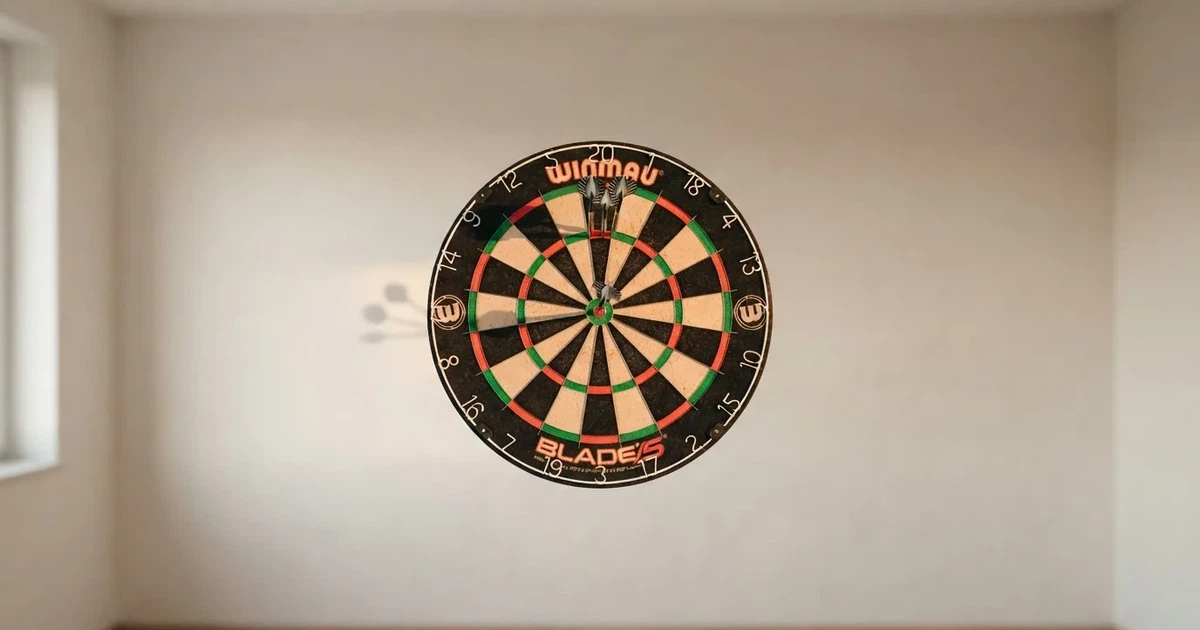
The two paths in front of a reader of this page are simple. One is to learn the shape of darts betting well enough to know which market is being offered and what a price is saying about it. The other is to pick a bookmaker whose markets, terms and pace match the way the reader actually bets. The first half of this guide covers the sport, the markets and the prices themselves. The second half compares the ten bookmakers licensed by the Gambling Commission that feature here, set against the criteria the first half establishes. The closing sections deal with what is and is not legal in Great Britain, with the offers the operators run, and with live and in-play betting once a match is on the oche.
*Current as of 30 October 2026; Gambling Commission public register for licence verification.*
Reading a price before you back one
The fundamental move in darts betting has three parts, and the first of them is the price. Decimal odds state how much a winning one-pound stake returns — stake plus winnings included. A price of 3.50 returns £3.50 for every pound staked: £1 returned as stake, £2.50 as profit. Fractional odds state the profit alone: 5/2 returns £2.50 profit on every £1 staked, plus the £1 stake back. To convert a fraction to a decimal, divide the top by the bottom and add one. 5/2 becomes 3.50; 9/1 becomes 10.00; 6/4 becomes 2.50. The two formats describe the same price.

The relation between price and probability is a single calculation. The implied probability of a price is the reciprocal of the decimal odds. At 3.50, the implied chance of that outcome is one in 3.5, or about 28.6%. At 1.50, the implied chance is two in three. This is the bookmaker’s *estimate* of probability, not the true chance, and the difference is what the next section is about.
In play, prices move before the throw is thrown. A player who lands a 170 finish on a televised leg sees their price shorten on most books within a second or two; a player who misses three darts at double sees theirs drift. The speed is partly the liquidity of the market and partly the speed of the in-play product. Live scores for the PDC circuit are carried on almost every major bookmaker’s site, and the live odds update at the same pace.
The mental move that makes prices read clearly is to compare two prices for opposing outcomes of the same market, side by side. That comparison is the bookmaker’s margin.
Where the bookmaker’s edge sits inside the prices
Every market has outcomes, and every outcome has a price. Add the implied probabilities of those outcomes together and the total comes to more than 100% in normal play. The excess is the bookmaker’s margin, sometimes called overround. It is the share of every pound staked that the book keeps on average, before any other cost is considered.
For a tennis-style two-way market with decimal prices of 1.90 and 1.90 — equal odds, no favourite — the implied probabilities are 1 ÷ 1.90 and 1 ÷ 1.90, each about 52.63%, totalling 105.26%. The payout share on this market is the reciprocal: 1 ÷ 1.0526, or about 95.0%. The margin is therefore 5.0%, again before any other consideration. The result holds for any market: divide one by the sum of the reciprocals to get the payout share, subtract from one to get the margin.
That margin is the most important number on this page. A price of 1.90 with a 5% margin looks the same as a price of 1.90 with a 3% margin, and the difference is a 2% change in the expected cost of every bet. On a £100 stake at the same true probability, the higher-margin book keeps about £2 more on average over many bets. Across a season, that compounds.
The band the margin usually sits in on darts outright winner markets is between roughly 4% and 8%, with a typical value around 5–6% on top events. Match-specific markets tend to be tighter on the headline 1X2-style market and a touch looser on the side markets — handicap 180s, highest checkout, total legs — because the book is pricing a less liquid proposition. Handicaps and totals are where the book makes more of its margin on a given match, and where a punter who watches a lot of darts has the most to read between.
The related figure is the payout share: 1 minus the margin. A market with a 5% margin pays back 95% of stakes, on average, across enough bets. Punters call this the theoretical return to the player, and bookmakers call it the payout. The higher the payout share, the lower the margin, the cheaper the book is to bet with over time. This is one of the few numbers that compounds cleanly across a season, and it is the one to compare across bookmakers when comparing two quotes for the same player to win the same match.
What the markets on darts actually look like
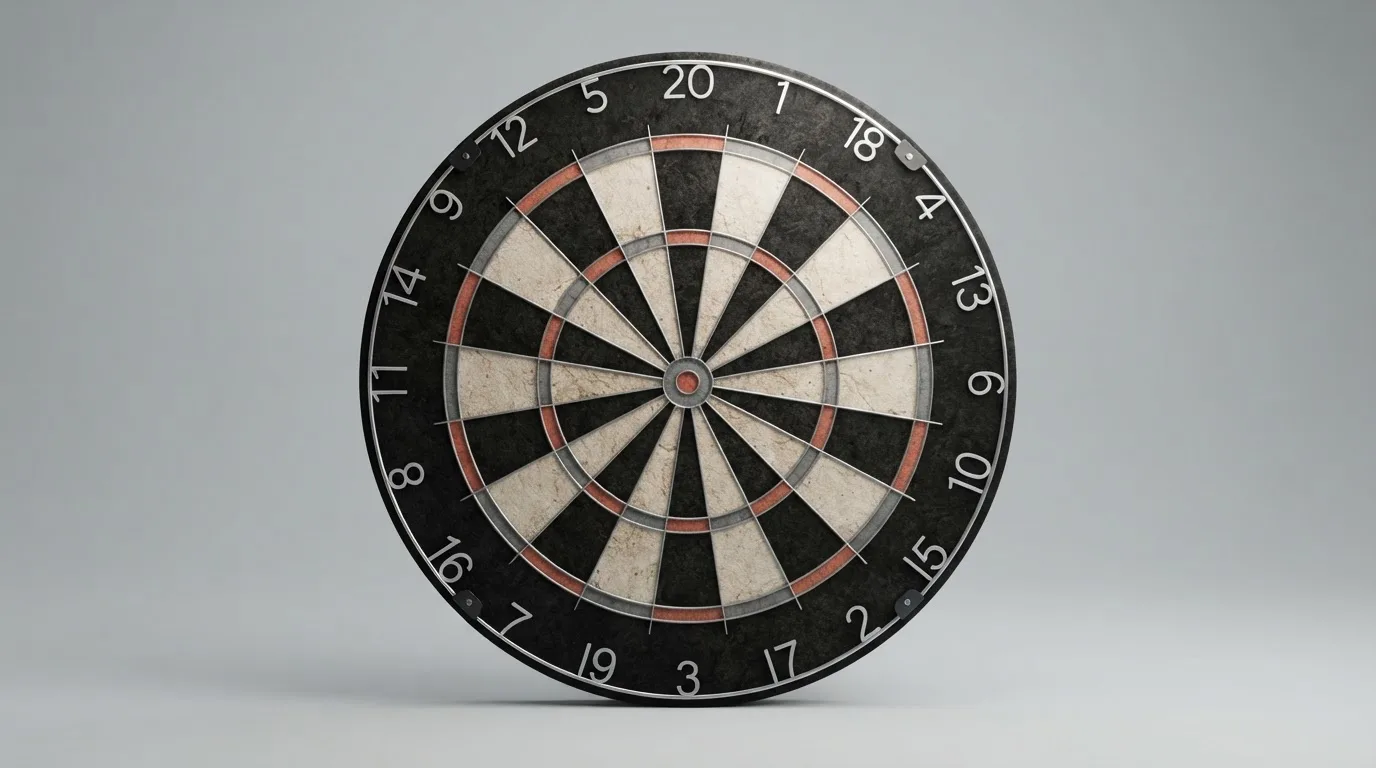
A standard dartboard has 20 numbered segments, each with single, double and treble areas; the bullseye is worth 50 and the outer bull 25. In 501 darts the player starts at 501 and must finish on a double or the bull, which sets the form of every televised leg. The standard throw distance is 2.37 metres, with the bullseye 1.73 metres above the floor. The shape of the sport, with its short legs and clear pauses, drives the markets a book offers.
The most common set of markets, in roughly the order a punter meets them on a betting slip, is:
- Match winner. Player A to beat Player B. Three-way in tournament play (which adds the draw after a specific number of legs), two-way in head-to-head stages. The headline market, usually the tightest price on the slip.
- Handicap. Player A starts the match at a leg disadvantage, expressed in legs or sets. The favourite is given a positive handicap to clear; the underdog a negative one. Settles on the official result with the handicap applied.
- Total legs / sets. Over or under a stated number of legs or sets in the match. Settles on the count at the conclusion of the match, with dead legs included.
- Highest checkout. Which player hits the higher finishing combination in the match, or whether a stated checkout value will be hit by either.
- Most 180s. Which player scores more 180s — the maximum with three darts — in the match, or whether a stated number will be reached by either or both.
- 170 finish in the match. A yes/no market on whether the highest possible three-dart checkout is hit by either player during the match.
- Correct score. The exact legs or sets scoreline, settled on the official result.
- Outright winner. Which player wins the tournament, settled at the conclusion of the final.
Side markets vary by stage of the competition. Group-stage matches carry a three-way result with a draw price; knockout matches do not. Tournament outrights carry a much wider field than match markets, and the margin on an outright tends to be wider than on a single match because the book is pricing more outcomes.
The Premier League Darts carries weekly evening meetings with a short field of invited players, and the books treat it as a season-long outright plus weekly match-by-match cards. The World Championship, by contrast, is a knockout from the first round, so a long-priced outsider at the start of the tournament can be backed at generous odds before the field narrows.
The shape of the season: where the action sits
The PDC is the highest governing body in darts alongside the World Darts Federation, and the PDC World Championship is held annually over the Christmas and New Year period. The tournament is darts’ flagship, and the longest outright market any book offers. The 2026 PDC World Darts Championship ran from 11 December 2025 to 3 January 2026 at Alexandra Palace, London, with 128 players, up from 96 in earlier editions. Luke Littler beat Gian van Veen 7–1 in the final; the prize fund was £5,000,000, with £1,000,000 to the winner. The rounds ran from first to 3 sets in rounds 1 and 2, first to 4 in rounds 3 and 4, first to 5 in the quarter-finals, first to 6 in the semi-finals and first to 7 in the final.
That format, with the format-shifting progression of sets across the rounds, drives the markets. A match in round 1 is shorter on average than a quarter-final, so the over/under on total legs settles at a lower line. A punt on Littler to win the tournament in 2025 went off at generous odds; by the final in early 2026 those same books had him as short as 4.00 to win the next edition, the price reflecting both the title defence and the calendar position. This is the rhythm the books price against.
Outside the World Championship, the televised calendar includes the Premier League Darts on Thursday evenings from February to May, the World Matchplay from the Blackpool summer, the World Grand Prix in late September and the Grand Slam of Darts in November. Each carries its own outright, weekly cards and side markets. The major TV events also carry streams on bookmaker sites for customers with funded accounts, which is one route into the action for a punter who does not already subscribe to a broadcaster.
The professional field is small enough that each bookmaker prices the top names from the same data, which compresses the headline match winner market. Liquidity is deepest on Littler, Humphries, van den Bergh, Smith and Aspinall, and the prices move quickly. Outside the top twenty names the book rounds more aggressively, often to the nearest 0.05 or 0.10, and the margin widens as a consequence.
Working out a return: stake, price and the formulas that sit behind them
A winning single returns the stake multiplied by the decimal odds. A £10 stake at 3.50 returns £35. The profit is stake times (odds minus 1): £10 × (3.50 − 1) = £25. The two figures say the same thing in two forms — one is the return, the other is the gain.
For a combined bet — a double, a treble, an accumulator — the prices of the legs multiply into one combined price. Two legs at 3.00 and 4.00 combine to 12.00. A £10 stake at 12.00 returns £120 if both legs win, with a profit of £110. The combined price is the only number that matters when the bet is placed; the legs’ prices are how the book built it. Each leg carries its own margin, so the combined margin is the compounded risk. Combined bets are how the book makes most of its margin on a busy betting day.
The free bet value formula is different. A free bet whose stake is not returned is worth less than the headline number suggests. The expected value of a £10 free bet at decimal odds of 4.00 is roughly £10 × (4.00 − 1) ÷ 4.00 × payout share, which on a 95% payout market gives about £7.13. The free bet is still worth claiming, but it is worth roughly 71% of its face value, not 100%. The size of the punt’s expected value depends on the price at which the free bet is placed: the higher the price, the closer to the face value the offer gets.
These three formulas — single return, combination price, free-bet expected value — are the only arithmetic the rest of this page relies on. They are arithmetic any reader can do with a phone.
Tips, predictions and the limits of forecasting
Search traffic on darts tends to cluster around three phrases: darts betting tips, darts betting tips today and darts betting today. They name the same activity — a forecast that combines form, head-to-head history and current prices — and they all run into the same limit: nobody knows the future. A tip that names a winner is a tip on a single event; a tip that runs over a season is a forecast about the distribution of results.
What a tipster can offer, and what a price is built on, is data. A bookmaker’s price is set by traders with form data, head-to-head, recent results and the live movement of comparable markets. A punter who has watched a season of televised darts and knows that a particular player averages 105 in the season but averages 96 against a particular opponent is doing the same thing the book does, slower and on one match. That is the value of the activity: knowing the shape of the form, the way a price responds to it, and the price at which the bet becomes worth taking.
A prediction-only offer — a free tip every Friday, a “best bet of the day” with a stake from the tipster’s money — is a marketing product. The tip inside it might be useful; the wrapper is a route to a deposit. Read the terms, never the tip, before acting on it.
Where the activity goes right is in the small print. The price a tip suggests may already have moved by the time the bet is placed. The bookmaker’s margin eats into every price. The combined bet applies the margin to each leg, so an acca of three legs is roughly three times as expensive per leg as a single. The free bet attached to the deposit is paid back as a stake-not-returned credit whose real value depends on the price at which it is staked. None of these costs is hidden, and a punter who reads them off understands the price in front of them.
The ten bookmakers on the comparison, and what each does well
The list below is the comparison the page returns to throughout the rest of the guide. Each bookmaker holds a Gambling Commission remote operating licence, which is what the regulator requires of any operator offering fixed-odds betting to customers in Great Britain. Each is licensed under the standard real-events betting category. Each has been reviewed against the criteria set out in this section — markets on the PDC circuit, in-play depth on televised legs, the offer attached to a first deposit, and the operational profile of the app and the customer service desk.
The order on the list is editorial and is not a ranking by quality. A bookmaker whose app is fast but whose outright market is narrow sits beside one whose outright market is generous but whose app is heavier; the reader is the one to weight those trade-offs.
LiveScore Bet — markets across football and the PDC
LiveScore Bet combines a sportsbook with the live scores product the LiveScore brand built on, and the site shows a clear card for the next televised PDC evening on the home page. The Bet Builder allows up to 10 selections and covers the major markets of a single match: match result, both teams to score, corners, total goals, player scoring and card markets. The Bet Builder’s coverage outside football is narrower, but its headline product, the live scores feed, is the same widget on every sport the site covers, which means the live tracking on darts is consistent with the rest of the product.
Gambling Commission remote licence 056859-R-332720-005; Commission account 56859; licence holder LiveScore Betting and Gaming (Gibraltar) Limited.
What sets it apart
The combined live scores and live odds product on the same screen, with the Bet Builder’s football depth, makes LiveScore Bet strong for a punter whose bets follow the live scores product rather than the betting slip alone.
Star Sports — phone-first service for the bettor who wants to talk
Star Sports keeps a phone desk that customers can ring to open an account, place bets or resolve queries at 08000 521 321, and a separate email address for written queries. The combined phone-and-online model suits a punter who wants to talk through a bet before placing it, particularly on a horse racing product that has been the company’s traditional focus.
Gambling Commission remote licence 009177-R-104555-019; Commission account 9177; licence holder Star Racing Limited.
What sets it apart
The phone desk, unusual among the brands on this list, is the kind of service a customer with a stake above the online ceiling — or a query on a non-runner — values. Outside horse racing the site is thinner than the rest of the comparison.
Kwiff — a different kind of price movement
Kwiff describes itself as a trademark operated by Spryme Ltd, with a 17+ App Store age rating. The product’s distinctive feature is the random “supercharge” on price — a punter’s stated odds may, at the moment of placement, be raised to a higher figure. The mechanism is a marketing layer on top of the standard sportsbook, and the typical user is a casual punter drawn in by occasional large prices rather than a steady singles punter with a portfolio.
Gambling Commission remote licence 044448-R-323408-017; Commission account 44448; licence holder Eaton Gate Gaming Limited.
What sets it apart
The supercharged price is a marketing device with occasional value. Where the underlying price is competitive the supercharged price is worth taking; where the underlying price is poor the supercharged price is still poor. Read the underlying price before reading the headline.
Unibet — long-running brand with a sports welcome offer
Unibet states it has operated since 1999, and its UK site is run by Platinum Gaming Limited, Gibraltar. The sports welcome offer is “Get £40 in Free Bets when you bet £20”: deposit and bet £20 or more at minimum odds of 2.0 (1/1); free bets expire within 7 days of issue; the offer is for new GB customers using a debit card or instant bank transfer. The terms are reasonable against the wider market — the 7-day expiry is on the shorter side, the £20 qualifying bet is at the higher end of the typical qualifying threshold — and the rest of the book is the standard multi-sport offering with in-play, cash out and a strong outright market on darts.
Gambling Commission remote licence 045322-R-324275-019; Commission account 45322; licence holder Platinum Gaming Limited.
What sets it apart
Length of operation and a familiar product. The welcome offer is best used by a punter who plans to bet through the £20 qualifier in the seven days after claiming, because the free bet expires on day 7. Beyond that, the breadth of the outright market and the strength of the live product are the strengths.
Betboro — modest welcome with a larger qualifying window
Betboro’s sports welcome offer is a 100% matched free bet of up to £25 on the first qualifying wager. The qualification is a debit card deposit of at least £10 and a first bet of £5 to £25 with at least three selections, each at 3/5 (1.60) or higher. The three-selection minimum means this is an offer for a punter who already planned an acca, not for one who backs singles. The matched ceiling of £25 is lower than the larger sign-up offers elsewhere on this list.
Gambling Commission remote licence 044181-R-324363-007; Commission account 44181; licence holder Webmedia Development N.V.
What sets it apart
A welcome offer calibrated to a punter who accas anyway. The qualifying minimum price of 1.60 on each leg shapes the kind of bet on which the offer is most efficiently used.
Tote — pool betting legacy on a digital product
Tote’s UK product is the digital home of the Tote brand, whose history is in pool betting on British and Irish racing. The site’s core is the pool product on horse racing, with fixed-odds sports as a side offering. The product suits a punter who wants access to Tote’s pool product from a phone, and who treats the sportsbook as a complementary product rather than the main one.
Gambling Commission remote licence 054779-R-331321-008; Commission account 54779; licence holder TDCO Limited.
What sets it apart
The pool product is the unique selling point. The fixed-odds sportsbook is functional but not the depth of the products higher on this list.
Copybet — best odds guaranteed all day, every day
Copybet offers Best Odds Guaranteed all day, every day on all UK and Irish racing, and pays first past the post on horse racing even if the winner is later disqualified. The “copy” framing on the brand is a peer-betting concept that has not migrated cleanly to the British market, but the BOG and FPTP terms on racing are concrete. The sportsbook is a newer line; the racing product carries more weight.
Gambling Commission remote licence 053774-R-330743-010; Commission account 53774; licence holder Copybet UK Limited.
What sets it apart
The all-day, every-day BOG on UK and Irish racing is generous against the typical 8am-onwards terms elsewhere. The sportsbook outside racing is still building depth.
Betway — a frequent-punter product on free bets
Betway’s Free Bet Club gives up to £10 in free bets every week after opt-in; spending £25 or more on sports earns 2 × £5 free bets. The product targets a punter who bets small but often, and who is happy to claim a small weekly reward rather than chase a single big welcome offer. The reward is modest but consistent, and the qualifying threshold is low.
Gambling Commission remote licence 039372-R-319367-029; Commission account 39372; licence holder Betway Limited.
What sets it apart
The weekly free-bet product for a small, regular stake. Best for a punter who plans to bet weekly anyway and can keep spend above the £25 threshold.
Betfred — deep sports and casino under one roof
The Betfred Sports, Casino & Games app is published by Done Brothers (Cash Betting) Ltd and covers 21 sports plus over 2,000 casino-style games. The depth on football and horse racing carries over from the high-street brand, with the darts product narrower but present on the televised schedule. The integrated casino product makes Betfred a familiar choice for a punter who previously bet in shop and wants the same brand on a phone.
Gambling Commission remote licence 039544-R-319290-010; Commission account 39544; licence holder Petfre (Gibraltar) Limited.
What sets it apart
Brand familiarity, an integrated casino product, and breadth on football and horse racing. Darts is present but not the front of the catalogue.
888sport — pre-match, in-play and a daily boosted line
888sport offers pre-match and in-play betting, Cash Out, Bet Builder, racing streams, BetFinder form tools, a live bet feed and daily boosted odds. The daily boosts are the headline of the marketing, with the practical product sitting underneath them: a full sportsbook with cash out and a bet builder, and racing streams for funded accounts. The product targets a casual punter with a phone.
Gambling Commission remote licence 039028-R-319297-014; Commission account 39028; licence holder 888 UK Limited.
What sets it apart
The daily boosted odds and the breadth of the small-features toolkit — BetFinder, live feed, racing streams — at a brand most casual punters already know.
A note on Spreadex and the spread betting register
Spreadex, which is regulated by the FCA for spread betting and by the Gambling Commission for fixed-odds betting, is included here only as a reminder that the spread side of the product carries losses that can exceed the deposit. Spread betting on darts price movements is a different product from fixed-odds betting on darts outcomes, and is not part of the comparison above. Where the regulator is the FCA, the consumer protection is the FCA’s, not the Commission’s.
A comparison of the ten bookmakers on this list, by licence and stated position
The table below sets each bookmaker against the licence number and the holder on the Gambling Commission’s public register, and a one-line note on what the operator’s own terms state on the headline offers and features the rest of this page covers. The order of the rows is the order in which the bookmakers are discussed above.
| Bookmaker | Licence status (per the Commission register) |
|---|---|
| LiveScore Bet | LiveScore Betting and Gaming (Gibraltar) Limited, Commission account 56859, remote general betting standard (real events); Bet Builder with up to 10 selections on a single match. |
| Star Sports | Star Racing Limited, Commission account 9177, remote general betting standard (real events); phone desk on 08000 521 321 to open or run an account. |
| Kwiff | Eaton Gate Gaming Limited, Commission account 44448, remote general betting standard (real events); random price supercharge on placement. |
| Unibet | Platinum Gaming Limited, Commission account 45322, remote general betting standard (real events); £40 free-bet welcome on a £20 qualifying bet at minimum odds 2.0, expiring within 7 days. |
| Betboro | Webmedia Development N.V., Commission account 44181, remote general betting standard (real events); £25 matched free bet on a £5–£25 qualifying acca, each leg at 1.60 or higher. |
| Tote | TDCO Limited, Commission account 54779, remote general betting standard (real events); pool betting as the core product, fixed-odds sports as a side line. |
| Copybet | Copybet UK Limited, Commission account 53774, remote general betting standard (real events); all-day BOG on UK and Irish racing and first-past-the-post settlement. |
| Betway | Betway Limited, Commission account 39372, remote general betting standard (real events); weekly Free Bet Club with 2 × £5 free bets after £25 of sports spend. |
| Betfred | Petfre (Gibraltar) Limited, Commission account 39544, remote general betting standard (real events); 21 sports plus over 2,000 casino-style games on a single app. |
| 888sport | 888 UK Limited, Commission account 39028, remote general betting standard (real events); pre-match and in-play with cash out, Bet Builder, racing streams, daily boosted odds. |
The numbers and the licence positions in this table come from the Gambling Commission’s public register and from each bookmaker’s own terms. Both move slowly; the register is updated as licences change, and the terms change as offers rotate.
Bonuses, free bets and what each one is really worth
The offers on this list fall into three families, and each family prices its cost differently:
Welcome bonus in money. A small matched deposit paid back as cash, withdrawable once wagering is cleared. The cost is the turnover at the stated wagering factor. At a 5x wagering factor on a £10 bonus, the punter has to place £50 of bets before withdrawing. Punters usually clear this fastest on the tighter margin markets — match winner on a televised leg rather than a 170-finish yes/no.
Free bet, stake not returned. The most common form. The headline figure is the stake; the value realised on the bet is stake × (odds − 1) ÷ odds × payout share. The earlier calculation gives roughly £7.13 expected value on a £10 free bet at 4.00 on a 95% market.
Enhanced odds and price boosts. A specific outcome pushed to a higher price, with stake usually returned and a max stake cap. The cost is the gap between the boosted price and the true price, which the book keeps if the bet loses; on a win the punter is paid at the boosted price with no wagering. This form is best used by a punter who was already going to back the outcome at the un-boosted price.
The wagering cap that now applies to bonuses at GB-licensed operators caps wagering requirements at 10x (so a £10 bonus requires no more than £100 of qualifying bets) and bans mixed-product promotions, the kind of “bet on football to get free spins” combination the regulator has closed off. The cap tightens the worst end of the bonus market and removes the cross-product hook that drove some of the largest advertised bonus values.
The expected cost of clearing a bonus through a margin is straightforward to calculate. Required turnover at 5x on a £20 bonus is £100. If the bets are placed on a market with a 5% margin, the expected cost is 5% of the £100, or £5. The remaining £15 of the bonus clears at a net cost of £5 on turnover; the offer makes sense, in money terms, when the expected return on the bets plus bonus exceeds the deposit cost. The figures balance if the bonus is at least 25% of the deposit and the punter bets at average odds. Smaller bonuses take longer to clear.
The deposits themselves are capped by the licensed operator’s deposit-limit controls, not by a state-set ceiling, so each punter’s exposure is a setting they can adjust in the account. Identity verification and a debit card or bank transfer remain the standard routes. Credit cards have been banned for gambling in Great Britain since 14 April 2020, including credit-card-funded e-wallet payments. Cryptocurrency deposits at licensed operators sit on the same footing as any other payment method: accepted or declined per the operator’s own terms, without a formal ban or formal endorsement.
Live betting, in-play and cash out on darts
Live darts is the most bettable live sport of the calendar outside horse racing. The legs are short, the breaks between legs are longer than between points in tennis, and the markets have natural checkpoints. A book that offers in-play on darts covers match winner, next leg, 180 in the next leg, highest checkout in the match, and total legs.
The cash out feature is settled at a price the book quotes on demand. It is most useful on a multi-leg acca where earlier legs have landed and the final leg is in play; cash out returns less than a full win but more than zero. The cash-out price is the book’s, and it typically incorporates a haircut to the live price.
The challenges of live betting on darts are the same as on any short-cycle sport. Prices move quickly, which means the price at the moment of placement may already be different by the time the bet is confirmed. The in-play product on mid-market matches is shallower than on televised matches, because the live data feed only covers the broadcasts the book has paid to carry. A punter betting in-play on a non-televised Challenge Tour match is betting on a thinner market.
The way to use live betting well is to decide before the match what the trigger conditions are. A punter who has decided to back a specific player in leg 5 of a match if they break throw in leg 4 has a decision rule that does not depend on the price at the moment. A punter who is going to back whoever is favourite at the moment is paying the live margin on every entry and exit.
Reading the licence number and what it tells you
The Gambling Commission is the body that regulates commercial gambling in Great Britain (England, Scotland and Wales). Northern Ireland is outside the Gambling Act 2005 and is regulated under different law, so a “GB-licensed” operator is licensed to deal with customers in those three nations but not with a customer whose address is in Belfast. The Commission’s public register is the authoritative list of who holds a licence, and the register can be searched by business name, trading name, domain or Commission account number.
To check a licence, take the Commission account number from a bookmaker’s terms and enter it on the Commission’s register. The register entry shows the licence holder — usually a corporate name that differs from the brand name — and the categories of licence held. For each entry on this list the categories are remote general betting standard (real events), which covers every fixed-odds sports bet the customer is likely to place. A pool-betting licence, a betting-intermediary licence, a casino or a bingo licence would each show separately on the register.
The register should be checked at the moment of the first deposit, not later. Licence conditions are amended and licences can be varied, suspended or revoked; the only way to be sure a brand holds an active licence today is to check today.
The minimum age at a licensed site is 18. Identity is verified before the first deposit or bet, including with a free bet or bonus, so a punter cannot open an account anonymously. The verification covers name, address and date of birth; at higher spend, source-of-funds questions follow. From a punter’s perspective, anonymous betting is not available at any site licensed by the Commission.
What the regulator does, and what it does not
The Commission licenses the activity; it does not license individual bets or bonuses. A promotion offered by a licensed operator is reviewed against the Licence Conditions and Codes of Practice and against the CAP Code (non-broadcast) and BCAP Code (broadcast), which the Advertising Standards Authority enforces. A complaint about an advert goes to the ASA. A complaint about a bet that has gone wrong goes to the licensed operator, with an approved alternative dispute resolution provider as a second port of call.
The Commission’s player-protection work focuses on three controls: GAMSTOP, the financial vulnerability check, and deposit-limit controls. GAMSTOP is a national multi-operator online self-exclusion scheme, mandatory for online operators since 31 March 2020. Exclusions run for six months, one year, five years, or five years with auto-renewal; after the minimum period the exclusion stays in place for a further seven years unless the punter asks GAMSTOP to remove it. GAMSTOP covers online sites and apps; betting shops use a separate service.
The financial vulnerability check applies when deposits minus withdrawals exceed £150 in a rolling 30 days. It is a public-record check (bankruptcy, county court judgments), not an income or credit-reference check. Financial risk assessments, the broader affordability checks announced in 2026 and staged without a start date, are a separate step. The two are not the same control and should not be confused.
Deposit limits are set by the punter, not by the regulator. The rules require the operator to offer a deposit-limit tool with a fixed time frame; the actual numbers are the punter’s choice. Help is available through GamCare, the National Gambling Helpline, GambleAware, the NHS gambling clinics and Gamblers Anonymous.
What happens if a site is not GB-licensed
A site that offers fixed-odds betting to customers in Great Britain without a Gambling Commission licence is committing an offence under section 33 of the Gambling Act 2005 (on summary conviction up to 51 weeks’ imprisonment, a fine up to level 5, or both; six months in Scotland). The offence is aimed at the operator. The customer who bets on such a site does not commit an offence under that section, but loses the protections a licensed site provides: no GAMSTOP coverage, no Commission complaints route, no approved dispute resolution body, and no British consumer redress if funds are withheld. The 10x bonus cap does not apply, and the £150 vulnerability check does not apply either, which means the offer can look more generous and the protections are thinner.
Enforcement is disruption, not blocking. The Commission can issue cease-and-desist notices, work with search engines to suppress unlicensed brands, work with registrars, hosts and payment providers, and now — under powers granted or about to be granted — obtain court orders for DNS blocking. ISP blocking of unlicensed sites is not yet in operation as a general measure. The framing that fits the facts is that licensed operators carry the checks, limits, GAMSTOP coverage and bonus caps, and unlicensed operators do not. Neither is “the safe choice” by default.
Tax: what the punter pays and what the book pays
The punter pays no tax on betting winnings in Great Britain. The bookmaker pays General Betting Duty on its gross profits at a current rate of 15%, with a new remote rate of 25% applying within it from 1 April 2027 on remote bets (UK horse racing, self-service betting terminals, pool betting and in-person betting remain at 15%). Until 1 April 2027 the remote rate stays at 15%. Whether operators pass duty on through the price is not established and should not be assumed; the comparison to make is across two operators’ headline prices on the same market.
Spread betting has its own rates (3% on financial spread bets, 10% on other spread bets). Spreadex, on this list, sits under both regimes — the FCA for the financial side, the Commission for the fixed-odds side. The other nine are Commission-only.
A professional gambler should ask HMRC or an adviser about their position; the body of this page is general information, not tax advice.
The shape of a good bet on darts
Three habits separate the punters who beat a darts book over a season from the punters who do not. The first is to log the price at the moment of placement, so the margin is known, not guessed. The second is to back at the tightest margin of the available markets — match winner on the most televised events — rather than the looser-margin side markets. The third is to read the bonus terms before claiming: the wagering factor, the minimum odds on the qualifying bet, the deadline on the free bet, and the cap on free-bet winnings.
A punter who picks the book whose welcome offer fits the bets the punter was already placing, who logs the margin on each bet, and who stays on the headline market on televised events is doing the work. A punter who chases the latest boosted price, who backs the live market on a non-televised match, and who claims every offer in rotation is paying the marketing tax the book wants them to pay.
The comparison earlier in this page ranks the bookmakers on licence and on their stated offers and features. What the comparison does not do is pick one for the reader. The decision belongs to the reader, against what the reader already knows about the shape of their bets. The bookmakers are well-matched on licence; the differences are in product depth, in the welcome offer, and in the small features (cash out, Bet Builder, racing streams, weekly free bets) that fit one punter’s rhythm better than another’s.
Frequently asked questions
How do you bet on darts?
Pick a licensed bookmaker from the comparison above, open an account with debit card or bank transfer, pass the identity check, deposit and place a single stake on the match winner market for the first televised match you watch. A 1.90-style match winner with the stake returned on a win and a confirmed settled bet within an hour of the match ending is the simplest starting bet. The margin on this market is the smallest figure on the slip and the easiest one to track.
What is darts betting?
Darts betting is fixed-odds wagering on the outcomes of a darts match or tournament. The set of markets runs from match winner (one of two or three outcomes) through handicaps, total legs, highest checkout, most 180s and correct score, to outright winner on a tournament. Each market is priced in decimal odds; the prices on opposing outcomes carry the bookmaker’s margin. Betting on darts is permitted at any operator licensed under the Gambling Act 2005 for the remote general betting standard (real events) category in Great Britain, and on no fewer than the ten brands on this list.
How does darts handicap betting work?
The favourite starts the match at a leg or set deficit, expressed as a positive number: a -3.5 leg handicap means the favourite has to win by four or more legs; a +3.5 leg handicap on the underdog means the underdog can lose by up to three legs and still cover. Settles on the official result with the handicap applied. Same numbers, reversed sign, on the underdog. Handicap prices are tighter per unit than outright prices, since the payout is being redistributed across one outcome rather than two.
How do I check a bookmaker holds a Gambling Commission licence?
Go to the Commission’s public register, search by business name, trading name, domain or Commission account number. The register entry shows the licence holder, the categories of licence held, and the current status. The Commission’s account number is published on every licensed operator’s terms page, usually at the foot of the page. None of the bookmakers on this list are licensed for the categories shown in any way other than the categories shown.
How is the return on a bet worked out from the stake and the odds?
Multiply the stake by the decimal odds. A £10 stake at 3.50 returns £35 — that is the £10 stake plus £25 of profit. The profit-only figure is stake × (odds − 1). For a combined bet, multiply the prices of the legs together to get the combined price; the same formula gives the return. For a free bet whose stake is not returned, the value to the punter is stake × (odds − 1) ÷ odds × payout share, which on a 95% payout market returns roughly 71% of the face value in expectation.
What is the bookmaker’s margin and how can it be seen in the odds?
The margin is the share of every pound staked the bookmaker keeps on average across all outcomes of a market. To see it, take the decimal prices on every outcome, work out their reciprocals (1 ÷ price), add them together and subtract from 1. The result is the margin. Two prices of 1.90 each have reciprocals of about 0.5263 each, totalling 1.0526; the margin is therefore 0.0526, or 5.3%. The remaining 94.7% is the payout share. The tighter the margin, the cheaper the book is to bet with over time; the wider the margin, the more the punter pays in expectation.
Tennis, darts & cue sports – systembetsguide.com
Content created by the «systembetsguide.com» team
