
Futsal odds, margins and the markets behind them — a guide for UK bettors
 Available in US
Every price a bookmaker publishes on a futsal match is a small arithmetic object: the implied probability of each outcome, plus the slice the book keeps for itself. Once a bettor sees that shape, the marketing around “best odds” and “boosted prices” becomes legible rather than persuasive. This guide walks through the sport itself, the markets a futsal match produces, the calculation that decides what a bookmaker’s margin costs, and the licensed UK bookmakers that carry futsal at all — in that order, because each step builds on the one before it. The angle is choice: which path suits which reader, where the marketing word diverges from the contract in the small print, and what the numbers look like once a punter stops taking the headline at face value.

_Article data current as of 30 October 2026; licence claims verified against the Gambling Commission’s public register._
Futsal predictions and strategy: how a tip becomes a price
A “futsal betting tip” is only as good as the inputs that fed it. Form, head-to-head, fatigue, court surface, the discipline record of each side, the goalkeeper rotation — these are the raw observations a tip turns into a probability, and a probability is what a price represents. The point is rarely the tip itself; it is what the tip implies and whether the market has priced it.

What a futsal tip actually contains
A tip is a statement about the most likely outcome of a specific market — match result, total goals, handicap, BTTS, first-goal scorer. Behind that single line is a chain of assumptions: how many goals each side scores per 20-minute period at this level, how substitutions reset the rhythm late in each half, how a red card or an accumulated-foul free kick from the second penalty mark shifts the expected goal rate. The market does not see those assumptions; it sees two, three or four numbers attached to outcomes. The tip’s job is to convert the assumptions into an implied probability, then to compare that probability with the price on offer.
A practical tip — one a punter can use — names the market, the price, the stake plan and the reason in one sentence each. “Back the home side on the -1.5 Asian handicap at 1.95 because they have won three on the spin and the visitors rotated the keeper midweek” is a tip. “Futsal tips today” is a search result.
Bankroll, forecast and the analytics habit
Bankroll management is the discipline that decides whether a forecast survives a bad week. The standard approach — fixed unit, no more than a small single-digit percentage of the bank per selection, no chase — exists because futsal seasons are short and variance is high. A 30-match season in some domestic leagues leaves little room for a punt who doubles the stake after each loss. The forecast is a probability; the bankroll is the part that survives the forecast being wrong, which it will be roughly a third of the time on any 1X2 market priced near evens.
Stats software for futsal is thinner than for football. Public data feeds cover senior FIFA tournaments and the larger European leagues; everything else is reconstructed from match reports, club social channels and federation sites. A punter who wants to beat the margin has to assemble their own expected-goals model from those fragments, or accept that the bookmaker’s margin is the tax they pay for the convenience of someone else’s price.
Bet types and odds: how a futsal match becomes a market
Futsal produces a small but well-defined set of markets because the sport itself is small and well-defined: two 20-minute periods, two teams of five, up to nine substitutes and unlimited changes, no offside in the football sense, accumulated-foul free kicks from the tenth metre once the count passes five in a period. Each of those features translates into a market.
The 1X2 and the two-way price
The match-result market is straightforward in shape but rarely priced the way it appears. A draw in futsal is common — regulation finishes level in roughly a quarter of top-level fixtures — but it is not the third of all outcomes a decimal 1X2 suggests, because regulation runs only 40 minutes and futsal goes to extra time and penalties in knockout fixtures. The pre-match price on a draw therefore sits a little higher than the true probability of a draw in regulation, and a little lower than the true probability of an outright draw across all 50 minutes.
Two-way markets — over/under a goal line, BTTS yes/no, handicap lines set to a half — sidestep the draw entirely. They are easier for a bookmaker to balance because there are only two outcomes, and the margin is taken from both sides in roughly equal measure.
Combination bets and the multiplication of odds
A combination bet — a double, a treble, an accumulator — multiplies the decimal prices into one. Two legs at 1.90 each return 3.61 if both win; three at the same price return 6.86. The combined price is honest about the multiplied probability but quietly multiplies the bookmaker’s margin too. A 5% margin on each of three legs is roughly 14% on the combined price before any leg is added or removed. Accumulators are how a small stake returns a headline-grabbing figure; they are also how the house takes its largest slice.
A Lucky 15 — 15 bets across four selections, including four singles, six doubles, four trebles and one four-fold — totals stake as unit stake times 15. A Heinz — 57 bets across six selections — multiplies by 57. A Goliath across eight selections is 247 bets. The structure is mechanical; the cost is whatever the unit stake is, multiplied by the number of bets.
Cash out, each-way and the British market vocabulary
Cash out lets a bookmaker close a position mid-event for a price it sets. On a multi-leg accumulator the cash-out figure is recalculated leg by leg as the live prices shift. It is a tool for the bettor who wants to lock in profit before the final leg, and a tool for the bookmaker who wants the bettor to settle a winning position before the closing leg pays out. Each-way betting doubles the stake — one bet on the win, one on the place — and is a fixture of British horse racing more than futsal, but a few bookmakers apply each-way markets to outright tournament futures.
Futsal tournaments and fixtures: what the calendar actually carries
Futsal’s competitive calendar is international, dense, and patchy in its UK coverage. The sport originated in Montevideo in 1930, created by Juan Carlos Ceriani for the YMCA movement, and FIFA is the highest governing body. The first FIFA futsal World Cup was held in 1989; the inaugural FIFA Futsal Women’s World Cup took place in the Philippines in 2025. Outside FIFA, UEFA runs the continental club and national competitions for European sides.
The court, the ball and the rules a punter reads
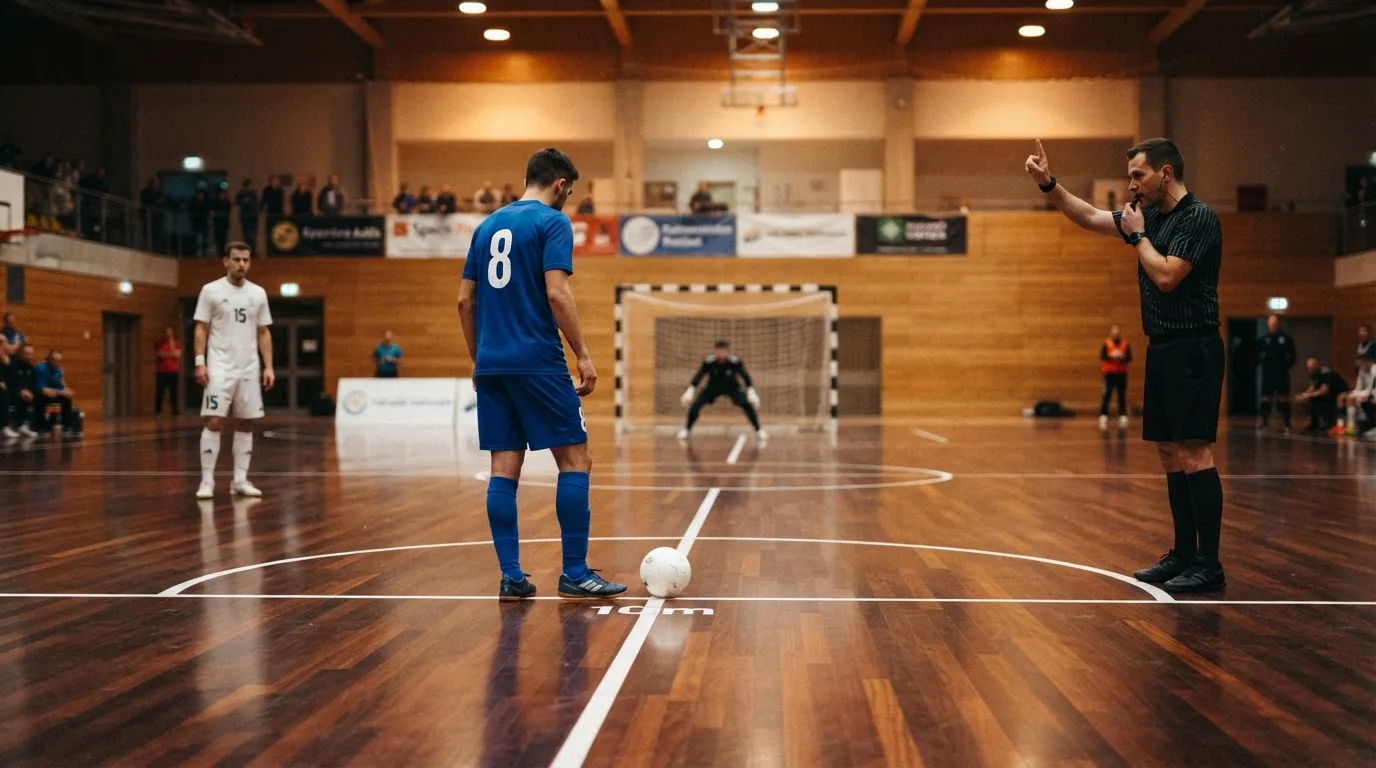
The standard international futsal court is 40 metres by 20 metres. The ball is size 4 — smaller and heavier than a size 5 football, with a lower bounce — and that single fact shapes how the game is played. The ball stays on the deck; the technique is closer to five-a-side than to football. A match is two 20-minute periods with the clock stopping at dead-ball situations, and each side has one one-minute timeout per period. From the sixth accumulated foul in a period the opposing team is awarded a direct free kick from the second penalty mark, ten metres from goal, with no wall allowed to form — the equivalent of a penalty in everything but name.
Those rules are what the markets price. Six-foul thresholds matter for totals and handicap markets because free kicks from ten metres with no wall convert at a high rate. Substitutions matter for live markets because a tired side rotates and a fresh one pushes. Two 20-minute halves with stoppage matter for in-play timing, because the clock is not the clock the television shows.
Where the fixtures come from
For the punter the practical question is which competitions the licensed bookmakers actually carry. Major domestic leagues — Brazil’s Liga Nacional de Futsal, Spain’s Primera División, Portugal’s Liga Placard, Russia’s Superliga before its removal from most western platforms — sit alongside UEFA’s Futsal Champions League and FIFA’s World Cup and continental cups. Friendly tournaments fill the gaps. The volume of fixtures is small compared to football, so the market depth is shallow and prices can move quickly when a single respected syndicate places a wager.
The top 10 UK-licensed bookmakers that cover futsal
The list below is built from the Gambling Commission’s public register: every brand named is a holder of a remote general betting standard licence for real events, the licence category that covers pre-match and in-play sports markets on actual fixtures. The order is not a ranking and not a recommendation; it is the set the Commission lists against each of these account numbers, and the way the brands line up on futsal coverage, market depth and small-print conditions.
The brands are described below in alphabetical order, each in the same five-field pattern: licence holder and account number; what the operator’s own terms state on futsal, on welcome offers and on live features; and a one-sentence verdict on where the brand lands.
BetVictor — Best Odds Guaranteed on racing, racing-led sportsbook
BetVictor runs under BV Gaming Limited with Gambling Commission account 39576. The brand is best known for British and Irish horse racing — Best Odds Guaranteed is offered on UK and Irish racing, with enhanced live race streaming and a BetFinder tool for finding racing bets, alongside Smart Stats. Futsal sits within the wider sports menu rather than at the front of it; prices on major FIFA and UEFA events are typically available, but the depth on lower-tier domestic futsal is shallow.
The welcome is racing-adjacent: a sports free-bet offer exists alongside the racing product, and the small print on each promotion is operator-specific. The smart stats feature is built around football, with team-level expected-goals numbers and form; for futsal the data feed is thinner. Cash out and bet builder are present in the standard form.
The verdict: BetVictor suits the punter who treats futsal as a side interest inside a racing-led account and wants Best Odds Guaranteed on the racing days. A futsal specialist will find the depth thin.
BoyleSports — Irish-rooted bookmaker with a UK remote licence
BoyleSports runs under Boylesports Enterprise with Gambling Commission account 39469. The sports welcome offer for UK players is £20 in free bets when a £10 bet is placed, with a parallel €30 in free bets for a €10 bet for Irish customers. The brand carries football, horse racing and a wide secondary menu; futsal coverage sits inside the football menu with the major FIFA and UEFA competitions priced.
The site is a standard fixed-odds sportsbook with pre-match and in-play menus, a bet builder feature and cash out on selected markets. Promotions are stated per term: free-bet offers, profit boosts and acca insurance run alongside the welcome.
The verdict: BoyleSports is a competent generalist with a small welcome that needs a £10 trigger and is paid back as free bets. A punt who wants one app that handles racing, football and the occasional futsal fixture fits this profile.
Copybet — all-day Best Odds Guaranteed and first-past-the-post payouts
Copybet runs under Copybet UK Limited with Gambling Commission account 53774. The brand’s distinctive terms are racing-specific: Best Odds Guaranteed is offered all day, every day on all UK and Irish racing, and the book pays first past the post on horse racing even when the winner is later disqualified. Those rules are the firm’s selling point. Sports coverage beyond racing sits inside the standard menu; futsal prices are present on major events but are not the headline product.
The welcome offer and ongoing promotions are stated in the brand’s own terms, with free-bet offers alongside the racing product. A bet builder feature is present in the standard form, and the in-play menu covers football, tennis and the major US leagues.
The verdict: Copybet suits the punter whose racing interest is large enough that all-day BOG and first-past-the-post payouts matter. Futsal is a side order here, not the main course.
DragonBet — Welsh-rooted bookmaker with British sports lean
DragonBet runs under DragonBet Ltd with Gambling Commission account 64908. The brand’s app emphasises Welsh football and rugby alongside racing, American football, in-play betting and bet builder markets. Futsal sits within the wider menu at a thin depth — major FIFA and UEFA events are priced; lower-tier domestic leagues are not always covered.
The welcome is stated in the app’s own terms and runs alongside Welsh-rugby and British-racing promotions. Live coverage is the standard in-play product with cash out on selected markets. The site’s English-language materials note the Welsh sports focus.
The verdict: DragonBet is for the punt who wants a British small-stakes bookmaker with a strong Welsh identity. Futsal depth is limited to top-tier events.
Fitzwilliam Sports — Dublin bookmaker with capped membership and a High Stakes Welcome
Fitzwilliam Sports runs under SBKI Limited with Gambling Commission account 48760. The brand describes itself as a Dublin bookmaker with capped membership; the welcome is a “High Stakes Welcome” subject to compliance criteria, meaning that the offer is sized for higher-stakes customers and the small print on eligibility is read carefully. Fitswilliam offers instant deposits, fast withdrawals, timeouts and deposit limits, and links to GambleAware, GamStop and Gamblers Anonymous on its own materials.
Futsal coverage is not the headline; the brand is built around horse racing and Irish-rooted sports with a small-membership model that limits the depth of any given market. A punter looking for a quieter book with stricter limits may prefer this profile.
The verdict: Fitzwilliam Sports is for the higher-stakes punter who values capped membership and is comfortable with the High Stakes Welcome’s compliance criteria. Futsal coverage is present at the major events only.
Hollywoodbets — stake-back accumulator welcome and South African roots
Hollywoodbets runs under Hollywoodbets International UK Limited with Gambling Commission account 53028. The brand’s sports welcome offer: new players who deposit £10 or more by card get their stake back as a free bet of up to £30 on their first qualifying losing accumulator — stake £10+, three or more legs, odds of 4/1 or greater, settled within seven days; one free bet per customer. The marketing word is “free”; the contract is stake-back on a losing accumulator, paid as a free bet whose stake is not returned with a win.
Futsal coverage sits inside the football menu with the major FIFA and UEFA events priced. In-play and bet builder features are present in the standard form. The brand has a South African roots identity visible in its sportsbook marketing.
The verdict: Hollywoodbets suits the punter who wants an accumulator-led welcome with a £10 entry point. Futsal depth is moderate; the headline offer is the accumulator insurance, not the futsal coverage.
NetBet — Daily Boosts, Profit Boosts and free-bet offers with a Bet Builder
NetBet runs under Netbet Enterprises Limited with Gambling Commission account 39170. The brand offers Daily Boosts, Profit Boosts and free bet offers, plus a Bet Builder with instant dynamic odds and sports stats for major leagues. The welcome and ongoing promotions are stated in the app’s own terms.
Futsal coverage is present on major FIFA and UEFA events within the wider menu. The bet builder is built for football but applies to selected futsal fixtures where the bookmaker has priced the component markets; instant dynamic odds are a feature of the builder rather than of every market. Sports stats cover the major football leagues at depth.
The verdict: NetBet is for the punter who wants a builder-led product with daily boosts. Futsal depth runs to top-tier events.
Spreadex — fixed-odds and spread betting in one app
Spreadex runs under Spreadex Limited with Gambling Commission account 8835. The brand is distinctive because it combines fixed-odds and spread betting in a single app, with one-click, auto and partial cash out, Bet Builder across fixed odds or spreads, and live streaming of UK and Irish horse racing, greyhounds, tennis, NFL and selected football. Spread betting losses can exceed the deposit — that is a feature of the spread product, not a bug, and it is a regulatory disclosure on the brand’s own materials.
Futsal coverage on the fixed-odds side is present on major events; on the spread side it is rarely priced, because spread betting on a low-scoring indoor sport produces narrow markets. The brand is regulated by the FCA for the spread product and by the Gambling Commission for the fixed-odds product.
The verdict: Spreadex is for the punter who wants spread and fixed-odds under one roof and accepts the spread-product disclosure that losses can exceed the deposit. Futsal fits the fixed-odds side at a thin depth.
BetTom — 50% back as a free bet and matching casino offer
BetTom runs under Bet Tom Limited with Gambling Commission account 64959. The brand’s sports welcome is 50% back as a free bet of up to £50, with a matching 50% back up to £50 as free slot funds for casino play — full terms apply on both halves. The welcome is two-sided: the sports side returns a free bet, the casino side returns free slot funds, and each runs its own wagering and expiry conditions.
Futsal coverage sits inside the football menu at a moderate depth; in-play and bet builder features are present in the standard form. The brand’s UK materials run in English and the sportsbook uses standard decimal and fractional pricing.
The verdict: BetTom suits the punter who wants a sportsbook with a parallel casino offer and is comfortable reading two sets of small print. Futsal coverage is moderate.
Betmaster — football, racing and eSports menu
Betmaster runs under BM Solutions GB Ltd with Gambling Commission account 65699. The brand’s app covers football, cricket, horse racing, NFL and eSports — League of Legends and Dota 2 — with a standard fixed-odds product and in-play menus. Futsal coverage sits inside the football menu at a thin depth; the brand’s eSports lean is its distinctive angle.
The welcome is stated in the app’s own terms; promotions include free-bet offers, profit boosts and acca insurance in the standard fixed-odds product. The brand carries standard decimal and fractional pricing.
The verdict: Betmaster is for the punter who wants a football-and-eSports-led book with a thin racing offering. Futsal depth is shallow.
Landmarks across the comparison
| Operator | Licence holder (Gambling Commission account) | What the operator’s own terms state on futsal |
|---|---|---|
| BetVictor | BV Gaming Limited (39576) | Futsal priced inside the football menu on major FIFA and UEFA events; depth thin at lower tiers. |
| BoyleSports | Boylesports Enterprise (39469) | Futsal inside the football menu on major events; standard fixed-odds product. |
| Copybet | Copybet UK Limited (53774) | Futsal inside the wider sports menu; racing product dominates the marketing. |
| DragonBet | DragonBet Ltd (64908) | Futsal priced on top-tier events inside a Welsh-rooted sports menu. |
| Fitzwilliam Sports | SBKI Limited (48760) | Futsal priced on major events only inside a capped-membership product. |
| Hollywoodbets | Hollywoodbets International UK Limited (53028) | Futsal inside the football menu; the headline product is the accumulator welcome. |
| NetBet | Netbet Enterprises Limited (39170) | Futsal inside the football menu; builder-led product with daily boosts. |
| Spreadex | Spreadex Limited (8835) | Futsal on the fixed-odds side only; the spread product is rarely priced on indoor sports. |
| BetTom | Bet Tom Limited (64959) | Futsal inside the football menu; the welcome is sports-plus-casino in parallel. |
| Betmaster | BM Solutions GB Ltd (65699) | Futsal inside the football menu at a thin depth; the brand leans to eSports. |
The comparison is on licence and stated product, not on futsal depth specifically — no UK bookmaker runs futsal at football depth — and a reader who bets on futsal occasionally will find the same fixtures priced at similar margins across the set. The differences sit elsewhere: welcome offers, racing features, builder product, and the spread-betting distinction at Spreadex.
Futsal betting in Great Britain: the legal frame
Great Britain has no statutory list of permitted sports or permitted betting markets. A bookmaker serving customers in Great Britain needs a Gambling Commission licence, and the Commission’s public register is the whole test of who holds one. Since the Gambling (Licensing and Advertising) Act 2014 an operator whose remote facilities are used in Great Britain needs a Commission licence wherever it is based — a Curaçao, Maltese or Gibraltar licence is not a substitute. There is no state monopoly and no cap on the number of licences.
What the licence categories mean
The remote general betting standard (real events) licence is the category every bookmaker named above holds. It covers pre-match and in-play sports markets on actual fixtures — which is what a futsal match is. The remote general betting standard (virtual events) licence is a separate category for computer-generated events; futsal sits under the real-events category, not under virtuals. The remote betting intermediary licence is the category for betting exchanges; the remote pool betting licence covers pool products on racing. A brand that holds only a casino licence cannot lawfully take a futsal wager in Great Britain.
Verification, age and the small print
Minimum age is 18. Name, address and date of birth are verified before a customer can deposit or gamble — that rule has applied since 7 May 2019, and it covers a free bet or bonus as much as a real-money stake. Credit cards are banned for gambling in Great Britain (since 14 April 2020), including credit-card-funded payments through an e-wallet; debit cards and bank-based payments are not covered by the ban.
Off-course and in-play
Off-course pool betting on horse or dog racing is a separate licence and duty. In-play betting is offered by GB bookmakers under their licence conditions and customer-protection duties; there is no statutory list of which markets may be in-play and which may not, and a punter should not read “in-play” as a legal conclusion about the underlying event. Spread betting that is not a financial product is inside General Betting Duty; financial spread betting is regulated by the Financial Conduct Authority and sits outside the Commission’s remit.
What the Commission does not do
The Commission does not license advertising. Marketing is regulated by the ASA under the CAP Code (non-broadcast) and BCAP Code (broadcast), alongside the Commission’s own LCCP marketing conditions. The Commission does not set stake limits in sports betting — operators set their own maximum stakes and may restrict customers individually. There is no state-set deposit or loss ceiling for betting; limits are the customer’s choice, set inside the operator’s product.
Safer gambling: tools a licensed bookmaker has to offer
Every operator listed above is a member of GAMSTOP, the national multi-operator online self-exclusion scheme, because membership is a mandatory licence condition for online operators since 31 March 2020. Self-exclusion periods are six months, one year, five years, or five years with auto-renewal; after the minimum period the exclusion stays in place for a further seven years unless the customer asks GAMSTOP to remove it. GAMSTOP covers online sites and apps; betting shops use a separate service.
Deposit limits and the deposit-limit timeline
Operators must offer a gross deposit limit on a fixed time frame under RTS 12. The first changes have applied since 31 October 2025; a second phase was postponed to 30 September 2026, and whether it is live is not established at the time of writing. The practical point is that a licensed operator will offer a deposit-limit tool on the account — the punter’s job is to set it before play begins.
Financial vulnerability and risk-assessment checks
A financial vulnerability check applies to licensed remote betting when a customer’s deposits minus withdrawals exceed £150 in a rolling 30 days (since 28 February 2025). It is a public-record check — bankruptcy or county court judgments, for instance — not an income check and not a credit reference check. Financial risk assessments have been announced in a staged plan (Commission article of 7 July 2026), with no start date — they are not yet in force.
Where to get help
GamCare runs the National Gambling Helpline. GambleAware funds treatment and research. The NHS runs gambling clinics in several regions. Gamblers Anonymous runs peer-support meetings. Each licensed operator’s site links to these services from the responsible-gambling section; a punter who is concerned about their play should reach for those links rather than for another deposit.
Bonuses and free bets: what the marketing word actually costs
A “free bet” is a stake the operator gives the punter. The stake is usually not paid back with a win: a £10 free bet at decimal odds 2.00 returns £10 in profit and zero of the original £10, so the headline figure is half of what a real-money bet at the same odds would return. The marketing word is “free”; the contract is a stake that does not return. That gap is the single sharpest line on a free-bet page, and a punter who reads the small print sees it immediately.
Wagering requirements and the 10x cap
Promotion rules in force since 19 January 2026 cap wagering requirements on bonuses at 10x — a £10 bonus at 50x would have needed £500 of bets before withdrawal; under the cap no more than £100 is required. The cap applies to bonuses; whether it applies to free bets with no wagering condition, and any cap on the money value of a bonus, are not established at the time of writing. Mixed-product promotions — an offer that requires gambling on two or more product types such as betting, casino, bingo and lottery — are banned under the same rules.
The free bet at a price, in numbers
A free bet at decimal odds of 4.00 on a market with a 5% margin is worth, on average, free-bet amount × (odds − 1) ÷ odds × payout share. For a £10 free bet at 4.00 with a 95% payout share, the average value is £10 × 3 ÷ 4 × 0.95, or roughly £7.13 — not £30, not the headline price times the stake, and not the stake back. The expected value of the free bet is a function of the price the punter takes and the margin the bookmaker runs.
Where the cap meets the offer
Hollywoodbets’ sports welcome offer — stake back as a free bet of up to £30 on a first qualifying losing accumulator, stake £10+, three or more legs, odds of 4/1 or greater, settled within seven days — is the kind of offer that lands inside the cap cleanly. The free-bet value is bounded by the stake; the wagering is zero; the marketing word is “free”; the contract is a stake that does not return and a window that closes at seven days.
Live futsal betting and cash out: the in-play menu
Live futsal betting is offered by UK-licensed bookmakers; in-play is a feature of the licence rather than a separate permit. The market depth is shallow because the fixture list is shallow: a live futsal match on a Sunday afternoon is one of perhaps a dozen events across all UK books, and the in-play market will close if liquidity drops or the score moves sharply.
What cash out actually does
Cash out lets a bookmaker close a position mid-event for a price it sets. On a multi-leg accumulator the cash-out figure is recalculated leg by leg as the live prices shift. It is a tool for the bettor who wants to lock in profit before the final leg, and a tool for the bookmaker who wants the bettor to settle a winning position before the closing leg pays out. The bookmaker’s margin is built into the cash-out price; the cash-out figure is rarely the same as the true value of the position at that instant, and a punter who relies on cash out accepts that.
The clock and the substitutions
Futsal’s clock stops at dead-ball situations, so live markets that key off the game clock — total goals at minute 30, next goal timing — carry their own risk because “minute 30” means different things on different bookmakers’ feeds. Substitutions are unlimited, so a tired side rotates without limit and a fresh goalkeeper can shift the expected goals. In-play markets priced on the assumption of a fixed eleven are mispriced when the line-up changes mid-period, and a punter who watches the match has an edge the live price does not always reflect.
How a price is built: the margin that sits inside every line
The bookmaker’s margin is the slice of every unit staked that the book keeps on average. It is hidden inside the prices: each outcome is priced so that the implied probabilities add up to more than 100%, and the excess is the margin. The arithmetic is the inverse of the odds.
The illustrative two-way market
Take an illustrative two-way market at decimal odds of 1.90 on each side — fractional 9/10, the standard “odds-on” line. The implied probability on each side is 1 ÷ 1.90, or roughly 52.6%. Added across both outcomes, the implied probabilities are 105.3%; the excess over 100% is the margin. The payout share — the proportion of every unit staked that is returned to winners on average — is 1 ÷ 1.05, or roughly 95.2%. The margin, stated on the other side of the same coin, is roughly 4.8%, give or take the rounding.
A real market does not present itself as a clean 1.90 / 1.90. A stronger favourite might be at 1.55 with the outsider at 2.55; the implied probabilities add up to roughly 103.7%, an overround of 3.7% and a margin of about 3.6% on that line. A balanced match might be 1.90 / 1.90; a one-sided match might be 1.35 / 3.30 with implied probabilities of about 104.4%. The margin is the bookmaker’s cut, and the bookmaker does not need to win every match to make money — it needs only the margin across enough bets.
The margin as a band, not a point
The margin on a single futsal line is one figure; the margin on a market across a season is a band that depends on the bookmaker’s book. A bookmaker running a tight 3% margin on Premier League football might run a 7-8% margin on a low-tier futsal league because the liquidity is thinner and the risk is harder to lay off. A punter who reads a single price sees one slice; a punter who reads a season’s worth of prices sees the band’s centre. State the result as a band with its condition: “roughly 5% on a balanced two-way line at 1.90 / 1.90, and rather higher on the smaller leagues”, never “5% on futsal” — the line matters.
Why the headline price is not the whole story
A “best odds” headline price on a single fixture is one observation from a noisy process. The margin on that single fixture might be 2% if the bookmaker wanted the line; the margin on the season’s worth of fixtures the punter actually bets on is the relevant figure. The arithmetic above is the answer to “what does this bookmaker keep of every unit I stake on this market”: roughly 5% on a balanced two-way line, with the understanding that real markets carry their own variation.
Frequently asked questions
How does someone bet on a futsal league?
A licensed UK bookmaker carries major futsal leagues — Brazil’s Liga Nacional, Spain’s Primera División, Portugal’s Liga Placard, the UEFA Futsal Champions League and the FIFA Futsal World Cup — under its football menu. Open an account with a brand holding a Gambling Commission remote licence, pass the age and identity check, deposit by debit card or bank transfer (credit cards are banned for gambling in Great Britain), find the futsal fixture under the sport menu, choose a market, enter a stake and confirm the bet. The bet settles on the result: regulation time for match markets, the full event including extra time where the bookmaker’s rules state so.
How can a punter check that a bookmaker holds a Gambling Commission licence?
The Commission’s public register at the Gambling Commission website lets a punter search by business name, trading name, domain or account number. The register is the whole test of who holds a licence: if the brand is on the register under the remote general betting standard (real events) category, it is licensed; if it is not, it is not. The Commission’s categories include remote general betting standard (real events), remote general betting standard (virtual events), remote general betting limited, remote pool betting and remote betting intermediary. A domain ending in .com or .co.uk proves nothing on its own — the register is the test.
How is the return on a bet worked out from the stake and the odds?
For a single bet at decimal odds of d and a stake of s, the return is s × d, and the profit is s × (d − 1). A £10 bet at 2.50 returns £25 and shows a profit of £15. For a combination bet — a double, a treble, an accumulator — the prices of the legs multiply into one: a double at 2.00 and 3.00 carries a combined price of 6.00, and a £5 stake returns £30 with a profit of £25. Each-way bets double the stake — one bet on the win, one on the place — and the place terms vary by sport and operator.
What is the bookmaker’s margin and how can it be seen in the odds?
The margin is the slice of every unit staked that the book keeps on average. It is the excess over 100% in the implied probabilities of all outcomes of a market. Take a two-way market priced at 1.90 on each side: the implied probability on each side is 1 ÷ 1.90, or about 52.6%, and the sum is about 105.3%; the excess of about 5.3% is the margin, and the payout share — the proportion of stakes returned to winners on average — is about 94.7%. A real market carries its own line: a balanced match at 1.90 / 1.90 produces one margin, an outsider-priced match at 1.35 / 3.30 produces another, and the difference matters because the margin is what the punter pays for the bookmaker’s service.
How do fractional odds such as 5/1 convert to decimal odds such as 6.00?
Fractional odds a/b convert to decimal odds a ÷ b + 1. Five-to-one is 5 ÷ 1 + 1, or 6.00; eleven-to-four is 11 ÷ 4 + 1, or 3.75; evens (1/1) is 1 ÷ 1 + 1, or 2.00. The decimal figure includes the stake; the fractional figure is the profit per £ stake. A £10 bet at 5/1 returns £60 (£10 stake plus £50 profit), which is the same as a £10 bet at decimal 6.00. British bookmakers quote fractional odds by default; UK-facing sites typically also show decimal odds alongside, and the conversion is mechanical.
Which tools for controlling play does a licensed bookmaker have to offer?
A licensed UK bookmaker offers a GAMSTOP self-exclusion route (mandatory for online operators), a deposit-limit tool on the account, timeouts, reality checks and self-assessment questionnaires. A financial vulnerability check applies once deposits minus withdrawals exceed £150 in a rolling 30 days (since 28 February 2025), running a public-record check rather than an income or credit check. Help links — GamCare, the National Gambling Helpline, GambleAware, NHS gambling clinics, Gamblers Anonymous — are linked from the responsible-gambling section. A punter who cannot find these tools on a licensed site is looking at the wrong site; a punter who uses them before play begins spends less than the punter who reaches for them afterwards.
Football – systembetsguide.com
Content created by the «systembetsguide.com» team
