
Where Gaelic Football Can Be Bet On, And What Those Prices Actually Cost
 Available in US
This article surveys how Gaelic football betting odds arrive at the screen — the bookmaker’s margin that sits inside every price, the markets the fixture calendar supports, and the British licensing frame that decides who is allowed to take a bet from a customer in Great Britain. It walks from the fundamentals of the sport that shape a market, through the offer mechanics (bonuses, free bets, cash out, in-play), through ten licensed operators written up one by one, and finishes with a worked example of margin on an illustrative two-way market at 1.90/1.90. The angle is choice: which paths exist for a UK punter, what each one costs, and which reader each one suits.

Data on this page is current as of 30 October 2026, verified against the Gambling Commission’s public register and each operator’s own terms pages.
Fixtures, Markets, and the Shape of Gaelic Football Betting
Gaelic football is one of the two Gaelic games governed by the Gaelic Athletic Association, the GAA. The senior inter-county championship is the spine of the betting calendar in Britain: provincial championships feed into the All-Ireland series, and the decider sits at Croke Park in Dublin each year. The 2026 All-Ireland Senior Football Championship final was played on 26 July 2026, with Mayo beating Kerry by 1–20 to 1–17 for their fourth title — that fixture is the kind the licensed UK bookmakers move their prices around, the way the Grand National moves a horse-racing book. The club championship runs underneath that, county by county, with a season that overlaps the inter-county calendar and finishes in March.
The match shape drives the betting shape. Senior inter-county games last 70 minutes — two halves of 35 — which is shorter than the Premier League’s 90, and that matters for in-play: a goal at minute 50 of a Gaelic football game is closer to the end of the match than a goal at minute 50 in football. Club games are shorter in most grades — two halves of 30 minutes — and secondary competitions sit at lower limits again.
The scoring system is part of why the markets are unusual. A goal — the ball under the crossbar into the net — is worth three points; a “point” — the ball over the crossbar — is worth one. Since 2025, shots from outside a new 40-metre arc are worth two points apiece, which is the closest Gaelic football comes to a three-point line and which a sharp bookmaker’s market will adjust for in its player-markets. For match-result betting the two commonest lines are a straight win (no draw offered), because a draw is possible at regulation and goes to extra time in some competitions but not others, and a handicap line against the stronger county. Bookmakers tend to keep the senior inter-county market open from Monday morning of the match week to deep in-play on Sunday, with odds for goal markets, total-points markets, half-time markets, and player props where the bookmaker has data feeds.
The bookmaker angle. Britain’s licensed bookmakers treat Gaelic football as a niche but orderly market. The fixture list is predictable from year to year, the teams are well-known (Kerry, Dublin, Mayo, Galway, Tyrone in recent seasons), and the bookmaker can build a season-long odds ledger. Most weeks of the championship, there will be five to ten matches priced at any one site. Off-season, the market is sparse, and the cash-out window is closed on days when no match is live.
Fundamentals of the Game That Shape the Markets
Senior inter-county Gaelic football matches last 70 minutes, two halves of 35, with stoppage added by the referee; most adult club matches last 60 minutes, two halves of 30. A Gaelic football pitch is rectangular, 130–145 metres long and 80–90 metres wide — slightly longer and a touch narrower than an English football pitch — and is shared with hurling. Teams start with 15 players and may name up to 15 substitutes, of whom six may enter the game, a substitution pattern that matters for player-markets: a starter who comes off in the third quarter is not the same proposition as one who sees out the full 70.
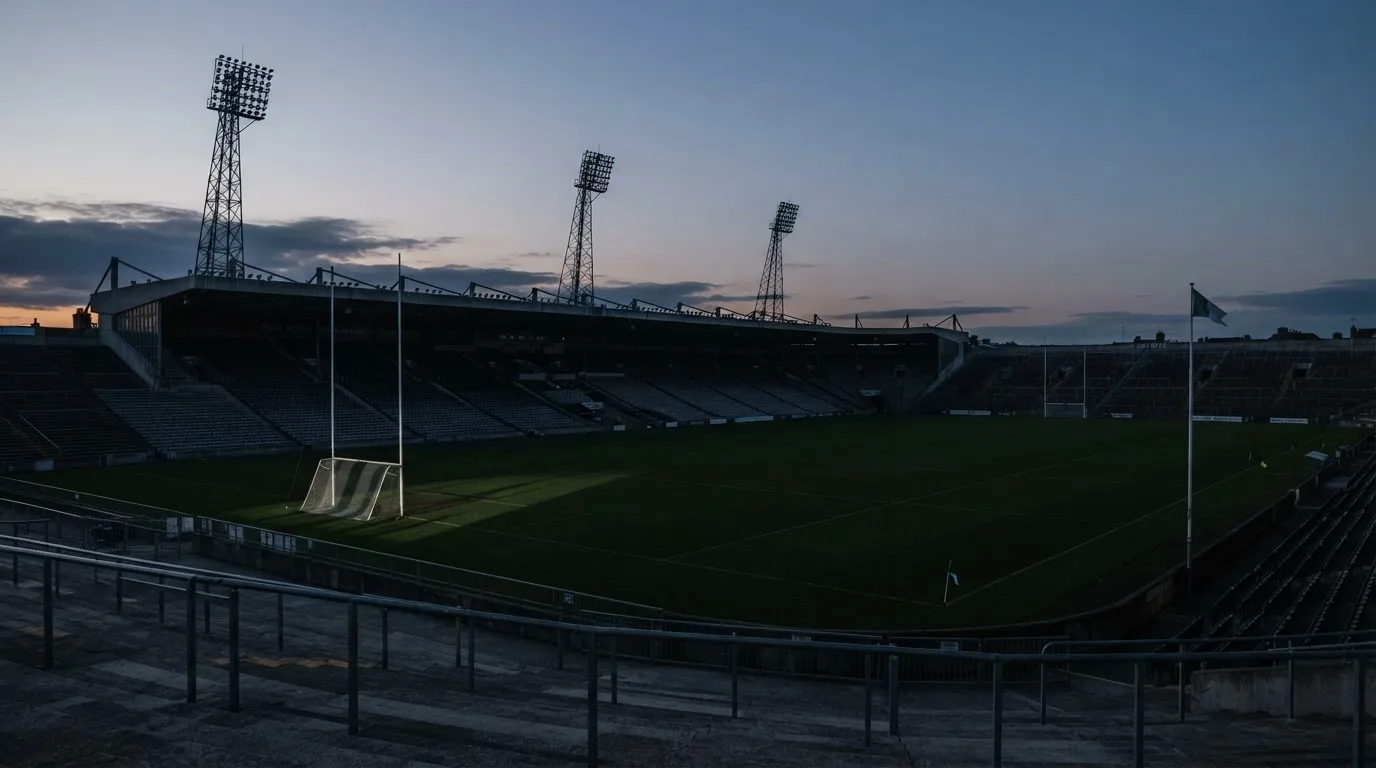
The scoreboard is what every price on a Gaelic football market settles against. A goal (the ball under the crossbar, into the net, signalled by the white-flag umpire) is worth three points. A “point” (the ball over the crossbar, between the posts) is worth one. Since 2025 a shot taken from outside the new 40-metre arc is worth two points regardless of whether it goes over or under, so a 1–10 to 0–12 scoreline at full-time is read as 13 points to 12 points and settles the match-result market accordingly. Reading scorelines correctly is what tells a punter whether a handicap of +3 against the favourite is a generous line or a tight one.
What that means for betting. The two-outcome habit most UK punters carry from football doesn’t transfer cleanly: draw is sometimes offered (drawn games in regulation), sometimes not, and extra time does not always apply. Goal totals are the market to watch for beginner-friendly staking — over/under 20.5 total points is a common line — and the margin on those is lean at the senior level because the bookmakers have long data feeds. Player markets tend to be thinner at club level than at senior inter-county, and player-prop wagers carry their own data-feed caveats: a bookmaker’s pricing model is only as sharp as the data feed it pays for.
Statute, Licensing, and How the Gambling Commission Regulates a Gaelic Football Book
There is no statutory list of “permitted” sports or markets in Great Britain. A bookmaker serving customers in Great Britain needs a Gambling Commission licence wherever it is incorporated; the licence is the permission, and the markets a bookmaker offers fall under its own licence conditions and the LCCP — the Licence Conditions and Codes of Practice. That is why a UK customer can place a bet on a Kerry vs Mayo All-Ireland semi-final, a Donegal club championship match, or a hurling fixture, and the regulator’s question is not what is being bet on but whether the operator taking the bet holds the right kind of licence.

What the licence covers. A Commission remote betting licence has several categories, and the relevant one for Gaelic football betting is “remote general betting standard (real events)”. Betting exchanges carry a separate category — remote betting intermediary — so a back/lay market on a Gaelic football game sits under a different licence. Spread betting on the outcome of a Gaelic football fixture is a different product under a different regulator: financial spread betting is regulated by the Financial Conduct Authority, and spread-betting losses can exceed the deposit a customer originally made. The point for a punter choosing among the licensed UK bookmakers is that the licence category is on the public register, with the licence number and the licence holder’s name attached.
The point-of-consumption rule. Since the Gambling (Licensing and Advertising) Act 2014 the test is where the customer is, not where the operator is. A bookmaker incorporated in Malta, Gibraltar, the Isle of Man or Curaçao still needs a GB licence to take a bet from a customer in Great Britain. The corollary is that GB-licensed brand names use a .co.uk domain for some products and a .com for others, so the domain tells a punter nothing about the licence: the Commission’s public register is the only check.
What that means for a Gaelic football punter. The licence register answers three questions directly: does this brand hold a GB licence; what licence categories does it hold; and which company is the licence holder. Beyond that, no licence counts those operators out of running a market on a sport — Gaelic football, hurling, club or senior, in-play or pre-match — and no licence guarantees the market will be open.
For age, identity and payments, the statutory floor is set. Minimum age is 18. The bookmaker verifies name, address and date of birth before the first deposit — verification, with the customer-held accounts GB-licensed sites have run since May 2019 — including for an account that is being credited with a free bet, so no UK-licensed site is anonymous in the sense a cryptocurrency or pre-paid-card offshore book can be. Credit cards cannot be used to fund gambling in Great Britain (since April 2020), and that ban extends to credit-card-funded e-wallet deposits. Debit cards, bank transfers, Trustly, Apple Pay and Skrill are not covered by the credit-card rule. Beyond those floors, the operator sets its own deposit and stake limits.
Bonuses and Free Bets — The Fine Print Behind the Headline
Bonus mechanics are the section of a betting offer where headline price and what the customer actually pays come apart. Two mechanisms dominate the licensed UK market on Gaelic football: the free bet, a stake the bookmaker credits and pays out only the winnings of (so a £10 free bet at 3.00 returns £20 profit, not £30), and the matched deposit, where the bookmaker matches a percentage of the customer’s first deposit in bonus credit, attached to a wagering requirement. Both look attractive on a banner; both come with rules the customer reads once and wishes they had read twice.
The wagering requirement. A wagering requirement is the multiple of bonus credit the customer must stake before the credit, and any winnings tied to it, become withdrawable. Wagering requirements on bonuses are capped at 10x, with the cap in force as of 19 January 2026: a £10 bonus at 50x used to need £500 of bets, no more than £100 under the cap. The cap applies to bonuses — matched deposit, casino credit, the lot — but its application to free bets whose stake is returned with the win (the rare form) is not established. Read the offer’s wagering terms to see which type the customer has.
The minimum price clause. Most matched-deposit bonuses carry a minimum price for qualifying bets, written as “odds of 3/5 (1.60) or higher” — the kind of clause that quietly disqualifies a single at 1.10 on a heavy favourite. A wagering requirement stuck to a minimum-price floor costs the customer less turnover than one stuck to a flat base, because the customer’s stake is concentrated on bets that settle at the right price. Flat bonuses are rarer than product-gated ones on UK-licensed sites, and a Gaelic football welcome bonus tied to a “bet on football” requirement fits the CAP Code’s exception about product mixing only narrowly.
The qualification window and the bet shape. Welcome bonuses in the licensed UK market typically give the customer seven days to deposit and place a qualifying bet, then seven days to use the free bets that come back. Multi-leg accas are a common product — “four £10 free bets” split between two football accumulators of four or more selections and two multiples of two or more — so the unwary customer expects cash and gets the shape of a coupon. Read the qualifying bet’s allowed market list before placing: a single on a GAA club championship match may or may not be a qualifying selection; the offer terms usually name the qualifying markets by sport and competition.
The matched-bet product. A “100% matched free bet” sounds like a 100% profit margin on the customer’s first deposit. It isn’t. The deposit is the customer’s money, not bonus credit. The free bet is the bookmaker’s, and its stake is usually not paid back with the win. The “matched” part refers to the free-bet amount being matched to the qualifying-bet stake, not to a profit guarantee. Two restrictions stack on top: a wagering requirement on the credit (capped at 10x under the new rule), and a deadline after which unused credit is removed.
The acca-insurance product. Accumulator insurance refunds the stake of a multi-leg acca if one leg loses — usually as a free bet, not cash. Refunded-as-free-bet means the customer does not get their stake back in money; they get another free bet that carries its own wagering rule and deadline. A £10 stake on a five-fold refunded as a £10 free bet is not the same protection as £10 back in cash, and the offer page rarely makes that distinction in the headline.
The price-boost product. A price boost is a bookmaker-driven uplift on the price of a particular selection — favourite-margin, each-way, a named market — for a stake limit and a window. The boost comes from the bookmaker’s margin, not from thinner air: a bookmaker offering 6/4 (2.50) on a result with a fair price of 2.00 is offering the customer about four-tenths of a point of margin, not “better odds”. The boost is genuine, but it is measured against the bookmaker’s own market, not against a competitor’s; on a market where several books are at 2.10, an “exclusive” boost to 2.50 only beats the field on that one site.
The operator angle. BoyleSports’ sports welcome offer is structured as £20 in free bets from a £10 qualifying bet for UK players, with a separate €30 in free bets for Irish players; read the qualifying-selection list to see which Gaelic football fixtures count. Betboro’s sports welcome offer is a 100% matched free bet of up to £25 on the first qualifying wager, attached to a debit-card deposit of at least £10 and a qualifying bet of £5 to £25 with at least three selections at 3/5 (1.60) or higher. BetUK’s is four £10 free bets from a £10+ deposit and a sports bet within seven days of registering, with each of the four free bets tied to a specific shape: two football accumulators of four or more selections, and two multiples of two or more selections. Octobet’s sports welcome is 50% back as a free bet up to £50, plus a £10 casino credit. None of these is a deposit bonus in the textbook sense — the headline offer is the free-bet bundle, and the cost is the qualifying bet and the seven-day wall.
Live Betting and Cash Out on Gaelic Games
In-play is the section of the market where the bookmaker’s margin moves quickest and the punter’s edge is shortest. A Gaelic football match running from 14:00 to roughly 17:30 on a championship Sunday is a long in-play window — three and a half hours — but the markets thin out at half-time and tighten at the start of the third quarter, with the goal-flurries around the 50th to 60th minute often the sharpest spreads the day produces.
What “in-play” actually means. In-play is the category of bet the customer places after the match has started, and a GB-licensed bookmaker offers it subject to its own conditions (no statutory cap on in-play exists). The customer’s stake on an in-play wagering selection is committed against a live price the bookmaker is reposting every few seconds, and the customer’s edge is to spot when the market over- or under-prices the situation the bookmaker’s data feed has not caught up with. For Gaelic football, the data feed is usually a live score feed and a half-time feed; few bookmakers run a full real-time event-feed at club level, and the senior inter-county matches are the ones that get live in-play pitched against the major prices.
Cash out is a feature layered on top of in-play. The bookmaker offers to settle the customer’s open bet before the event finishes, at a price based on the current in-play market; the customer locks in either profit (the bet is winning) or a partial loss (the bet is losing). Cash out does not change the shape of the bet: the punter still pays the bookmaker’s margin on the closing line, and cash-out maths is unfavourable to customers who take it on losing bets (the cash-out price eats into remaining stake) more than on winning ones. A disciplined use of cash out is “lock in profit when the favourite is ahead by five points with ten minutes to play”, not “use cash out on every position”.
The midnite product. Midnite lists in-play events on its UK site, has an acca builder, popular accas, and price boosts with maximum-stake limits attached; the in-play offering is one of the company’s distinguishing products and the price-boost mechanic one of its hooks. The site is licensed by the Gambling Commission (account 101839), so the in-play product runs under UK rules.
The sporting index product. Sporting Index lets the customer move between fixed odds and spread betting, with in-play betting, a Bet Builder for football, auto cash-out and a Multi-Markets product. A customer who wants spread and fixed at the same account gets both products under one licence (the fixed-odds side under the Gambling Commission, the financial-spread side under the Financial Conduct Authority). Read both terms pages before staking.
The cash-out caveat. Auto cash-out closes the customer’s position at a price the bookmaker sets, not at the live in-play market; manual cash-out is a click away, and the customer can refuse. Auto cash-out’s price is usually set wider than the manual price — the bookmaker prefers automatic settlement because it removes the human review — so a customer who has set an auto cash-out trigger on a winning bet may be settled at a worse price than the live mid had they waited a minute. Read the cash-out policy in the operator’s terms.
The latency caveat. In-play prices on Gaelic football are updated on a tick-by-tick basis the bookmaker’s platform decides, and the customer’s mobile data connection sits between the customer’s eye and the bookmaker’s screen. A bet placed at 1.90 in-play, accepted, and settled because the score changed two minutes later, is a normal in-play settlement; a bet placed at 1.90 and rejected because the price moved to 1.85 between the customer clicking and the bookmaker’s server accepting the bet, is also a normal in-play settlement. The bookmaker’s terms give it the right to void a bet where the price has moved materially; the customer’s recourse in a dispute is the operator’s complaints procedure and, failing that, an Alternative Dispute Resolution (ADR) provider registered with the Commission. The ADR route exists for GB-licensed customers and does not exist for customers of unlicensed sites.
Tips, Predictions, and Strategy — What Sharpens the Edge
The market for Gaelic football tips is large, free, and loaded with confident claims from people who have no edge to claim. A “tipster” who advertises a 70% strike rate is selling a number, not a method, and a punter who backs every tip pays a margin on each bet that the tipster’s strike rate has to overcome before the punter is ahead. A 60% strike rate at average decimal odds of 2.00 and an average bookmaker margin of 5% gives the punter about a 5% loss across 100 bets, which is no edge.
What a tip can be. A tip is a piece of inside knowledge (line-up, weather, venue, motivation), a piece of analytical work (form, head-to-head, market), or a piece of marketing (someone wanting to look sharp on social media). The licensed bookmakers do not sell tips in any regulated sense, and they do not advertise future outcomes; the tipster’s value is independent of the bookmaker’s licence. The two are different products and a punter who conflates them pays twice.
The bankroll angle. A bankroll is the stake the punter sets aside for betting, separated from rent, bills and savings, set at a level the punter is comfortable losing. Staking plans (level stakes, percentage staking, the Kelly criterion) are ways to deploy that bankroll across a sequence of bets; they do not fix the underlying problem of whether the bets are good ones. A flat-stake plan on a sequence of bets at a margin of 5% loses 5% of turnover to the bookmaker; doubling the stake does not double the edge, it doubles the loss.
The fixture-knowledge angle. The best edge a Gaelic football punter has is familiarity with the senior inter-county calendar and the clubs within it. The GAA publishes fixtures, results, and disciplinary records at the official GAA site and the unit-by-unit newspapers, and a punter reading both can usually tell when a county’s first-team XV is unavailable (club championship finals overlap the back end of the inter-county league) or when a county’s half-back line is missing. Most licit edges in a niche market come from knowing the fixture list better than the bookmaker’s data feed does, and the bookmakers’ data feeds are very good — the punter has to be better to take a price.
The specialisation cost. A punter who backs goalscorer markets on Gaelic football needs data the licensed bookmakers’ player-prop market is rarely priced from. The bookmaker’s market on “first goalscorer” at senior inter-county level is moderately liquid; at club championship level it is often unset. A punter who has compiled a player-props model should expect long sequences of bets at the club end of the season and short sequences at the senior end — the punter’s model has fewer shots on target at club level, and the bookmaker’s margin is wider for the bets it does offer because the bookmaker’s data is thinner.
The risk angle. Betting on Gaelic football carries the same propensities toward loss as betting on any other sport: variance, the house’s margin, time preference, and the risk that the punter’s bankroll shrinks. Tools to manage that are part of the licensed bookmaker’s product: deposit limits, timeouts, self-exclusion through GAMSTOP, reality checks. The section on responsible gambling walks through those tools in detail.
Bet Types and How Gaelic Football Odds Are Settled
Gaelic games betting odds in Britain are framed in fractional form in most bookmaker windows (5/1, 11/4, evens, 6/4), with decimal equivalents (6.00, 3.75, 2.00, 2.50) as a secondary display. The two display forms are interchangeable; a price of 5/1 is the same as a decimal 6.00 (5 ÷ 1 + 1), and a price of evens (1/1) is 2.00 in decimal. Conversion formula: decimal = a ÷ b + 1, where a/b is the fractional price.
The bet types. Singles on match result, handicaps and totals dominate the senior inter-county market. Doubles, trebles and accumulators (“accas”) link multiple selections from multiple events; the odds of each leg multiply into the combined price, and the staking is unit stake × number of selections for the multi-leg bets in the system-bet family (Trixie 4, Patent 7, Yankee 11, Lucky 15 15, Canadian 26, Heinz 57, Goliath 247 bets on a single ticket). Each-way is available on outright markets and a small number of pre-match markets; an each-way bet is two bets of equal stake — one on the win, one on the place — and the place terms vary. BTTS (both teams to score) is the “yes/no” market that is a default on football and is sometimes offered on hurling but rarely on Gaelic football because the scoring pattern is different.
The bet builder. A bet builder is a single-event accumulator, where the bookmaker prices several selections on the same fixture into one ticket — match result, total points, first goalscorer, and so on, all from one fixture. bet365’s product is Bet Builder+, which combines markets from one event into a single bet available both pre-match and in-play, with Winnings Boosts on selected Bet Builders and singles. Bet Builder legs must all be priced and active; if one leg fails, the whole ticket loses. The drawback is the book’s compounding margin: each leg carries its own margin, and the bet builder’s overall margin is the sum, sometimes amplified. A bet builder at four legs, each at 5% margin, is closer to 20% margin on the combined ticket.
The handicap. A handicap is the bookmaker’s line on the result after a virtual points adjustment: Mayo −3 means Mayo are considered three points better than their listed opponent for the purposes of the wager. The handicap moves the favourite’s price closer to evens and the outsider’s price closer to a long shot, and the bookmaker’s margin is collected on both sides of the line. A handicap of 0 (the level handicap) is offered at the championship level where a draw is the worst outcome for the favourite; the punter’s stake is refunded if the match is a draw in regulation where the rule applies.
The total-points market. Gaelic football matches settle at all sorts of totals — a tight defensive championship tie can settle at 15–18 points total; an open game at 25–30. Bookmakers price over/under lines around the 20.5 total points mark at senior inter-county; club fixtures run a few points lower in the typical total. The market moves during the match, and an in-play over/under is one of the more useful markets on a low-scoring sport: a goal in the first half moves the total by 3, which is larger than the equivalent move in football (1) and gives the punter more leverage per data-tick.
The price-boost caveat. A price boost is the bookmaker putting up a market at a higher price than the standing line for a stake limit, and the customer is on the right side of the margin only if the boost’s price beats the competing bookmakers’ lines. The boost is genuine at the moment it is offered. The bookmaker’s stake limit (often £10 to £50) is the cap the punter faces.
The ante-post market. Ante-post is the long-odds market on the outright winner (the All-Ireland SFC, the All-Ireland SHC) months before the competition closes; the price sags as the competition tightens, and a non-runner (a team knocked out) hands the punter the “Rule 4” deduction the bookmaker uses — a percentage reduction on the price. The bookmaker’s terms give the Rule 4 table; the punter’s edge is to read it before staking.
The spread-betting product. Spread betting on a Gaelic football total is offered by some UK-licensed firms. Sporting Index lets the customer move between fixed odds and spread betting, with in-play on the same fixture. Spread bets differ from fixed-odds bets in three ways that matter: the stake is a unit-per-point deposit, the punter pays or receives the difference between the spread and the actual outcome, and a run of one direction can cost the punter more than their original stake. Read the firm’s product-specific terms before staking.
The spread-betting tax note. Spread betting on sports outcomes is not financial spread betting and is inside General Betting Duty; financial spread betting on indices is regulated by the FCA. The distinction matters for the tax treatment the customer faces: spread-betting losses on financial indices can be set against income tax in some circumstances; spread-betting losses on sports outcomes are losses, with no tax relief.
Tournaments and Where the Calendar Carries the Markets
The Gaelic Athletic Association runs the championships that bookmakers price. Inter-county championships at senior grade are split into four provincial competitions (Connacht, Leinster, Munster, Ulster), each producing a provincial finalist, with the four meeting the four qualifiers from the new Tailteann Cup (replacing the old second-tier championship) in the All-Ireland series. The All-Ireland quarter-finals, semi-finals and final sit at Croke Park for the bigger rounds; provincial finals at provincial grounds (often provincial stadiums). Hurling runs the same shape under the same calendar.
The All-Ireland Senior Football Championship final is the betting high-water mark of the year. The 2026 final was played on 26 July 2026 at Croke Park, with Mayo beating Kerry by 1–20 to 1–17 for their fourth title; the fixture length, the venue’s large crowd, and the high media profile make it the most-traded match of the year at the licensed UK bookmakers. Kerry hold the record for most All-Ireland SFC titles (39), and the historical table matters less to a price than the form going into the year, but a long-term punter on the ante-post market reads both.
The club championship. The All-Ireland Club Football Championship is the senior club final at Croke Park in March; the match is a strong draw for Irish-resident punters and a thinner one for British punters. The four provincial club championships feed into it. UK-licensed bookmakers may or may not price the club final outright, depending on which bookmaker.
The leagues. The National Football League runs from January to May, with each county playing seven league matches. The bookmakers’ league market is much thinner than the championship market, with smaller margins and lower liquidity; a league match in February is a B-tier market for most firms, and the customer should expect a wider margin in the price.
The Sigerson and Fitzgibbon Cups. The university competitions run in the first term of the calendar year, between January and February. These are college-level markets, with tiny liquidity and a bookmaker’s margin that drifts the price well past a fair line. Sigerson markets exist at some licensed UK firms but are not a stable product; check the firm’s Gaelic games weekly coupon.
The hurling connection. Gaelic football and hurling are the two GAA sports, with the same governing body and a calendar that runs alongside. The licensed UK bookmakers price both sports and bookmakers’ punters who follow hurling can sometimes spot the football market’s price lagged. There is no cross-sport market, but a customer willing to follow both has more fixtures in the week and more chances to deploy the bankroll.
The fixture availability caveat. UK-licensed bookmakers price Gaelic football in their weekly coupon through the senior inter-county championship and quiet during the off-season; club fixtures and lower-tier inter-county markets appear at selected firms and disappear at others. A punter who wants a full fixture list should expect to hold accounts at two or three bookmakers and to check the weekly coupon on Monday mornings for the week’s prices.
The data-feed note. Club fixtures and Sigerson are thinly priced because the data feed is thin: a bookmaker pricing a Sigerson Cup tie at 11/10 about a college has limited form data to back the price, and the book’s risk is held against an unsettled position. The result is the kind of price a punter can’t read for value without inside data, and the bookmaker’s margin is wider as a result. Markets with this profile are best avoided by a punter who does not have a data edge.
Landscape of Licensed Operators Offering Gaelic Football
The table below summarises the ten licensed UK bookmakers in the comparison set, with their Gambling Commission remote-licence number and licence holder, plus what the operator’s own terms state on the key issues the punter checks first. Columns are the matter of comparison; the operator’s own terms page is where the punter reads the fine print, and the row entries name what those terms state, in summary.
| Brand | Gambling Commission remote licence | Licence holder | Welcome offer shape (operator’s terms) |
|---|---|---|---|
| Ladbrokes | 54743 (054743-R-330863-014, remote general betting standard real events + remote betting intermediary) | LC International Limited | Sports app published by Entain Operations Limited; rated 4.66 from 101,255 ratings in the GB App Store |
| Paddy Power | 39439 (039439-R-319330-013, remote general betting standard real events) | PPB Counterparty Services Limited | Sports app covers football, horse racing, boxing, rugby, tennis, golf, darts, snooker and F1; published by Paddy Power PLC |
| DAZN Bet | 48756 (048756-R-327274-019, remote general betting standard real events) | DZBT Limited | Deposits start at £5 by debit card, Apple Pay, Paysafecard, Trustly and Skrill, and at £20 by PayPal, with no processing fees |
| BetUK | 39198 (039198-R-319450-029, remote general betting standard real events) | LeoVegas Gaming PLC | Four £10 free bets after a £10+ deposit and a sports bet within 7 days, with the four free bets split: two football accumulators of 4+ selections, and two multiples of 2+ selections; valid 7 days, opt-in required |
| Sporting Index | 27343 (027343-R-308898-011, remote general betting standard real events) | Sporting Index Limited | Switches between fixed odds and spread betting; in-play betting; Bet Builder for football; auto cash-out; Multi-Markets |
| BoyleSports | 39469 (039469-R-319383-025, remote general betting standard real events) | Boylesports Enterprise | Sports welcome: £20 in free bets when a £10 bet is placed for UK players (€30 in free bets for a €10 bet for Irish players) |
| Lottoland | 38991 (038991-R-319408-020, remote general betting standard real events) | EU Lotto Limited | Combines casino, lottery betting, sports betting and scratchcards; licensed for customers in Great Britain |
| Octobet | 62545 (062545-R-337248-006, remote general betting standard real events) | Octopus Game Limited | 50% back as a free bet up to £50, plus a £10 casino credit for new customers |
| Kwiff | 44448 (044448-R-323408-017, remote general betting standard real events) | Eaton Gate Gaming Limited | UK Gambling Commission licensed; trademark operated by Spryme Ltd; app carries a 17+ age rating |
| Betboro | 44181 (044181-R-324363-007, remote general betting standard real events) | Webmedia Development N.V. | 100% matched free bet of up to £25 on the first qualifying wager; debit-card deposit of at least £10; first bet £5 to £25; minimum three selections at 3/5 (1.60) or higher |
All ten brands are GB-licensed for “remote general betting standard (real events)”, which covers Gaelic football price making on its own licence terms. Paddy Power and Betfair are commonly known because they share a parent group (Flutter), but in this comparison Paddy Power stands alone as the Flutter brand and is named as the comparison’s licence holder. The mixed-licence caveat applies most clearly to Sporting Index, where fixed-odds sports betting runs under the Gambling Commission and the financial spread-betting book runs under the Financial Conduct Authority — punters using the spread book should look at the FCA-licensed company’s terms. The other nine brands are gambling-only; the financial-spread book sits at Sporting Index.
The angle. The ten brands vary across four axes: the offer shape (matched free bet, free-bet bundle, refund-style, deposit match), the product breadth (sports-only vs sports-plus-casino, vs sports-plus-lottery-and-scratchcard), the player-protection depth (the published safer-gambling tools in the brand’s help section), and the in-play/exchange posture (in-play pricing, betting exchange, spread book). A punter who wants a sportsbook with a tight price on the All-Ireland SFC market will move differently from one who wants a deep in-play product with cash-out, and the table is a way of reading the choice at a glance.
The licence-verification note. Each brand appears on the Gambling Commission’s public register against the licence number listed above. Verification is the punter’s task, not the bookmaker’s marketing, and the licence number is the key for the Commission’s business-name search. Punters should verify before depositing, with the licence number and not the brand name alone.
Overview — How UK Gaelic Football Betting Actually Works
In Great Britain, the path from “I want to bet on Kerry to win the All-Ireland” to “I have a betting account, a stake and an open ticket” runs through one of the ten licensed bookmakers in the comparison set. The bookmaker’s licence is held under the Gambling Act 2005, the brand runs under a Commission-issued remote licence for the relevant category, and the customer verifies an account with a name, address and date of birth before the first deposit. The bookmaker’s product is a market on a Gaelic football match priced against the firm’s data feed, and the customer pays the book’s margin on every bet.
Three things bind the licensed UK market and define a punter’s choice. First, the customer plays at a Commission-licensed brand or not at all: an offshore brand is not licensed to take a GB customer’s bet, and the customer of an offshore brand has none of the protections. Second, the operator checks identity and the customer’s deposit before the first bet: there is no anonymous play at a licensed UK site. Third, the gamble is between the customer and the bookmaker, and the bookmaker’s offer is governed by the LCCP, the CAP Code on marketing, and the Commission’s enforcement.
The sport-side picture. The Gaelic football calendar is the senior inter-county championship (April–July), the club championship (autumn–March), and a winter/spring set of secondary competitions. The licensed UK bookmakers’ senior inter-county market is the deepest, with the biggest liquidity and the leanest margin. The club and secondary markets are thinner, often slower to price, and carry a higher house edge. A punter’s product is the senior inter-county match-result and totals markets in the spring, and the ante-post market on the All-Ireland SFC during the winter.
The offer-side picture. The licensed UK bookmakers’ welcome offers are calibrated to the 10x wagering cap and to the seven-day qualification window. The shape is matched free bets (most), free-bet bundles (some), refund-style offers (rare). A 100% matched free bet up to £25 attached to a three-leg minimum is the typical cost, and the punter is being asked to commit a stake at a minimum price for an ante of a free bet; the picture is a steady-state 5%-to-7% loss under most wagering conditions.
The trade-off. The trade-off a UK punter makes is between licensed play (full British protections, identity verification, GAMSTOP, ADR) and the cost in time and privacy of those checks. The trade-off a punter does not have to make is between licensed and offshore: licensed is the only regime that gives the punter a route to a British dispute body if the operator withholds funds, and unlicensed is the only regime where the punter’s recourse is in a foreign jurisdiction. The trade is clean, and a punter who reads the comparison’s ten brands will find the same answer across all of them: stay licensed.
Legality — The British Licensing Frame for Remote Betting
The framework is the Gambling Act 2005, with the Gambling (Licensing and Advertising) Act 2014 bringing remote operators into the point-of-consumption rule. The Gambling Commission licenses the whole commercial market under the Act; Northern Ireland is outside the 2005 Act and has its own older regime, so a “GB licence” regulates operators taking bets from customers in England, Scotland and Wales, and a separate licence covers Northern Ireland. The Commission is a non-departmental public body sponsored by the Department for Culture, Media and Sport, and its public register is the test of whether a brand is licensed.
The licence categories. The relevant categories for Gaelic football betting are remote general betting standard (real events) and remote betting intermediary (the betting exchange). Spread betting on a sports outcome sits under the same general-betting standard; financial spread betting is regulated by the FCA. The licence is a single document, and it is the licence the Commission checks against for that category. The licence holder is the legal entity that holds the licence, not always the brand name on the marketing — LC International is the Ladbrokes/Coral licence holder, PPB Counterparty Services Limited is the Paddy Power/Betfair licence holder, and so on. Multiple brands can run under one licence.
The point-of-consumption rule. Since 2014, a bookmaker whose remote facilities are used in Great Britain needs a Commission licence wherever it is incorporated. A Curaçao, Maltese or Gibraltar licence is not a substitute, and a brand incorporated outside Britain is still bound by the GB framework if it takes GB customers. The corollary is that a brand using both .co.uk and .com is still one firm under one licence, and the domain tells a punter nothing about the licence: the Commission’s public register is the only check.
The statutory framework for offers. Advertising for gambling is not licensed by the Commission; it runs through the CAP Code (Committee of Advertising Practice) on non-broadcast media and the BCAP Code on broadcast, enforced by the ASA alongside the Commission’s LCCP marketing conditions. CAP Code section 16 requires gambling marketing to be socially responsible, not strong in appeal to under-18s, and not to feature anyone who is or seems to be under 25 in a significant role. The rules apply to the content of ads, not to who is allowed to bet.
The statutory framework for bonuses. From 19 January 2026, wagering requirements on bonuses are capped at 10x (a £10 bonus at 50x used to need £500 of bets; under the cap no more than £100), and mixed-product promotions are banned (an offer that requires gambling on two or more product types such as betting, casino, bingo and lottery — for example, “bet on football to get free spins”). The cap applies to bonuses; whether it applies to free bets without a wagering condition, and any cap on the money value of a bonus, are not established in the public sources. A punter reading a 10x-or-less welcome offer sees a British-licensed firm; a punter reading higher multiples probably sees an unlicensed firm.
The statutory framework for advertising. “Whistle-to-whistle” is an industry code enforced by the betting industry itself, not law: since 1 August 2019, betting advertisements are not shown on TV from five minutes before a live sporting event to five minutes after it, before the 9pm watershed, with horse racing and greyhound racing excluded. The Premier League clubs’ withdrawal of gambling sponsorship from the front of matchday shirts (from 2026/27; sleeves and hoardings remain) is voluntary, not law. Both are market-side self-regulation; neither is the basis for a regulatory sanction.
The statutory framework for tax. The player pays no tax on betting winnings in Great Britain (general information, not tax advice; a professional gambler should ask HMRC or an adviser). General Betting Duty is the operator’s tax on gross profits, currently 15%, with a new remote betting rate of 25% from 1 April 2027 on top of it; remote bets on UK horse racing, on self-service betting terminals in licensed premises, on pool betting, and on in-person betting stay at 15%. Whether operators pass duty on through odds is not established, and the player is not charged duty: the operator is. The Commission’s statutory levy is a separate charge, not a tax, and is the operator’s contribution to the regulator’s research and treatment funding.
The statutory framework for spread betting. Spread betting on financial indices is regulated by the FCA, with tax treatment under the spread-betting regime. Spread betting on sports outcomes sits inside General Betting Duty and is the Sports Spread Betting Limited-style product offered by Sporting Index. The licence is the same kind of licence (remote general betting standard), but the regulatory framework is different; a punter reading both terms pages is reading two regulators.
The statutory framework for in-play. No statutory cap on in-play exists. GB bookmakers offer in-play on Gaelic football, on senior inter-county fixtures in particular, with operator-driven controls (delay, voiding, market suspension) under the LCCP. A punter’s recourse in an in-play dispute is the operator’s complaints procedure and an Alternative Dispute Resolution provider.
The statutory framework for offshore. The 2005 Act makes it an offence, on summary conviction, to provide gambling facilities in Great Britain without the licence required by the Act (sections 33 and 36 as amended). The offence is committed by the operator; no offence aimed at a customer who simply bets at an unlicensed site was found in the public sources. Enforcement is disruption, not blocking: cease-and-desist notices, search-engine referrals, work with registrars, hosts and payment providers; the Commission has been given, or is about to receive, court-order DNS blocking powers, and ISP blocking is not in operation. The honest framing is “licensed = checks, limits, GAMSTOP, bonus cap; unlicensed = none of those protections and possible loss of funds”, and neither is “the safe choice” by default.
Responsible Gambling Tools and Where Bettors Get Help
The British framework expects a licensed bookmaker to offer five safer-gambling tools: deposit limits, timeouts, reality checks, self-exclusion, and access to support organisations. The bookmaker’s LCCP-compliant stack sits inside the customer’s account settings, and a punter who has not set a deposit limit and a reality check has not used the licensed product in its published form.
Deposit limits. Deposit limits are operator-run, not state-set, and the limit is the customer’s choice. There is no statutory maximum deposit a punter may make at a UK-licensed site; the operator’s stack is the customer’s protection. A deposit limit locks the customer out of further deposits until the next window (next day, week, month), and a change to raise the limit usually has a 24-hour or 7-day cooling-off delay. The bookmaker’s UI for deposit limits sits in the account’s safer-gambling section.
The financial vulnerability check. The financial vulnerability check (LCCP condition 3.4.4) is a check that applies to licensed remote betting when a customer’s deposits minus withdrawals exceed £150 in a rolling 30 days (since 28 February 2025). The check is a public-record check (bankruptcy or county court judgments, for example), not an income check, not a credit reference check. The bookmaker may decline further deposits or step the customer down to a lower limit if a public-record flag is found; the route is data-led, not income-led.
The financial risk assessment. The financial risk assessment (the “affordability checks” in the press) is announced in a Commission article of 7 July 2026, with a staged plan and no start date. The published rule is “announced, staged, no start date” — not “in force”. A punter who hears a friend refer to “affordability checks” is reading a draft of a future framework, not the current state. The bookmaker’s UI today is the financial vulnerability check, not the risk assessment.
GAMSTOP. GAMSTOP is the national multi-operator online self-exclusion scheme and a mandatory licence condition for online operators since 31 March 2020. Exclusion periods are six months, one year, five years, or five years with auto-renewal; after the minimum period the exclusion stays in place for a further seven years unless the customer asks GAMSTOP to remove it. GAMSTOP covers online sites and apps; betting shops use a separate offline-scheme service. The customer signs up at the GAMSTOP site and the participating operators carry the exclusion.
Self-exclusion at the operator. Self-exclusion at the operator is a quicker, brand-level decision: the punter tells one firm to exclude them, and that firm locks the account. The exclusion does not cover other brands, so a punter who has a gambling problem should use GAMSTOP for the full multi-operator block. Both tools are complementary: GAMSTOP for the multi-operator, self-exclusion at the operator for the immediacy.
Reality checks. Reality checks are pop-ups at intervals the punter sets (e.g. every 30 minutes, every hour) showing time staked, money staked and money won or lost. The pop-up is a pause; the punter can dismiss it and continue. A useful mechanic for the punter who feels the session is running longer than intended.
Timeouts. Timeouts are short breaks — 24 hours, 48 hours, one week — during which the account is locked and cannot be reopened. Useful for a punter who feels a tilt after a bad beat and wants a 24-hour reset. The timeout counts from the punter’s request, not from the punter’s last bet.
Where help is found. GamCare runs the National Gambling Helpline (0808 8020 133). GambleAware funds the National Gambling Treatment Service. The NHS runs gambling clinics. Gamblers Anonymous runs peer-support meetings. Fitzwilliam Sports, in the brand’s published help section, links to GambleAware, GamStop and Gamblers Anonymous. None of the licensed UK bookmakers in this comparison set charges the punter for the time taken to look up the helpline number, and the Commission’s safer-gambling checklist is the right place to begin a conversation about a punt that is getting out of hand.
The pitch. A punter who has not used a single safer-gambling tool is running the licensed UK product on its worst setting. The tools sit in the account pages: a 30-minute reality check, a £50 weekly deposit limit, a 24-hour timeout when the session runs long. The punter’s account is run, not the punter’s luck.
Crypto, Anonymity, and Why Neither Survives UK Verification
Three search queries turn on this question: Gaelic football betting with cryptocurrency, Gaelic football betting with crypto, and Gaelic hurling betting with bitcoin or crypto. The honest answer, in the British framework, is that no UK-licensed bookmaker offers its customers an anonymous play path, and very few offer a cryptocurrency-deposit path at all. The Commission’s verification regime has effectively required identification before the first deposit since May 2019, and that regime covers free bets and bonuses too, so an anonymous betting account at a GB-licensed firm is not on the menu.
The verification requirement. Licensed remote operators verify name, address and date of birth before the customer can deposit or gamble. The verification is the customer’s name and address as on a UK passport or a UK driving licence, plus a proof-of-address document (utility bill, bank statement) and, in many cases, a third check. A cryptocurrency wallet does not satisfy the name and address check; the wallet’s address is a pseudonymous identifier, not a verified identity, and the Commission’s money-laundering rules (the 2017 regulations transposing the EU 4MLD and 5MLD, plus the post-Brexit AML framework) require source-of-funds questions at higher spend. Crypto-funded deposits may be declined outright at the on-ramp, or the bookmaker may ask the punter to source-of-funds the deposit.
The credit-card ban. Credit cards are banned for gambling in Great Britain since 14 April 2020 (LCCP condition 6.1.2), and that ban extends to credit-card-funded e-wallet deposits. Crypto-funded debit-card deposits are not covered by the credit-card rule, but the source-of-funds rule may still ask the customer to evidence where the crypto came from. The simplest answer for a punter is: a UK bank account, a debit card, and one of the licensed UK bookmakers, with a verification check on the first deposit.
Some search results for crypto-based gaelic football betting often show offshore sites that operate without UK regulation. Licensed bookmakers in the UK do not market using those terms, as the necessary verification standards are incompatible with such payment methods. Using an offshore platform means operating outside Commission-regulated protection, and customers must accept the inherent risks of those terms.
The crypto-side caveat. Some licensed UK bookmakers accept e-wallets funded from a card, which itself is sometimes funded from a crypto sale. The crypto funds the e-wallet; the e-wallet funds the bookmaker. The bookmaker’s verification checks the e-wallet’s owner, and the punter’s crypto path becomes invisible to the bookmaker if the e-wallet is in the punter’s name. The bookmaker’s terms do not require the punter to declare the funds’ origin, but the anti-money-laundering rules may ask at higher spend. The honest framing: the British framework doesn’t forbid crypto in the punter’s chain, but it does forbid anonymity at the bookmaker’s counter.
The privacy trade-off. The punt a UK punter wants from a Gaelic football match does not, on its own, require identity verification at the bookmaker’s counter. The bookmaker’s verification is part of the licensed product. The punter’s choice is whether to take the licensed product (with verification) or the offshore product (without). The first gives GAMSTOP coverage, a British ADR route, a Commission complaints route, a 10x bonus cap, a £150 vulnerability check; the second gives none of those. The privacy the punter loses is in exchange for the protection the punter gains.
The angle. A punter searching for a “crypto betting” experience on Gaelic football is searching for a product that the British framework deliberately does not provide at a licensed counter. The deliverable is the trade-off read plain: GB-licensed = full British protections, identity verification, GAMSTOP, ADR; crypto-friendly = none of those. The punter’s choice is the trade-off, and a punk who wants both should expect the licensed product and a UK bank account.
Operator Reviews
The ten reviews below cover each brand named in the comparison set. The reviews work from the licence, the sportsbook product, the welcome-offer shape, the in-play and bet-builder features, the safer-gambling tools, the deposit/payment terms, and the verdict — what the brand actually suits, and what it does not.
Ladbrokes
The licence is held by LC International Limited, on Commission account 54743; the categories covered are remote general betting standard (real events) and remote betting intermediary. The sports-betting app is published by Entain Operations Limited and is rated 4.66 from 101,255 ratings in the GB App Store; the rating is a function of usability, not of welcome-offer generosity. The Ladbrokes sportsbook carries Gaelic football markets through the championship season, with a full multi-leg acca product.
The product shape is the traditional high-street brand’s product: a deep sportsbook with football, horse racing and greyhounds as its anchor markets, a betting exchange through the intermediary licence, and a casino attached. The Gaelic football coverage is the senior inter-county championship, with totals, handicaps and outright markets priced through the season; club markets are thinner. The brand’s in-play product is competitive at senior inter-county level. The welcome offer cycle shifts seasonally; read the brand’s welcome page at the moment of signing up.
The angle. Ladbrokes suits a punter who wants a long-established high-street name under one of the deeper sportsbooks in Britain, with a betting exchange under the same parent. The drawback is the brand’s age: the app and UI were not redesigned last year, and the in-play product is sharper at newer firms. It is a solid choice for a Gaelic football punter who values market depth.
Paddy Power
The licence is held by PPB Counterparty Services Limited, on Commission account 39439; the operator is authorized for remote general betting (real events). The sports-betting app is published by Paddy Power PLC and covers football, horse racing, boxing, rugby, tennis, golf, darts, snooker and F1; Gaelic football sits under football. The Paddy Power product has the firm’s humorous marketing layer above it.
The product shape is a deep sportsbook with a strong horse-racing anchor, a deep football market, and a multi-leg acca product. The Gaelic football market is the senior inter-county championship’s match-result, totals, and handicaps, with club markets thinner; the brand’s in-play product is competitive at senior level. Paddy Power’s brand of “Money Back” promotions (e.g. money-back-if-loses) shapes the welcome and ongoing offers; the rule of thumb is to read the offer’s “what counts as a qualifying bet” line, which on a Money Back is usually narrower than it looks.
The angle. Paddy Power suits a punter who wants the Flutter group’s deep sportsbook with the firm’s horse-racing pedigree and a wide football book. The drawback is the marketing layer: Paddy Power’s personality-driven marketing has a louder claim-to-attention than the deeper firms, and the bettor who dislikes noise should look elsewhere. It works well for a punter who prioritizes market variety.
DAZN Bet
The licence is held by DZBT Limited, on Commission account 48756; the operator holds a remote general betting (real events) permit. The product is a sportsbook anchored on the DAZN sports media brand’s distribution, with deposits starting at £5 by debit card, Apple Pay, Paysafecard, Trustly and Skrill, and at £20 by PayPal; no processing fees apply. DAZN Bet’s payment stack is one of the more flexible in the comparison set.
The product shape is a focused sportsbook with a Gaelic football market at senior inter-county level, and a wider book across football, tennis, basketball, MMA and motor sport; the brand’s content layer is the DAZN sports-video subscription, which the punter does not need to hold a betting account for. The welcome offer cycles with the rest of the comparison; read at signing-up.
The angle. DAZN Bet suits a punter who wants a flexible deposit stack with multiple e-wallets and a £5 floor on most of them. The drawback is the brand’s youth: the firm is newer than Ladbrokes and Paddy Power, and the in-play product is building out. For those with a small budget, this is a practical entry point.
BetUK
The licence is held by LeoVegas Gaming PLC, on Commission account 39198; the operator’s remote general betting (real events) permit is active. The welcome offer is four £10 free bets after a £10+ deposit and a sports bet within 7 days, with the four free bets split: two football accumulators of 4+ selections, and two multiples of 2+ selections. The free bets are valid for 7 days, with opt-in required. The structure is the comparison’s most acca-shaped welcome, and the punter who wants a single is not in the welcome’s qualifying shape.
The product shape is a focused sportsbook with football, horse racing and greyhounds as anchors, and a multi-leg acca product suitable for a senior inter-county championship market. Gaelic football sits under football. The brand’s in-play product is competitive at senior level. The LeoVegas parent group brings casino scale to the brand’s casino side, but the sportsbook is the focus.
The angle. BetUK suits a punter who wants an acca-shaped welcome with four legs (the four £10 free bets) and a small first deposit. The drawback is the welcome’s shape: a punter whose first bet is a single on a GAA fixture is not in the qualifying list, and a punter whose account is not a 7-day-prior deposit-and-bet is not in the qualifying window. It is tailored specifically for acca-heavy betting strategies.
Sporting Index
The licence is held by Sporting Index Limited, on Commission account 27343; the firm is permitted to offer remote general betting (real events). The product lets the customer move between fixed odds and spread betting on the same account, with in-play betting, a Bet Builder for football, auto cash-out, and Multi-Markets. Sporting Index is the comparison’s only spread-and-fixed brand, and the regulator split is the Commission’s general-betting standard for fixed odds and the FCA’s permission for financial spread.
The product shape is a combined fixed-odds and spread-betting sportsbook, with Gaelic football covered in both. Fixed-odds markets are match-result, totals, and handicaps; spread markets are the firms’ own index (e.g. “match supremacy”, “total points”) with a closing line set by the firm. The customer should read the spread book separately: spread bets cost per point of run, with no stake cap to the punter’s wallet beyond the firm’s product limits.
The angle. Sporting Index suits a punter who wants fixed odds and spread on the same account, with a Bet Builder product on football. The drawback is the spread book’s cost profile: spread bets can cost the punter more than their stake if the line moves further against them, and the punter’s risk is wider than a fixed-odds punter’s. Spread betting demands more expertise than the standard fixed-odds alternative.
BoyleSports
The licence is held by Boylesports Enterprise, on Commission account 39469; the brand is cleared for remote general betting (real events). The sports welcome is £20 in free bets when a £10 bet is placed (UK players); Irish players get €30 in free bets for a €10 bet. The welcome is shaped as a free-bet bundle from a single qualifying bet, not a multi-leg product.
The product shape is a sportsbook anchored on horse racing and football, with a strong Irish horse-racing pedigree. Gaelic football sits under football at senior inter-county level; the firm’s Irish roots mean the brand has a habit of pricing Gaelic football fixtures at some club levels, depending on the season. The in-play product is competitive at senior inter-county.
The angle. BoyleSports suits a punter with an Irish connection who wants a sportsbook with a Gaelic football fixture list priced deeper than most UK high-street brands. The drawback is the welcome’s British-vs-Irish split: £20 in the UK and €30 in Ireland, with the difference reflecting the markets’ liquidity, not generosity to the punter. This platform is frequently the preference for those with specific Gaelic football knowledge.
Lottoland
The licence is held by EU Lotto Limited, on Commission account 38991; this operator is cleared for remote general betting (real events). The product combines casino, lottery betting, sports betting and scratchcards, with the brand licensed for customers in Great Britain. Lottoland is the comparison’s mixed-product brand: the punter’s sportsbook share is one of four products, and the punter may or may not have come to Lottoland for sport.
The product shape is a multi-product brand with a sportsbook that has a Gaelic football market at senior inter-county level. The lottery-betting product sits beside the sportsbook and is the brand’s anchor; the sportsbook is the secondary product. The punters who come for sport often stay for lottery-betting, and vice versa; the safer-gambling tools cover all four product lines in the same account.
The angle. Lottoland suits a punter who wants a mixed-product account with sportsbook and lottery-betting in one wallet. The drawback is the product mix: the Lottoland sportsbook is shallower than the dedicated sportsbooks in the comparison set, with in-play thinner and Gaelic football market liquidity lower. It serves those who prefer a single account for diverse gaming types.
Octobet
The licence is held by Octopus Game Limited, on Commission account 62545; the category is remote general betting standard (real events). The sports welcome is 50% back as a free bet up to £50, plus a £10 casino credit for new customers. The structure is a refund-shape rather than a matched-shape, and the punter’s first qualifying bet is the trigger; the half-back refund caps at £50.
The product shape is a relatively new sportsbook with a senior inter-county Gaelic football market and a focus on British and European football. The brand’s in-play product is building, and the multi-leg acca product is a moderate depth. The casino credit is secondary; the sportsbook is the anchor.
The angle. Octobet suits a punter who wants a refund-shape welcome (50% back as a free bet up to £50) with a small casino credit as a side product. The drawback is the brand’s youth: the in-play book is shallower than Ladbrokes or Paddy Power, and the multi-leg acca market is at mid-tier depth. A refund-style welcome may suit a more cautious punter.
Kwiff
The licence is held by Eaton Gate Gaming Limited, on Commission account 44448; the category is remote general betting standard (real events). The brand is licensed by the UK Gambling Commission; the trademark is operated by Spryme Ltd; the app carries a 17+ age rating. The product is a sportsbook with an unusual “surprise” pricing layer on the brand’s name, where random selections get random price boosts.
The product shape is a sportsbook with senior inter-county Gaelic football markets, a multi-leg acca product, and the firm’s “kwiff” mechanic — surprise boosts on customer selections. The boosts are operator-driven and the stake limits are the firm’s own, set against a defined window. The safer-gambling tools are the standard Commission’s stack (deposit limits, timeouts, GAMSTOP); the surprise-boost product is a marketing layer on top of the standard sportsbook.
The angle. Kwiff suits a punter who wants the surprise-boost mechanic on top of a standard sportsbook and is willing to hold the trade-off that the boost window is short. The drawback is the surprise mechanic itself: it is a marketing layer, and the punter’s underlying edge is the standard price minus the book’s margin; the boost is a bonus when it hits, not a steady edge. Some punters find the boost mechanic creates an unpredictable betting experience.
Betboro
The licence is held by Webmedia Development N.V., on Commission account 44181; the category is remote general betting standard (real events). The sports welcome is a 100% matched free bet of up to £25 on the first qualifying wager; the qualifying conditions are a debit-card deposit of at least £10 and a first bet of £5 to £25 with at least three selections each at 3/5 (1.60) or higher. The structure is a matched-shape bonus with the tightest qualifying bet shape of the comparison set (three selections, minimum price 1.60 each).
The product shape is a sportsbook with a senior inter-county Gaelic football market, a multi-leg acca product, and a focus on British and European football. The welcome is a tight match: the punter needs three selections at 1.60 or higher, which is an acca-shape that is harder to satisfy than a single-leg welcome.
The angle. Betboro suits a punter who is happy to back three-leg minimum-price accas and wants a 100% matched free bet up to £25. The drawback is the welcome’s strict qualifying: a 1.60 minimum on each of three legs stacks the book’s margin on the qualifying bet, and a punt at 1.60 on three legs sits in the book’s zone (heavy-favourite price). The verdict fits a punter who bets accas heavily and is comfortable with the 1.60 price floor; it does not fit a punter who backs singles on senior inter-county matches.
Margin and Value — A Worked Example
The book’s margin sits inside every price. A book that prices a two-way market at 1.90 / 1.90 (fractional 9/10) is taking a margin that can be calculated from the prices directly.
The arithmetic. For a two-way market with decimal odds p₁ and p₂, the payout share is 1 / (1/p₁ + 1/p₂). At 1.90 / 1.90, the payout share is 1 / (1/1.90 + 1/1.90) = 1 / (2 × 0.5263) = 1 / 1.0526 = 0.95, or 95%. The margin is 1 − payout share = 0.05, or 5%.
The result. A bookmaker pricing a two-way market at 1.90 / 1.90 retains an average of 5 pence on every pound staked across both outcomes, with the 95% payout share returning the remaining 95 pence in aggregate to the customer pool. The 5% figure is a band rather than a point: a three-way market (the win/draw/loss line on a senior fixture where a draw is offered) has a wider margin (closer to 7%–8% on a typical Gaelic football line), and a heavily one-sided market (a handicap with the favourite at 1.20 / 4.50) has a margin of 10%–12% because the book’s risk profile rewards the wider spread.
The condition. The figure depends on the prices being 1.90 / 1.90 at the snapshot, and on the market being a two-way line. A bookmaker that prices the same fixture at 1.85 / 1.95 has a margin of about 5.3% on the same calculation; a bookmaker that prices it at 1.80 / 2.00 sits closer to 5.9%. The 5% band is illustrative; the book’s margin is whatever the prices say it is at the snapshot a punter sees.
The interpretive point. A 5% margin means the customer pays 5% of every pound staked across both outcomes of the market, regardless of which outcome wins. The customer’s edge is to find markets where the book’s margin is narrower (1.90 / 1.90 is narrow) and to stake on the side of the price where the customer’s model beats the bookmaker’s. A 5% margin across a sequence of 100 bets at a level stake is a 5% loss-of-turnover to the house, before considering the variance of each bet’s outcome.
The price discipline. The discipline is to read the price before staking. A book that prices Kerry at 1.85 / 1.95 on the championship is offering a 5.3% margin; a book that prices the same game at 1.90 / 1.90 is offering 5.0%. The customer’s choice is to take the book with the thinner margin (1.90 / 1.90) on the same selection, not to switch the side of the bet. The mistake is to switch the side of the bet to chase a thinner margin; the side of the bet is what the customer’s model says is value, and the side-switching error loses value.
The headline-price trap. A book that offers “Best Odds Guaranteed” on horse racing is offering a different product — a price promise on the SP-vs-take price — and the GAA market is rarely BOG. A book that offers an “enhanced price” on a senior inter-county match is offering a price uplift on a defined market, often with a stake cap. Neither is a margin change: both are price-side product on top of the standing margin. A customer who reads the price without the marketing sees the book’s margin; a customer who reads the marketing without the price does not.
Frequently asked questions
How to bet on gaelic football?
A punter opens an account with a UK-licensed bookmaker, completes the identity verification (name, address, date of birth, source-of-funds at higher spend), deposits with a debit card or an e-wallet not funded by credit card, and stakes on the Gaelic football markets listed in the bookmaker’s weekly coupon. Senior inter-county fixtures are priced from Monday of match week; club fixtures and second-tier inter-county markets are thinner and may not appear at every bookmaker. Match-result, totals, handicaps and player props are the commonest markets; the punter reads the bet builder and acca-insurance terms before staking on multi-leg bets. Each bookmaker sets its own stake limits, and an in-play wagering term sits in the terms pages.
How can it be checked that a bookmaker holds a Gambling Commission licence?
The Gambling Commission’s public register, at the Commission’s website, lets a punter search by business name, trading name, domain or account number. The licence number is the key: the comparison’s ten brands each list their Commission account number, and the punter looks up the account number to read the licence category and the licence holder. A brand with no record on the register is not licensed; a brand with a record is licensed for the categories the register states. The Commission’s search covers both .co.uk and .com domains. The licence tells the punter what category the bookmaker holds; it does not guarantee the market is open on a specific fixture.
How is the return on a bet worked out from the stake and the odds?
For a single bet, the return is stake × decimal odds, and the profit is stake × (decimal odds − 1). For a £10 stake at 3.00, the return is £30 and the profit is £20. For a multi-leg acca where each leg’s odds multiply into one price, the same formula applies: stake × combined odds gives the return, stake × (combined odds − 1) gives the profit. The bookmaker’s margin is built into the odds, so the combined price on a two-leg acca is the product of two individual margins, and the customer’s expected loss is larger than on either single alone. The calculation is for a single settled bet; an unsettled bet is not a return.
What is the bookmaker’s margin and how can it be seen in the odds?
The margin is what the bookmaker keeps of every pound staked across both outcomes of a market, on average. For a two-way market at decimal odds p₁ and p₂, the payout share is 1 / (1/p₁ + 1/p₂), and the margin is 1 − payout share. A 1.90 / 1.90 market has a 95% payout share and a 5% margin. A 1.85 / 1.95 market has a 94.7% payout share and a 5.3% margin. The margin is the statistical cost of betting with that bookmaker on that market, averaged over many bets. A thinner margin is what a punter looks for in the standing prices; a higher margin is the cost of the bookmaker’s price-shape advantage (a wider book, a deeper product) on a market.
How do fractional odds such as 5/1 convert to decimal odds such as 6.00?
The conversion formula is decimal = a ÷ b + 1, where a/b is the fractional price. For 5/1, decimal = 5 ÷ 1 + 1 = 6.00. For 11/4, decimal = 11 ÷ 4 + 1 = 2.75 + 1 = 3.75. For evens (1/1), decimal = 1 ÷ 1 + 1 = 2.00. For odds-on 4/6, decimal = 4 ÷ 6 + 1 = 0.6667 + 1 = 1.6667. The two displays are interchangeable; the fractional form is the British convention, and the decimal form is universal. A £10 stake at 5/1 returns £60 (the £50 profit plus the £10 stake); the same bet at 6.00 returns £60. The decimal form is often the underlying price on the bookmaker’s risk system; the fractional form is what the bookmaker shows in the customer-facing odds.
Which tools for controlling play does a licensed bookmaker have to offer?
Deposit limits (operator-set, customer-chosen), timeouts (24 hours to one week), reality checks (pop-ups at intervals the punter sets), self-exclusion at the operator (per-brand), and self-exclusion through GAMSTOP (multi-operator, six months or longer, with a seven-year tail). GAMSTOP is the multi-operator block; self-exclusion at the operator is the per-brand block. The bookmaker’s “safer gambling” section sits in the account pages and is the punter’s first stop. A punter who is concerned about their play should set a deposit limit, set a 30-minute reality check, and use GAMSTOP for the wider block; the helpline is GamCare’s National Gambling Helpline on 0808 8020 133, which is free from a UK phone.
Rugby, cricket & Gaelic – systembetsguide.com
Content created by the «systembetsguide.com» team
