
Handball betting tips: how value is found, and what it actually costs
 Available in US
A guide, not a tip sheet. The page that follows explains how a tip is built — form, statistics, line-ups, the market’s own prices — and what a “value bet” means once the bookmaker’s margin is taken out. No concrete match predictions, picks or promised wins appear here, because nobody can know an outcome before a ball is thrown. The logic here explains what a price implies about probability, what the margin inside it costs, and what a bonus really asks of the customer who claims it.

State of the data as of 30 October 2026: every licence claim below was checked against the Gambling Commission’s public register, and the betting figures carry the dates research gives them.
What a “handball betting tip” actually is
A tip is a bet a tipster has decided to publish. Behind the published line sits a probability estimate, a comparison with the bookmaker’s price, and a stake sized to the bettor’s bank. The mechanics are simple. The skill is hard to find in the wild.

Every betting tip rests on three pieces of work. Research collects the inputs — recent form, head-to-head records, injuries, suspensions, venue, the travel load of an international schedule, the refereeing profile, the rotation habits of a coach late in a congested week. Modelling turns those inputs into a probability for each outcome. The price-finding step compares that probability with the bookmaker’s decimal odds and asks whether the price is greater than the probability implies — that is, whether the bettor’s edge is real once the bookmaker’s margin is taken out.
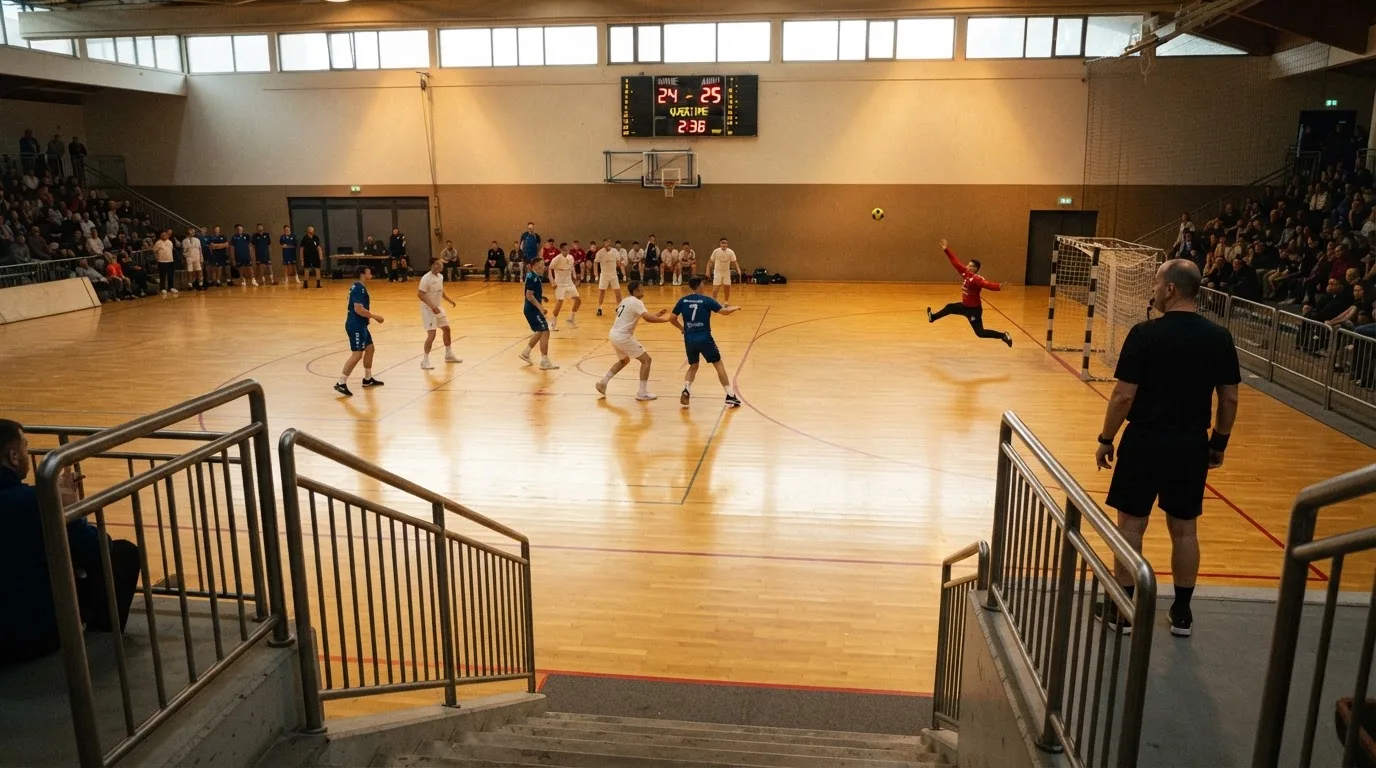
Handball is a friendly sport to model for the reader who likes numbers. Teams play two halves of 30 minutes, the court is 40 by 20 metres with goals 2 metres high and 3 metres wide, and professional sides typically land between 20 and 35 goals each, which gives totals markets real signal. A decisive match that ends level goes to two 5-minute overtime periods and then a penalty shootout — a wrinkle football does not have and one most bookmakers price into the draw line. Seven-a-side (six outfield plus a goalkeeper) means rotations matter: a seven-player bench is normal, and tracking minutes played is part of what an analyst does.
The shape of the calendar rewards the patient reader. The International Handball Federation stages men’s and women’s World Championships in odd-numbered years; the men’s tournament has been held every two years since 1995. Denmark holds the 2025 men’s title, France the 2023 women’s. Men’s handball debuted at the 1936 Berlin Olympics and returned indoors in 1972; women’s handball was added in 1976. On a quiet news day, the calendar tells the reader where the next fixture pool will come from.
The title “best tip” is reserved for the bet the tipster would back with their own money at the available price. A tip with no price attached is an opinion, not a tip — and an opinion is exactly what a tipster may publish without ever having to defend it.
Bonuses and free bets on handball markets
The “free bet” on a sportsbook’s landing page is rarely the gift it looks like. Three things decide what it is worth: whether the stake comes back with a win, the rollover the operator attaches to any winnings, and the minimum price at which the free bet will pay out at all. Each is set by the house, and each cuts the headline number down by a measurable amount.
Unibet’s sports welcome offer is £40 in free bets for a £20 qualifying bet at minimum odds of 2.0 (1/1), with free bets expiring within seven days of issue. QuinnBet free bets last seven days from credit and need odds of at least 1.5 (1/2); the maximum price the operator will pay out is 50/1, and straight accumulators are permitted but the multi-leg formats Trixie, Patent and Yankee are not. Spreadex gives £60 in free bets for a £10 fixed-odds bet, and the qualifying wager needs to be placed within 28 days of opening the account. BetTom returns 50% of a first stake as a free bet up to £50, mirrored by a 50% match up to £50 in free slot funds for casino play. Free-bet stakes are not returned with a win on these offers; the offer is the chance to keep the profit only.
The deeper read takes the fine print at face value. A £20 free bet at decimal odds of 3.00 that wins pays £40 in profit, not £60 — the £20 stake is missing. A 10x wagering requirement on a £10 bonus means £100 of qualifying stakes at the operator’s allowed minimum price; the same requirement on a £50 bonus is £500 of stakes, all of it done on the operator’s house terms and after the bonus clears the customer’s account. The bigger the headline, the larger the ask.
A few offers try to sound like free money but tighten the rope elsewhere. Bet Ahoy’s 10% Acca Bonus tops out at £1,000, with a Sub-Cover feature for player substitutions that pays out when a named player is taken off. Kwiff’s Supercharge can take an ordinary price such as 2/1 and lift it to 20/1 on the same selection. Both make the offer sound larger than it is, and both belong to the same family: a sweetener attached to bets the customer would have placed anyway. The gain to the customer is the difference between the boosted price and the unboosted one. The cost is the chance that the boosted price was already the worst price on the market before the boost.
Three rules of thumb for the reader who plans to claim.
Read the minimum price the offer requires. A free bet that has to be placed at 2.0 (1/1) or higher keeps the bettor out of the low-margin, high-confidence favourites that are the natural home for a stake. The price floor is the first filter on what counts as a clearing bet.
Read the expiry. A free bet that disappears in seven days is a timer the bettor has to clear; a 28-day window asks for less urgency. The calendar of the offer is part of its cost.
Treat the headline number as a third of the value at best. The audit of any free bet takes the headline, divides by a representative rollover, multiplies by a market margin, and ends with the realisable amount. That is the figure the offer deserves.
Live betting and cash out on handball
In-play betting is the wager the customer places once the match has already started. The price moves on every goal, every two-minute suspension, every timeout, every substitution the bench makes — and a bookmaker’s margins on live markets are typically wider than on the pre-match line. Handball is unusually well suited to in-play work: seven players on court, goals scored in bunches rather than evenly, and a scoring tempo that lets the disciplined observer read a swing within a five-minute stretch.
The customer-facing tool for closing a position mid-match is cash out. The bookmaker offers to settle the open bet at a price of its own calculation — and that price is almost always worse than the live market on the same selection, because the firm is taking the margin on both sides of the bet. Cash out is the emergency exit the operator offers when it would otherwise have to honour a drifting line.
Two pieces of context matter before either tool is used.
The in-play offering tracks the pre-match calendar. A Champions League week produces a run of fixtures at peak European evenings; a quiet midweek in the Bundesliga produces a near-empty coupon. Even the slickest in-play product can show nothing.
The cash-out button is a price, not a favour. It is the offer the operator makes, and the offer is its. The bettor who treats it as a convenience fee rather than an opportunity is the customer the firm is built for.
For pre-match prep, the live calendar pages of GB bookmakers — the ones that show fixtures with start times and live status — are the practical entry point. Kalooki Sportsbook advertises in-play betting alongside instant withdrawals by bank transfer within minutes. Midnite shows in-play events, an acca builder, popular accas and price boosts with maximum-stake limits. Spreadex is regulated by the FCA for spread betting and by the Gambling Commission for fixed-odds betting; spread-betting losses can exceed deposits — a separate permission with separate mechanics and a different warning.
Predictions, strategy and the bankroll
A betting strategy is a rule for sizing stakes and choosing prices, not a call on who will win. Three rules cover most of what a strategy needs to do, and each one has a check the bettor can run on a real betting slip.
The value bet
A value bet exists when the bookmaker’s price is greater than the probability of the outcome implies. The comparison runs in implied probability — the inverse of the decimal odds — and the bookmaker’s margin sits inside every price on every market, raising the implied probabilities above 100 percent when summed. The bettor who accepts the bookmaker’s price at face value has already lost that margin; the bettor who works out a personal probability, compares it with the price, and bets only where the price exceeds the personal probability is hunting the small edge the margin leaves behind.
No tip is ever certain. The price is the market’s best collective guess at the moment the bet is placed, and the guess is wrong an average of just under half the time even at favourable prices. A reader who treats a tip as a call to bet the stake rather than a comparison to run is the customer the bookmaker relies on.
Bankroll discipline
Staking a fixed percentage of the bank per bet — one to two percent is the common range — keeps a losing streak from blowing the bank in a single session. The number on the betting slip is what size of stake the rule allows; the bet itself is decided by the value test. Either side alone is incomplete: a value bet placed at the wrong stake is wasteful, and a stake rule followed without a value test is the recipe for the slow loss.
The bank is the figure the bettor can write off entirely without affecting the household. Anything above that figure is borrowed from the rent, the bills or the next month’s budget — and the betting slip does not know that the money is meant to come back.
Why no published tip is certain
A tipster can publish a confident pick and lose it on the next whistle; an analyst can fix a probability at 70 percent and watch the 30 percent land. The market prices in the possibility; the bettor who reads a price as a forecast has misread it. Every published tip should be read as a price comparison rather than an instruction — a tip is “the price is greater than my probability, and my probability is built from these inputs”, not “this side will win”. Treating the tip as a comparison is what makes it useful. Treating it as a forecast is what makes it expensive.
Bet types, odds and how a price is read
A decimal price is what a winning stake returns, stake included. A stake of £10 at decimal odds of 3.00 returns £30; the net profit is £20; the multiple is three. A stake of £10 at 1.50 returns £15; the net profit is £5. Fractional odds of 5/1 mean a £10 stake returns £60 (a £50 profit over the £10 stake); 11/10 means a £10 stake returns £21 (£11 profit). The conversion is fraction → decimal: a/b → a ÷ b + 1, so 5/1 is 5 ÷ 1 + 1 = 6.00 and 11/10 is 11 ÷ 10 + 1 = 2.10.
A match-result market in handball has three outcomes — home win, draw, away win — and the bookmaker’s three prices sum to an implied probability above 100 percent. The margin sits inside that excess. For an illustrative two-way market priced at 1.90 / 1.90, the implied probability of each side is 1 ÷ 1.90 = 52.63 percent, the two together sum to 105.26 percent, and the bookmaker’s margin is 5.26 percent of every unit staked. Over a season, that is the take the operator earns from the market whether the bets win or lose. On a real three-way line the margin is normally larger; the band depends on the competitiveness of the book and on whether the market is a featured match or a filler fixture.
The same match-result line at 1.85 / 1.85 is the same bet at a thinner margin: 1 ÷ 1.85 = 54.05 percent, summing to 108.11 percent, an 8.11 percent margin. The smaller the excess over 100 percent, the more competitive the book — and the more important the search for value becomes, because each price carries less free margin to find. Two bookmakers at the same event can quote the same favourite at different prices because their margins differ, and on a heavily bet match that gap can be the difference between a value bet and an expensive opinion.
This is why a real tip does not just name a team. It names a team at a price, on a bookmaker, on a market, in a snapshot. The price moves; the snapshot dates; the team plays; the bet settles.
The accumulator multiplies the prices of the legs into one. A treble of 1.80 × 2.20 × 3.00 carries decimal odds of 11.88 — a £10 stake returns £118.80 on a win — but the implied probability of each leg is built on the same margin, and the compounded margin of the accumulator is the largest of the three. The bet pays well because it is unlikely, not because the bookmaker is being generous.
Each-way betting is built around horse racing more than handball; on team sports it appears mostly in ante-post outrights (tournament winner markets priced far in advance), where the each-way terms settle half the stake on a place finish. Cash out and bet builder are richer territory for a handball bettor and are discussed elsewhere on this page.
Handball tournaments and where the fixtures come from
The calendar shapes the betting calendar. Three layers matter: the IHF World Championships in odd-numbered years, the European Handball Federation events (EHF Champions League, the European league below it, the European championships), and the domestic leagues that run almost year-round (Germany’s Bundesliga and Handball-Bundesliga, Spain’s Liga ASOBAL, France’s Starligue, Denmark’s Håndbold Ligaen). An international break pulls national-team players into qualifiers and friendlies; a European club week pulls them back.
Tournament outrights are priced weeks ahead and settle when the trophy is lifted. Match-result markets are denser through winter; the spring brings playoff runs in the major leagues; the summer is mostly qualifiers, friendly tournaments and the run-up to a World Championship in an odd-numbered year. The bettor who watches the calendar reads the betting calendar for free.
The Olympics are a special case. Men’s handball debuted in 1936 and has been indoors since 1972; women’s handball was added in 1976. Olympic handball is a fortnight every four years — a short sample on a long calendar — and the outright and match-result markets are densely populated while it runs.
The ten reviewed bookmakers
Each operator below holds a Gambling Commission remote licence for Great Britain. A licence means identity checks before a first deposit, GAMSTOP membership, and access to Commission dispute resolution; it does not mean a better price, a larger bonus or a more accurate tip. Where a fact is missing from a row, a no-data marker is used and the prose beside it notes what is available. Descriptions below name the licence, the platform’s own headline features and the verdict a reader comparing options needs.
The selected set is the featured list on this page, not the licensed market. Many more brands sit on the Commission’s public register. No reviewed brand is “the only” licensed one.
Lottoland
Licensed in Great Britain: account 38991; licence holder EU Lotto Limited. The UK app combines casino, lottery betting, sports betting and scratchcards.
The platform is built around a wider product mix than most sports-first brands, and the sportsbook sits inside that mix. A reader who lands on Lottoland for the lotteries and stays for the handball coupon finds a smaller sportsbook than a specialist would offer. That is a feature, not a defect, for the customer who already has a lottery habit and wants the sportsbook on the same wallet.
Worth it for the reader who would rather not open a second account for an occasional handball bet.
Unibet
Licensed in Great Britain: account 45322; licence holder Platinum Gaming Limited. Unibet states it has operated since 1999. Safer-gambling tools include deposit limits, a player profile test, product restrictions and self-exclusion, alongside live chat and links to BeGambleAware, GamCare, GAMSTOP, Gambling Therapy and the BGC. The sports welcome offer is £40 in free bets for a £20 qualifying bet at minimum odds of 2.0 (1/1), with free bets expiring within seven days of issue.
The European pedigree and the long track record show in the depth of the safer-gambling toolkit. The welcome offer asks for a qualifying bet at 2.0 and clears in a week — short timer, ordinary rollover, an offer for the customer who bets on the Saturday coupon anyway.
This brand suits the reader who wants a mainstream operator with a serious safer-gambling setup and a long-standing sportsbook.
BetVictor
Licensed in Great Britain: account 39576; licence holder BV Gaming Limited. Best Odds Guaranteed on UK and Irish horse racing, enhanced live race streaming, a BetFinder feature for racing bets and Smart Stats are available.
Racing is the headline product, and the in-play product for handball sits beside it. Smart Stats is the operator’s own data overlay; a reader used to working with form and head-to-head numbers will find the tool fits their notes. The football-style markets carry across.
Worth it for the racing-led reader who wants a serious sportsbook with a reliable data layer for the team sports as well.
Swifty Sports
Licensed in Great Britain: account 58957; licence holder Swifty Global (UK) Ltd. Best Odds Guaranteed, Cash Out on markets including horse racing and football, daily price boosts, live streaming and in-play betting are listed; Bet Builder is marked as coming soon.
The brand is newer to the market and lighter on the racing-led heritage. The cash-out offering covers the standard markets, and the price-boost rail is the centre of the promotional offer. A reader who likes a long price-boost list will find one here.
An option for the reader who prioritises feature-led products and daily price boosts over a long-standing brand name.
BetTom
Licensed in Great Britain: account 64959; licence holder Bet Tom Limited. The sports welcome offer is 50% back as a free bet of up to £50, with a matching 50% back up to £50 as free slot funds.
The cross-product offer is the headline: a deposit that turns into both a sports free bet and casino slot funds. A bettor who plays both verticals gets both halves; a sports-only bettor forfeits the casino side and the headline figure.
Worth it for the reader who plays both sports and casino under one wallet and can clear both halves of the welcome.
Bet Ahoy
Licensed in Great Britain under a general betting standard licence; account 100094; licence holder Bet Ahoy Ltd. A 10% Acca Bonus up to £1,000, Sub-Cover for player substitutions, Best Odds Guaranteed on UK and Irish horse and greyhound racing up to £100, and Double Result payout are available.
The acca bonus is the centre of the offer: it pays on accumulators as an extra return, with the £1,000 cap shaping the headline. Sub-Cover for player substitutions is a niche feature that pays out when a named player is taken off — useful in injury-prone leagues.
Worth it for the accumulator-led bettor who works with named-player markets and wants a payout cushion on substitutions.
Kwiff
Licensed in Great Britain under a general betting standard licence; account 44448; licence holder Eaton Gate Gaming Limited. The Supercharge feature can instantly boost the odds on a bet, for example from 2/1 to 20/1, for single or multi bets.
The random boost model is unusual: a 2/1 price becomes 20/1 not through the operator’s selection but by way of an in-app surprise. The feature is the product, and the average boosted price is the variable the bettor should price in — most boosts are small, the rare big one writes the marketing copy.
Worth it for the customer who likes the lottery-style draw of an upgraded price and understands the average.
Kalooki Sportsbook
Licensed in Great Britain under a general betting standard licence; account 57730; licence holder Kalooki Sportsbook Limited. Features include instant bank transfer withdrawals, Best Odds Guaranteed on UK and Irish horse racing, in-play betting and daily boosts.
The withdrawal pitch — minutes, not days — is the headline differentiator, and it puts the brand on a narrower set of competitors than most. In-play and daily boosts are the rest of the offer; the racing product carries the BOG.
Worth it for the bettor who values fast withdrawal over a longer marketing list and is happy with a GAMSTOP-registered, single-account product.
QuinnBet
Licensed in Great Britain under the Commission’s remote general betting standard (real events) licence; account 61011; licence holder QuinnBet (Gibraltar) Limited. Free bets are valid for seven days from credit at minimum odds of 1.5 (1/2), with a maximum price of 50/1; straight accumulators are allowed but Trixies, Patents and Yankees are not.
The free-bet terms are the headline: a wide minimum-odds floor at 1.5 lets a bettor clear offers on the favourites, the 50/1 maximum cap excludes the long-shot moves, and the multi-leg ban cuts off the higher-multiple formats. The bettor who plays singles and small accas fits the rules; the bettor who likes a Yankee does not.
Worth it for the single-and-small-acca reader who wants the offer to clear on a real coupon rather than a manufactured one.
Spreadex
Licensed in Great Britain under the Commission’s remote general betting standard (real events) licence; account 8835; licence holder Spreadex Limited. Spreadex is regulated by the FCA for spread betting and by the Gambling Commission for fixed-odds betting; spread-betting losses can exceed deposits. The new customer offer is £60 in free bets for a £10 fixed-odds bet, with the free bets usable across fixed odds and spread betting; the qualifying bet must be placed within 28 days of opening the account.
The split between FCA-regulated spread betting and Commission-regulated fixed-odds betting is the point of the brand. A reader who wants both products under one roof finds that here; a reader who wants only fixed odds finds a sportsbook paired with a derivative product they have to actively avoid. The 28-day qualifying window is generous against the seven-day clocks most rivals run.
Worth it for the reader who wants a fixed-odds and spread-betting account in one place and reads the FCA risk warning on the spread side.
Compliance, licensing and the offer’s small print
A bookmaker serving customers in Great Britain needs a Gambling Commission licence wherever it is based; since the Gambling (Licensing and Advertising) Act 2014 the requirement applies at the point of consumption. A Curaçao, Maltese or Gibraltar licence is not a substitute. The Commission’s public register is the whole test of who holds one, and the licence categories on the register are real — remote general betting standard (real events), remote general betting standard (virtual events), remote general betting limited, remote pool betting and remote betting intermediary (the licence for betting exchanges).
The register is searched by business name, trading name, domain or account number, so the existence of a .com address does not establish licensing and the absence of a .com does not establish unlicensed: licensed operators use both endings. Northern Ireland is outside the Gambling Act 2005; a “GB-licensed” brand does not regulate Northern Ireland, and a Northern Ireland customer should check the local rules.
The identity check is the first thing the licence condition buys. Name, address and date of birth are verified before a customer can deposit or gamble — since 7 May 2019 including free bets and bonuses — so no anonymous play exists at a licensed site. The minimum age is 18. Credit cards have been banned for gambling in Great Britain since 14 April 2020, including credit-card-funded payments through an e-wallet; debit cards and bank-based payments are not covered by that ban. The player pays no tax on betting winnings in Great Britain — a general statement, not tax advice — and the operator’s tax (General Betting Duty) sits inside the margin the customer never sees.
The advertising rules carry hard edges. The CAP Code (non-broadcast) and BCAP Code (broadcast) sit alongside the Commission’s marketing conditions; marketing must be socially responsible, must not be strongly appealing to under-18s, and no one who is or seems to be under 25 may be featured gambling or play a significant role (with an exception for marketing placed where a bet can be made directly); that rule concerns who may appear in the advertisement, not who may bet. From 19 January 2026, wagering requirements on bonuses are capped at 10x (a £10 bonus at 50x is therefore capped as no more than £100 of qualifying bets), and mixed-product promotions — an offer that requires gambling on two or more product types — are banned. The whistle-to-whistle ban on TV betting adverts five minutes before and after a live sporting event before the 9pm watershed is in force since 1 August 2019, with horse and greyhound racing excluded. The Premier League clubs’ voluntary withdrawal of gambling sponsorship from the front of matchday shirts from 2026/27 is not law.
The financial-vulnerability check is a separate regime. Under LCCP condition 3.4.4, in force since 30 August 2024, a licensed remote operator runs a public-record check (bankruptcy or county court judgments, for example) when a customer’s deposits minus withdrawals exceed £150 in a rolling 30 days — a check that has applied since 28 February 2025. It is a public-record check, not an income check and not a credit-reference check. Wider financial risk assessments — the “affordability checks” of the press — are announced in a staged plan (Commission article of 7 July 2026) with no start date; write “announced, staged, no start date” rather than “in force” until the Commission says otherwise.
The deposit-limit regime sits close by. Operators must offer a gross deposit limit on a fixed time frame; the first changes have applied since 31 October 2025, a second phase was postponed to 30 September 2026, and whether that phase is live is not established. There is no state-set deposit or loss ceiling for betting in Great Britain: limits are the customer’s choice.
Offshore remains an option a click away, and the loss of protection deserves a clear statement. A bookmaker outside the Commission’s regime is not bound by the 10x bonus cap, the £150 vulnerability check, GAMSTOP membership, the Commission’s complaints route or any approved British dispute-resolution body. Funds withheld by an offshore firm have no British consumer redress to chase. The Commission enforces by cease-and-desist notices, search-engine referrals and work with registrars, hosts and payment providers — not by blocking — and any ISP-level DNS blocking is approaching but is not in operation. A customer of an unlicensed site has not committed an offence under the Act, but neither does the Act protect them.
Safer gambling and the help that exists
Gambling is entertainment with a price and a chance of a return; it is not a way to make an income, and a tipster publishing a confident pick has made neither the stake nor the loss. The customer who can treat a loss as the cost of a cinema ticket is the customer the market is built for; the customer who cannot is the customer the safer-gambling regime exists for.
Three tools sit on every GB-licensed platform. Deposit limits cap the gross amount that can be deposited in a fixed time frame; the customer sets them, the operator enforces them. Time-out takes the account offline for a chosen period (24 hours to several weeks). Self-exclusion removes the account for at least six months and is irreversible for the minimum period. GAMSTOP is the national multi-operator online self-exclusion scheme: it is a mandatory licence condition for online operators since 31 March 2020, the periods are six months, one year, five years, or five years with auto-renewal, and the exclusion stays in place for a further seven years after the minimum period unless the customer asks GAMSTOP to remove it. GAMSTOP covers online sites and apps; betting shops use a separate service.
The help services sit outside the bookmaker. GamCare runs the National Gambling Helpline. GambleAware funds research, treatment and education. NHS gambling clinics operate across the regions. Gamblers Anonymous runs peer-led meetings. Where a customer needs help, the operator’s safer-gambling page is the doorway, and the help services are what sit behind it.
The customer who bets more than they planned to is the customer who needs the help lines today, not the day the bank account is empty.
Crypto, bitcoin and the question of anonymity
Three reasons a reader asks about bitcoin on a handball bookmaker. The first is privacy: a payment that does not pass through a card statement. The second is speed: deposits and withdrawals that settle on the chain rather than over a banking rail. The third is access: an offshore bookmaker that holds no GB licence and accepts the currencies a UK bank declines.
The answer runs through the licensing point. A bookmaker serving customers in Great Britain needs a Gambling Commission licence; that licence requires identity verification before a first deposit, including with a free bet or bonus; that verification is incompatible with anonymous play. No bitcoin deposit changes that — the operator still has a duty to know who the customer is, and a customer who wants no identity check is looking for a bookmaker that does not hold a GB licence. Such a brand is outside the regime: no GAMSTOP coverage, no Commission complaints route, no British dispute-resolution body, no consumer redress if funds are withheld, and no protection under the 10x bonus cap or the £150 vulnerability check. The risk is the operator-side risk, the same one a customer accepts every time they place real money with an unlicensed firm.
The practical effect on the GB-licensed side. None of the ten operators reviewed on this page accepts bitcoin, ethereum or another cryptocurrency as a deposit method. The quality of the read at a GB-licensed brand is the quality of the licensed product — a verified customer, a regulated margin, a GAMSTOP exit, a Commission route — paid for in the verification step that anonymous play requires.
The anonymity question is settled by the licensing regime. It does not exist on a GB-licensed site. Where a reader wants it, they are looking at an offshore brand, and the rest of the licensed product leaves with it.
The bookmaker’s margin, in one worked example
The arithmetic here uses an illustrative two-way market at decimal odds of 1.90 / 1.90 to show what a price implies about probability, what the margin inside it costs, and what a bonus really asks of the customer who claims it.
The 5.26 percent figure is the take the operator earns from this market whether the bets win or lose. A real three-way 1X2 market on a handball match — home win, draw, away win — typically carries a margin in a wider band, somewhere between 5 and 10 percent depending on the competitiveness of the book and the prominence of the fixture. The band is the operator’s headroom; the spot the bookmaker lands in depends on how tightly the traders and the model compete for the bettor’s stake. The narrowest margins sit on the heavily bet markets where several books fight for volume; the widest sit on the fixtures only one book bothers to price up.
The bettor’s edge lives in the gap between the bettor’s own probability and the bookmaker’s implied probability. The 5.26 percent the bookmaker keeps is not the bettor’s edge; it is the cost of taking part. The bettor’s edge is the room the bookmaker’s margin leaves behind, and the size of that room depends on the bettor’s modelling accuracy.
A short note on licences and reader-side checks
The licences listed above are taken from the Gambling Commission’s public register. Each is a real entry, but each entry can change — a licence can be varied, surrendered, revoked or have its conditions amended. The register is the test, and a reader comparing options should run a current check on the licence number before staking a meaningful amount. The register accepts a search by business name, trading name, domain or account number, and it shows the licence categories and the licence holder behind each.
The point is editorial, not administrative: a licence is the operator’s promise to the regulator, and the regulator’s register is the only proof that promise is current.
| Brand | Licence | Notes |
|---|---|---|
| Lottoland | Gambling Commission 038991 | Combines casino, lottery and sports |
| Unibet | Gambling Commission 045322 | European pedigree, strong safer gambling |
| BetVictor | Gambling Commission 039576 | Racing-led with Smart Stats data |
| Swifty Sports | Gambling Commission 058957 | Feature-led with daily price boosts |
| BetTom | Gambling Commission 064959 | Cross-product welcome offer |
| Bet Ahoy | Gambling Commission 100094 | Acca Bonus and Sub-Cover |
| Kwiff | Gambling Commission 044448 | Supercharge odds-boost feature |
| Kalooki | Gambling Commission 057730 | Fast bank transfer withdrawals |
| QuinnBet | Gambling Commission 061011 | Single-and-small-acca focussed |
| Spreadex | Gambling Commission 008835 | Fixed-odds and spread-betting |
FAQ
Does every handball bookmaker hold a Great Britain licence?
No. While many popular sites are licensed by the Gambling Commission, others operate offshore without GB approval. A licensed site provides player protections like GAMSTOP, while an unlicensed site offers no British consumer redress. Always check the Commission’s public register before depositing funds.
What happens if a handball match ends in a draw?
In handball, a draw in a decisive match leads to two 5-minute overtime periods, followed by a penalty shootout if scores remain level. This is distinct from football, and betting markets usually include these overtime periods in the final match result or price them specifically.
Are bonuses for handball betting worth claiming?
Bonuses are promotional tools that come with conditions. Always check the minimum odds, the rollover requirements, and the validity period. A bonus is best valued by how much realisable profit it offers after the wagering requirements are met, rather than the headline figure.
Can I bet anonymously at a licensed handball bookmaker?
No. GB-licensed operators are required to verify the identity of every customer before the first deposit, including for accounts using free bets or bonuses. This verification is a mandatory part of the licence to ensure compliance with money-laundering and age-restriction rules.
How does the bookmaker’s margin affect my betting profit?
The margin is the percentage “cut” the bookmaker builds into the odds, ensuring the summed implied probability of all outcomes exceeds 100 percent. A tighter margin means more competitive odds, leaving more room for the bettor to find genuine value against the market’s true probability.
Closing on the choice
Three threads hold the page together. The tip thread: a tip is a price comparison, not a forecast, and the bettor’s edge is the gap the bookmaker’s margin leaves behind. The offer thread: a free bet is a stake that is not returned, a bonus is a rollover the customer has to clear, and a capped market or a minimum price is the cost the offer charges. The licence thread: a GB-licensed bookmaker verifies the customer, takes part in GAMSTOP and answers to the Commission, and offers none of those things at the price of an anonymous bet at an unlicensed brand.
The choice the reader makes is across those three threads. A mainstre
US & other team sports – systembetsguide.com
Content created by the «systembetsguide.com» team
