
Horse Racing Betting Odds in 2026: Where They Come From, What They Cost, and Which UK Bookmaker Fits
 Available in US
The odds on a horse are not a prediction of how fast it will run. They are a price: the amount a bookmaker pays back for each pound staked, after a margin has been skimmed off every outcome in the market. Once that margin is visible, the rest of the page — each-way bets, ante-post pricing, best odds guaranteed, the dozen-odd operators competing for a British licence — becomes a set of choices with real trade-offs rather than marketing to be sorted through.
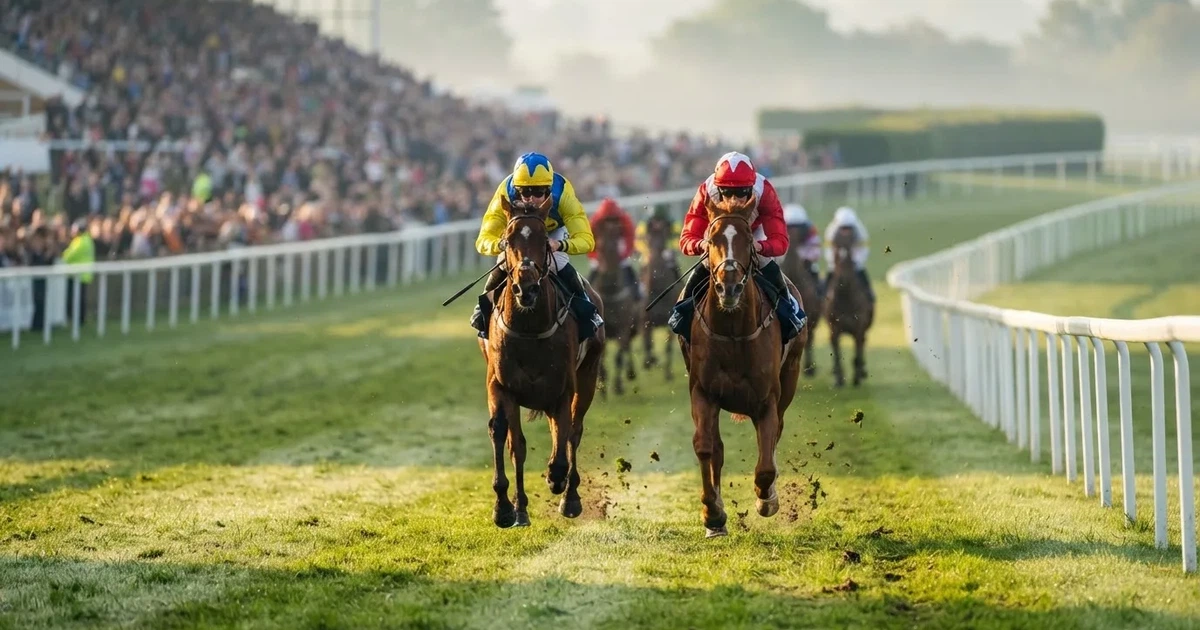
This guide works through those choices one shelf at a time. It opens with the mechanics of a price, covers the legal frame a British punter actually bets inside, and then walks the betting calendar from crypto rails to accumulator insurance before ranking ten Gambling Commission–licensed operators that take horse racing bets in Great Britain.
Data current as of 30 October 2026, checked against the Gambling Commission’s public register.
What an Odds Figure Actually Represents
An odds figure answers exactly one question: how much does the bookmaker pay back if this selection wins, per pound staked? The industry calls that figure a price, and it can be shown two ways. Fractional odds (5/1, often read “five-to-one”) mean a winning pound returns five pounds of profit plus the original pound, so the total return is six pounds. Decimal odds (6.00) carry the same information in one number — a winning pound returns six pounds in total, profit included. A fair conversion between the two is: fractional a/b becomes decimal a ÷ b + 1, so 9/10 (the near-even money common on horse racing favourites) becomes 2.00 in decimal, and 5/1 becomes 6.00.
The conversion is mechanical and it is not the interesting part. The interesting part is what sits *inside* the price. A bookmaker is not a prediction engine; it is a counterparty that builds a book — a set of prices on every runner in a race — and skims a margin off the whole field so that whatever wins, the operator keeps a slice.
Take a two-way example to see the mechanism at its simplest. Suppose a bookmaker quotes a hypothetical market with both outcomes priced at decimal odds 1.90 (roughly 9/10 in fractional terms). A punter who stakes £1 on one side gets £1.90 back if it wins, £1.90 if the other side wins — for a total potential payout of £3.80 on a £2 stake. A “fair” book, one with no margin, would have both sides priced at 2.00 (even money), so the total payout was exactly £4 on £2. The gap between £4 and £3.80 is the margin: 1 − (3.80 ÷ 4.00) = 0.05, or 5%. That 5% is, on average over many bets, what the bookmaker keeps of every pound staked on this market.
The same arithmetic on a twelve-runner race works the same way, only with twelve prices instead of two. The bookmaker builds a book in which the implied probabilities of every runner sum to slightly more than 100%, and the surplus is the margin. On a competitive horse racing market the margin is usually in the low single digits; on a smaller field or a less-tipped meeting it can climb well above that. That is why two bookmakers offering the same race can return slightly different odds on the same horse — one is running a 4% margin, the other a 7% margin, and the difference lands in the punter’s pocket over a season of betting.
Race Formats, Distances, and Why They Shape the Market
Horse racing in Great Britain splits into two distinct codes. Flat racing is run directly between two points around a straight or oval track, while jump racing — steeplechasing and hurdling — is called National Hunt racing in Britain and Ireland. The two codes meet different conditions, build different form books, and attract different betting patterns; a punter who only follows the flat will see a jump festival like Cheltenham or Aintree as a different sport.
Flat distances range from 440 yards (400 m) up to more than four miles (6.4 km), with five to twelve furlongs (1.0 to 2.4 km) the most common distances. Jump races run further on average, with the Grand National course at Aintree stretching just over four miles and a half with thirty fences.
Handicap races are the place where form meets mathematics most directly. Each horse is assigned a different weight to carry based on its assessed ability — the official handicapper’s job is to bring the field as close to level as the form allows, and a bettor reading a handicap is reading a weighted contest rather than a free-for-all. Conditions races, by contrast, give horses the same weight with allowances for younger horses and for fillies and mares. The British Flat season’s three Classic races — the 2000 Guineas, the Derby, and the St Leger — are conditions races, and they make up the British Triple Crown. A horse that wins all three joins an exclusive club: the last to complete the feat was Nijinsky in 1970.
The distinction matters at the betting counter because a handicap and a conditions race produce different each-way place terms (covered below). It also matters for ante-post markets: a long-priced outsider in a twelve-runner handicap is a structurally different bet from a long-priced outsider in a five-runner Group 1.
Each-Way Bets and the Place-Term Ladder
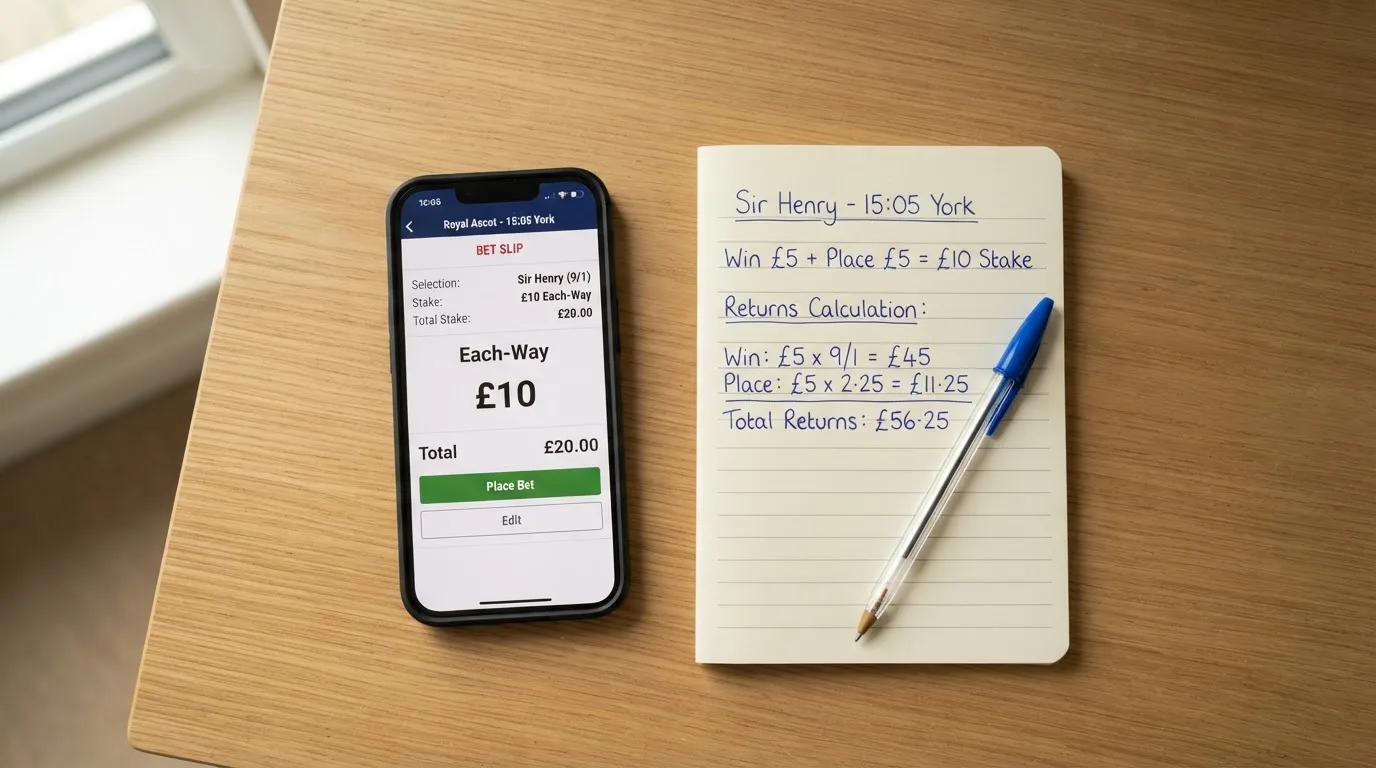
An each-way bet is, mechanically, two bets of equal stake on the same selection — one on the horse to win, one on the horse to be placed. The stake doubles: a £5 each-way bet on one horse costs £10 in total. If the horse wins, both parts pay out. If it finishes in a place but does not win, the win part loses and the place part pays at a fraction of the win odds. If it finishes outside the places, the punter loses both bets.
Place terms in Britain are not uniform across the sport. The standard ladder runs like this:
- Handicaps with more than fifteen runners: quarter odds (1/4 of the win price) for the first four places.
- Twelve to fifteen runners: 1/4 odds for three places.
- Any other race with more than seven runners: 1/5 odds for three places.
- Five to seven runners: 1/4 odds for two places.
- Fewer than five runners: win only, no place part pays.
That ladder is the industry default, but individual operators can offer better terms on a featured race — extra places on a Classic, for instance, or enhanced place terms on a big handicap. The promoted “extra places” market on a marquee race is a real change to the maths of an each-way bet, and worth reading before placing it.
Worked example on the default terms: a £10 each-way bet (£20 total stake) on a 10/1 horse in a race paying 1/4 odds for three places. If the horse wins, the win leg returns £10 × 10 + £10 = £110; the place leg returns £10 × (10/4) + £10 = £35; total return £145. If the horse finishes second or third, the win leg is lost and the place leg pays £35, so the net position is £35 returned against a £20 stake. The each-way structure costs more than a single win bet at the same odds, but it gives the punter a paid position when the horse runs well without winning — useful in a deep field where short-priced favourites dominate but the place terms still offer meaningful returns.
Decimal vs. Fractional, and What an “Even Money” Race Means
British bookmakers publish fractional odds by tradition; that is the form printed in the Racing Post, spoken on course, and quoted on most on-course boards. Decimal odds are a holdover from continental European practice and they tend to show up on betting exchanges, in-app displays, and accumulator builder screens. The two carry identical information, and the conversion is exact:
- Fractional 5/1 → decimal 6.00 (a £1 stake returns £6).
- Fractional evens (1/1) → decimal 2.00.
- Fractional 9/10 → decimal 1.90.
A race where the favourite is at 9/10 (decimal 1.90) and the second favourite is at 4/1 (decimal 5.00) is structurally a race where the bookmaker sees one runner as much more likely to win — and the second favourite, at a longer price, is where the punter seeking value looks hardest. A favourite at 1/10 (decimal 1.10) is so short that a winning bet pays back £1.10 for every £1 staked and gives no margin for error; longer-priced runners carry more risk but more return on a win.
Shorter than evens is called “odds-on” in the trade: 4/6, 1/2, 2/5. These prices sit below 2.00 in decimal form, and a punter staking on an odds-on favourite is paying back less in profit than the stake risked. A punter staking on something at 20/1 is doing the opposite: a £1 stake returns £21 if it wins, but the chance of winning is remote enough that a bookmaker is comfortable laying it.
The Legal Frame: Gambling Commission Licences and What They Cover
A bookmaker serving customers in Great Britain needs a Gambling Commission licence, and the Commission’s public register is the whole test of who holds one. Since the Gambling (Licensing and Advertising) Act 2014, an operator whose remote facilities are used in Great Britain must hold a Commission licence wherever it is based — a Curaçao, Maltese, or Gibraltar licence alone is not a substitute. The register can be searched by business name, trading name, domain, or account number, and any operator detail quoted against a customer-facing terms page should reconcile against a register entry.
Betting licence types vary. Remote general betting standard (real events) is the standard online sportsbook licence and what most of the operators on this page hold. Remote pool betting covers off-course pool products like the Tote. Remote betting intermediary is the licence exchanges run under. Remote general betting (virtual events) covers computer-simulated racing. Each carries its own conditions and codes of practice.
There is no state monopoly and no statutory cap on the number of licences. There is also no statutory list of permitted bets or markets: an operator holds a licence for a category and offers markets under its own rules and the Commission’s Licence Conditions and Codes of Practice (LCCP). The minimum age is 18, and since 7 May 2019 licensed operators verify a customer’s name, address, and date of birth before they can deposit or gamble — including with a free bet or a bonus. There is no anonymous play at a licensed site.
Financial spread betting is regulated by the Financial Conduct Authority rather than the Gambling Commission; the two regimes govern different products and the protections diverge.
In-Play Betting, Cash Out, and What the Rules Permit
A licensed British bookmaker offers in-play betting on most major horse races, and the controls sit in the operator’s licence conditions and customer-protection duties rather than in statute. In-play on horse racing is unusual among sports because the runs are short and the markets sometimes settle in under five minutes — a bookmaker’s in-play offering on a race meeting ranges from full in-running markets to “winner” markets only, depending on the operator and the technology.
Cash out is a feature that lets a punter settle a bet before the outcome is decided, at a price the bookmaker sets. It is offered by most modern British bookmakers and is best understood as a second price the bookmaker quotes on a market it already holds the customer’s money in. The cash-out price moves with the live event — a horse travelling well into the home straight might have a rising cash-out figure; one pulled up or hampered has a falling one. Whether cashing out is “right” depends on what would have happened had the punter held the bet to settlement, and there is no general answer to that question.
A few features are common across in-play products on horse racing at the operators reviewed below: Bet Builder (combining markets from one event into a single bet, available pre-match and in-play at some brands), acca insurance (a refund as a free bet if one leg of an accumulator loses), and price boosts (a one-off inflated price on a featured selection, usually capped at a small stake).
Bonuses, Free Bets, and What They Actually Cost
Two patterns dominate the British bonus landscape for horse racing. The first is the “bet £10, get £10 in free bets” structure: a new customer places a qualifying bet, receives free bets of equal or near-equal value, and must use the free bets within a stated window — often seven days — while the stake is not returned with any winnings. The second is the price boost or enhanced odds: a one-off inflated price on a featured runner, usually capped at a £10 or £20 stake, paid in cash or as a free bet.
Wagering requirements on bonuses are capped at 10× since the 19 January 2026 rule change. A £10 bonus at 50× would require £500 of qualifying bets under the old rules; under the cap, no more than £100 is needed. Mixed-product promotions — an offer that requires gambling on two or more product types, such as “bet on football to get free spins” — are banned in the same rule set.
The shape of a free bet matters. A free bet whose stake is not returned pays back *profit only* on a win. A £10 free bet at decimal odds 3.00 returns £20 (the £10 free bet stake is not given back, but the profit of £20 is paid); the punter does not see the stake twice. That is different from a cash bonus, which is paid in withdrawable money but carries its own turnover. Each operator’s own terms state how its promotion works — read them before claiming anything, because the difference between a free bet, a risk-free bet, and a cash bonus is not small.
Best Odds Guaranteed (BOG) is the most important horse-racing-specific promotion in the British market. Most major bookmakers offer it on UK and Irish racing: if the starting price (SP) on a horse is higher than the price the punter took when placing the bet, the bet is settled at the higher SP. The promotion usually applies from 8 AM on the day of the race to the off, on both single and multiple bets, and excludes ante-post, tote, and pari-mutuel bets. For regular punters on UK and Irish racing, BOG is one of the few promotions that changes the maths of the book they bet into.
Crypto, E-Wallets, and Payment Rails on Licensed Sites
A licensed British bookmaker does not, in the normal run of things, accept cryptocurrency deposits. The Commission’s customer due diligence and source-of-funds requirements, combined with anti-money-laundering obligations, have pushed licensed operators towards regulated payment rails: debit cards, bank transfers, and established e-wallets. Crypto-friendly brands tend to operate outside the GB licensing regime; an unlicensed brand is not covered by GAMSTOP, the Commission’s complaints route, approved dispute-resolution bodies, or the 10× bonus cap, and there is no British consumer redress if funds are withheld.
Credit cards have been banned for gambling in Great Britain since 14 April 2020, including credit-card-funded payments through an e-wallet. Debit cards and bank-based payments are not covered by that ban. A British named-account rule, a state list of permitted payment methods, and any rule for or against cryptocurrency deposits at licensed operators are not established — describe payments from each operator’s own terms.
The trade-off for a punter choosing a licensed brand is the verification step at sign-up. Name, address, and date of birth are verified before the first deposit, and source-of-funds questions at higher spend are normal under the money-laundering rules. That is the cost of the licence regime; the benefit is that funds held with a licensed operator are held under British regulatory supervision rather than in an offshore trust.
Mobile Apps, Browsers, and the Shape of the Modern Betting Experience
The British betting app market has consolidated around a small number of well-funded products. The largest operators run their own apps with full sportsbook, in-play, cash-out, and live-streaming stacks; smaller and specialist brands tend to lean on shared platform technology and add their own markets on top. Punters comparing apps usually care about three things: how quickly the bet slip loads, how clearly the live markets show during a race, and whether cash out settles instantly.
A few structural points are worth noting. Live streaming is offered at most major British bookmakers on UK and Irish racing — typically requiring a positive account balance or a bet on the race in question. Bet Builder exists at the larger apps and is increasingly available in-play. Bet Boosts and acca insurance are advertised prominently in-app.
Specialist apps in the horse racing niche exist alongside the major players. Geoff Banks, for instance, is published by GB Sports Advisors Limited and concentrates on racing markets with live in-play prices and ante-post pricing; BetGoodwin sits in a similar specialist bracket.
Spread Betting vs. Fixed Odds — Two Different Products
Spread betting on horse racing is a different animal from fixed-odds betting. A spread betting firm quotes a spread — for example, a horse quoted at 18–22 lengths means the firm expects the winning distance between first and second to fall in that range; the punter decides whether to buy (bet the distance will be higher than the spread) or sell (bet it will be lower). The payout is then the stake multiplied by the difference between the result and the spread.
Spread betting losses can exceed the deposit. A punter who sells at 22 and the horse finishes 50 lengths clear has lost 28 × the stake. That is a structural risk unique to spread betting and the reason it sits under Financial Conduct Authority regulation rather than the Commission’s. A punter who wants the fixed-odds experience — defined stake, defined return at the price quoted at placement — should stay with a fixed-odds bookmaker.
Some firms offer both products on the same login. Sporting Index, for instance, lets a customer switch between fixed odds and spread betting on the same platform, with in-play betting, auto cash-out, and multi-market access. The right product depends on the punter’s appetite for variable losses.
The British Racing Calendar and Where to Find Each Market
The British Flat season runs roughly from late March to early November, with the Classics in May and June. The National Hunt season runs from late autumn through to the following spring, with the Cheltenham Festival and the Grand National at Aintree as its marquee meetings. All-weather racing runs year-round on synthetic surfaces.
Ante-post markets are quoted weeks or months in advance of a race and run on the bookmaker’s own terms — typically no BOG, no refunds on non-runners unless the race is abandoned, and a Rule 4 deduction can apply when a horse is withdrawn. The closer to the off a punter waits, the more accurate the prices tend to be, but ante-post prices on well-backed horses can be much more attractive than those on the day.
Daily markets concentrate around the major race meetings, with evening cards supplementing the daytime fare. Each bookmaker’s app shows the day’s races in order; place terms and any extra-places promotions are listed on the race card.
Top 10 Horse Racing Betting Odds Sites in Great Britain
The ten operators below all hold a Gambling Commission remote betting licence for Great Britain, cover horse racing, and are presented in the order set by research rather than as a personal ranking. Each card describes what the operator offers and where it sits in the comparison. Where a feature or a term was not in evidence at the snapshot date, it is left unsaid.
Tote
Licence: Gambling Commission remote licence 054779-R-331321-008 (account 54779), held by TDCO Limited. The Tote has run pool betting on British and Irish racing since 1928 and is the only bookmaker on this list whose core product is the pool rather than fixed odds. Pool betting means the punter bets into a fund, the fund is divided after the deduction of the operator’s take, and payouts reflect the volume bet on each runner rather than a fixed price set in advance.
The trade-off for the punter is variance. A pool payout on a long-priced winner can dwarf a fixed-odds return, because the fund is split among fewer winning tickets. A pool payout on a short-priced favourite is usually worse than the equivalent fixed-odds price, because the favourite has attracted more money into the pool. A punter who plays the Tote is implicitly betting on a market structure rather than on a horse, and the structure favours certain betting strategies over others.
The Tote’s app and tote.co.uk site cover the major British and Irish meetings and the international festivals.
BetGoodwin
Licence: Gambling Commission remote licence 002927-R-327985-008 (account 2927), held by Goodwin Racing Limited. BetGoodwin positions itself as a racing-led bookmaker — football and a small number of other sports are priced, but the betting programme and the promotional calendar are weighted toward horse racing.
The welcome structure, on BetGoodwin’s own terms, is a sports welcome offer made up of three £5 segments: a £5 sports bet, a £5 acca, and a £5 Sub-Cover bet, triggered by an initial £10 qualifying stake.
Geoff Banks
Licence: Gambling Commission remote licence 054095-R-330366-010 (account 54095), held by GB Sports Advisors Limited. Geoff Banks is a specialist racing bookmaker and the betting programme is concentrated on racing markets. The app, published by GB Sports Advisors Ltd, offers live in-play prices on selected meetings and ante-post prices on future events.
VBet
Licence: Gambling Commission remote licence 044662-R-324273-022 (account 44662), held by SCGO Limited. VBet runs a broader sportsbook covering horse racing among twenty-plus sports, with a mix of in-play, pre-match, and casino products. The welcome structure, on VBet’s own terms, is a £10 free bet for a new, verified customer who stakes £10 or more on a first bet that loses.
Sporting Index
Licence: Gambling Commission remote licence 027343-R-308898-011 (account 27343), held by Sporting Index Limited. Sporting Index specialises in spread betting on sports, with fixed odds as a secondary product. The platform lets a customer switch between fixed odds and spread betting on the same login and offers in-play betting, auto cash-out, Bet Builder for football, and Multi-Markets spread products.
Kalooki Sportsbook
Licence: Gambling Commission remote licence 057730-R-333396-005 (account 57730), held by Kalooki Sportsbook Limited (company number 12938274). Kalooki is a GAMSTOP member and operates its UK sportsbook under the Gambling Commission’s remote general betting licence. The site positions itself as a streamlined racing and sports product.
LiveScore Bet
Licence: Gambling Commission remote licence 056859-R-332720-005 (account 56859), held by LiveScore Betting and Gaming (Gibraltar) Limited. LiveScore Bet sits inside a wider LiveScore media stack and serves a customer base that already follows live scores. The Bet Builder allows up to ten selections and covers match result, both teams to score, corners, total goals, player scoring, and card markets.
Dabble
Licence: Gambling Commission remote licence 065677-R-340363-005 (account 65677), held by Dabble Sports UK Ltd. Dabble’s welcome structure, on its own terms, is “Bet £10, Get £10 in Free Bets” on a first deposit for new customers, with a minimum-odds qualifier, a 7-day expiry on the free bets, and the stake not returned with any winning free bet. The social and in-app features lean into a chat-led market experience.
10bet
Licence: Gambling Commission remote licence 043173-R-322899-023 (account 43173), held by Blue Star Planet Limited. 10bet’s sportsbook covers football, tennis, and horse racing among other sports, with cash out, Bet Builder, and Live Streaming on selected events.
Betfred
Licence: Gambling Commission remote licence 039544-R-319290-010 (account 39544), held by Petfre (Gibraltar) Limited. The Betfred Sports, Casino & Games app is published by Done Brothers (Cash Betting) Ltd in the UK retail layer and covers twenty-one sports plus over 2,000 casino-style games. Betfred is one of the longest-established British bookmakers and operates a substantial high-street estate alongside its online product.
The table below maps each operator to its licence number and the holder, alongside a one-line summary of what each operator’s terms state on the subject of horse racing.
| Brand | Gambling Commission remote licence | Holding the licence | What the operator’s terms state |
|---|---|---|---|
| Tote | 054779-R-331321-008 (account 54779) | TDCO Limited | Pool betting on British and Irish racing, the long-running pool product |
| BetGoodwin | 002927-R-327985-008 (account 2927) | Goodwin Racing Limited | Racing-led sportsbook with a multi-segment welcome offer |
| Geoff Banks | 054095-R-330366-010 (account 54095) | GB Sports Advisors Limited | Specialist racing markets with in-play and ante-post prices |
| VBet | 044662-R-324273-022 (account 44662) | SCGO Limited | Multi-sport sportsbook with racing among twenty-plus sports |
| Sporting Index | 027343-R-308898-011 (account 27343) | Sporting Index Limited | Spread betting on sports with fixed odds as a secondary product |
| Kalooki Sportsbook | 057730-R-333396-005 (account 57730) | Kalooki Sportsbook Limited | GAMSTOP member, streamlined sports product |
| LiveScore Bet | 056859-R-332720-005 (account 56859) | LiveScore Betting and Gaming (Gibraltar) Limited | In-app live scores, Bet Builder with up to ten selections |
| Dabble | 065677-R-340363-005 (account 65677) | Dabble Sports UK Ltd | Welcome offer with a stake-not-returned free-bet structure |
| 10bet | 043173-R-322899-023 (account 43173) | Blue Star Planet Limited | Multi-sport sportsbook with cash out and live streaming |
| Betfred | 039544-R-319290-010 (account 39544) | Petfre (Gibraltar) Limited | Twenty-one-sport sportsbook with a large retail estate |
Across the ten operators the structural differences are sharper than the brand-on-brand comparisons usually suggest. The Tote runs a pool product where the price is set by the pool itself; Sporting Index runs a spread product where the loss can outrun the deposit; the rest are fixed-odds bookmakers whose differences sit in how wide their racing programme is, how aggressive their welcome terms are, and whether their in-play and live-streaming stacks cover the meetings the punter actually follows.
What “Licensed” Buys a Punter — and What It Doesn’t
A Gambling Commission licence means the operator sits inside a defined regulatory frame. Identity verification happens before the first deposit, source-of-funds questions are normal at higher spend, GAMSTOP coverage is mandatory, the 10× wagering cap on bonuses applies, advertising is constrained by the CAP Code (non-broadcast) and BCAP Code (broadcast), and complaints route through the operator and, if unresolved, an approved alternative dispute resolution body. The player’s winnings carry no British gambling tax; General Betting Duty is the operator’s tax on gross profits, currently 15% and rising to a 25% remote rate from 1 April 2027 (with remote bets on UK horse racing, in-person betting, and pool betting staying at 15%).
A licensed operator is not the same as “the safe choice” by default. The verification step at sign-up is intrusive, the affordability checks (financial vulnerability checks from 30 August 2024 and the announced, staged financial risk assessments with no start date) are real, and the bonus landscape is more constrained than in an unregulated market.
An unlicensed brand trades against this frame. There is no verification before deposit, no GAMSTOP coverage, no Commission complaints route, no approved dispute-resolution body, no British consumer redress if funds are withheld, and no 10× cap on bonus wagering. The Commission’s enforcement powers — cease-and-desist notices, search-engine referrals, registrar and payment-provider work, and soon court-order DNS blocking — are aimed at the operator, not the customer. No offence aimed at a customer who merely bets on an unlicensed site was found in the rules reviewed; the loss is in the protections that come with a GB licence.
Player Protection and What the Industry Owes a Punter
GAMSTOP is the national multi-operator online self-exclusion scheme and a mandatory licence condition for online operators since 31 March 2020. Self-exclusion periods are six months, one year, five years, or five years with auto-renewal, and after the minimum period an exclusion stays in place for a further seven years unless the customer asks GAMSTOP to remove it. GAMSTOP covers online sites and apps; the high-street betting shop network uses a separate in-shop self-exclusion mechanism.
A financial vulnerability check (LCCP condition 3.4.4, in force since 30 August 2024) applies to licensed remote betting when a customer’s deposits minus withdrawals exceed £150 in a rolling 30 days. The check is a public-record search — for example, bankruptcy or county court judgments — and not an income check or a credit reference check. Financial risk assessments — the “affordability checks” of the press — are announced in a staged plan with no start date as of the snapshot.
Deposit limits (Remote Technical Standard 12) require operators to offer a gross deposit limit on a fixed time frame. The first phase has applied since 31 October 2025; a second phase was postponed to 30 September 2026, and whether it is live is not established at the snapshot. There is no state-set deposit or loss ceiling for betting — limits are the customer’s choice.
Help: GamCare operates the National Gambling Helpline. GambleAware funds treatment and prevention. The NHS operates gambling clinics in several regions. Gamblers Anonymous runs peer-support meetings across the country.
Promotion Rules and the 10× Cap
Wagering requirements on bonuses have been capped at 10× since 19 January 2026. A £10 bonus at 50× would have required £500 of qualifying bets under the old rules; under the cap no more than £100 is needed. Mixed-product promotions — an offer that requires gambling on two or more product types, such as “bet on football to get free spins” — are banned in the same rule set. Whether the cap applies to free bets with no wagering condition, and any cap on the money value of a bonus, are not established and would be confirmed through the Commission’s published guidance.
“Whistle-to-whistle” is an industry code, not law. Since 1 August 2019, betting advertisements are not shown on TV from five minutes before a live sporting event to five minutes after it, before the 9pm watershed. Horse and greyhound racing are excluded from the whistle-to-whistle ban. The Premier League clubs’ withdrawal of gambling sponsorship from the front of matchday shirts (from 2026/27, with sleeves and hoardings remaining) is voluntary and not law.
Operators are responsible for marketing by their affiliates. No promo code is printed in the comparison above; each operator’s own terms state its current welcome structure, and the punter’s own check at the time of sign-up is the right way to confirm what is on offer.
What Offshore Means in the British Context
A GB licence is compulsory at the point of consumption: an operator whose remote facilities are used in Great Britain needs a Commission licence, and providing gambling facilities in Great Britain without one is an offence under section 33 of the Gambling Act 2005. Enforcement against unlicensed operators runs through cease-and-desist notices, search-engine referrals, work with registrars and hosts and payment providers, and the court-order DNS blocking powers the Commission has been given or is about to receive. ISP-level blocking of unlicensed sites is not in operation across the board.
For a punter, the choice between a licensed and an unlicensed site comes down to the protections a licence buys. The licensed side carries the verification burden and the affordability check; the unlicensed side carries the loss of those protections. Neither is framed here as the safe choice by default — both have costs.
How a Punts Compares Two Operators on Horse Racing
Three checks give a useful read on a British bookmaker’s racing product. The first is licence status on the Commission’s public register, checked by business name or trading name rather than by a casual web search. The second is the place-terms ladder and any extra-places promotions on the operator’s marquee meetings — those are the offers that change the maths of an each-way bet. The third is Best Odds Guaranteed coverage on UK and Irish racing: which markets it applies to, what the time window is, and whether ante-post and multiple bets are included.
Two notes on the comparison itself. Ante-post markets run on different terms from on-the-day markets — Rule 4 deductions, no BOG, and different non-runner rules — and the price difference between an ante-post quote and the day-of-race quote can be substantial enough to outweigh the convenience of betting early. Cash out prices are a second price from the same bookmaker on the same market the punter has already paid to enter; whether to take a cash-out offer is a separate decision each time it appears.
The Margin in a Two-Way Market — A Worked Sense
A two-way market priced at decimal odds 1.90 / 1.90 — used here as an illustrative example rather than as a quoted price from a real race — gives a payout of £1.90 for each £1 staked on either side. Total payout on a £2 stake across both outcomes is £3.80, against a “fair” total of £4.00 if both sides were priced at even money (2.00 / 2.00). The shortfall is the bookmaker’s margin: 1 − (3.80 ÷ 4.00) = 5%.
That figure is a band rather than a single number, because the actual margin on any given race varies with the field size, the market type (win, each-way, forecast, tricast), and the operator’s pricing model. A typical horse racing win market on a competitive twelve-runner race carries a margin in the low single digits; a smaller field or a less mainstream meeting can run higher. The margin a punter pays is the difference between the returns they actually get and the returns a true-fair market would deliver, summed across however many bets they place in a season. That is the line that makes choosing between operators a decision worth taking, rather than a marketing exercise.
Picking the Right Operator for What You Actually Bet On
The right bookmaker depends less on the operator’s overall ranking than on what the punter bets. A racing-only punter who plays the Tote pool will be served by a very different operator from a multi-sport punter who wants a Bet Builder and live streaming. A each-way punter on handicaps wants the best place-terms ladder and any extra-places offers. A spread-betting punter wants a different product altogether, under FCA regulation rather than the Commission’s.
A few cross-cutting notes. BOG on UK and Irish racing is the single most valuable promotion for a regular racing punter, and operators differ on which multiple bets it covers. In-play markets on smaller meetings are often thin — a major meeting like the Cheltenham Festival carries wider in-running coverage than a Tuesday afternoon all-weather card. Welcome offers are best treated as one-off value rather than as a reason to stay; loyalty terms, place-terms promotions, and BOG coverage are what matter once the welcome cycle ends.
The verification step at sign-up is intrusive and unavoidable at any licensed brand. The affordability checks kick in above modest deposit thresholds, and source-of-funds questions are normal. A punter who finds that friction unacceptable has chosen the wrong product; the friction is the cost of the protections the licence buys.
What Changes Year to Year in the British Market
Three structural changes are worth keeping in mind. General Betting Duty rises to a 25% remote rate from 1 April 2027, while remote bets on UK horse racing, in-person betting, and pool betting stay at 15%. The 10× wagering cap on bonuses took effect on 19 January 2026. The whistle-to-whistle TV advertising rule has been in force since 1 August 2019. The Premier League’s voluntary withdrawal of gambling sponsorship from shirt fronts starts from 2026/27.
Financial vulnerability checks rolled out from 30 August 2024 and apply when deposits minus withdrawals exceed £150 over a rolling 30 days. The Commission’s staged plan for financial risk assessments has no start date at the snapshot.
The shape of the licensed market is stable in the near term — the ten operators above all hold current GB remote licences, and their licences run for multi-year periods subject to renewal. New entrants face the same verification and affordability regime as the established names, and any new brand worth comparing will appear on the Commission’s register first.
Quick Orientation for a Reader Comparing Operators
A short reading order:
- Licence status on the Commission’s public register.
- BOG coverage on UK and Irish racing, and the time window.
- Each-way place-terms ladder and any extra-places promotions.
- In-play and live-streaming coverage on the meetings the punter follows.
- Welcome structure and welcome-expectation versus long-term loyalty terms.
The five points are not exhaustive — withdrawal times, payment-method coverage, and customer service quality all matter — but they are the ones a racing punter can check quickly against the operator’s own pages.
Closing Note
A betting licence is not a guarantee of winning. The bookmaker’s margin sits inside every price, and a licensed operator is not a tipster; the punter’s actual edge sits somewhere else, in handicapping, in odds-reading, in staking discipline, and in the discipline of stopping. A punter who bets on a market they understand, at a price they have reason to believe is too generous, with a stake they can afford to lose, is the punter most likely to enjoy the sport and to keep their accounts in working order.
Frequently Asked Questions
How is a bet on a horse race placed?
A bet on a horse race is placed by selecting a runner (the horse to back), choosing a market (most commonly win or each-way), entering a stake, and confirming the bet at the odds shown at that moment. Decimal odds of 3.00 on a £10 stake return £30 total (£20 profit plus the £10 stake). The odds can change between placing and the start, and Best Odds Guaranteed settles the bet at the higher of the taken price or the starting price.
How does an each-way bet work?
An each-way bet is two bets of equal stake on the same horse: one on it to win and one on it to be placed. The total stake is doubled (£5 each-way costs £10). If the horse wins, both legs pay; if it places but does not win, only the place leg pays at a fraction of the win odds (commonly 1/4 or 1/5 of the win price, depending on the field size and the race type).
How do betting odds on horse racing work?
Odds on horse racing are the price a bookmaker pays back per pound staked if the horse wins. They carry two pieces of information: the implied probability (the bookmaker’s view of the chance of winning, embedded in the price) and the margin (the cut the bookmaker keeps of every unit bet on the market). The lower the margin, the closer the implied probabilities add up to 100%, and the better the long-term return for the punter.
How can a bookmaker’s Gambling Commission licence be checked?
The Commission’s public register can be searched at the official register address by business name, trading name, domain, or account number. A licensed operator’s entry shows the licence number, the categories held, the licence holder’s name, and the trading names operating under that licence. The register is the single source of truth on who holds a GB betting licence, and any operator’s customer-facing licence claims should reconcile against it.
How is a return on a bet calculated from the stake and the odds?
A return is calculated by multiplying the stake by the decimal odds: a £10 stake at decimal odds 4.00 returns £40 total (£30 profit plus the £10 stake). For a combination bet, the odds of each leg multiply into one combined price. A free bet whose stake is not returned pays profit only (£10 at odds 4.00 returns £30, not £40), and that distinction is the one to watch in any free-bet offer.
What is the bookmaker’s margin, and how does it show up in the odds?
The bookmaker’s margin is the share of every pound staked that the bookmaker keeps on average over many bets. It shows up in the odds as the difference between the implied probabilities of all outcomes and 100%. A two-way market priced at 1.90 / 1.90 has an implied total probability of about 105%, a surplus of 5% over the fair 100%, which is the margin.
Horse racing & greyhounds – systembetsguide.com
Content created by the «systembetsguide.com» team
