
Online kabaddi betting in 2026: paths, prices, and the reader each path suits
 Available in US
Kabaddi betting in Great Britain is not a market that announces itself on a Premier League front-of-shirt or a Tube advert. The Pro Kabaddi League runs in India, the World Cup is held every few years, and most UK-licensed bookmakers list the sport under an “international” or “other” tab rather than at the top of the homepage. Anyone who types “kabaddi betting” into a search box this year is asking two questions. Where can the sport actually be bet on, and what does the price look like once they find it. The first question is partly answered by the Gambling Commission’s public register, which is the only test of who holds a remote licence to serve customers in Great Britain. The second is answered by arithmetic, because every price a bookmaker publishes carries a margin inside it, and the spread between back and lay tells a bettor what they are really paying.

This page is built around a single editorial choice: the reader decides the path. Some people want a Friday-night Pro Kabaddi acca with a Bet Builder and a price boost; others want to lay the favourite on an exchange and never watch the match. The operator list, the bet types, the in-play options, the app experience, and the responsible-gambling machinery all exist to serve those two readers, plus everyone between them. What follows covers each of those shelves in turn, then works through the ten operators in the ranking, and finishes with the calculations and questions a careful punter asks first.
Data current as of 30 October 2026, verified against the Gambling Commission’s public register and each operator’s own terms.
Reading the odds on a Pro Kabaddi match
Pro Kabaddi League matches settle through the same plumbing as any other fixed-odds market: a stake at a price, settled against the outcome. The result is what most UK punters care about. Where kabaddi differs is in the wording of the markets, because the sport scores in a way football does not.

A raider earns one point per defender tagged out, plus a bonus point when six or more defenders are on court and the raider crosses the bonus line. A team that tackles all seven opponents scores two extra points for the All Out. Ties go to a five-raids-each tie-breaker and then a golden raid, where the first team to score wins. None of that needs to be remembered to read the odds, but the markets follow it. A match winner is two-way; a handicap is built around the All Out bonus; totals are tied to the points curve; raider props sit on top of the points ladder. Knowing the rules lets a reader skip the markets that mean nothing to them, which is the only edge a sport-specific punter has over a sport-specific bookmaker.
The bigger reading is the price itself. Decimal odds of 1.90 and 1.90 on a two-way market are not a fair coin: they imply a margin. Work the arithmetic once and the picture clears. The payout share of a market is one divided by the sum of the reciprocal odds, so 1 ÷ (1/1.90 + 1/1.90) = 0.95, or 95 % of every pound staked returned to winners on average. The margin is one minus that figure, so 5 % of every unit staked is what the bookmaker keeps on this two-way market at 1.90/1.90. The condition matters: the same 5 % holds for that specific price, that specific snapshot, and that specific market. Touch either side to anything else and the band moves. At 1.85/1.85 the figure becomes 1 ÷ (1/1.85 + 1/1.85) ≈ 0.926, or a margin near 7.4 %. At 1.95/1.95 it falls to about 2.6 %. The market does not have one margin; it has a band, and the price the punter accepts decides where in the band they sit.
What does that mean in practice. A punter backing the favourite at 1.90 on every match of a season, at a 5 % margin, expects to lose 5 pence of every pound staked across the campaign, before their own skill is added or subtracted. Skill can move that figure, sometimes by a lot. The margin cannot be removed by skill; it can only be picked around, by reading price rather than match. That is the cost the bookmaker charges for the convenience of a Bet Builder, an in-play screen and a £10 free bet on a losing opener. It is also the reason an exchange, where punters set the prices and the platform takes a small commission on net winnings, often shows tighter margins than a fixed-odds firm on the same fixture.
For readers who prefer fractional prices, the conversion is mechanical: divide the first number by the second, add one, and the answer is the decimal price. Five-to-one (5/1) becomes 5 ÷ 1 + 1 = 6.00. Eleven-to-four (11/4) becomes 11 ÷ 4 + 1 = 3.75. Evens (1/1) becomes 2.00. The arithmetic is the same in reverse: take the decimal odds, subtract one, and write the remainder as a fraction. 3.50 in decimals is 2.50, or 5/2. British bookmakers write fractional odds by default; their apps convert them in a tap.
What kabaddi betting odds look like in practice
A spread of handicap, total and outright prices sits on every match a bookmaker lists. The handicap market handles the All Out bonus without the punter having to call it: a -2.5 handicap on the favourite concedes the bonus and a half-point either way, which is what a punter buying points actually wants. Totals follow the points curve, and most Pro Kabaddi matches settle between 35 and 55 total points, with team totals running from the high teens to the low thirties depending on the matchup. Outrights — who wins the league, who finishes top of the table, who tops the raid chart — are typically priced months in advance at fat margins, because the bookmaker is paid to take a view on a long, noisy competition.
A line of 1.85/1.95 on the match winner looks ordinary. A line of 1.70/2.10 looks fat. The punter’s job is to notice the difference and price the matches that work.
Two markets deserve a closer read. The toss market — who wins the coin toss that decides which side raids first — is a coin flip, and a coin flip should be priced near 1.91/1.91 at a tight bookmaker. If a firm offers 1.80/2.00 on the toss, the reader is paying a margin of about 5.5 % on a market that should be a coin. The same firm on the same fixture might offer a proper handicap at 1.90/1.90. The reader who notices the gap reads price first, market second. The other is the each-way market, common on outrights: two bets of equal stake, one on the win and one on the place, so the stake doubles. The place terms vary by competition and by operator, and the punter checks them before staking, not after.
How the punter reads price is what separates a Pro Kabaddi bettor from a punter who happens to have backed a Pro Kabaddi match. A Bet Builder on a single match is convenient and the price compounds, leg by leg, into a single number that often carries a heavier margin than the underlying markets would have. A pre-built acca across the card is the same trade dressed differently. The accumulator pays more because it is harder to win; the margin is harder to read because the legs multiply. Reading the price of the individual legs, then comparing the compounded price to the price the firm offers, is the only honest check on what the builder costs.
Kabaddi betting sites, fixtures and the calendar that drives the market
The fixture calendar decides what a kabaddi betting site can actually offer. The Pro Kabaddi League runs from October to December each year, a twelve-team franchise competition that began in 2014 with eight sides and grew to twelve before the 2017 season. Outside Pro Kabaddi, the international calendar is the Kabaddi World Cup, first held in 2004 in Mumbai and organised by the International Kabaddi Federation, which Indian men’s and women’s teams have won at every edition. National leagues in Iran, South Korea, Japan and Pakistan fill the gaps. A UK punter looking for fixtures in spring and summer is reading the wrong calendar.
That calendar matters because most UK-licensed bookmakers carry kabaddi only when there is a tournament to bet on. A site that lists the sport all year is reading from a different page than a site that lists it during Pro Kabaddi season and quietly shelves it the rest of the year. A reader who bets kabaddi weekly has a short list of firms that handle the sport properly; a reader who bets once a year on a World Cup final has the whole industry available, because every firm with an international tab can list that match.
The first decision is therefore about commitment. A punter who wants Pro Kabaddi all season narrows the field to firms with a deep kabaddi book and a working in-play product. A punter who bets once or twice a year widens it to any firm with an international menu. The list that follows is built for the wider reader, because ten firms listed here is a wider field than the small handful with a deep kabaddi book, and the wider field carries everything else a reader needs when they move on from a single bet.
Top 10 kabaddi betting sites in 2026
The ten firms below are the ones the Gambling Commission’s public register confirms as holding a remote general betting standard licence (or, in one case, a remote betting intermediary licence) for customers in Great Britain. Each card covers the licence, what the operator’s own terms say about kabaddi specifically where they say anything, the welcome offer the firm publishes for sports, and what kind of reader the firm actually suits. The order is not a ranking.
| Brand | Gambling Commission remote licence number and licence holder | What the operator’s own terms state on kabaddi |
|---|---|---|
| Copybet | 053774-R-330743-010; Copybet UK Limited | Offers Best Odds Guaranteed all day, every day on UK and Irish racing; pays first past the post on horse racing even if the winner is later disqualified. Kabaddi listed under the international menu during Pro Kabaddi season. |
| Smarkets | 039173-R-319366-011 (betting intermediary); Smarkets (Malta) Limited | Commission-based exchange. UK deposits by open bank transfer instant from £10 up to £10,000; withdrawals processed within 6 hours from £10 up to £100,000; UK debit card deposits instant from £10 up to £15,000. Lay kabaddi outrights and match winners in season. |
| 10bet | 043173-R-322899-023; Blue Star Planet Limited | Sportsbook covers football, tennis and horse racing with Cash out, Bet Builder and Live Streaming. Kabaddi sits on the international tab during Pro Kabaddi and on World Cup windows. |
| Spreadex | 008835-R-104580-022; Spreadex Limited | Combines fixed-odds and spread betting in one app; one-click, auto and partial cash out; Bet Builder across fixed odds or spreads; live streaming of UK and Irish racing, greyhounds, tennis, NFL and selected football. Spread betting losses can exceed deposits; FCA regulates spread betting, the Gambling Commission the fixed-odds side. |
| BetTom | 064959-R-339314-003; Bet Tom Limited | Sports welcome is 50 % back as a free bet up to £50 with a matching 50 % up to £50 as free slot funds for casino; full terms apply. Kabaddi on the international menu. |
| Fitzwilliam Sports | 048760-R-335434-009; SBKI Limited | Self-described Dublin bookmaker with capped membership; welcome is a “High Stakes Welcome” subject to compliance criteria. Instant deposits, fast withdrawals, timeouts, deposit limits, links to GambleAware, GamStop and Gamblers Anonymous. |
| BoyleSports | 039469-R-319383-025; Boylesports Enterprise | UK sports welcome is £20 in free bets on a £10 bet (€30 in free bets on a €10 bet for Irish players). Kabaddi listed when fixtures run. |
| VBet | 044662-R-324273-022; SCGO Limited | Sports welcome is a £10 free bet if a new, verified customer stakes £10 or more on a first-ever bet that loses. International menu during Pro Kabaddi season. |
| Octobet | 062545-R-337248-006; Octopus Game Limited | Sportsbook welcome is 50 % back as a free bet up to £50, plus a £10 casino bonus for new customers. Kabaddi on the international tab. |
| BetGoodwin | 002927-R-327985-008; Goodwin Racing Limited | Sports welcome is “Bet £10 & Get £15 in Free Bets” in a £5 sports bet, a £5 acca and a £5 Sub-Cover bet. Racing-leaning bookmaker; kabaddi on international menu when listed. |
The reader who wants an exchange to lay the favourite in Pro Kabaddi reads the Smarkets card and stops there. The reader who wants a deep fixed-odds book with a Bet Builder and live streaming reads the 10bet and Spreadex cards together, then chooses between a sportsbook-only product and a combined fixed-odds and spread-betting product. The reader who wants a racing bookmaker’s house style on a sport that races by weekend its Bengal book chooses BetGoodwin or BetTom. The reader who wants a Dublin bookmaker with capped membership reads Fitzwilliam Sports and accepts that compliance criteria narrow who qualifies. Each card closes on what the firm actually suits, not on what the welcome offer says.
Copybet
Copybet is licensed by the Gambling Commission under account 53774. The headline product is Best Odds Guaranteed all day, every day on UK and Irish racing, with first past the post paid even when the winner is later disqualified, which is the racing punter’s two main gripes handled in one line. Kabaddi is listed on the international tab during Pro Kabaddi season and during World Cup windows, with the standard two-way match winner and a basic outright market; the depth is the same depth the firm offers on most international sports. The welcome for racing is the headline, and the kabaddi punter is reading the card for the racing product even when betting on the Indian league.
Copybet is a racing-first bookmaker with an international tab, and it works best for a punter who understands that kabaddi is a secondary offering here.
Smarkets
Smarkets runs on a Commission remote betting intermediary licence under Smarkets (Malta) Limited, account 39173, the licence category that covers betting exchanges. The product is a commission-based exchange: punters back and lay each other, the platform takes a small slice of net winnings, and the resulting margin is usually tighter than a fixed-odds bookmaker’s on the same fixture. UK deposits by open bank transfer are instant from £10 up to £10,000 and withdrawals are processed within 6 hours from £10 up to £100,000; UK debit card deposits are instant from £10 up to £15,000. The deep markets on Pro Kabaddi include match winner, handicaps and outrights, with the kind of liquidity on the big matches that lets a serious layer move money at the price they want.
Smarkets enables users to lay the favourite on a Pro Kabaddi match and accept an exchange’s commission in lieu of a fixed-odds margin. It is not designed for someone hunting for a free bet, since exchanges do not run bonuses in the fixed-odds sense.
10bet
10bet is licensed by the Commission under account 43173. The sportsbook covers football, tennis and horse racing with Cash out, Bet Builder and Live Streaming, which is the standard full-service product. Kabaddi sits on the international tab during Pro Kabaddi and on World Cup windows, with match winner, handicap and totals markets; the in-play product is general, not kabaddi-specific, and a reader who bets in-play on Pro Kabaddi takes the same in-play screen a football punter takes. The welcome is the standard sportsbook structure.
10bet suits a reader who wants a full-service sportsbook with a Bet Builder and a live stream. It is a good choice for someone betting across multiple international sports.
Spreadex
Spreadex is licensed under Commission account 8835, and the FCA regulates the spread-betting side of the same firm. The product is fixed-odds and spread betting in one app: one-click, auto and partial cash out, Bet Builder across fixed odds or spreads, and live streaming of UK and Irish horse racing, greyhounds, tennis, NFL and selected football. The headline warning the firm itself prints is that spread betting losses can exceed deposits, which is not true of fixed-odds betting and which a punter reads before they open the spread side. Kabaddi is on the fixed-odds international tab during Pro Kabaddi season; the spread side is not a natural kabaddi product.
Spreadex is an option for the punter looking to explore spread betting on familiar sports, provided they carefully weigh the risks against the fixed-odds alternatives.
BetTom
BetTom is licensed under Commission account 64959. The sports welcome is 50 % back as a free bet up to £50, with a matching 50 % up to £50 as free slot funds for the casino side, both subject to the firm’s full terms. The sportsbook covers the standard menu with kabaddi on the international tab during Pro Kabaddi season. The welcome is the headline, and the punter reads the small print on the free bet — wagering, minimum odds, expiry — before staking the qualifying bet, because every “50 % back” is a different deal depending on what the terms do with the free bet once it lands.
BetTom suits a reader who wants a generous welcome structure and who reads the small print before they claim it. The free bet is the point of the welcome; the small print is the cost.
Fitzwilliam Sports
Fitzwilliam Sports is licensed under Commission account 48760. The firm describes itself as a Dublin bookmaker with capped membership, and the welcome is a “High Stakes Welcome” subject to compliance criteria, which is the firm’s way of saying the offer is for customers the firm approves rather than for anyone with a debit card. The responsible-gambling product is honest: instant deposits, fast withdrawals, timeouts, deposit limits, and links to GambleAware, GamStop and Gamblers Anonymous. Kabaddi is on the international tab during Pro Kabaddi season; the depth is the standard international depth.
Fitzwilliam Sports suits a reader who wants a Dublin bookmaker with capped membership and who accepts that compliance criteria narrow the offer to customers the firm wants on the book. It does not suit a casual reader looking for a sign-up bonus, because the welcome is gated.
BoyleSports
BoyleSports is licensed by the Gambling Commission under account 39469. The UK sports welcome is £20 in free bets when a £10 bet is placed (€30 in free bets for a €10 bet for Irish players), which is a clean structure: one qualifying bet, a fixed free-bet return. Kabaddi is listed when fixtures run, with match winner and the standard international markets. The sportsbook is a generalist product with a racing tilt, and the punter who wants an Irish firm’s house style on the Pro Kabaddi season reads the BoyleSports card.
BoyleSports is an Irish bookmaker with a straightforward welcome offer and a generalist sportsbook menu that fits a broad range of betting styles.
VBet
VBet runs on a Commission remote general betting standard licence under SCGO Limited, account 44662. The sports welcome is a £10 free bet if a new, verified customer stakes £10 or more on a first-ever bet that loses, which is a refund-on-loss structure with the refund paid as a free bet, not as cash. The sportsbook is a standard full-service product; kabaddi sits on the international menu during Pro Kabaddi season and on World Cup windows, with the depth a generalist sportsbook offers on an international sport. Verification before the first deposit, named in the welcome as a condition, is the standard under a Commission licence.
VBet provides a refund-on-loss welcome and delivers a standard sportsbook experience with an international menu that includes Pro Kabaddi.
Octobet
Octobet runs on a Commission remote general betting standard licence under Octopus Game Limited, account 62545. The sportsbook welcome is 50 % back as a free bet up to £50, plus a £10 casino bonus for new customers, which is a combined sportsbook-and-casino welcome under the Commission’s promotion rules. The sportsbook covers the standard menu; kabaddi is on the international tab. The welcome is the headline; the punter reads the wagering terms on both the free bet and the casino bonus before claiming.
Octobet offers a combined sportsbook-and-casino welcome package, which is a good choice for someone comfortable with the wagering requirements on both sides.
BetGoodwin
BetGoodwin runs on a Commission remote general betting standard licence under Goodwin Racing Limited, account 2927. The sports welcome is “Bet £10 & Get £15 in Free Bets”, split into a £5 sports bet, a £5 acca and a £5 Sub-Cover bet, which is a three-part free bet structure that asks the punter to place three different bet types to use the full £15. The firm is racing-leaning, and kabaddi is on the international menu when the firm lists it, with the depth a racing-leaning book offers an international sport. The Sub-Cover bet is a racing-specific product that does not transfer to kabaddi.
BetGoodwin suits a racing reader who wants a three-part welcome and who accepts that the international menu is shallower than at a generalist sportsbook.
What online kabaddi betting is — and what it isn’t
Online kabaddi betting is a fixed-odds product on a niche international sport, sold through a UK-licensed bookmaker’s international tab during a short annual fixture calendar. It is not a major sport with a dedicated homepage banner, a Premier League-style sponsorship presence, or a dedicated betting show on a British sports channel. It is a sport with one headline league — Pro Kabaddi — and one headline international cup, and a UK punter finds it on the same tab that hosts handball, volleyball and badminton. The reader who searches for it once a year, on a World Cup final, finds every generalist sportsbook; the reader who searches for it weekly, across a Pro Kabaddi season, narrows the field.
The licensing frame around it is the Gambling Commission’s remote general betting standard licence. There is no separate kabaddi licence; there is no statutory list of permitted sports or markets; there is no monopoly. A firm with a remote general betting standard licence can list any sport under its own rules and the LCCP. The Commission’s public register is the test of who holds one, and a reader who wants to check a firm’s licence looks up the business name, trading name, domain or account number on the register, and the entry confirms or denies the licence.
What it isn’t, equally, is anonymous. The Commission’s identity-verification rules apply to a customer’s first deposit at any licensed firm, since 7 May 2019, including a free bet or bonus, and the punter who arrives expecting a no-questions-asked sign-up is reading the wrong product. Verification is the cost of a licensed site, and the same verification is the protection a licensed site gives back.
Regulation in Great Britain — and what an unlicensed site costs
The Gambling Commission regulates commercial gambling in Great Britain under the Gambling Act 2005, with Northern Ireland outside the Act and on its own older law. Since the Gambling (Licensing and Advertising) Act 2014, an operator whose remote facilities are used in Great Britain needs a Commission licence wherever it is based; a Curaçao, Maltese or Gibraltar licence is not a substitute. There is no state monopoly and no cap on the number of licences; the market is open and the register is the test.
Licence types the reader meets are remote general betting standard (real events), remote general betting standard (virtual events), remote general betting limited, remote pool betting, and remote betting intermediary, which is the category that covers betting exchanges. The firms listed above are general betting standard (real events) except Smarkets, which is a betting intermediary. The licence type matters when the reader asks what markets the firm can offer: real-event kabaddi falls under real events, not virtuals, and the firm lists it accordingly.
Betting duty is the operator’s tax, not the customer’s. General Betting Duty is currently 15 % of the operator’s gross profits on general betting, with a new remote betting rate of 25 % applying within it from 1 April 2027 on remote bets other than those on UK horse racing, on self-service betting terminals in licensed premises, on pool betting, and on in-person betting, which stay at 15 %. Until 1 April 2027 the remote rate stays at 15 %. The player pays no tax on betting winnings in Great Britain, and that rule has not changed. A professional gambler should ask HMRC or an adviser; this page is general information.
What an unlicensed site costs the customer is the clearer frame. A site without a GB licence is not blocked at the ISP level by statute, but the protection a GB licence brings disappears: no GAMSTOP coverage, no Commission complaints route, no approved dispute-resolution body, no British consumer redress if funds are withheld, not bound by the 10x bonus cap, not bound by the £150 financial vulnerability check. The customer who bets on an unlicensed site is not committing an offence under section 33 of the Gambling Act 2005, which is aimed at the operator, but is also not protected when the operator stops paying. That is the trade-off, and the Commission’s enforcement against unlicensed sites is disruption — cease-and-desist notices, search-engine referrals, work with registrars, hosts and payment providers — not consumer protection. The reader who chooses an unlicensed site accepts that trade.
The reader who chooses a licensed site accepts the other trade: verification before the first deposit, name and address and date of birth, and source-of-funds questions at higher spend. Neither choice is free. The licensed choice is the one the regulator can enforce on the operator; the unlicensed choice is the one the regulator cannot reach at all.
Responsible gambling at a UK-licensed kabaddi bookmaker
The responsible-gambling machinery at a UK-licensed firm runs on three layers: customer-set limits, GAMSTOP self-exclusion, and operator-side checks.
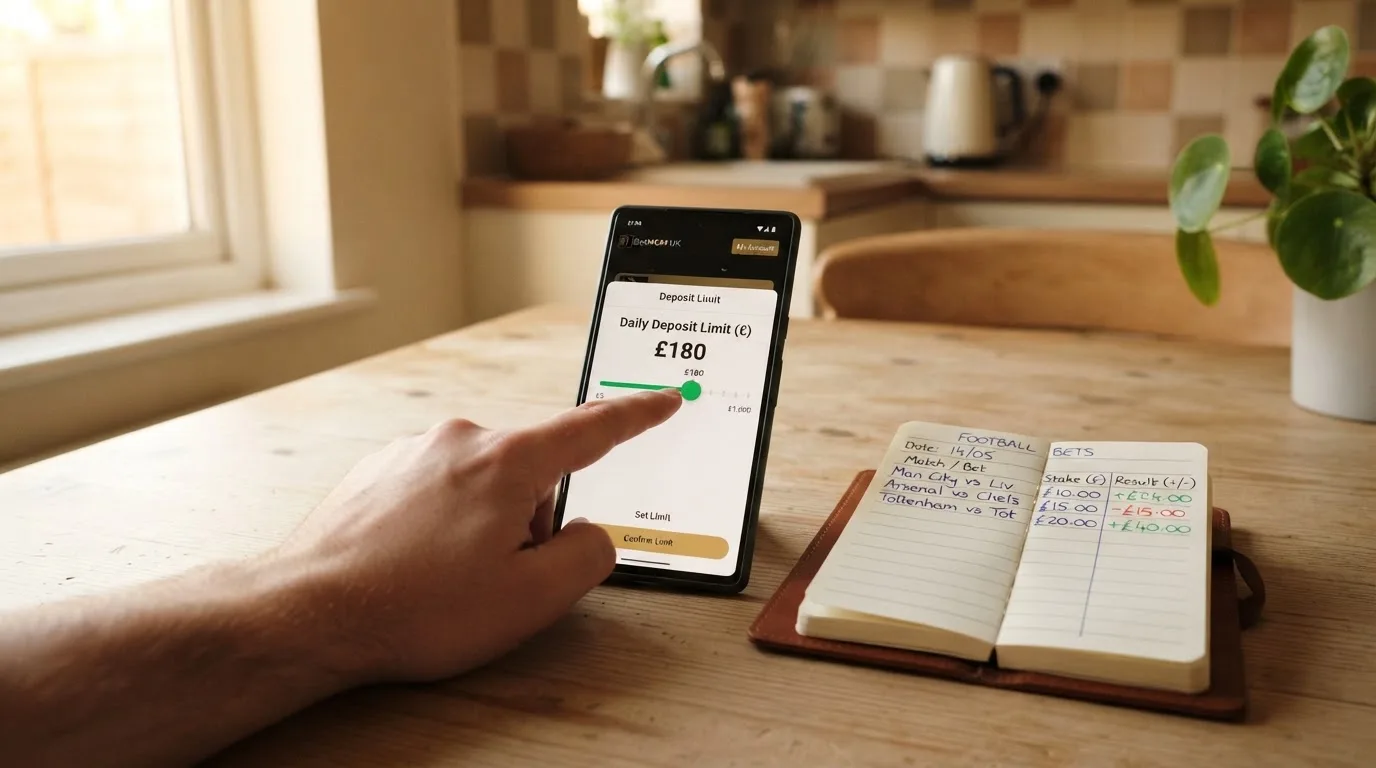
Customer-set limits are the firm’s deposit limits, timeouts and reality checks. Operators must offer a gross deposit limit on a fixed time frame under the Remote Technical Standards; the first phase of changes has applied since 31 October 2025, a second phase was postponed to 30 September 2026, and whether it is in force is not established. There is no state-set deposit or loss ceiling for betting: limits are the customer’s choice, and a punter who never sets a limit has the operator’s default. Setting a limit is the cheapest responsible-gambling tool the punter has.
GAMSTOP is the national multi-operator online self-exclusion scheme and a mandatory licence condition for online operators since 31 March 2020. The schemes offered are six months, one year, five years, or five years with auto-renewal, and after the minimum period the exclusion stays in place for a further seven years unless the customer asks GAMSTOP to remove it. GAMSTOP covers online sites and apps; betting shops use a separate service. A punter who self-excludes through GAMSTOP is excluded from every UK-licensed online operator, not from one, and the exclusion is the strongest single tool the regulator puts in the punter’s hands.
Operator-side checks are the financial vulnerability check and the announced financial risk assessments. The financial vulnerability check, under LCCP condition 3.4.4 in force since 30 August 2024, applies to licensed remote betting when a customer’s deposits minus withdrawals exceed £150 in a rolling 30 days (since 28 February 2025); it is a public-record check (bankruptcy, county court judgments), not an income check and not a credit reference check. Financial risk assessments, the affordability checks of the press, are announced in a staged plan (Commission article of 7 July 2026), with no start date, and a careful punter reads the plan as “announced, staged, no start date” rather than as “in force”. A punter who reads the limit and the rule as they stand today is on the page the regulator publishes.
Help outside the operator runs through GamCare (the National Gambling Helpline), GambleAware, NHS gambling clinics and Gamblers Anonymous. A punter who needs help finds it through any of those names, and the firms link to them because the LCCP requires it.
Kabaddi betting apps — what to look for
The headline app question is whether the firm’s app lists kabaddi at all. A firm with a deep kabaddi book runs the sport on the app, on mobile, and on desktop; a firm with a thin book lists it on the website and buries it in the app. The punter who bets kabaddi weekly checks the app before depositing, because a website-only listing disappears the moment the punter wants to bet on the bus home.
The second question is whether the app handles the in-play product the punter wants. Cash out is the test: a firm with a one-click, auto and partial cash out on its app is closer to the in-play product a Pro Kabaddi punter wants than a firm with cash out as a website-only feature. Live streaming narrows it further: a firm that streams UK and Irish racing, greyhounds, tennis, NFL and selected football (Spreadex) is not going to stream Pro Kabaddi, and the punter who needs a stream on the match wants a different product, not a different firm.
The third question is whether the app handles the welcome without friction. Verification before the first deposit is the rule, and a slow verification flow is the most common reason a punter never claims a welcome. The firms that handle it well do it in minutes; the firms that handle it badly do it in days. The punter reads the verification flow on a review site before signing up, because the welcome is only worth the time it takes to claim.
bet365 is the official global betting partner of the UEFA Champions League and its app is the most downloaded sports betting app in the UK; Bet Builder+ combines markets from one event into a single bet, available pre-match and in-play, with Super Boosts, Winnings Boosts on Bet Builders and selected singles, and daily Bet Boosts; in-play betting, live streaming worldwide, Bet Track, Match Live and a Live Golf Tracker round out the product. bet365 is not on the ten-firm list above, but the app is the reference product against which the ten firms’ apps are read.
Lottoland UK’s app combines casino, lottery betting, sports betting and scratchcards and is licensed by the Gambling Commission for customers in Great Britain; Midnite’s site cites Gambling Commission licence 101839 and shows in-play events, an acca builder, popular accas and price boosts with maximum-stake limits; Kalooki Sportsbook is operated by Kalooki Sports Book Ltd (company number 12938274), licensed by the Gambling Commission under account number 57730, and is a GAMSTOP member. None of those three is on the ten-firm list either; each is named because a reader comparing apps asks about products outside the ranking.
The punter who bets kabaddi on the bus home picks the app that lists the sport and settles in-play. The punter who bets from a desktop in the evening picks the firm with the deepest menu. The punter who bets from a betting shop with a self-service terminal has a different product, and the ten-firm list is the wrong frame.
Live kabaddi betting and cash out
Live kabaddi betting is in-play on a sport that runs in two halves of twenty minutes for men and fifteen for women with a five-minute interval, which is a stop-start rhythm that suits in-play price moves. The raiders rotate; the All Out bonus flips the score; the golden raid in a tie-breaker decides a match in one possession. An in-play screen that updates with the points and the raids gives the punter a real-time picture; an in-play screen that lags the broadcast does not.
Cash out is the in-play tool that lets a punter close a bet before the final whistle. One-click cash out settles a bet in a tap; auto cash out sets a threshold and waits for it; partial cash out takes a slice of the stake off the table and lets the rest ride. The cash-out price is the bookmaker’s in-play price for the position the punter is closing, and it carries the same margin as the pre-match price, sometimes a heavier margin because the bookmaker is pricing a smaller, more volatile market. A punter who uses cash out accepts the in-play margin in lieu of waiting for the final outcome.
The firms that offer cash out on kabaddi are the firms with a full in-play product. Spreadex offers one-click, auto and partial cash out across fixed odds and spreads, which is the deepest in-play product on the ten-firm list. 10bet offers Cash out as part of a sportsbook that also includes Bet Builder and Live Streaming. The firms that do not list cash out on the international menu are the firms the punter narrows out of the in-play choice.
Live streaming is the rarer feature. Spreadex streams UK and Irish racing, greyhounds, tennis, NFL and selected football; bet365 streams events worldwide. Neither firm streams Pro Kabaddi, and the punter who wants a stream on a Pro Kabaddi match watches a stream from an Indian broadcaster with a bet on the side, not a stream from the bookmaker. The trade is the punter’s: a stream from a third party and a bet on the bookmaker, or a bet on the bookmaker and no stream. There is no British bookmaker that streams Pro Kabaddi at this writing.
Calculating the margin on a two-way market at 1.90/1.90
The calculation the page earns its keep on is the bookmaker’s margin on a two-way market, expressed as a band with its condition. The condition matters, because the margin depends on the price.
A two-way market at decimal odds 1.90 / 1.90 implies a payout share of 1 ÷ (1/1.90 + 1/1.90) = 0.95, or 95 %, and a margin of 1 − 0.95 = 0.05, or 5 %. That 5 % is the bookmaker’s take of every unit staked on this specific market at this specific snapshot. Touch either side and the band moves. A line of 1.85 / 1.85 implies a payout share of 1 ÷ (1/1.85 + 1/1.85) ≈ 0.926 and a margin near 7.4 %. A line of 1.95 / 1.95 implies a payout share of about 0.974 and a margin near 2.5 %. The market does not have one margin; it has a band that runs from about 2.5 % at tight prices to about 7.5 % at fat prices, with the average on a typical sportsbook somewhere in the middle.
What does that band cost the punter. A punter backing the favourite at 1.90 on every match of a Pro Kabaddi season, at the 5 % margin the calculation yields, expects to lose 5 pence of every pound staked across the campaign, before their own skill is added or subtracted. A punter who reads price and picks around the fat end of the band pays less margin; a punter who reads price and ignores it pays more. Skill can move the expected loss to a win; the margin cannot be removed by skill, only picked around.
The band is what the punter sees across a season. Some matches price tighter, some price fatter; the average is the page’s number, and the page’s number is the band 2.5 % to 7.5 %, with the condition that the band applies to a two-way market at the prices named. Single prices on Pro Kabaddi match winners routinely price fatter than 5 %, especially on the underdog, and the punter who prices every match before staking sees that pattern across a card.
The same arithmetic on a three-way market — a match winner with the draw at 1.90/3.40/4.20, for instance — gives a different number. The payout share becomes 1 ÷ (1/1.90 + 1/3.40 + 1/4.20) ≈ 0.892, the band is wider, and the margin sits near 10.8 %. Three-way markets price fatter because the draw is a real outcome the bookmaker has to price, and the punter who reads price reads the difference between a 5 % two-way margin and a 10 % three-way margin before they stake.
The exchange number is the same calculation, applied to the back price and the lay price on the same selection. The platform takes a small commission on net winnings, which the punter adds to the implied margin on the spread, and the resulting band is the tighter band the exchange punter accepts in lieu of the fixed-odds bookmaker’s product. The arithmetic is identical; the result is tighter.
Frequently asked questions
How is the return on a bet worked out from the stake and the odds?
The return on a winning bet is the stake multiplied by the decimal odds. A £10 stake at decimal odds of 3.75 returns £37.50, made up of the £10 stake and £27.50 of profit. The net profit is the stake multiplied by the decimal odds minus one, so a £10 stake at 3.75 returns £27.50 of profit on its own. For a combination bet the odds of the legs multiply into one price: a double at 2.0 and 3.0 is priced at 6.0, and a £10 stake returns £60 on a winning double.
What is the bookmaker’s margin and how can it be seen in the odds?
The bookmaker’s margin is the slice of every pound staked the bookmaker keeps on a market, expressed as a percentage. It sits inside the prices. On a two-way market priced 1.90/1.90 the implied payout share is 1 ÷ (1/1.90 + 1/1.90), or 95 %, so the margin is 5 %. The bigger the margin, the fatter the bookmaker’s take. A punter who reads price before staking sees the margin before they bet, and that is the only honest way to compare two firms on the same fixture.
How can it be checked that a bookmaker holds a Gambling Commission licence?
The Gambling Commission’s public register can be searched by business name, trading name, domain or account number, and the entry confirms or denies the licence. The register is the whole test of who holds a remote licence to serve customers in Great Britain, and a punter who wants to confirm a firm looks the firm up on the register before depositing. The licence number on the firm’s own terms page should match the register entry; if it does not, the punter treats the firm as unlicensed until the register says otherwise.
How do fractional odds such as 5/1 convert to decimal odds such as 6.00?
Fractional odds convert to decimal by dividing the first number by the second and adding one. Five-to-one (5/1) becomes 5 ÷ 1 + 1, or 6.00. Eleven-to-four (11/4) becomes 11 ÷ 4 + 1, or 3.75. Evens (1/1) becomes 1 ÷ 1 + 1, or 2.00. The arithmetic is the same in reverse: take the decimal odds, subtract one, and write the remainder as a fraction. British bookmakers write fractional odds by default; their apps convert them in a tap.
How to bet on kabaddi?
The first decision is the firm. A punter who wants an exchange to lay the favourite reads the Smarkets card; a punter who wants a full-service sportsbook reads the 10bet and Spreadex cards; a punter who wants a racing-leaning bookmaker’s style reads BetGoodwin or BetTom; a punter who wants a Dublin bookmaker with capped membership reads Fitzwilliam Sports. The second decision is the market: match winner, handicap, totals, outrights. The third decision is the price, and the price is read before the stake is placed, because the margin is what the bookmaker keeps regardless of who wins. A punter who bets once a year on a World Cup final finds the match on every firm’s international tab; a punter who bets weekly across a Pro Kabaddi season narrows the field to the firms with a deep kabaddi book.
US & other team sports – systembetsguide.com
Content created by the «systembetsguide.com» team
