
Badminton betting odds in Great Britain — how to read them, where to place them
 Available in US
30 October 2026 · Verified against the Gambling Commission’s public register (with cross-checks against each operator’s own published terms)

Smash. Net cord. Service over. Three points that, in sequence, settled a part of a game — and three points the betting slip does not show either. The price a bookmaker prints for the next point carries the same statistical scaffolding as the price for the match winner, the handicap, the total games or the outright tournament: it compresses probabilities, layers in the bookmaker’s margin and pays only the side that lands. That is the whole job of an odds line, and it is the same job whether the bet is on a Thomas Cup tie in Chengdu or an Olympic semi-final in Paris. This guide walks through how badminton odds are built, what the most common markets do, which tournaments the calendar actually serves up, how ten GB-licensed bookmakers compare for the sport and what every figure a page quotes past actually counts. No betting tips, no predicted winners — past performance settles no future shuttle.
The point of this page is choice: which paths exist, which one suits which reader, and what each costs the punter who walks it. The way through is short.
Forecasts, form and bankroll: reading the market without predicting it
Badminton betting tips crowd the search results, and almost all of them are written like weather forecasts for next Tuesday. Nobody knows who will win. What a tipster does know, on a good day, is shape: a player’s recent results, head-to-head history, surface comfort, fitness flags, the path through a draw, the conditions of the venue. The market also knows shape, and the price a bookmaker prints already folds it in. A “tip” that says “Player A looks strong” and a price of 1.50 are the same sentence; one of them is just dressed up.

That is the first thing to learn about badminton betting predictions: treat them as a second opinion on price, not a substitute for it. A tip that pushes you to back the favourite at 1.20 is asking you to risk £10 to win £2 — and the favourite loses roughly one match in six at that price, on a level playing field. The maths is in the section on margin, lower down. A tip that points to an outsider at 6.00 with form and conditions behind it is closer to the kind of bet a thinking punter might consider: longer price, larger return if it lands, larger loss if it does not. The tip’s job is to argue the price is wrong; the punter’s job is to decide whether the argument holds.
Badminton betting tips today, written for a single day, face the same problem from the other side. The fixtures list changes by the hour. A tournament starts on Monday in Malaysia; by Wednesday the men’s singles is down to the semis and the doubles is over. A punter reading Tuesday’s column on Wednesday is reading about players who are no longer in the draw. Daily tips work only as a snapshot, and a snapshot ages fast.
Bankroll is the harder discipline. A punter who stakes a fixed percentage — two per cent, say — on every selection has a fixed exposure per bet and a known worst case in any losing streak. A punter who sizes up when confident and down when cautious is running a strategy that is hard to evaluate afterwards, because no two stakes were the same. The advice almost every serious bankroll guide gives is also the one most punters ignore: pick a stake size in advance, and stick to it across winning and losing runs alike.
Stats software gets mentioned alongside predictions, and the honest version is that for badminton the public stats layer is thin. The BWF publishes tournament draws, results and a world ranking; tournament-level data is also held by tournament organiser websites and the larger sports data shops. A punter who pays for a feed gets more to look at; a punter who reads the BWF site and a couple of news outlets is not far behind, on a tournament-by-tournament basis. The value of any software is what it does with the data — filtering form across surfaces, adjusting for opponent strength, tracking injury time — and a reader who does not know what the software does cannot tell whether it is worth paying for. Trial a feed before paying for one, and read the methodology page before reading the results.
The short version: predictions are an argument about price, not a forecast; bankroll is stake discipline; stats software is what it does, not what it is called.
Markets, prices and what a bet actually pays
Badminton betting odds are printed in fractional form by every GB-licensed bookmaker — 5/1, 11/4, 4/6 — with a decimal form shown alongside. A bet at 5/1 returns five units for every one staked, plus the stake back, so £10 at 5/1 returns £60 (£50 profit, £10 stake). A bet at 11/4 returns eleven units for every four staked, so £10 at 11/4 returns £37.50 (£27.50 profit, £10 stake). A bet at 4/6 — odds-on — returns four units for every six staked, so £10 at 4/6 returns £16.67 (£6.67 profit, £10 stake). The decimal form is the simpler handle: 5/1 becomes 6.00, 11/4 becomes 3.75, 4/6 becomes 1.67.
The return on a winning single is the formula below. The same formula, written in one clause for the case research fixes as an example: a £10 stake at decimal odds of 2.50 returns £25 in total — £15 profit on top of the £10 stake. The stake × (odds − 1) form gives the profit alone. That is what the betting slip calls “winnings”; “return” is stake plus winnings.
| Stake | Decimal odds | Return (stake + profit) | Profit |
|---|---|---|---|
| £10 | 2.50 | £25.00 | £15.00 |
| £25 | n/a | £45.00 | £20.00 |
| £50 | 6.00 | £300.00 | £250.00 |
Badminton has a small set of recurring markets, and most licensed bookmakers offer the same core line:
- Match winner. Two selections, home and away only on the slip. The most heavily margined market in any sport — the book’s cut is built into every price.
- Game winner (per game). Settled on the score of a single game within a match, not the match itself. Useful when one player starts fast and the price on the next game is out of step with how the match is going.
- Total games. Over/under 2.5 on a best-of-three match — the most common line. Two games is under, three is over.
- Handicap. A player starts on a virtual score, most commonly ±1.5 games, to balance a heavy favourite.
- Set betting / correct score. The exact games score: 2-0 or 2-1.
- Outright tournament winner. Ante-post on the BWF World Championships, the All England, the Thomas Cup, the Uber Cup, the Sudirman Cup, the Olympic title. Long-priced, settled when the draw finishes.
- Each-way on outrights. Two bets of equal stake — half on the win, half on the place. Bookmakers’ place terms vary by event; read them before staking.
- Accumulators. Two or more selections combined into one bet, with the odds multiplied. A double at 2.00 and 3.00 carries combined odds of 6.00 — a £10 stake returns £60 if both legs win, zero if either loses. Accas are the bet type the marketing copy loves most and the one that punishes margin accumulation hardest, because every leg carries its own.
Olympic badminton betting odds follow the same line, with one wrinkle: the men’s singles, women’s singles, men’s doubles, women’s doubles and mixed doubles all play to the same format. A bettor who likes the format across all five gets five markets at once; the bookmaker’s outright market on the Olympic men’s singles is typically priced up a year ahead.
Best badminton betting odds is, as a phrase, almost meaningless: the price that wins is the price the bookmaker paid, and a bookmaker that prices 2.10 on one selection and 2.05 on another is not offering “better” odds — it is offering a different price. The job for the punter is to find the highest available price on the selection they want, across the licensed bookmakers. That is what odds comparison is for, and it is one place where a small edge compounds.
Badminton odds betting is, in the end, a single decision per market: back the side that wins, lay the side that loses, or pass. Every other choice is timing, stake size or combination.
Tournaments, fixtures and the badminton calendar
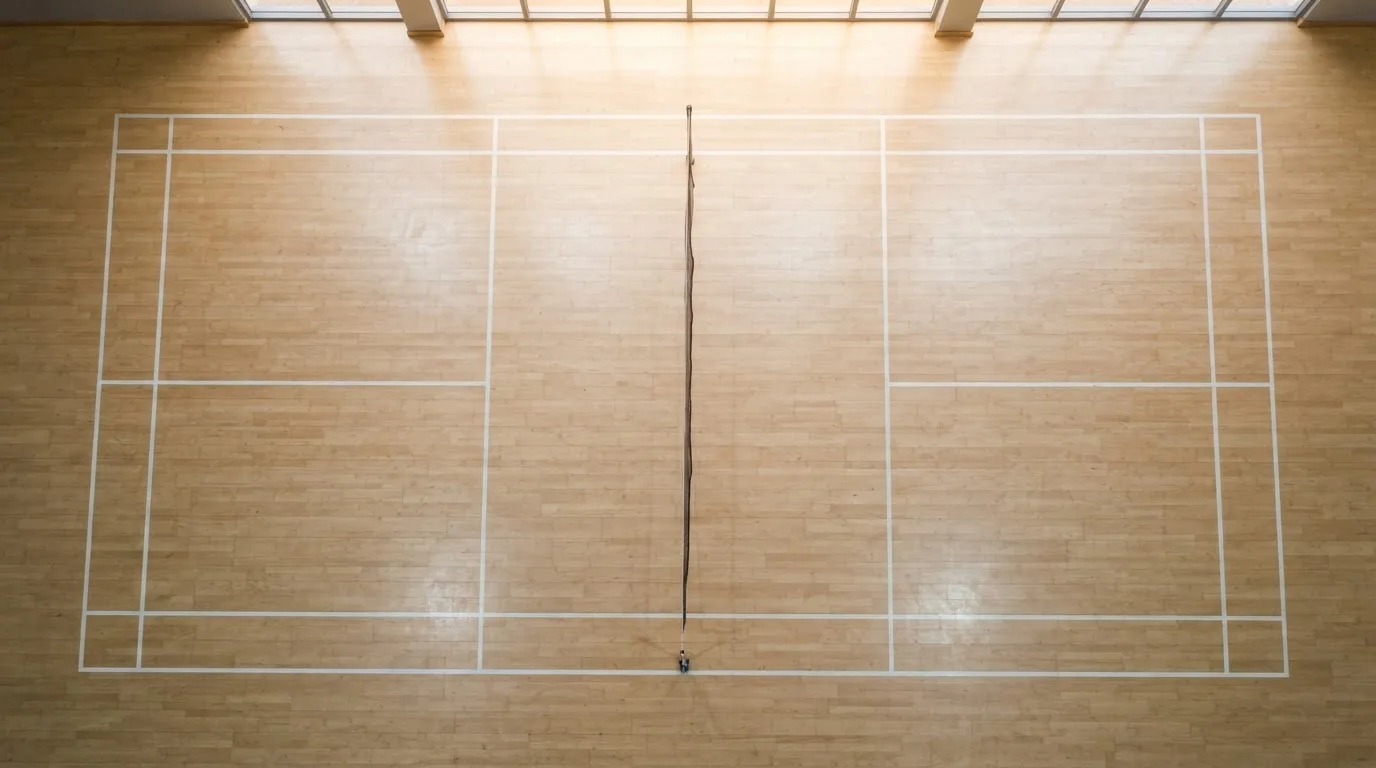
The Badminton World Federation (BWF), founded in 1934 as the International Badminton Federation, governs international badminton. Five disciplines play at the top level: men’s singles, women’s singles, men’s doubles, women’s doubles and mixed doubles. Each game is played to 21 points with rally point scoring — every rally produces a point, server or not — and a match is the best of three games. At 20–20 play continues until one side leads by two; at 29–29 the next point wins. The court is 13.4 metres long, 6.1 metres wide for doubles and 5.18 metres wide for singles; the net is 1.55 metres at the edges and 1.524 metres at the centre.
Badminton has been an official Summer Olympic sport since 1992, with mixed doubles added at the next Games. The tournament calendar splits the year into recognisable pieces. The All England Open Championships, first held in 1900, is the sport’s oldest tournament and remains a major title. The BWF World Championships began in 1977 and run every year except the Olympic year. The Thomas Cup (men’s team) and the Uber Cup (women’s team) are held every two years; the Sudirman Cup, the mixed-team event, began in 1989 and is also on a two-year cycle.
At the bottom of the calendar sit the BWF World Tour events — Super 1000, Super 750, Super 500, Super 300 and Super 100 — and the continental championships. A punter watching the calendar sees a fixture list that never empties: a Super 300 somewhere in Asia, a Super 500 in Europe, the season-ending BWF World Tour Finals in December.
What that means for the bettor is that fixtures are dense at the top of the season and thin at the bottom of it; that in-play markets thicken with the calendar; and that outright markets on the major team events open months before the draw is set. The BWF rankings update weekly through the season and are the single best public reference for player form, but they weight the most recent year heaviest — exactly the right bias for a sport with a short competitive memory.
Ten GB-licensed bookmakers compared for badminton in 2026
Every brand below holds a remote operating licence from the Gambling Commission, the regulator that licenses the whole commercial market for Great Britain under the Gambling Act 2005. A licence is the floor, not the ceiling: each brand is on its own in how it prices badminton, runs in-play, structures its welcome offer and pays out. The ranking that follows is not the Commission’s view and is not a tip — it is the ten brands the comparison pulls together, in the order the inputs carry them, each on its own merits and its own terms. Every bookmaker in this set is a member of GAMSTOP, the national multi-operator self-exclusion scheme.
| Brand | Licence | Licence holder | What the operator’s terms say about badminton |
|---|---|---|---|
| Ladbrokes | 054743-R-330863-014 | LC International Limited | Ladbrokes is the higher-profile of the LC International brands and offers a broad sport menu; the betting app is rated 4.66 in the GB App Store from over 100,000 ratings |
| Bet Ahoy | 100094-R-341742-003 | Bet Ahoy Ltd | Bet Ahoy’s welcome is structured as a £10 sports bet plus a £5 acca on a £10 qualifying bet |
| Fitzwilliam Sports | 048760-R-335434-009 | SBKI Limited | Fitzwilliam positions itself as a Dublin bookmaker with capped membership and a “High Stakes Welcome” subject to compliance criteria; safer-gambling tools include deposit limits, timeouts and instant withdrawals |
| London Bet | 066162-R-340278-004 | Thistle Bet Limited | London Bet bundles football, tennis, horse racing, greyhounds, darts, golf, cricket, NFL, NBA, MLB and snooker into one app alongside Pragmatic Play casino slots |
| Unibet | 045322-R-324275-019 | Platinum Gaming Limited | Unibet’s UK site states it has operated since 1999 and runs an in-play console, an acca builder and price boosts with maximum-stake limits |
| Smarkets | 039173-R-319366-011 | Smarkets (Malta) Limited | Smarkets is a betting exchange; deposits by open bank transfer are instant from £10 to £10,000 and withdrawals are processed within six hours from £10 to £100,000 |
| Fafabet | 057385-R-333191-006 | Taichi Tech Limited | Fafabet pays Best Odds Guaranteed on UK and Irish horse racing from 9am on race days; the badminton menu is not separately described |
| bet365 | 055148-R-331498-002 | Hillside (UK Sports) ENC | bet365 is the official global betting partner of the UEFA Champions League, runs in-play with live streaming worldwide and offers Bet Builder+, Super Boosts, Winnings Boosts and Bet Boosts |
| Hollywoodbets | 053028-R-330019-013 | Hollywoodbets International UK Limited | Hollywoodbets refunds the stake as a free bet up to £30 on the first qualifying losing accumulator (stake £10+, three or more legs, odds of 4/1 or greater, settled within seven days) |
| Kalooki Sportsbook | 057730-R-333396-005 | Kalooki Sportsbook Limited | Kalooki Sportsbook is operated by Kalooki Sports Book Ltd (company number 12938274) and is a GAMSTOP member |
A note on column two: every licence number above is the Commission’s remote licence, taken from the public register, with the licence holder named as the register shows it. The licence holder is the legal entity the Commission regulates; the trading brand is the name on the app and on the betting slip. Several brands can run under one licensee.
The single thing the comparison does not show is the price each bookmaker prints on a specific fixture. Prices shift minute to minute; a snapshot of one price at one time is not a basis for a comparison. A punter who wants the best price on a specific selection checks two or three licensed bookmakers at the moment of placing the bet — that is the practical test.
Badminton betting in Great Britain: how the licence works
There is no statutory list of permitted sports or markets in Great Britain. A bookmaker serving customers here needs a Gambling Commission licence, wherever it is based, since the Gambling (Licensing and Advertising) Act 2014 brought remote facilities into the regime. The Commission’s public register is the whole test: search by business name, trading name, domain or account number. The licence category on the register tells the reader what the licence covers — remote general betting standard (real events), remote betting intermediary (the licence for betting exchanges), and so on — and most online bookmakers hold the real-events category.
A Curaçao, Maltese or Gibraltar licence is not a substitute. Section 33 of the Gambling Act 2005 makes providing gambling facilities in Great Britain without the licence the Act requires an offence. That is aimed at the operator, not the customer: no offence aimed at a customer who merely bets on an unlicensed site was identified. The honest framing of an offshore brand is what the customer loses: no GAMSTOP coverage, no Commission complaints route, no British dispute-resolution body, no British consumer redress if funds are withheld, and not bound by the 10x bonus cap or the £150 vulnerability check described below. A licensed brand checks, limits and verifies; an unlicensed brand does none of those and may keep the punter’s money.
Minimum age for betting in Great Britain is 18. Since 7 May 2019, name, address and date of birth are verified before a customer can deposit or gamble — including with a free bet or bonus. There is no anonymous play at a licensed site.
Betting exchanges — Smarkets is the one in this set — run under a separate licence category (betting intermediary) and have their own terms: back and lay, commission on net winnings, settlement rules that are different from a bookmaker’s. The odds on an exchange are set by the users and typically carry a thinner margin than a bookmaker’s price on the same selection.
Responsible gambling: what every licensed site has to offer
GAMSTOP is the national multi-operator online self-exclusion scheme. It is a mandatory condition of every GB remote betting licence, and the periods are six months, one year, five years, or five years with auto-renewal. After the minimum period the exclusion stays in place for a further seven years unless the customer asks GAMSTOP to remove it. GAMSTOP covers online sites and apps; betting shops use a separate scheme.
A financial vulnerability check has applied since 30 August 2024 (LCCP condition 3.4.4), and is in force when a customer’s deposits minus withdrawals exceed £150 in a rolling 30 days. That came in on 28 February 2025. The check is a public-record check — bankruptcy or county court judgments, for example — not an income check and not a credit reference check. Financial risk assessments — what the press calls “affordability checks” — have been announced in a staged plan, with no start date; state them as announced and staged, not in force.
Deposit limits apply under the Commission’s Remote Technical Standards: operators must offer a gross deposit limit on a fixed time frame, with the first changes in force since 31 October 2025. There is no state-set deposit or loss ceiling: limits are the customer’s choice. The tools a GB-licensed bookmaker has to offer are deposit limits, timeouts, self-exclusion (through GAMSTOP) and access to support services.
Help is at GamCare (which runs the National Gambling Helpline), GambleAware, NHS gambling clinics and Gamblers Anonymous. Fitzwilliam Sports links to GambleAware, GamStop and Gamblers Anonymous from its own home page; the other brands in this set do the same.
Bonuses and free bets in badminton betting offers
The language of bookmaker marketing does the punter no favours, and a “free” bet is the clearest example. A free bet is a credit the bookmaker issues to use on a selection. If it wins, the stake is usually not paid back — the punter receives the profit only. A £10 free bet at 5/1 pays £50 in profit, not the £60 a £10 cash stake would pay. The difference, the stake, is the price of the free bet. That is what “free” means in bookmaker English.
A “risk-free” bet is the same product with a softer name. A £10 risk-free bet that loses returns the stake as another free bet — the same shape, with the loss refunded in credit rather than cash. Hollywoodbets’ welcome runs in this form: a stake of £10 or more on the first qualifying losing accumulator, with three or more legs at 4/1 or greater and settled within seven days, returns the stake as a free bet up to £30. One free bet per customer.
A “100% bonus” sounds like a doubling of the deposit but is usually a bonus balance with a wagering condition. From 19 January 2026, the Commission caps wagering requirements on bonuses at 10x: a £10 bonus at 50x needed £500 of bets before withdrawal, and under the cap no more than £100. A £10 bonus at 10x needs £100 of bets at minimum. Mixed-product promotions — offers that require gambling on two or more product types such as betting and casino — are banned. Free bets with no wagering condition are not separately established to be inside the cap or outside it; a punter who wants certainty reads the terms.
Best odds guaranteed on horse racing — Fafabet’s offer from 9am on race days — does not appear in this set on badminton. Badminton has no starting-price equivalent and no industry-wide BOG arrangement; the price the bookmaker shows before the match is the price settled, unless the bookmaker’s own terms state otherwise.
Welcome offers change. A punter comparing offers today reads the bookmaker’s current terms before staking, because the headline figure is rarely the whole offer. Bet Ahoy’s headline is a £10 sports bet plus a £5 acca on a qualifying £10 bet; Unibet’s is £40 in free bets on a £20 qualifying bet at minimum odds of 2.0 (1/1), with the free bets expiring within seven days of issue, for new GB customers using a debit card or instant bank transfer. Both are described as the operators describe them; neither is the whole shape.
In-play badminton betting and the cash-out question
Badminton is built for in-play. A game lasts twenty to thirty minutes; a match runs forty to ninety; every rally settles a point. The bookmaker’s in-play console shows the match winner moving with every game won and the next-game market updating inside a point. London Bet, bet365, Unibet and Midnite all run in-play on a sports menu that includes badminton; the in-play depth — how many markets, how quickly prices update — varies.
Live streaming changes the in-play experience. bet365 streams events worldwide alongside its in-play console and tracks bets live with Bet Track, Match Live and a Live Golf Tracker for selected sports. Watching a feed and betting into the match is a different experience from refreshing the page between games.
Cash out is a feature, not a market. The bookmaker offers to buy the bet back at a price set by the bookmaker’s own model: in-play, on selected markets, at selected moments. The price is not the price the bet would settle at; it is the price the bookmaker is willing to pay at that moment, with its own margin inside it. A punter who cashes out at 1.80 when the price on the same selection is now 1.95 has taken the bookmaker’s price, not the market’s. Used selectively — locking in profit before a wobble, cutting a loss before the worst — it is a useful tool. Used as a habit, it is a slow leak.
Live badminton betting sites are not separately licensed or separately regulated; they are GB-licensed bookmakers that carry badminton on their in-play console. The test is the licence, the in-play depth, and whether the brand streams the events it lets you bet on.
The bookmaker’s margin — what the price is actually telling the punter
A bookmaker’s margin is the cut the book keeps of every unit bet on a market. It is built into the prices, and the only honest way to see it is to convert the prices back to implied probabilities and add them up. Take the simplest case: an evenly matched game, decimal prices of 1.90 on each side. The implied probability of each side is one over the odds — 1 ÷ 1.90 = 0.5263, or 52.63%. Two sides at 52.63% sum to 105.26%, and the five-point-two-six excess over 100% is the margin. The book’s cut is roughly 5%, expressed as one minus the payout share.
That is the calculation in this guide, written as one clause for the case research fixes as an example: a two-way market priced at decimal odds of 1.90 on each side carries an implied probability of 52.63% per side, summing to 105.26% across both outcomes, and the margin is the 5.26% excess over a clean 100% — the book’s cut on every unit bet on this market. State it as a band, never a single figure: a market at 1.85 / 1.85 carries a margin of roughly 8%, a market at 1.95 / 1.95 carries a margin of roughly 3%, and the round number “5%” is the centre of a band that swings with the price.
Three things follow.
The favourite-longshot bias. In a real match with a clear favourite, the price on the favourite is shorter than the price on the outsider — say 1.20 on Player A, 4.50 on Player B. The implied probabilities are 83.33% and 22.22%, summing to 105.55% — a margin of 5.55%. The bookmaker’s margin is heavier on the outsider than on the favourite in implied terms: the longshot’s 22.22% is overstated more than the favourite’s 83.33%. That is why betting favourites at short odds is the slowest grind in the book.
Accumulator margin stacks. A two-leg acca at 2.00 and 3.00 carries combined odds of 6.00, but the margin on each leg is its own. A leg at 2.00 carries a margin of 5%; a leg at 3.00 carries a margin of roughly 12%; combined, the margin is heavier than either leg alone, because the implied probabilities multiply along with the odds. A four-leg acca on heavy favourites at 1.50 each looks safe at combined odds of 5.06, and carries a margin of roughly 16%. The acca is the bet type the marketing copy loves most, and the one where the margin compounds fastest.
Margin tells the punter what to expect. A market at 5% margin pays back 95p per pound on average over the long run; a market at 10% margin pays back 90p. The difference, year on year, is the difference between a sustainable hobby and a slow leak. The punter’s edge, if there is one, is the gap between the true probability and the implied probability — and the punter’s edge has to be larger than the margin to come out ahead over time.
The legal and tax frame a UK punter actually meets
The player pays no tax on betting winnings in Great Britain. General Betting Duty is the operator’s tax — currently 15% on gross profits, with a new remote betting rate of 25% scheduled from 1 April 2027 — and is paid to HMRC. Whether operators pass the duty on through odds is not established; the punter should not assume it either way.
Credit cards have been banned for gambling in Great Britain since 14 April 2020, including credit-card-funded payments through an e-wallet. Debit cards and bank-based payments are not covered by that ban; open bank transfer, instant bank transfer and Faster Payments are normal at every GB-licensed bookmaker. Smarkets’ terms give the shape: deposits by open bank transfer are instant from £10 to £10,000, withdrawals are processed within six hours from £10 to £100,000, and UK debit card deposits are instant from £10 to £15,000.
Advertising is not licensed by the Commission. It runs through the CAP Code (non-broadcast) and BCAP Code (broadcast), enforced by the ASA, alongside the Commission’s marketing conditions. CAP Code section 16 holds marketing to be socially responsible, not of strong appeal to under-18s, and no one who is or seems to be under 25 may be featured gambling or play a significant role. “Whistle-to-whistle” — no betting ads from five minutes before to five minutes after a live sporting event, before the 9pm watershed — has been in force since 1 August 2019.
The Premier League clubs’ withdrawal of gambling sponsorship from the front of matchday shirts from 2026/27 onward is voluntary, not law; sleeves and hoardings remain.
A note on Northern Ireland: it is outside the Gambling Act 2005 and has its own older law. A GB licence regulates Great Britain (England, Scotland and Wales), not Northern Ireland. This page is written for the GB-licensed market.
Ten shortlist verdicts, each on its own terms
Ladbrokes. The higher-profile of the LC International brands, with a betting app that has racked up over 100,000 GB App Store ratings at an average of 4.66 — a bet on offer depth and brand familiarity rather than on a niche specialism. Badminton sits on a broad sport menu rather than as a flagship, and the price depth in-play is the main thing to check before staking. Verdict: a dependable generalist for a punter who wants one bookmaker across many sports, with badminton as one of many.
Bet Ahoy. Smaller brand, with a welcome structured as a £10 sports bet plus a £5 acca on a £10 qualifying bet — the kind of split that lets a new punter try both single and acca without committing more than £10. Badminton coverage is best confirmed directly with the operator at the time of betting, since small brands can be uneven on niche sports. Verdict: a sensible option for a punter testing the water with a small first deposit, less so for a regular badminton bettor wanting in-play depth.
Fitzwilliam Sports. A Dublin bookmaker with capped membership — a deliberate choice to limit the customer base, with a “High Stakes Welcome” subject to compliance criteria. Instant deposits, fast withdrawals, deposit limits and timeouts are the safer-gambling tools. Verdict: the high-stakes welcome is a flag, not a recommendation: capped membership and a high-stakes welcome point at a narrower customer base than the generalists, and the punter who wants to bet small is not the target reader.
London Bet. Combines football, tennis, horse racing, greyhounds, darts, golf, cricket, NFL, NBA, MLB and snooker with Pragmatic Play casino slots and live in-play on one app — a broad menu rather than a badminton specialism. Verdict: a multi-sport option with badminton on the menu, more useful for a punter who mixes sports than for a badminton-only bettor.
Unibet. Has operated since 1999 under Platinum Gaming Limited in Gibraltar, with a UK site that runs an in-play console, an acca builder, popular accas and price boosts with maximum-stake limits. The welcome is £40 in free bets on a £20 qualifying bet at minimum odds of 2.0 (1/1), with the free bets expiring within seven days. Verdict: a long-established brand with a deep feature list — the welcome’s seven-day expiry on the free bets is the figure to read before claiming, since seven days goes faster than it sounds.
Smarkets. A betting exchange rather than a bookmaker, with a betting intermediary licence and a different shape: back and lay, commission on net winnings, settlement rules that diverge from a bookmaker’s. Open-bank-transfer deposits are instant from £10 to £10,000 and withdrawals within six hours from £10 to £100,000. Verdict: for a punter who wants the exchange side of the market — laying a selection, trading a price — Smarkets is one of the licensed venues; for a punter who wants a bookmaker’s menu, the experience will feel lean.
Fafabet. Best Odds Guaranteed on UK and Irish horse racing from 9am on race days — a horseracing feature that does not extend to badminton. The badminton menu is not separately described in the operator’s terms, which is not the same as saying the brand does not cover it; it means the punter checks the operator’s site directly. Verdict: a horseracing-first bookmaker where badminton coverage is something to verify before staking, not something to assume.
bet365. Official global betting partner of the UEFA Champions League, with in-play betting, live streaming worldwide, Bet Builder+ (combining markets from one event into a single bet, available pre-match and in-play), Super Boosts, Winnings Boosts on Bet Builders and selected singles, and daily Bet Boosts. The feature list is the deepest in this set. Verdict: the breadth of features — streaming, bet builder, multiple boost types — is the case for bet365 over the rest, with badminton sitting inside that breadth; the punter who wants the most features on one app has the clearest reason to choose bet365.
Hollywoodbets. The welcome refunds the stake as a free bet up to £30 on the first qualifying losing accumulator — stake £10 or more, three or more legs, odds of 4/1 or greater, settled within seven days; one free bet per customer. The shape is a “risk-free” bet in bookmaker English: the refund is in free-bet credit, not cash, and the stake on the free bet is not paid back if it wins. Verdict: a clean refund-against-losing-accra offer with the acca requirement built in, useful for a punter who was going to back an acca anyway and indifferent for one who was not.
Kalooki Sportsbook. Operated by Kalooki Sports Book Ltd (company number 12938274), licensed under account number 57730, and a GAMSTOP member. The brand is in the set as a licensed option; the badminton menu is not separately described in the terms at the time of writing. Verdict: a licensed operator where the punter checks the badminton menu directly before staking; not a flagship badminton bookmaker, not a brand to write off without checking.
How to choose, and how the choice ages
Three decisions narrow the field.
By sport menu depth. bet365 and Unibet carry badminton as one sport on a deep menu, with in-play, boosts and a bet builder. Ladbrokes and London Bet carry it on a broad menu with the depth varying. Fitzwilliam, Fafabet, Hollywoodbets, Kalooki and Bet Ahoy carry it on a narrower menu where the price depth at the time of betting is what matters.
By welcome offer shape. A punter who was going to back a single bets on the welcome’s terms; a punter who was going to back an acca prefers an acca-shaped offer. Hollywoodbets’ acca-back welcome is the acca-shaped option in this comparison; Unibet’s £40 free bets on a £20 qualifying bet is the single-shaped option. Bet Ahoy splits the difference with a £10 sports bet plus a £5 acca.
By licence and safer-gambling tools. Every brand in this set holds a remote licence and is a GAMSTOP member; every brand must offer the standard safer-gambling tools. The differences are in how visible those tools are on the site and how quickly the support routes respond — both of which the punter checks directly.
The choice ages. A bookmaker that is competitive on badminton today may not be competitive in six months; a welcome offer that is generous today is the standard one next quarter. The comparison is a snapshot, and the snapshot’s shelf life is the calendar — the next major tournament, the next odds shift, the next term change.
Frequently asked questions
How does a punter bet on badminton?
Pick a licensed bookmaker from the Commission’s public register, complete the verification check on first deposit, navigate to the badminton menu, choose a fixture and a market, enter the stake and confirm. In-play works the same way once the match has started; outrights work the same way on the tournament winner before the draw finishes. A bet settles when the event settles, with winnings credited to the account minus any stake not returned on a free bet.
How is it checked that a bookmaker holds a Gambling Commission licence?
Open the Commission’s public register, search by business name or domain, and confirm the licence category covers the product offered (remote general betting standard for real-event sports; fixed-betting intermediay for exchanges). The register is the whole test, and the licence number the operator publishes should match the register’s number exactly.
How is the return on a bet worked out from the stake and the odds?
A single bet’s return is stake × decimal odds. The profit is stake × (odds − 1). On a £10 stake at 2.50, return is £25 (profit £15). For a combination bet, the odds of the legs multiply into one combined price before multiplying by the stake.
What is the bookmaker’s margin, and how can it be seen in the odds?
The margin is the cut the book keeps of every unit bet on a market, built into the prices. Convert each price to an implied probability of one over the decimal odds, add the probabilities of all outcomes and subtract 100%: the excess is the margin. An evenly priced two-way market at 1.90 on each side sums to 105.26%, giving a margin of roughly 5%. A heavier favourite-longshot split carries a heavier margin.
How do fractional odds such as 5/1 convert to decimal odds such as 6.00?
Divide the numerator by the denominator and add one. 5/1 becomes 5 ÷ 1 + 1 = 6.00. 11/4 becomes 11 ÷ 4 + 1 = 3.75. 4/6 becomes 4 ÷ 6 + 1 = 1.67. Fractional and decimal forms describe the same price; decimal is the simpler handle for the return calculation.
Which tools for controlling play does a licensed bookmaker have to offer?
A GB-licensed remote bookmaker must offer deposit limits on a fixed time frame, timeouts and self-exclusion through GAMSTOP (six months, one year, five years, or five years with auto-renewal). A financial vulnerability check applies on deposits minus withdrawals above £150 in a rolling 30 days. The support services — GamCare, GambleAware, NHS gambling clinics, Gamblers Anonymous — are linked from the safer-gambling pages of every licensed site.
Tennis, darts & cue sports – systembetsguide.com
Content created by the «systembetsguide.com» team
