
Where snooker fits in a British betting account in 2026
 Available in US
Snooker has long sat in the shadow of football and horse racing on British betting sites, but the sport’s calendar is unusually generous to a bettor. A short match is a best-of-7 over a couple of hours; a World Championship final stretches to a best-of-35, decided over two days. That range shapes what bookmakers offer and how the prices are built — from frame-by-frame in-play markets weeks before a tournament to outright winner prices that move on a single missed black. This guide works through how snooker betting works in practice, what the offers really cost, and which of ten UK-licensed bookmakers suit which kind of punter. The data on licences and odds was verified against the Gambling Commission’s public register as of 30 October 2026.

Bonuses and free bets for snooker
The promotional shelf on a snooker page looks busy and the arithmetic underneath it rarely matches the headline. A bookmaker “free bet” is a credit, not cash; a “matched deposit bonus” is bonus money that needs to be turned over before it pays out; a “boosted odds” offer enlarges the price for one selection and ties the rest of the bet to its own rules. The thing a punter actually buys with a promotion is a stake the buyer has not put up himself — and the price of that stake is the turnover, the minimum odds and the deadline the operator attaches to it.
Bonuses at UK-licensed bookmakers have been running under tighter rules since 19 January 2026. The Commission capped wagering requirements on bonuses at ten times the bonus amount, which means a £10 bonus needs no more than £100 of qualifying bets before the bonus funds convert to withdrawable cash. Mixed-product promotions — offers that ask a punter to bet on snooker to unlock free spins on a slot, for instance — are banned outright. That second rule matters more for snooker than for most sports, because the sport’s natural fit for cross-sell is a casino freebie: any snooker-bet-plus-free-spins deal that existed before the rule should have gone by now.
What the rules have not done is change the shape of the offers that remain. Three flavours still carry most of the shelf space:
- Free bet credits. A bookmaker credits the punter’s account with a set amount (commonly £5, £20 or £40) once a qualifying bet has settled. The stake is almost never returned with a winning free bet — the credit pays the winnings, not the stake back on top — so a £20 free bet at odds of 4.00 returns £60, not £80. The wagering requirement on the winnings varies; at the cap of ten times the bonus, only qualifying bets settled within the offer’s window count.
- Enhanced odds and price boosts. A boosted price on a single outright — Ronnie O’Sullivan to win the Masters at an inflated price, say — is settled at the boosted number if the bet wins. The boost is usually capped at a small stake (often £5 or £10) and frequently pays in free bet tokens rather than cash, which brings the wagering cap back into play.
- Acca insurance. A stake-back offer on accumulators when one leg lets the punter down. Most run on football accas, but snooker accas are sometimes included. The refund is typically paid as a free bet, capped at the stake the operator names, and almost always restricted to one refund per day.
What a punter reads for free from a comparison the operator does not write is the bonus code itself. Codes do not appear on this page by design — the page describes what an offer is worth, not how to claim it.
The dead weight on the promotional shelf is the wagering multiple. A “100% bonus” that needs to be turned over ten times in qualifying bets before withdrawal is asking for a hundred pounds of betting for every ten pounds of bonus. The turnover is what the punter buys the bonus with; the bonus is the headline. Read the rollover before the headline.
Live betting and cash out on snooker
Snooker is one of the cleaner sports for in-play betting because the action is structured into discrete frames with a natural break in the middle. Each frame settles a winner and a loser, and a bookmaker can price the next frame, the next set, the match outright, or any of a handful of micro-markets (next colour potted, whether a 50+ break will be made, whether the player to break will clear the table) while the cue ball is still on its spot.
Three structural features make snooker in-play different from football or tennis:
- Frame-by-frame markets. Most UK bookmakers price the winner of the current frame, the winner of the next set, and (in longer matches) the match outright at intervals during the interval. Prices move on each visit to the table and reset at the start of each frame, which gives a punter a working price roughly every twenty minutes.
- Match-length markets. A best-of-7 settles in four frames; a best-of-35 settles in eighteen. The longer the match, the more granular the in-play menu: total frames, handicap frames, player to win from behind, method of victory (clearance, snookers required). Best-of-7 markets tend to be thinner because the match often finishes before the punter’s screen has caught up.
- Settlement rules. Bookmakers settle frame markets on the result the players record on the table, with voids for non-completion (a player conceding the match mid-frame, for example) at the operator’s discretion. A punter who backs the next-frame winner during a frame that is later restarted loses the bet.
Cash out turns the live price into a tradable position. A bookmaker’s cash-out function lets the punter settle a running bet before the match is over — either locking in a profit if the bet is winning or cutting a loss if it is losing. The price the operator offers is its own live quote, derived from the current frame state and the original bet, and the spread on it is wider than the spread on the pre-match price because the bookmaker needs to cover the new risk instantly. Snooker suits cash-out because frames are short and the price moves meaningfully between them; the bettor who backs the match winner at 2.10 before the first frame and cashes out at half-time when the favourite is 3-1 up will see the operator’s quote reflect that lead with a margin of its own.
Live streaming is the third leg. Several UK-licensed bookmakers stream World Snooker Tour events and a portion of the secondary tour directly through the betting app, gated by either a funded account or a recent bet on the event. Snooker’s TV rights sit with several broadcasters and the streaming rights sit with the tour itself; a bookmaker that streams a tournament in one season may not in the next. The practical test for a punter is whether the in-play page links to a video player at all, rather than whether the marketing copy promises streaming.
The risk in snooker in-play is not that the price is wrong; it is that the bet does not exist any more. A frame market voids if the frame is not completed, and an outright voids if a player retires mid-tournament. The price the punter sees is the price the punter sees — but only for the bets the operator still accepts.
Predictions, tips and predictions pages for snooker
Searches for “snooker betting tips” and “snooker predictions” land on pages that promise a winner and rarely deliver one. The honest framing is that no one knows the outcome of a snooker match before it starts: form, head-to-head, ranking, the venue table, the referee’s pace, the long-format effect on a player who has not played a best-of-19 in six months — all of these shift the price, and a tipster who claims to out-price a bookmaker on any of them is doing something the bookmaker is not. The job of a tipster is to add information the market has not yet priced in; the job of a tipster who is mostly selling subscriptions is to look like the first kind while doing the second.
What a punter can do with the information that is genuinely public:
- Draw the head-to-head. The World Snooker Tour publishes every frame result; the betting sites list head-to-head records. A player who has lost their last six meetings against a particular opponent has form that the bookmaker knows, and the price already reflects it. The price differential between two players who rarely meet is where information lives — and that differential narrows sharply once the betting market is liquid.
- Read the frame-count context. A best-of-7 between a break-builder and a grinder is a different match from a best-of-19 between the same two players. Best-of-7 is variance; best-of-19 is skill. The punter who prices a tournament favourite into a first-round best-of-7 against a journeyman is paying for a price that has not absorbed the format.
- Track the schedule. Snooker tours run three or four events back-to-back in the autumn and spring. A player in the second round of event B who flew out of event A on the Sunday has a form state that the next-day odds may not have caught up with.
- Ignore outright tips from tipsters who sell them. A tip that costs money is a tip that has already been arbitraged into the price the punter sees — the bookmaker’s market is faster than the email.
The honest takeaway is that no published tip page can promise a winner, and a punter who treats one as such is paying for noise. What a punter can do is build a process: the price, the format, the recent form, the surface (the table matters more in snooker than in most cue sports), and the schedule load. The same six inputs, applied across a season, will produce a price more often than a tipster — because the tipster is selling the same six inputs dressed in the language of certainty.
Bet types and odds on snooker
The snooker menu at a UK bookmaker breaks into four families: outright, match, frame and novelty. Each family has its own settlement rhythm and its own margin, and the price the punter sees on the screen is built from the same inputs as the price on any other sport — the probability of each outcome, the bookmaker’s margin, and the way the operator rounds the final decimal.
The basic building block is the match result: Player A to win, Player B to win. A best-of-7 offers two outcomes; a best-of-9, -11 or -19 offers the same two outcomes over more frames. Prices for match result on a best-of-7 sit between roughly 1.50 (a heavy favourite) and 3.50 (a genuine outsider); on a best-of-19 first round they spread wider, from about 1.30 to 6.00, because the format rewards the better player more often.
Frame betting is the snooker-specific market. Prices are offered on the winner of the next frame, the winner of the next set (group of frames), and on the first-frame winner in matches that start with a coin-toss break-off. Frame markets move quickly because the live state of the table (which player is at the table, the score, the colours remaining) feeds directly into the next-frame price.
Handicap frames are the snooker equivalent of an Asian handicap. A bookmaker offers Player A -2.5 frames at 1.90, meaning Player A must win by three or more frames for the bet to win. The handicap is set in half-frames so the bet cannot tie; in a best-of-9, a -2.5 favourite has to win 5-2 or better.
Outright winner is the tournament-long market. Prices on a World Championship field run from about 4.00 on the favourite down to 500.00 or 1000.00 on the qualifier who drew the defending champion in round one. Each-way terms typically pay a quarter of the outright odds for reaching the final (four places at major events; two at smaller ranking events) — and the stake doubles, because an each-way bet is two equal stakes at the stated price.
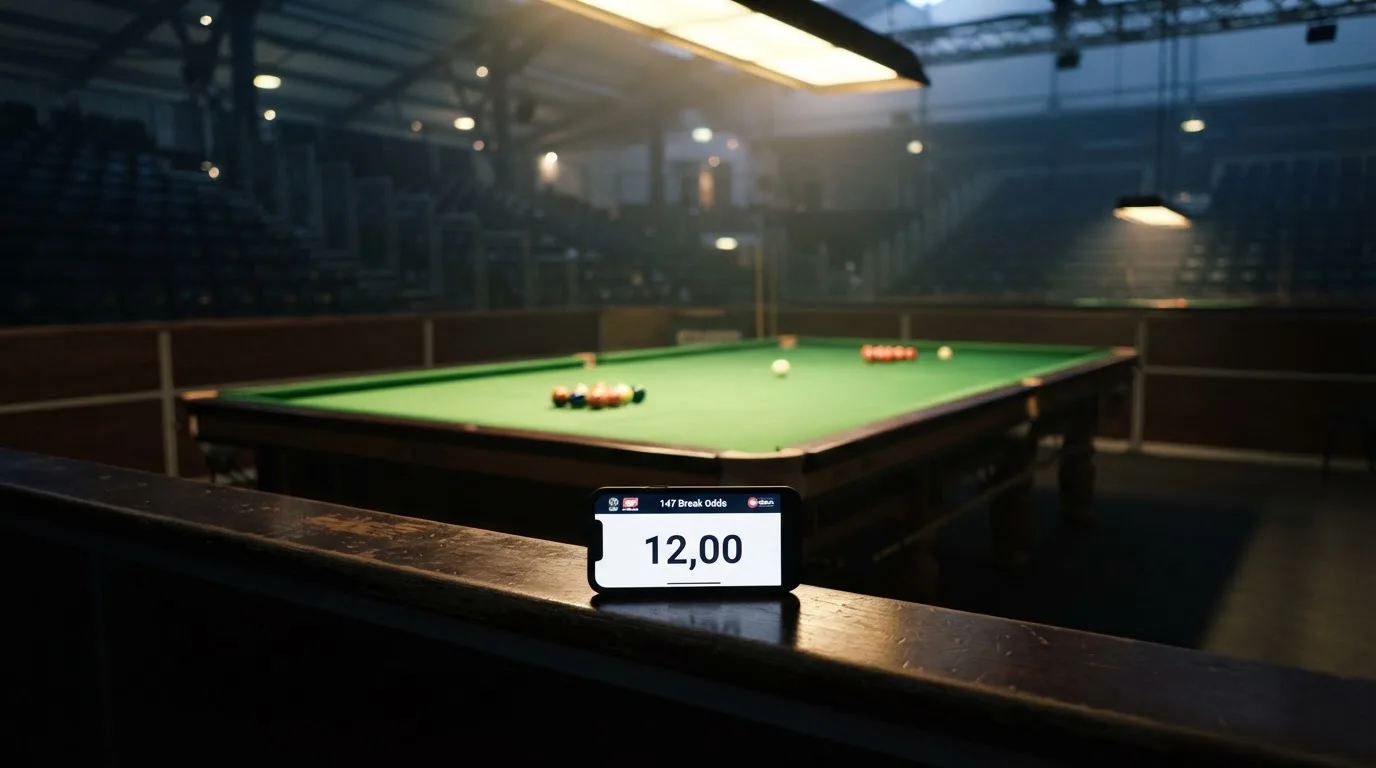
Century breaks, 147s and novelty markets. Bookmakers price whether a century break will be made in a frame, whether the tournament will see a maximum 147, and whether the match will contain a clearance from a snooker (a re-spot situation that requires the opponent to foul). These markets are settled on the official WST record, not on the broadcast feed.
The structure of decimal odds is the same as anywhere else on the site. A price of 3.00 pays three pounds for every pound staked, including the stake; the punter who bets £10 at 3.00 and wins receives £30, of which £20 is profit. The fraction-to-decimal conversion a/a+1 is mechanical: 5/1 becomes 6.00; 11/4 becomes 3.75; evens (1/1) becomes 2.00.
A worked example from the page’s margin calculation: an illustrative two-way market at 1.90 / 1.90. The implied probabilities are 1 ÷ 1.90 = 52.63% for each outcome; they sum to 105.26%. The bookmaker’s margin is the gap above 100%, which is 5.26% on this example. The same five per cent margin expressed as a payout share is 100% ÷ 105.26% ≈ 95%. The punter who backs either side at 1.90 receives 95p back from every pound staked across the market as a whole, before commission; the bookmaker keeps the other 5p.
The band the calculation actually lives in is 4–7% on most snooker match-result markets, with frame markets a touch wider because they are shorter and harder to price, and outrights the widest of all because the field is large and the liquidity per runner is thin. The narrower the margin, the better the long-run return for the punter — and snooker sits in the middle of the British sportsbook range, tighter than horse racing, looser than football.
Snooker tournaments the betting sites cover
The professional snooker calendar runs the World Snooker Tour (WST), with the IBSF governing amateur play beneath it. The WST’s main tour runs ranking events almost every month from September to May, topped by three majors — the UK Championship in December, the Masters in January, the World Championship in April–May — and the Champion of Champions in November. Most events are best-of-7 through the early rounds, best-of-9 or -11 through the quarters and semis, and best-of-19 or best-of-25 at the later stages of the bigger events.
The World Championship has been held at the Crucible Theatre, Sheffield since 1977. The current format runs a first-round best-of-19 over two sessions, a second-round best-of-25 over three sessions, the quarters as best-of-25, the semis as best-of-33, and the final as a best-of-35 over two days. The 2026 World Championship ran from 18 April to 4 May 2026 at the Crucible; Wu Yize beat Shaun Murphy 18–17 in the final, with the winner receiving £500,000 from a £2,395,000 prize fund. Stephen Hendry and Ronnie O’Sullivan share the modern-era record with seven world titles each; Joe Davis won fifteen in a row from 1927 to 1946, a record that is unlikely to be matched under any modern format.
The tournament menu that UK bookmakers price in practice falls into a few tiers. The World Championship, UK Championship and Masters are priced weeks in advance on outright, with deep in-play coverage during the event. The second-tier ranking events (English Open, Scottish Open, German Masters, International Championship, Players Championship, Tour Championship) are priced in the week of the event, with in-play coverage on most major UK bookmakers. The lower-tier ranking events and the Q School qualifiers are priced on a smaller set of sites, often by the specialist snooker bookmakers rather than the high-street names.
Match format matters for the betting because the longer the match, the more the better player wins. A best-of-7 between two top-32 players is a coin-flip at 1.85–1.85 most weeks of the season; the same two players meeting in a best-of-19 at the Crucible in April is a 1.30 vs 3.50 match because the format has stopped rewarding variance. The punter who prices a tournament outright should adjust for the round at the start, not for the tournament as a whole.
A full-size snooker table is 12 ft by 6 ft with six pockets. The maximum break is 147, made by potting all 15 reds with blacks and then all six colours. Matches are refereed by a WST official and umpired on the cue ball position by a second official in the bigger events; frame results are settled on the referee’s call, not on the broadcast replay.
The ten reviewed bookmakers
Ten UK-licensed bookmakers sit behind the comparison below. Each is licensed by the Gambling Commission for remote general betting standard (real events); each is a GAMSTOP member by virtue of holding that licence; each settles bets under its own published terms rather than under any shared rule. The table below pairs the operator with the licence account number the Commission has published against it; the deeper review that the table anchors follows the table.
| Operator | Gambling Commission remote licence number and licence holder | What the operator’s own terms state on the key’s subject |
|---|---|---|
| DAZN Bet | 048756-R-327274-019 (Commission account 48756) — DZBT Limited | Minimum deposit £5 by debit card, Apple Pay, Paysafecard, Trustly and Skrill; £20 by PayPal; no processing fees. |
| Swifty Sports | 058957-R-334734-006 (Commission account 58957) — Swifty Global (UK) Ltd | Best Odds Guaranteed on selected markets, Cash Out on horse racing and football, daily price boosts, live streaming, in-play betting; Bet Builder listed as coming soon. |
| Ladbrokes | 054743-R-330863-014 (Commission account 54743) — LC International Limited | App rated 4.66 from 101,255 ratings in the GB App Store; full sportsbook with snooker outright and match markets. |
| QuinnBet | 061011-R-335683-004 (Commission account 61011) — QuinnBet (Gibraltar) Limited | Best Odds Guaranteed on UK and Irish horse racing from 10:00am on the day on singles, multiples and system bets; maximum benefit £150 per customer per race. |
| DragonBet | 064908-R-339041-003 (Commission account 64908) — DragonBet Ltd | Welsh football and rugby markets, racing, American football, in-play betting and bet builder markets. |
| Copybet | 053774-R-330743-010 (Commission account 53774) — Copybet UK Limited | Best Odds Guaranteed all day, every day on UK and Irish racing; pays first past the post on horse racing even if the winner is later disqualified. |
| Bet600 | 044731-R-323941-016 (Commission account 44731) — Tyche Tech Limited | Best Odds Guaranteed on horse racing; if the starting price is bigger than the early or show price taken, the bet is paid at the SP. |
| Sporting Index | 027343-R-308898-011 (Commission account 27343) — Sporting Index Limited | Customers can switch between fixed odds and spread betting; in-play betting, Bet Builder for football, auto cash-out and Multi-Markets. |
| William Hill | 039225-R-319373-015 (Commission account 39225) — WHG (International) Limited | Best Odds Guaranteed on UK and Irish horse racing from 8:00am on the day of the race on single and multiple bets; does not apply to ante-post, tote or pari-mutuel bets. |
| LiveScore Bet | 056859-R-332720-005 (Commission account 56859) — LiveScore Betting and Gaming (Gibraltar) Limited | Bet Builder allowing up to 10 selections covering match result, both teams to score, corners, total goals, player scoring and card markets. |
The account numbers above are the values the Gambling Commission publishes against each operator in its public register; the licence holder names come from the same register. A punter who wants to verify a licence themselves can search by business name, trading name or account number; the register is the whole test of whether a brand holds a Commission licence.
DAZN Bet
DAZN Bet is the sports betting arm of the DAZN streaming business, and the UK site launched under a DZBT Limited licence in the period since the Commission’s 2014 point-of-consumption rule took effect. The site is a sportsbook first — no casino — and the deposit menu is wider than the average UK bookmaker, with Apple Pay, Paysafecard, Trustly and Skrill all starting at a £5 minimum, and PayPal at £20. No deposit method carries a processing fee. The snooker menu offers comprehensive outright and match markets on the WST events; in-play coverage on the bigger events is solid; the price-boost and acca-insurance promotions run weekly. The deposit floor is a quiet plus for punters who want to keep their snooker staking separate from their main account. The low entry point and solid in-play coverage make this a strong pick for recreational punters focusing on high-profile WST events.
Swifty Sports
Swifty Sports is a younger UK brand, licensed in 2022 and built around a clean sportsbook with Best Odds Guaranteed on selected markets and Cash Out on horse racing and football. The snooker menu provides standard coverage of outright and match markets; the in-play menu is functional rather than deep. The app’s daily price-boost page is the live feature; Bet Builder is listed as coming soon, so a punter who relies on a builder for the same-game multi should check the current state before staking. The mobile app is well-rated and the deposit flow is the standard UK three-step (deposit, bet, withdraw) with debit card and the common e-wallets. With a clean mobile interface and accessible daily price boosts, it is a straightforward option for those prioritising speed and simplicity over complex markets.
Ladbrokes
Ladbrokes is one of the high-street names of British betting, licensed to LC International Limited, and the app carries the largest user-rating base of the ten reviewed operators at 4.66 from 101,255 ratings in the GB App Store. The snooker menu covers the WST events in depth, with outright, match, frame and a reasonable in-play menu across the bigger tournaments. The site’s wider book — horse racing, football, greyhounds, golf — is the main reason a punter picks Ladbrokes over a snooker specialist: a punter whose snooker staking is one of several sports on the same account can run it through the same wallet without a second deposit flow. The shared wallet for sports makes this a seamless experience for those who regularly alternate between snooker and other major betting sports.
QuinnBet
QuinnBet is a Gibraltar-licensed sportsbook whose UK site is operated under a Commission remote licence. The site is best known for its horse racing menu — Best Odds Guaranteed from 10:00am daily on UK and Irish racing, on singles, multiples and system bets, with a maximum benefit of £150 per customer per race. The snooker menu provides markets on the WST events; the in-play menu is thinner than the high-street names. It is an effective alternative for users already betting on horse racing who appreciate the competitive BOG offerings and want snooker as a complementary market.
DragonBet
DragonBet is a Welsh-licensed sportsbook with a Commission remote licence, and the site’s tilt is Welsh football and rugby alongside the standard racing and American football menus. The snooker menu is a smaller offering than the high-street names, with outright and match markets on the bigger WST events. The site features in-play betting and a bet builder on the covered sports. This operator is well-suited to those with a specific interest in Welsh sport who also need a reliable, focused market for their casual snooker betting.
Copybet
Copybet combines a sportsbook with a copy-betting feature that lets users follow tipsters’ bets at stake. The Commission’s record shows Copybet UK Limited as the licence holder, and the racing side of the book pays Best Odds Guaranteed all day, every day on UK and Irish racing and pays first past the post on horse racing even if the winner is later disqualified. The snooker menu covers the main WST events; the in-play menu is functional. The social betting aspect offers a distinct approach for those interested in copying established tips while maintaining a standard snooker book.
Bet600
Bet600 is a UK-licensed sportsbook whose racing product pays Best Odds Guaranteed on horse racing: if the starting price is bigger than the early or show price taken, the bet is paid at the SP. This book provides a functional snooker market for those who primarily use the site for racing and appreciate the transparency of SP settlement.
Sporting Index
Sporting Index is one of the two UK names in spread betting, and the Commission’s record shows Sporting Index Limited as the licence holder. The site lets customers switch between fixed odds and spread betting, with in-play betting, Bet Builder for football, auto cash-out and Multi-Markets. The financial spread side of the business is regulated by the Financial Conduct Authority, not the Commission; losses on the spread side can exceed the deposit, which is a structural difference from the fixed-odds book. The snooker menu on the fixed-odds side runs outright and match markets on the WST events. For experienced bettors who prefer to combine fixed-odds snooker markets with spread-betting opportunities, this platform offers a unique dual-product approach.
William Hill
William Hill is the other high-street name of British betting, licensed to WHG (International) Limited, and the racing product pays Best Odds Guaranteed on UK and Irish horse racing from 8:00am on the day of the race, on single and multiple bets; the rule does not apply to ante-post, tote or pari-mutuel bets. The snooker menu is the deepest of the ten operators reviewed, with outright, match, frame and in-play coverage across the WST events. With the most comprehensive snooker menu among the reviewed operators, this high-street stalwart remains the primary destination for serious tournament followers.
LiveScore Bet
LiveScore Bet is the sportsbook arm of the LiveScore scores-and-stats brand, licensed to LiveScore Betting and Gaming (Gibraltar) Limited. The site’s Bet Builder allows up to 10 selections covering match result, both teams to score, corners, total goals, player scoring and card markets — a builder depth that exceeds most of the UK sportsbook field on football, though the snooker builder depth is more modest. The snooker menu runs outright and match markets on the WST events with in-play coverage on the bigger tournaments. Those who heavily utilise the detailed football Bet Builder will find the snooker offering to be a useful and reliable addition to their betting portfolio.
What snooker betting actually looks like in 2026
Snooker has slipped under the radar of the British betting public for years, but the calendar makes it unusually good value for the punter who watches the sport. The World Snooker Tour runs ranking events almost every month between September and May; the bigger events get four or five days of live coverage; the lower-tier events get at least an outright and a match market on most UK bookmakers. The punt on snooker is the punt on a sport whose schedule outpaces the average British punter’s attention.
The shape of the snooker market on a UK bookmaker in 2026 looks like this. Outrights on the World Championship, UK Championship and Masters appear four to six weeks before the event and trade through to the final; the price of the favourite moves on form and on the draw. Match markets appear the day before each round; in-play markets open as the match starts and run frame by frame. Frame markets and total-frames markets are bookmaker-specific: the bigger sites price them on the World Championship and UK Championship and skip them on the lower-tier events. The novelty markets (century breaks, 147, clearance from a snooker) run on the bigger events.
What is missing from the British snooker market is breadth on the women’s tour and on the amateur game, and breadth on the secondary tours outside the WST ranking events. A punter looking for those markets is looking at a smaller set of operators — the snooker-specialist sportsbooks rather than the high-street names. This guide covers the high-street end of the market because the high-street end carries ninety per cent of the British snooker wallet.
The honest summary is that snooker is a competent second-string sport on the British betting sites in 2026 — deep enough to bet on the World Championship at the level the punter wants, and thin enough that the specialist sites carry markets the high-street names skip. The punter who wants snooker as their second sport should look at the high-street names reviewed here; the punter who wants snooker as their primary sport should add a specialist sportsbook to the shortlist.
Legality and regulation of snooker betting in the UK
Snooker betting in Great Britain is regulated by the Gambling Commission under the Gambling Act 2005. The Act covers England, Scotland and Wales; Northern Ireland runs under its own older law, so a Commission licence is a Great Britain licence, not a UK licence, and an operator holding a Commission remote licence is licensed for customers in Great Britain. The 2014 Gambling (Licensing and Advertising) Act made a Commission licence compulsory at the point of consumption — a Curaçao, Maltese or Gibraltar licence alone is not enough for an operator taking bets from British customers.
There is no statutory list of permitted sports or markets. The Commission’s regime is licence-based rather than market-based: an operator holds a licence for a category (remote general betting standard for real events is the standard snooker licence) and lists the markets it offers under its own rules and the Licence Conditions and Codes of Practice. A bookmaker licensed for real events can offer snooker match markets, snooker frame markets, outrights and most novelty markets; the menus seen on the sites reviewed above are menus the operators have chosen to price, not menus the Commission mandated. Snooker has never been a restricted sport in the British regime, and no operator licensed for real events has been refused a snooker market on legal grounds.
The Commission’s public register can be searched by business name, trading name, domain or account number, and is the whole test of whether a brand holds a Commission licence. A punter who wants to verify a licence searches the register by the operator’s business name (the licence holder name, not the trading name) or by the Commission’s account number; the register is updated within a working day of a licence change. The licence numbers carried in the comparison table above are the values the Commission publishes against each operator in the register; a punter who wants to confirm those numbers can run the search themselves.
A scrolled-through session of the register shows several hundred operators licensed for real events, with snooker menus priced at most of them. The point of the public register is not to give a shortlist; it is to confirm that the brands a punter has shortlisted are licensed. The “best” snooker bookmaker is not the only licensed one, and there is no licensed-only shortlist of ten names — the ten reviewed here are a shortlist the punter can use as a starting point, and the register carries several hundred others.
The 2014 point-of-consumption rule also moved the duty side of the regime. General Betting Duty is the operator’s tax on gross profits, currently 15 per cent; from 1 April 2027 a new remote betting rate of 25 per cent applies within it, while remote bets on UK horse racing, bets on self-service betting terminals, pool betting and in-person betting stay at 15 per cent. Until 1 April 2027 the remote rate stays at 15 per cent; whether operators pass duty through the odds is not established, and the punter pays no tax on winning bets in Great Britain in any case.
Financial spread betting is regulated by the Financial Conduct Authority, not the Commission — which is why the Sporting Index card above notes the dual regime. Spread betting on indices, shares and currencies sits under the FCA; spread betting on sports sits under the Commission as part of the general betting regime. The punter who opens a spread-betting account on a sporting index is opening two separate products under two separate regulators, and the FCA’s financial-spread disclosure (losses can exceed deposits) is the rule that the FCA requires, not the Commission’s.
Responsible gambling at snooker bookmakers
The British gambling regime puts the responsibility duty on the operator rather than on the customer. The Commission’s social responsibility code requires licensed operators to interact with customers showing signs of harm, to offer deposit limits, timeouts and self-exclusion, and to take part in GAMSTOP — the multi-operator online self-exclusion scheme. GAMSTOP is mandatory for online operators since 31 March 2020; every operator reviewed above is a GAMSTOP member by virtue of holding the licence.
GAMSTOP periods are six months, one year, five years, or five years with auto-renewal; after the minimum period the exclusion stays in place for a further seven years unless the customer asks GAMSTOP to remove it. GAMSTOP covers online sites and apps; betting shops run a separate service (the multi-operator self-exclusion scheme for retail premises). A punter who has registered with GAMSTOP cannot open a new account at any licensed online operator for the duration of the exclusion, and the operator is required to close any existing account.
The Commission’s financial vulnerability check (LCCP condition 3.4.4, in force since 30 August 2024) applies to licensed remote betting when a customer’s deposits minus withdrawals exceed £150 in a rolling 30 days (since 28 February 2025). It is a public-record check — bankruptcy, county court judgments — not an income check and not a credit reference check. A punter whose net deposits have crossed the threshold over a rolling month will be asked for the operator to run the check, and the operator is required to do so before further deposits.
Financial risk assessments (the affordability checks of the press) have been announced in a staged plan, with no start date. The Commission’s article of 7 July 2026 set out the staged approach; the operator-side implementation has not started. A punter who reads that affordability checks are “in force” is reading outdated coverage; the current state is “announced, staged, no start date”.
Deposit limits (RTS 12) are the operator’s duty to offer. The first changes applied since 31 October 2025; a second phase was postponed to 30 September 2026; whether it is live is not established. There is no state-set deposit or loss ceiling for betting in Britain; the limit is the customer’s choice. The punter who wants a deposit limit sets one in the operator’s safer-gambling tab; the limit can be lowered immediately and raised after a cooling-off period.
Help lines and support services sit alongside the operator duty. GamCare runs the National Gambling Helpline; GambleAware funds treatment and research; NHS gambling clinics run regional treatment services; Gamblers Anonymous runs peer-support meetings. The reviewed operators all link to these services in their safer-gambling sections; a punter who is concerned about their own or someone else’s betting can reach the helpline through any of them.
The credit-card ban (in force since 14 April 2020) is the structural piece: no credit card, no credit-card-funded e-wallet top-up, for any gambling at a licensed operator. A punter who funds a betting account with a credit card funded Skrill top-up is funding the bet with credit, which the ban covers. Debit cards and bank-based payments are not covered by the ban; the ban is on credit, not on card payments in general.
The identity check at registration (since 7 May 2019) means there is no anonymous play at a licensed operator. Name, address and date of birth are verified before the first deposit and before the first bet, including with a free bet or bonus. A punter who is uncomfortable sharing identification should weigh that against the protections the licensed regime carries — the GAMSTOP coverage, the bonus cap, the dispute-resolution route — before choosing to play offshore.
The honest summary: the British licensed regime carries the strongest consumer protection in the world and the highest friction at the door. The punter who wants friction-free sign-up is not the punter the British regime is built for; the punter who wants a complaints route, a self-exclusion scheme and a bonus cap is exactly the punter the regime is built for.
Crypto and anonymity in snooker betting
There is no established rule for or against cryptocurrency deposits at UK-licensed snooker bookmakers. None of the ten operators reviewed here publish crypto on the deposit page; the standard payment set on the UK sites is debit card, bank transfer, Apple Pay, PayPal, Trustly, Skrill, Neteller and Paysafecard. A punter who wants to fund a snooker account with bitcoin, ethereum or a stablecoin is looking at a brand outside the licensed set.
The licensed set is licensed for identity-verified customers. The Commission’s money-laundering regime requires source-of-funds checks at higher spend and customer due diligence at the door; a punter who funds with crypto at a licensed operator is funding an account the operator is required to verify to a source, and the practical outcome is that most licensed operators do not accept crypto at all. A punter who finds a licensed operator that accepts crypto is finding a brand whose payment menu is a one-off rather than a sector pattern.
Crypto snooker betting sites — the brands that advertise themselves as accepting bitcoin and running snooker markets — sit outside the licensed set by their own design. The crypto-friendly sportsbooks are typically licensed in Curaçao or another offshore jurisdiction, accept deposits in BTC, ETH and the major stablecoins, and settle in the same currency. The licence they hold is not a Commission licence, so the protections the British regime carries do not apply: no GAMSTOP coverage, no Commission complaints route, no approved dispute-resolution body, no British consumer redress if funds are withheld, no 10x bonus cap, no £150 vulnerability check, no identity verification at the door.
The honest framing is that crypto snooker betting is a different product from licensed snooker betting. The licensed product is slower at the door, slower to pay out, and carries consumer protection the offshore product does not. The offshore product is faster at the door, faster to pay out in the same currency, and carries none of the consumer protection. Neither is “the safe choice” by default — the licensed choice is the regulated one; the offshore choice is the frictionless one.
The enforcement regime catches up with offshore operators over time. The Commission has been given or is about to receive court-order DNS blocking powers; cease-and-desist notices, search-engine referrals, and work with registrars, hosts and payment providers have all been used; the Commission’s public register is the list of brands that have cleared the bar; the list of brands that have not is the list the punter cannot check on the Commission’s site. The punter who bets offshore is betting outside the British regime by choice, and the choice is a real one — but it is a choice that costs the protections the British regime carries.
Snooker markets on the offshore crypto-friendly sportsbooks are usually thinner than the high-street names; the World Championship, UK Championship and Masters are priced, and the lower-tier events are sometimes priced on a smaller set. The price on an offshore bookmaker is often closer to the sharp end of the market because the operators that price crypto-friendly are also the operators that price to a sharper customer; but the price is also a price a punter cannot complain about if the operator decides to void a winning bet at settlement.
The honest summary: the crypto snooker punter has two paths. The licensed path is identity-verified, slower at the door, and covered by the British regime. The offshore path is faster at the door, pays in the same currency, and carries none of the British regime’s protections. The path a punter picks is the path they have decided the protections are worth; the cost of either path is on the punter’s side of the decision, not on the page’s.
Frequently asked questions
How do I bet on snooker?
Open an account at a UK-licensed bookmaker, deposit by debit card or an e-wallet, navigate to the snooker section, pick a tournament (World Championship, UK Championship, Masters, or a ranking event), pick a market (outright, match result, frame, handicap), enter the stake, confirm the bet. The bet settles on the referee’s official record; most markets settle within an hour of the match ending, and outrights settle when the tournament finishes.
Can I bet on snooker?
Yes, at any UK-licensed bookmaker licensed for real events. There is no statutory list of permitted sports; snooker is a real event and is priced by most licensed operators. The minimum age is 18, and identity (name, address, date of birth) is verified before the first deposit or the first bet, including with a free bet or bonus.
How do I check that a bookmaker holds a Gambling Commission licence?
Search the Commission’s public register by business name, trading name, domain or account number. The register is the whole test of whether a brand holds a Commission licence and shows the licence categories the operator is licensed for. A punter who cannot find the brand on the register should not deposit.
How is the return on a bet worked out from the stake and the odds?
In decimal odds, return = stake × odds, so a £10 stake at odds of 3.00 returns £30 (of which £20 is profit). In fractional odds, the fraction (5/1, 11/4) is the profit per unit stake; 5/1 means a £10 stake returns £60 in profit plus the £10 stake. A combination bet multiplies the odds of each leg into one price.
What is the bookmaker’s margin and how can it be seen in the odds?
The margin is the gap between the implied probabilities of all outcomes of a market and 100%. For an illustrative two-way market at 1.90 / 1.90, the implied probabilities sum to 105.26%, so the margin is 5.0% and the payout share is 95%. Tighter odds mean a lower margin and a better long-run return for the punter.
How do fractional odds such as 5/1 convert to decimal odds such as 6.00?
Divide the numerator by the denominator and add one. 5 ÷ 1 + 1 = 6.00. 11 ÷ 4 + 1 = 3.75. Evens (1/1) becomes 2.00. The fraction is the profit per unit stake; the decimal is the total return per unit stake including the stake.
Tennis, darts & cue sports – systembetsguide.com
Content created by the «systembetsguide.com» team
